Child Pedestrian Accident Near a School in Oregon: How These Cases Are Investigated and Valued
Child Pedestrian Accident Near a School in Oregon: How These Cases Are Investigated and Valued
When a child is hit by a vehicle near school, parents often have to manage several urgent things at once: medical care, school disruption, insurance calls, missing information, and fear about what the injury may mean long term.
The legal investigation usually starts with a practical question: what exactly happened, where did it happen, and what evidence can still be preserved? In Oregon, school-area pedestrian cases can turn on details such as crosswalk location, school-zone signs, flashing lights, arrival or dismissal schedules, signal timing, driver speed, visibility, crossing-guard information, video, and the child’s medical course.
This article is educational information for Oregon readers. It is not legal advice and cannot evaluate any specific child’s case. Every claim depends on its facts, the available evidence, the responsible parties, and the applicable deadlines.
Key Takeaways
- In Oregon, the exact crash location matters: marked or unmarked crosswalk, school-zone signs, signals, sightlines, and where the child and vehicle were before impact.
- A road is not automatically a 20 mph school zone just because it is near a school. Oregon school-zone speed rules depend on signs, location, timing, flashing lights, school days, or “children are present” conditions.
- Evidence can disappear quickly, including school video, bus footage, dashcam video, beacon-operation records, and crossing-guard or traffic-patrol information.
- A child pedestrian injury claim is valued through proof: medical care, prognosis, future needs, school and activity disruption, fault disputes, insurance coverage, liens, and other case-specific issues.
- Oregon deadlines can be complicated for children, especially if a school district, city, county, ODOT, transit agency, public employee, or another public body may be involved.
After a Child Is Hit Near School, the First Questions Are Factual
It is natural for parents to want an immediate answer about who was at fault. But early assumptions can be unreliable. A school-area crash may involve several overlapping issues:
- Was the child in a marked crosswalk, an unmarked intersection crosswalk, or somewhere else?
- Were school-zone speed signs present, and what did they say?
- Were flashing lights operating at the time?
- Was school starting, ending, or in session?
- Was a crossing guard or traffic patrol member present?
- What did the traffic signal or countdown display show?
- Were sightlines blocked by parked cars, buses, traffic, landscaping, darkness, glare, or weather?
- Did any camera capture the crash or the moments before it?
- What injuries were diagnosed right away, and what symptoms developed later?
Those details can affect both liability and valuation. They can also be time-sensitive. Video may be overwritten, witnesses may become harder to find, and school or traffic-device records may require prompt preservation.
Why the Exact Crossing Location Matters Under Oregon Law
School-area cases often begin with the crossing itself. Oregon law does not treat every pedestrian location the same way.
Marked and Unmarked Crosswalks
Oregon defines a crosswalk to include marked pedestrian crossings and, in some situations, unmarked portions of intersections. Where marked crosswalks have been indicated, those marked crossings—and no others—are treated as the lawful crosswalks across that roadway at that intersection. That means a painted crosswalk is important, but the absence of paint does not always end the analysis at an intersection.
For broader background, see Johnson Law’s guide to Oregon pedestrian laws and crosswalk basics.
When Oregon Drivers Must Stop for Pedestrians
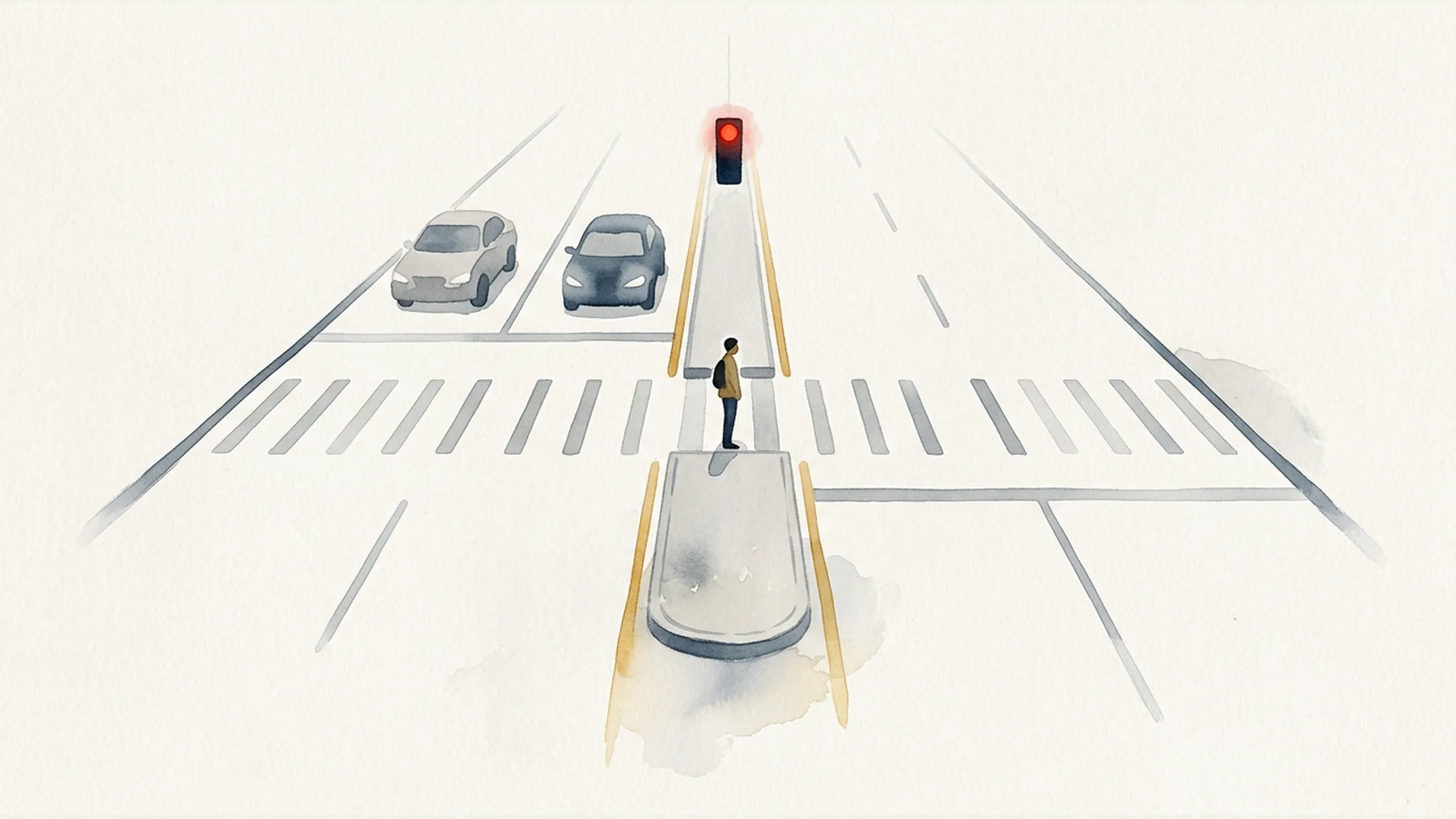
Oregon law requires drivers to stop and remain stopped for a pedestrian who is crossing in a crosswalk under specified conditions, including when the pedestrian is in the driver’s lane, an adjacent lane, or the lane into which the driver is turning. Under Oregon’s crosswalk statute, a pedestrian can be considered to be crossing when any part or extension of the pedestrian—such as the body, a cane, a crutch, a wheelchair, or a bicycle—moves into the roadway in a crosswalk with the intent to proceed.
In a child pedestrian case, investigators may look closely at where the child was standing or walking, which lane the vehicle occupied, whether the driver was turning, and whether the child had entered the roadway before impact.
This does not mean crosswalk status automatically decides the case. Oregon law also preserves duties of due care for both drivers and pedestrians. The facts still matter.
Passing a Vehicle Stopped at a Crosswalk
One dangerous school-crossing pattern occurs when one driver stops for a pedestrian and another driver passes that stopped vehicle. Oregon prohibits a driver from overtaking and passing another vehicle stopped at a marked or unmarked crosswalk at an intersection to allow a pedestrian to cross.
If a child was struck after another car had stopped, evidence from both vehicles, nearby witnesses, dashcams, and traffic cameras may be important.
School-Zone Speed Rules Depend on Signs, Timing, and Conditions
Parents often ask whether the driver violated a school-zone speed limit. That can be an important question, but Oregon’s school-zone rules are not automatic simply because a crash happened near a school.
What Counts as a School Zone in Oregon
Oregon defines a school zone as a highway segment adjacent to school grounds and marked by required signs. It also includes certain crosswalks not adjacent to school grounds when they are marked by required signs.
For a crash investigation, that makes the sign sequence important. Photographs or video of the roadway can help document:
- the “SCHOOL SPEED LIMIT 20” sign;
- any “When Flashing,” “School Days 7AM to 5PM,” or “When Children Are Present” language;
- the “END SCHOOL ZONE” sign or next posted speed sign;
- where the crash occurred in relation to those signs.
The Oregon Driver Manual explains that a school speed zone begins at the school-speed-limit sign and ends at an end-school-zone sign or another posted speed sign.
When the 20 mph Rule May Apply
Oregon’s school-zone speed statute includes a 20 mph rule for qualifying school zones when the statutory sign, location, and timing conditions are met. ODOT describes school zones adjacent to school grounds as using reduced speed limits marked “When Flashing” or “School Days 7AM to 5PM.” School crosswalk zones away from school grounds may use “When Flashing” or “When Children are Present.”
The practical point is this: the investigation should confirm the exact signs and conditions, not assume them. A driver may have been in a qualifying school zone—or may not have been—depending on the location, signage, timing, and whether the applicable statutory conditions existed.
Flashing Lights and “Children Are Present” Evidence
Flashing school-zone lights can become a major evidence issue. Oregon law limits when school-zone flashing lights used to indicate children may be arriving or leaving are generally operated, with a specific exception for certain higher-speed roads where a school has a parking lot across the street.
For some school-crosswalk speed rules, Oregon defines “children are present” to include children in or walking within the crosswalk, children waiting on the curb or shoulder at the crosswalk, or a traffic patrol member present to assist children at that crosswalk.
That means the following may matter:
- whether the beacon was flashing;
- whether the beacon was operating correctly;
- school arrival and dismissal schedules;
- whether children were waiting at the curb;
- whether a traffic patrol member or crossing guard was present;
- what witnesses, video, or device records show about the timing.
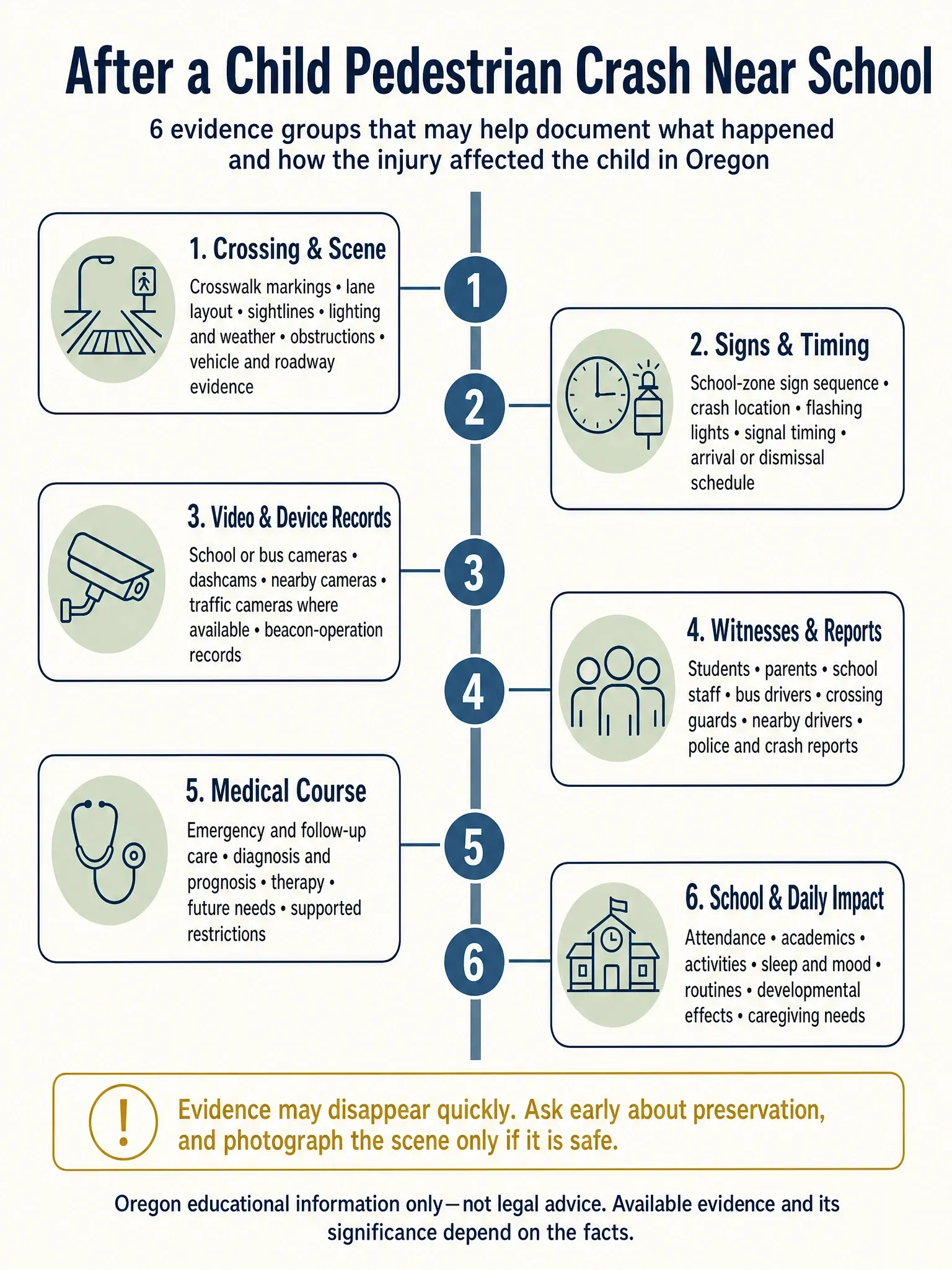
The Evidence That Can Shape a School-Area Pedestrian Crash Investigation
A strong investigation is usually built from many small facts, not one single document.
Physical and Scene Evidence
Scene evidence may include:
- crosswalk markings;
- curb ramps and school crossing signs;
- school-speed-limit signs and end-school-zone signs;
- flashing beacons;
- lane layout and turn lanes;
- bus stops, parking areas, and drop-off or pickup patterns;
- roadway width and traffic congestion;
- lighting, weather, glare, and visibility;
- obstructions such as parked vehicles, buses, landscaping, or construction;
- skid marks, debris, vehicle damage, and final rest positions.
Oregon’s basic speed rule also matters. A driver can violate the rule by driving faster than is reasonable and prudent under the conditions, considering traffic, road surface and width, intersection hazards, weather, visibility, and other existing circumstances. A driver’s statement that they were at or under the posted speed limit may not answer whether the speed was reasonable for a crowded school-area crossing.
Video, Witnesses, and School Records
Video can be especially important near schools. Potential sources may include:
- school exterior cameras;
- school bus cameras;
- dashcams;
- nearby business or residential cameras;
- city, county, or ODOT traffic cameras where available;
- phone video from witnesses.
Witnesses may include students, parents, school staff, bus drivers, crossing guards, traffic patrol members, nearby drivers, and neighbors. Oregon law describes school traffic patrols as people appointed by a school to protect pupils crossing streets or highways on the way to or from school by directing pupils or cautioning drivers.
Access to school video, bus footage, or student-related records may involve retention schedules, privacy rules, and formal process. Families should not assume footage will be available indefinitely.
This roadway-crash analysis is different from an on-campus claim involving school supervision or a physical condition. Johnson Law’s separate guide addresses injuries at an Oregon public school involving supervision, dangerous conditions, records, and notice.
Police, Driver, and ODOT Crash Reports
Official reports can be useful, but they are not the entire case.
Oregon crash-reporting rules require involved drivers to report to ODOT for crashes on a highway or premises open to the public that result in injury or death, property damage over $2,500, or a vehicle being towed from the scene. Oregon also requires a driver involved in a collision causing injury or death to stop, remain at the scene, provide identifying and insurance information, and render reasonable assistance, with additional requirements in certain circumstances.
ODOT crash tools can provide broader context, including published crash data and reports compiled from driver and police crash reports. But ODOT cautions that qualifying crashes may not all be represented and that details for a single crash may not always be complete or accurate. These datasets may help with context, but they do not replace a case-specific investigation.
How Fault Arguments May Arise in Oregon Child Pedestrian Cases
Even when a child was hit near a school, insurers may still dispute fault. That does not mean the defense is correct. It means the facts need careful review.
Driver Speed, Visibility, and Due Care
Investigators may look at whether the driver:
- was traveling too fast for school-area conditions;
- failed to stop and remain stopped for a child in a crosswalk;
- passed a stopped vehicle at a crosswalk;
- failed to keep a proper lookout;
- was distracted;
- failed to respond to a signal, beacon, sign, or crossing guard;
- should have anticipated children near a school at that time of day.
Because Oregon’s basic speed rule focuses on what is reasonable under existing conditions, visibility, congestion, road width, weather, and school arrival or dismissal activity can all matter.
Crosswalk and “Immediate Hazard” Arguments
Oregon law also includes pedestrian duties. For example, a pedestrian may not suddenly leave a curb or other place of safety and move into the path of a vehicle so close as to create an immediate hazard. Pedestrian signal rules can also matter when a crossing has “Walk” and “Don’t Walk” signals.
In a child case, those issues should be evaluated carefully. A defense argument that a child “stepped out” may depend on many facts: age, height, line of sight, signal phase, crosswalk location, vehicle speed, traffic congestion, parked cars, school-zone signs, lighting, and whether the driver could have stopped. For more on this type of dispute, see Johnson Law’s article on when a driver says a pedestrian stepped out too fast.
Child Age and Capacity Are Fact-Sensitive
Oregon’s comparative fault statute generally allows recovery when the claimant’s fault is not greater than the combined fault of specified others, with damages reduced in proportion to the claimant’s percentage of fault. But applying fault concepts to a child is not the same as applying them to an adult.
An older Oregon Supreme Court case recognized that a very young child—about three and a half years old in that case—may be incapable, as a matter of law, of exercising judgment and discretion to avoid injury. That does not create a simple age cutoff for every Oregon case. A child’s age, development, experience, and the surrounding circumstances should be evaluated with care.
How a Child Pedestrian Injury Claim May Be Valued
There is no reliable “average settlement” number for a child pedestrian crash near a school. Case value depends on proof.
Economic and Noneconomic Damages in Oregon
Oregon requires verdicts to state economic and noneconomic damages separately.
Economic damages generally refer to objectively verifiable monetary losses, such as medical, hospital, nursing, rehabilitative, loss-of-income, and future earning-capacity losses. In a child injury case, medical and rehabilitation expenses may be a central part of the economic-damages proof.
Noneconomic damages include harms such as pain, mental suffering, emotional distress, inconvenience, interference with usual activities, and loss of care, comfort, companionship, or society.
Child-Specific Valuation Factors
For a child, valuation may require close attention to both immediate and developing effects, including:
- emergency care and follow-up treatment;
- diagnosis and prognosis;
- physical therapy, occupational therapy, counseling, or other rehabilitation;
- future treatment needs;
- scarring, mobility limits, pain, or functional restrictions when supported by records;
- missed school and academic disruption;
- changes in sports, play, transportation, sleep, mood, or daily routines;
- developmental impact;
- emotional distress or fear around traffic, school, or walking routes;
- the effect on family caregiving needs and schedules.
These factors must be documented. Medical records, school records, teacher observations, attendance records, therapy notes, photographs, and parent journals can all help show how the injury affected the child’s life over time.
Other issues can also affect value, including disputed fault, insurance coverage, liens or reimbursements, public-body issues, and whether future medical opinions are needed.
Medical Expense Claim Structure and Minor Settlements
Oregon has specific rules for some child injury claims and settlements. When a guardian ad litem or conservator brings a child’s damages claim, Oregon law allows a parent, parents, or conservator to file consent to include doctor, hospital, and medical expenses caused by the injury in the child’s action. If that is allowed, separate parent claims for those expenses are barred.
Oregon also allows a person with legal custody of a minor to settle a minor’s claim without further court approval only in limited circumstances, including where no conservator has been appointed and the total claim amount—excluding specified reimbursements, fees, and costs—is $25,000 or less, with statutory payment, deposit, affidavit, or verified-statement requirements. Larger or litigated settlements may involve guardian ad litem, conservator, or court approval issues under Oregon rules.
Those are technical process issues. Parents should not assume a child’s settlement can be handled like an adult settlement.
Deadlines and Public-Body Issues Can Be Urgent
Deadline questions deserve caution. A child’s age can affect some timing rules, but it does not mean families can safely wait.
General Oregon Injury Deadlines and Minor Tolling
Oregon generally requires personal-injury actions not otherwise specifically listed to be filed within two years. Oregon also tolls many statutes of limitation for a child younger than 18 when the claim accrues, but the extension may not exceed five years or one year after the child turns 18, whichever occurs first.
Those general rules do not answer every case. They do not replace a deadline review, and they do not solve evidence-preservation problems.
Oregon Tort Claims Act Notice
School-area crashes may involve public bodies or public employees depending on the facts. Examples could include a public school district, city, county, ODOT, transit agency, road authority, or public employee connected to the roadway, signage, crossing program, traffic device, or school-related activity.
Oregon Tort Claims Act notice rules can require notice within 180 days for non-wrongful-death claims, subject to specific rules and limited exclusions. OTCA claims are technical, and the notice deadline can arrive long before a family expects it.
A cautious general takeaway is simple: families should not rely on minor tolling or general limitation periods without checking whether a public-body notice issue, insurance deadline, or evidence-preservation issue may require faster action.
Practical Steps Parents Can Take Without Trying to Investigate Alone
Parents should not have to become crash investigators while caring for an injured child. Still, a few practical steps can help preserve information:
- Make sure the child receives appropriate medical care and follow-up.
- Keep copies of discharge papers, visit summaries, prescriptions, therapy records, bills, and referrals.
- Photograph visible injuries over time, if appropriate.
- Save school attendance records, activity restrictions, and communications with teachers or administrators.
- Write down the date, time, weather, lighting, traffic conditions, and school schedule if you know them.
- Photograph the crossing, signs, signals, school-zone markings, and surrounding sightlines if it is safe to do so.
- Save names and contact information for witnesses.
- Preserve insurance letters, claim numbers, voicemails, emails, and text messages.
- Ask early about preserving potentially relevant school, bus, dashcam, or nearby-camera footage.
- Avoid guessing about fault in recorded statements or social media posts.
This kind of documentation can help an attorney, insurer, or investigator understand what happened and how the injury affected the child.
When Legal Help May Be Especially Important
Parents may want to speak with an Oregon pedestrian injury attorney when:
- the child’s injuries are serious, changing, or not fully diagnosed;
- the driver or insurer disputes fault;
- the crash involved a marked or unmarked crosswalk;
- school-zone signs, flashing lights, or signal timing are disputed;
- a crossing guard, traffic patrol, school bus, or school employee may have relevant information;
- video may exist but has not been preserved;
- a public body may be involved;
- the insurer is pushing for a quick settlement;
- there are questions about minor settlements, court approval, or medical expense claims;
- the family is unsure which deadlines apply.
Johnson Law handles pedestrian injury claims in Oregon, including Portland pedestrian accident cases, and can help families think through evidence, deadlines, and claim structure. Contacting a lawyer does not guarantee any outcome, but it may help families identify evidence-preservation and timing issues early.
Frequently Asked Questions
Is every street near an Oregon school a 20 mph school zone?
No. Oregon school-zone speed rules depend on qualifying signs, location, timing, flashing lights, school days, or “children are present” conditions. The exact sign sequence and crash location matter.
What evidence matters after a child pedestrian accident near a school?
Important evidence may include crosswalk status, school-zone signs, flashing lights, school schedules, crossing-guard or traffic-patrol information, signal timing, vehicle speed, sightlines, weather, video, witnesses, police or crash reports, and medical and school records showing how the injury affected the child.
Can a driver blame a child for stepping into the road?
An insurer may raise comparative-fault or “immediate hazard” arguments, but those arguments require careful review. The child’s age, capacity, crosswalk location, signal status, vehicle speed, visibility, school-zone conditions, and driver conduct all may matter.
How is a child pedestrian injury claim valued in Oregon?
Value depends on proof of economic and noneconomic damages, including medical care, prognosis, future care, school and activity disruption, developmental effects, pain, emotional distress, fault disputes, coverage, liens, and other case-specific factors. There is no dependable average settlement number.
Do parents have more time because the injured pedestrian is a minor?
Oregon minor tolling may apply in some situations, but parents should not assume they can wait. Public-body notice rules, evidence loss, insurance issues, and medical documentation needs can require prompt action.
Does a minor settlement in Oregon need court approval?
It depends. Oregon allows some small qualifying minor settlements of $25,000 or less, excluding specified reimbursements, fees, and costs, to proceed without further court approval if statutory conditions are met. Larger or litigated matters may involve guardian ad litem, conservator, or court approval issues.
Sources and Further Reading
- ORS 801.220 — Oregon crosswalk definition
- ORS 811.028 — Driver duty to stop and remain stopped for pedestrians in crosswalks
- ORS 811.020 — Passing a vehicle stopped at a crosswalk
- ORS 811.005 — Due care duties concerning pedestrians
- ORS 811.100 — Oregon basic speed rule
- ORS 811.111 — Oregon school-zone speed provisions
- ORS 801.462 — Oregon school zone definition
- ORS 810.243 — Oregon school-zone flashing-light timing
- ORS 811.124 — Meaning of “children are present”
- ODOT School Zone Speed Limits
- Oregon Driver Manual, Sharing the Road
- ORS 339.650 — Oregon traffic patrols
- ORS 814.010 — Oregon pedestrian signal rules
- ORS 814.040 — Oregon pedestrian-yield and immediate-hazard rule
- ORS 31.600 — Oregon comparative fault
- ORS 12.110 — Oregon personal-injury limitations period
- ORS 12.160 — Tolling for minors
- ORS 30.275 — Oregon Tort Claims Act notice and action timing
- ORS 811.720 — Oregon crash reporting
- ORS 811.705 — Driver duties after injury or death collisions
- ODOT Crash Data Viewer
- ODOT TDS Crash Reports
- ORS 31.705 — Oregon economic and noneconomic damages definitions
- ORS 31.700 — Medical expenses in a child’s damages claim
- ORS 126.725 — Settlement of minor claims
- ORCP 27 — Minor or incapacitated parties
Disclaimer: This article is for general educational information only. It is not legal advice and does not create an attorney-client relationship. Oregon law, deadlines, and claim requirements can change and may apply differently depending on the facts.
Client-First Fee Promise
Client First = Bills First, Fees Second
Your unpaid medical bills do not have to make your lawyer's fee bigger. Johnson Law subtracts qualifying medical bills before calculating our fee, helping clients keep more of their settlement.
Applies to qualifying cases. Results vary.