Crash Caused by Missing or Confusing Signage: When a Road Design Claim Is Possible
Crash Caused by Missing or Confusing Signage: When a Road Design Claim Is Possible
Because public-road claims can involve short deadlines, start with the Oregon Tort Claims Act notice deadline and compare other road-hazard claims against a city or state.
Start with the Practical Answer: A Signage Claim May Be Possible, But It Is Not Automatic
If a missing, obscured, misplaced, or confusing sign contributed to an Oregon crash, a claim against a public road authority may be possible in some circumstances. But these cases are not simple “bad sign equals liability” claims.
Oregon public-body claims are governed by special rules. Under the Oregon Tort Claims Act, public bodies can be subject to civil claims for torts, but the same statute also includes important immunities and procedural requirements. One of the biggest issues in road-design and traffic-control cases is discretionary-function immunity, which can protect certain governmental policy or judgment calls.
That means the useful question is not just whether a sign was confusing. The better questions are: Who controlled the road? Was the problem a design or placement decision, a maintenance failure, an obstruction, or a failure to implement an adopted decision? Were there prior complaints, crash history, work orders, or engineering records showing the hazard was known? And was Oregon Tort Claims Act notice handled on time?
This article is educational information only and is not legal advice. Signage and public-body cases are fact-specific, and deadlines can be short.
What Counts as a Missing or Confusing Signage Problem?
Signage-related crash issues can take several forms. Some involve a sign that was missing or hard to see. Others involve signal timing, stop-control choices, sight lines, warnings, or temporary traffic control. The category matters because different records and defenses may apply.
Missing, misplaced, or hard-to-see signs
A driver, cyclist, pedestrian, or motorcyclist may suspect a signage problem when a warning sign was absent, a stop sign was obscured, a sign was placed where it could not reasonably be seen, or sight lines made the traffic control difficult to understand.
In Portland, PBOT’s public safety-reporting materials identify visibility, signage, sight lines, signal timing, and stop sign requests as categories of traffic safety concerns. PBOT also distinguishes routine safety concerns from urgent hazards such as sign or signal repairs. That distinction can matter because an urgent maintenance issue may involve different records than a broader engineering or design question.
Confusing signals, stop control, or warnings
Some cases focus less on whether a sign existed and more on whether the traffic-control setup was confusing. Examples can include stop-control decisions, signal operation, intersection configuration, or warnings that do not clearly guide road users.
These issues often require engineering context. A crash claimant may need to know whether the sign or signal matched applicable standards, whether the road authority studied the intersection, and whether prior crash reports or complaints prompted any review.
Temporary work-zone signs are related but may need separate analysis
Temporary traffic control in construction or work zones can raise related questions, but it may involve different permits, contractors, right-of-way rules, and temporary traffic-control standards. ODOT’s temporary traffic-control materials note that road jurisdictions may have additional or more restrictive requirements and that permits are generally required for work within the public right-of-way. If a crash involved a work zone, that should be evaluated specifically rather than treated exactly like a permanent road-design issue.
Step One: Identify the Road Authority
The public body responsible for a road cannot always be assumed from the crash location.
Oregon law designates road authorities by road type. ODOT is the road authority for state highways. Counties are generally the road authority for county roads outside incorporated cities. Incorporated city governing bodies are generally the road authority for highways, roads, streets, and alleys within city boundaries, other than state highways; maintenance responsibility may depend on other law or agreements.
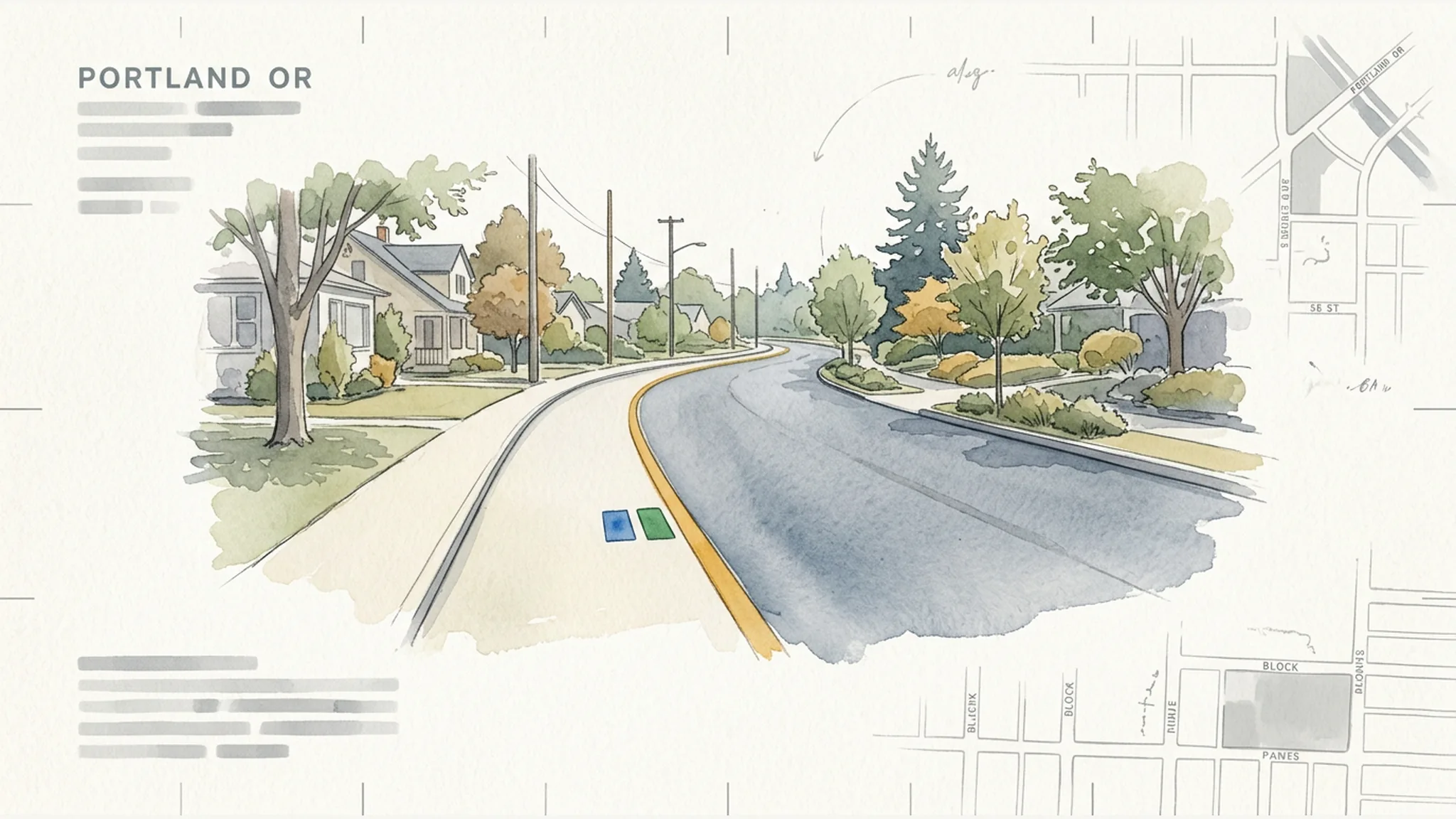
In Portland, that means PBOT may be a key records holder for many local streets, but some roads within the city may still involve ODOT, Multnomah County, or more than one entity. Identifying the correct road authority affects almost every part of the investigation: tort-claim notice, records requests, maintenance records, engineering files, sign or signal records, and potential defenses.
Oregon Traffic-Control Standards: Why MUTCD, ODOT, and Local Criteria Matter
Traffic-control standards can be important evidence, but they are not an automatic shortcut to liability.
Oregon requires uniform traffic-control-device standards
Oregon law requires the Oregon Transportation Commission to adopt a manual and specifications for uniform traffic-control-device standards. Oregon law also provides that traffic-control devices placed or operated in the state must conform to commission-approved specifications.
Each road authority must place, maintain, and control traffic-control devices on its own highways as it considers necessary for safe and expeditious traffic control or to regulate, warn, or guide traffic. Those devices must conform to the state manual and specifications.
That framework can help define what records and standards to review. But the wording also matters: traffic-control decisions often involve judgment, and that judgment may connect to discretionary-immunity defenses.
MUTCD and Oregon Supplement context
The Federal Highway Administration describes the Manual on Uniform Traffic Control Devices as the national standard used by road managers to install and maintain traffic-control devices on streets, highways, pedestrian and bicycle facilities, and site roadways open to public travel.
ODOT states that use of the MUTCD is required on Oregon public roads and that, effective January 1, 2026, Oregon adopted the MUTCD 11th Edition, the Oregon Supplement to the MUTCD 11th Edition, and the January 2026 Oregon Temporary Traffic Control Handbook through OAR 734-020-0005.
For a legal claim, however, it is important to verify the specific edition, supplement, and provision that applied at the relevant time. A general reference to the MUTCD is not the same as proving that a particular sign, signal, or warning violated an applicable requirement.
Portland stop-sign criteria as an example
PBOT’s stop-sign overview is a useful example of how local criteria can frame the investigation. PBOT states that safety is the primary factor in stop-sign placement and that traffic engineers consider traffic flow and volume, intersection configuration, crash reports, and overall neighborhood safety before final installation decisions.
PBOT also lists factors for two-way stop signs, including lower-volume roads intersecting higher-volume roads, restricted view, crash records indicating a need for stop control, and neighborhood stop plans. For all-way stops, PBOT describes crash-history and volume-related considerations.
Those criteria can point investigators toward useful records. They should not be treated as a guarantee that a stop sign should have been installed or that liability exists.
The Biggest Legal Hurdle: Discretionary-Function Immunity
Oregon’s Tort Claims Act gives public bodies immunity for claims based on the performance of, or failure to exercise or perform, a discretionary function or duty, whether or not the discretion is abused. In plain English, that can protect certain governmental policy-level choices even when someone later argues the choice was wrong.
In signage and road-design cases, discretionary-function immunity is often a central issue.
Policy-level design choices may be immune
Oregon cases show why these claims can be difficult. In Stevenson v. State, the Oregon Supreme Court treated adoption of the Uniform Traffic Control Device Manual as an immune governmental policy act. In Gallison v. City of Portland, the Oregon Court of Appeals held that design and installation of traffic signals were discretionary acts where the signal operated according to its original design rather than having fallen into disrepair. In Morris v. Oregon State Transportation Commission, the Court of Appeals treated the operation or application of a railroad-crossing traffic signal as discretionary where the signal operated as intended and the manual provisions left room for engineering judgment.
Those cases do not mean every signage claim fails. They do show that a claim framed only as “the government should have designed the intersection differently” may face a serious immunity defense.
Implementation, maintenance, and non-decisions can be different
The same Oregon cases also leave room for more careful analysis.
In Stevenson, the court recognized that implementation of a particular signal may be non-immune if it did not conform to the government’s policy and no other discretionary reason justified the deviation. In Little v. Wimmer, the Oregon Supreme Court emphasized that evidence of how a decision was made matters and that a legal duty to warn or protect cannot necessarily be avoided through a continuing non-decision.
That is why records matter. A court may need to know whether the public body made a protected policy choice, failed to implement an adopted decision, ignored a known hazard without a true discretionary decision, or allowed a sign or signal to fall into a maintenance problem.
Why the evidence matters more than labels
Calling a crash a “road design case” or a “missing sign case” does not answer the legal question. The analysis usually turns on the actual records: standards, engineering studies, complaints, crash history, work orders, maintenance logs, sign or signal timing records, and documents showing who decided what and when.
Design, Maintenance, Obstruction, or Failure to Implement: Why the Category Matters
The same confusing intersection can raise different legal theories depending on what went wrong.
Design or placement decisions
Design and placement questions may include where a warning sign was placed, whether a stop sign or all-way stop was warranted, how a signal was applied, or whether a particular traffic-control device should have been used. These questions often involve engineering judgment, which is why discretionary-function immunity must be considered.
Maintenance, malfunction, or visibility obstruction
Maintenance issues can look different from design decisions. A sign may have been damaged, a signal may have failed, or vegetation or another obstruction may have affected visibility. PBOT’s public materials distinguish urgent maintenance issues such as repair of traffic signs or signals from routine safety concerns, which may help identify different records or reporting channels.
Oregon source materials also note a Portland stop-sign visibility case in which city responsibility for a nondiscretionary duty was not avoided by ordinances assigning responsibility to abutting property owners. Because the available support for that point is a statutory annotation summary, it should be used cautiously unless the underlying opinion is reviewed before publication.
Failure to follow or implement an adopted decision
A public body may have adopted a standard, completed an engineering study, approved a traffic-control change, or decided to install or modify a sign or signal. If the issue is failure to implement that adopted decision—or implementation that does not match the adopted standard—the case may be different from a broad challenge to policy-level design discretion.
Evidence That Can Make or Break a Signage Claim
Signage claims are evidence-heavy. Useful records are often held by public agencies, and the most important facts may not be visible at the crash scene.
Prior complaints and safety reports
Prior complaints can matter if they are tied to the same hazard, location, and time period. PBOT’s non-urgent traffic safety reporting page covers concerns about visibility, signage, signal timing, sight lines, and stop sign requests. PBOT says concerns are logged, and new non-routine traffic safety concerns may receive an engineering investigation, typically about three to four months when the issue has not been studied in the last two years.
Those records may help show whether a road authority had notice of a problem. They do not, by themselves, prove liability.
Crash history and near-miss context
Crash history may also help establish foreseeability or show why an engineering review occurred. ODOT’s Crash Analysis & Reporting Unit maintains 10 years of crash data and includes crashes coded for city streets, county roads, and state highways. ODOT identifies tools such as the Crash Data Viewer, TDS Crash Reports, TransGIS crash layers, and the Oregon Transportation Safety Data Explorer.
Crash data has limits. PBOT explains that Portland typically has 10,000 to 12,000 reported crashes each year and that ODOT compiles those crashes into the state’s official crash record. PBOT also states that ODOT generally releases the complete official crash record 12 to 18 months after the end of the reported year. PBOT notes that most crash data relies on self-reported information and that not all traffic-related deaths are included in the official record.
So crash databases can be useful, but they may not capture every dangerous incident, near miss, or recent crash.
For a more detailed framework on data vintages, reproducible searches, and screening earlier events for substantial similarity, see how to use Portland High Crash Network data after a street injury.
Engineering studies, work orders, and maintenance records
Depending on the issue, relevant records may include engineering studies, traffic counts, complaint logs, sign or signal maintenance records, work orders, signal timing records, sign inventories, and correspondence about prior requests or complaints.
The key is connection. A general concern about an intersection may not be enough. Stronger evidence usually ties the specific signage or visibility issue to the crash location, timeframe, road authority, and mechanism of the collision.
Public-records requests are evidence tools, not claim notices
Oregon public-records law gives every person the right to inspect public records of a public body unless an express exemption applies. Public bodies must provide copies or a reasonable inspection opportunity upon written request, must acknowledge receipt or complete a response within five business days, and may charge fees subject to statutory rules.
For Portland matters, the City of Portland maintains a records-request program, and PBOT provides public-records request resources through its data pages.
But a public-records request is not the same as Oregon Tort Claims Act notice. Requesting records may help investigate a claim; it does not, by itself, preserve a tort claim against a public body. Special rules may also apply when a requester is a party to a civil case or has filed an OTCA notice.
Oregon Tort Claims Act Deadlines and Limits Need Early Attention
Public-body claims move on a different timeline than ordinary insurance claims.
Under ORS 30.275, OTCA notice is required for claims against Oregon public bodies. The general notice period is 180 days for claims other than wrongful death and one year for wrongful death claims, with a limited incapacity extension not exceeding 90 days. Formal notice must include a statement that a damages claim is or will be asserted, a description of the time, place, and circumstances as known, and the claimant’s name and mailing address. The statute also recognizes actual notice, timely commencement of an action, or payment as ways notice may be satisfied.
Claims generally must be commenced within two years after the alleged loss or injury, subject to statutory exceptions. That two-year period is separate from the shorter notice requirement.
Liability limits may also apply to Oregon public-body claims. For local public bodies, ORS 30.272 provides personal-injury and death liability limits for claims arising out of a single accident or occurrence, and those limits are adjusted annually by the State Court Administrator. This article does not state current dollar amounts because those figures should be verified against the current table when a claim is evaluated.
The takeaway is simple: if a city, county, ODOT, or another public body may be involved, deadline and notice issues should be evaluated promptly. This article cannot calculate a specific person’s deadline.
How These Cases Usually Get Evaluated
A signage-related road claim usually comes down to a practical investigation framework.
Did the signage issue contribute to the crash?
The sign, signal, warning, or sight-line issue must be connected to how the crash occurred. A confusing sign near the scene is not enough if it did not contribute to the collision.
Who controlled the road, sign, or signal?
Road authority matters. ODOT, a county, a city such as Portland, or more than one entity may control different aspects of the road, sign, signal, or right-of-way.
Was the problem a discretionary design choice or a maintenance/implementation issue?
This classification can shape the immunity analysis. A protected policy-level design choice may be treated differently from a damaged sign, an obscured sign, a malfunctioning signal, or failure to implement an adopted decision.
Did prior records show notice or foreseeability?
Prior complaints, crash history, engineering studies, traffic counts, work orders, maintenance dispatch records, and sign or signal files may show what the road authority knew or considered. The records must be tied to the relevant hazard and timeframe.
What to Do After a Crash Where Signage May Be Involved
If signage, signal placement, sight lines, or warnings may have contributed to a crash, practical preservation steps can help:
- Document the sign, signal, intersection layout, sight lines, and crash location when it is safe to do so.
- Preserve photos, video, dash-camera footage, helmet-camera footage, or nearby surveillance leads if available.
- Identify witnesses who noticed the sign, signal, visibility problem, or confusing traffic pattern.
- Keep track of the exact location, direction of travel, time of day, lighting, weather, and anything that affected visibility.
- Promptly evaluate whether a public-body claim may exist because OTCA notice deadlines can be short.
- Remember that public-records requests can help obtain evidence, but they do not replace tort-claim notice.
An attorney evaluating the case may look for crash data, prior complaints, engineering studies, work orders, maintenance records, sign or signal timing records, and documents showing how the road authority made or failed to make a decision.
FAQ
Can I sue a city or the State of Oregon if a missing sign caused my crash?
Possibly, but it depends on the facts. The investigation usually needs to identify the road authority, connect the signage issue to the crash, evaluate Oregon Tort Claims Act notice, consider discretionary-function immunity, and review evidence such as standards, complaints, crash history, maintenance records, or implementation records.
What is discretionary-function immunity in an Oregon road-sign case?
Discretionary-function immunity is an Oregon Tort Claims Act defense for claims based on discretionary functions or duties. In road-sign and traffic-control cases, it can protect certain policy-level design or engineering judgment decisions. The analysis depends on how the decision was made, what standards applied, and whether the problem was truly discretionary or instead involved maintenance, implementation, or a non-decision.
Does a MUTCD violation automatically prove liability?
No. MUTCD, ODOT, and local traffic-control standards can be important evidence, but they do not automatically create a tort claim or guarantee recovery. The specific standard, road authority, immunity issues, causation, and records all matter.
What records can show that a road authority knew about a dangerous sign or intersection?
Potentially relevant records include prior complaints, 311 or PBOT safety reports, crash history, engineering studies, traffic counts, work orders, sign or signal maintenance records, signal timing records, and sign inventories. The records are most useful when they relate to the same hazard, location, and timeframe.
How long do I have to give notice for an Oregon public-body injury claim?
Under ORS 30.275, OTCA notice is generally required within 180 days for claims other than wrongful death and within one year for wrongful death claims, with a limited incapacity extension not exceeding 90 days. Deadline questions can be fact-sensitive, so a potential public-body claim should be evaluated promptly.
Is a public-records request the same as an Oregon Tort Claims Act notice?
No. A public-records request may help obtain evidence from a public agency, but it is not a substitute for OTCA notice. Records requests and tort-claim notices serve different purposes.
For related public right-of-way problems, see Portland sidewalk defect claims and why some collisions show signs of being more than a simple insurance claim.
Sources
This article is based on the approved source materials for this topic and relies on the following source categories:
- Oregon Tort Claims Act sources: ORS 30.265, ORS 30.275, ORS 30.272, and ORS 30.300.
- Oregon road-authority and traffic-control-device sources: ORS 810.010, ORS 810.200, ORS 810.210, and ORS 810.250.
- Traffic-control standards context: ODOT’s Implementing Uniform Traffic Control Devices page and FHWA’s MUTCD materials.
- Oregon case-law sources: Stevenson v. State, Little v. Wimmer, Gallison v. City of Portland, and Morris v. Oregon State Transportation Commission.
- Portland examples and records sources: PBOT Stop Sign Overview, PBOT non-urgent traffic safety reporting materials, City of Portland records-request resources, and PBOT data resources.
- Crash-data sources: ODOT Crash Statistics & Reports and PBOT’s explanation of how Portland crash data works.
- Oregon public-records sources: ORS 192.314 and ORS 192.324.
Disclaimer
This article provides general educational information about Oregon signage-related crash claims and public-body issues. It is not legal advice and does not create an attorney-client relationship. Legal deadlines, notice requirements, immunity issues, liability limits, and claim value depend on the specific facts and should be reviewed with a qualified attorney.
Client-First Fee Promise
Client First = Bills First, Fees Second
Your unpaid medical bills do not have to make your lawyer's fee bigger. Johnson Law subtracts qualifying medical bills before calculating our fee, helping clients keep more of their settlement.
Applies to qualifying cases. Results vary.