Industrial Crush Injury in Washington: Workers’ Compensation vs. Third-Party Recovery
Industrial Crush Injury in Washington: Workers’ Compensation vs. Third-Party Recovery
After an industrial crush injury in Washington, workers’ compensation is usually the first legal track. It may provide medical and wage-related benefits without requiring the worker to prove that the employer caused the incident.
But workers’ compensation is not always the only track. Under RCW 51.24, a worker may also have a fault-based claim against a legally responsible person or business outside the worker’s “same employ.” A machine manufacturer, maintenance company, equipment lessor, outside contractor, general contractor, or legally distinct property owner may warrant investigation depending on what happened and what role each party played.
Not every crush injury supports a third-party claim. When both tracks exist, they are connected: election and notice requirements, reimbursement, a statutory lien, settlement approval, and an offset against future benefits can all affect the result. The practical task is to identify the right parties, preserve the right evidence, and track each deadline separately.
Educational information only: This article provides general information about Washington law and is not legal advice. It does not predict claim acceptance, third-party liability, lien treatment, settlement value, or any outcome.
The Two Legal Tracks After a Washington Industrial Crush Injury
The simplest way to understand a potential Washington crush-injury case is to separate two questions:
- What benefits may be available through Washington’s industrial-insurance system?
- Did a legally distinct third party contribute to the injury through actionable conduct or a product defect?
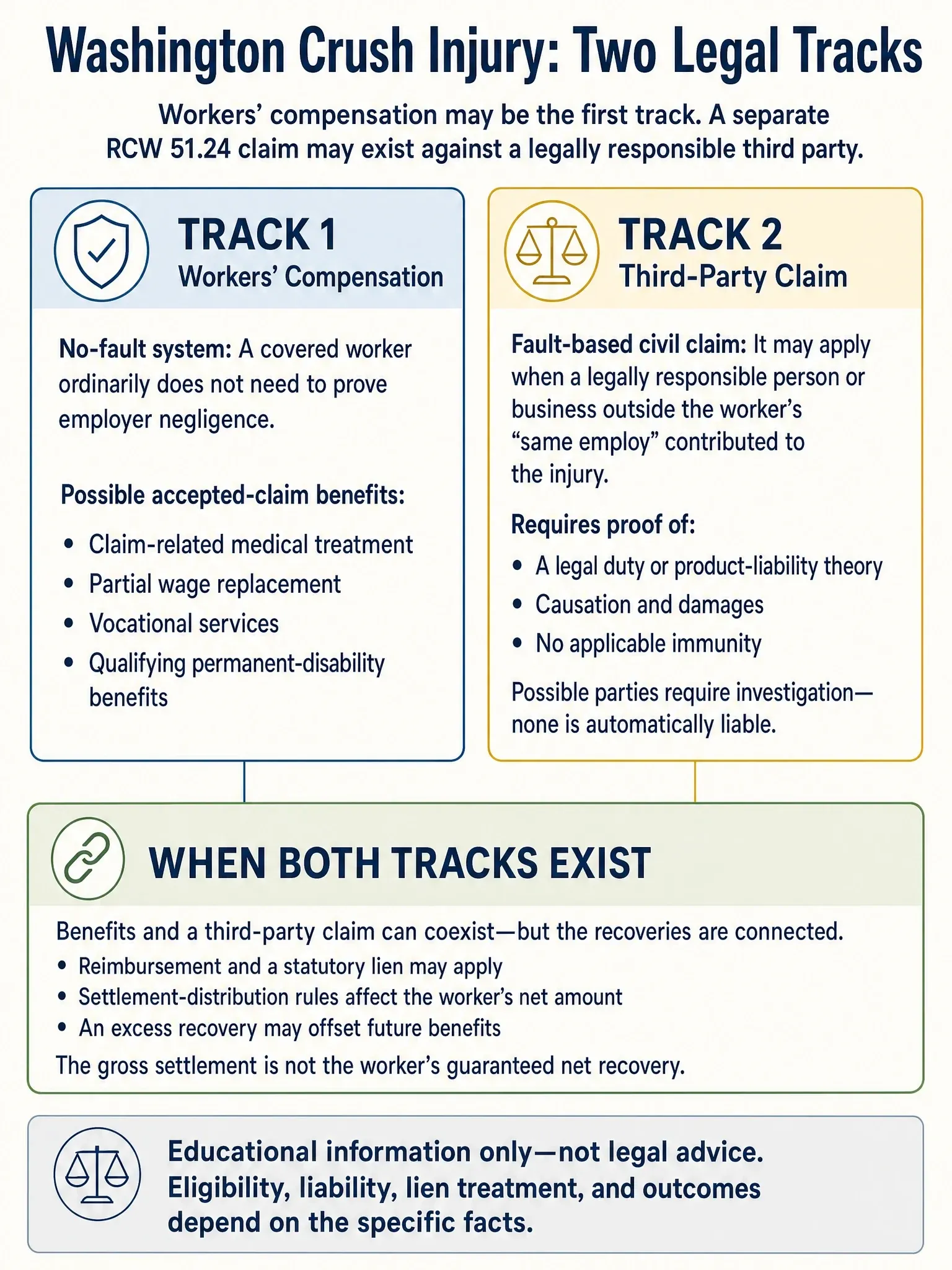
Track One: An L&I or Self-Insured Workers’ Compensation Claim
Washington workers’ compensation is a no-fault system. A covered worker does not ordinarily need to prove that the employer was negligent to pursue industrial-insurance benefits. Depending on the accepted claim and statutory requirements, benefits may include claim-related medical treatment, wage replacement, vocational services, permanent partial disability compensation, or a permanent-total-disability pension.
L&I administers state-fund claims. If the employer is self-insured, the employer or its claims administrator initially manages and pays the claim under L&I oversight, but the worker has substantively similar benefit rights.
Track Two: A Fault-Based Claim Against a Third Party
RCW 51.24 may allow a worker or beneficiary to seek damages from a responsible “third person” who is not in the worker’s same employ. Unlike a no-fault workers’ compensation claim, this civil claim requires proof of an applicable legal duty or product-liability theory, causation, damages, and the absence of immunity.
In that civil action, the worker’s entitlement to workers’ compensation is not pleaded or admitted as evidence. The third party’s legal responsibility is determined separately, even though RCW 51.24 later connects the civil recovery to the workers’ compensation claim through notice, reimbursement, lien, and distribution rules.
What Washington Workers’ Compensation May Provide
The exact benefits available depend on the conditions L&I or the self-insurer accepts, medical support, wage calculations, treatment authorization, disability findings, vocational status, and claim orders.
Medical Care and Wage Replacement
An accepted claim can cover proper treatment for the claim-related condition until that condition becomes medically stable. The accepted conditions matter: workers’ compensation does not necessarily cover every diagnosis or treatment merely because it follows the incident.
When an injury prevents work, time-loss compensation may provide partial wage replacement. L&I states that time-loss is generally 60% to 75% of wages, depending on the worker’s dependents and statutory minimums and maximums. Payment is not automatic; medical certification and supporting findings are required.
For injuries on or after June 6, 2024, the first three days after injury are a waiting period. Those days are paid only if the worker remains unable to work on the seventh day. Different timing applied to older injuries.
Vocational and Permanent-Disability Benefits
Some workers may qualify for vocational services if the covered injury affects their ability to return to work. A permanent loss of function—including, in some cases, an amputation resulting from a crush event—may support a scheduled permanent partial disability award. A permanent-total-disability pension may be available when its more demanding statutory criteria are met.
These categories describe possible benefits, not predetermined outcomes. The accepted conditions, medical stability, disability rating, and other claim-specific findings control.
What Workers’ Compensation Does Not Measure
Washington industrial insurance does not calculate tort damages such as pain and suffering. That difference helps explain why a valid third-party claim can matter after a life-changing injury: a civil case addresses a different legal wrong and may include damage categories that the industrial-insurance system does not measure.
The difference does not mean that a worker automatically has a third-party case. A legally supportable claim against a non-immune party must still exist.
Why a Claim Against the Employer or Coworker Is Usually Barred
Washington’s Industrial Insurance Act generally substitutes statutory benefits for a private lawsuit against the employer. A severe injury, a safety failure, or evidence of negligence does not by itself remove that exclusivity rule.
Washington’s Broad Exclusivity Rule
RCW 51.04.010 withdraws covered workplace injuries from private controversy and provides industrial-insurance relief to the exclusion of other remedies unless Title 51 creates an exception. In practical terms, the employer is usually protected from an ordinary negligence lawsuit for a covered workplace injury.
Determining who the employer actually was can still require careful analysis. Staffing arrangements, host employers, borrowed workers, joint employment, affiliated companies, and disputed corporate relationships may affect whether a particular person or business is an immune employer or a legally distinct third party.
The Narrow “Deliberate Intention” Exception
RCW 51.24.020 allows a claim against an employer when the injury resulted from the employer’s deliberate intention to produce that injury. The Washington Supreme Court applies this exception narrowly: the employer must have had actual knowledge that injury was certain to occur and must have willfully disregarded that knowledge.
Negligence, gross negligence, or even substantial certainty is not enough. A missing machine guard, known hazard, prior near miss, ignored complaint, or safety citation may be important evidence, but none automatically satisfies the deliberate-intention test. This is not a broad exception for an unsafe workplace or a regulatory violation.
When Coworker Immunity Requires a Closer Look
Ordinary negligence by an on-duty coworker performing the employer’s work is generally within workers’ compensation immunity. But it is too broad to say that every person on the same payroll is immune in every situation.
Under the Washington Supreme Court’s decision in Entila v. Cook, a coworker invoking “same employ” immunity must establish both the same employer and that the alleged conduct occurred in the scope and course of employment. Off-duty conduct or a possible dual-capacity role requires a fact-specific analysis.
When RCW 51.24 May Allow a Third-Party Claim
The key investigation question is whether someone legally distinct from the worker’s same employ contributed to the crush incident through actionable conduct or a defective product. The following are categories to investigate—not parties who are automatically liable.
Machinery Manufacturers and Product Sellers
Washington’s Product Liability Act may support a claim against a manufacturer if a product was not reasonably safe because of negligent design or inadequate warnings or instructions. It also addresses strict liability for a construction defect or nonconformity with specified warranties when the defect proximately causes harm.
In a machinery case, relevant questions may involve guards, interlocks, emergency stops, warnings, instructions, alternative designs, and post-sale warnings. The investigation must also account for modifications, removed guards, maintenance history, misuse, and causation.
A distributor, dealer, rental company, lessor, or other nonmanufacturer seller is not automatically strictly liable merely because it was in the chain of distribution. Under RCW 7.72.040, a nonmanufacturer seller is generally liable for its own negligence, express warranty, intentional misrepresentation, or intentional concealment unless a statutory circumstance gives it manufacturer-level liability.
Maintenance Companies, Lessors, and Outside Contractors
A maintenance or repair company may warrant investigation if its work, omissions, or contractual responsibilities contributed to the dangerous condition. An equipment lessor may be relevant depending on its role, the equipment supplied, and the applicable product-liability rules. An outside contractor may be involved if it created the hazard, controlled part of the task, supplied equipment, or assumed duties that bear on the injury.
Contracts, actual control, the work performed, corporate relationships, and causation determine whether any such claim is viable. The company’s presence at the worksite is not enough by itself.
General Contractors and Legally Distinct Property Owners
Washington recognizes direct common-law and WISHA duties owed by a general contractor to subcontractor employees. A general contractor’s specific WISHA duty rests on its innate supervisory authority.
An ordinary jobsite owner is different. Its WISHA duty generally depends on whether it retained control over the manner in which contractors performed the work. An industrial plant owner is not automatically a general contractor, and property ownership alone does not establish liability. Contracts, actual working relationships, retained control, the work area, and the instrumentality involved all matter.
Questions That Help Identify an Outside Defendant
Early investigation may ask:
- Who designed, manufactured, sold, leased, installed, programmed, or supplied the equipment?
- Who modified, guarded, serviced, inspected, maintained, or repaired it?
- Who owned or controlled the machine, task, and work area?
- Did a staffing company, host employer, or other multi-employer arrangement exist?
- Did an outside business assume safety, maintenance, or supervisory duties by contract or through its actual conduct?
- What role did each entity’s work play in causing the event?
These questions help identify possible parties. They do not establish negligence, a product defect, causation, or the absence of immunity.
How a Third-Party Claim and L&I Benefits Work Together
A worker’s election to pursue a third party—and even a recovery from that party—does not erase the underlying entitlement to Title 51 compensation and benefits. But that entitlement must be understood alongside the statutory reimbursement lien and potential offset against future benefit payments.
Electing to Pursue or Assign the Third-Party Action
L&I’s guidance describes two principal choices. A worker may:
- pursue the third-party action, with or without a lawyer; or
- assign the action to L&I or the self-insurer.
If the action is assigned, L&I or the self-insurer may decide whether to pursue it and controls the action. An affirmative election not to proceed also operates as an assignment.
Why an Election Demand Needs Prompt Attention
If L&I or a self-insurer serves a written election demand, failure to elect within 60 days after receiving it results in the action being deemed assigned. Assignment also occurs if, after electing to proceed, the worker does not institute or settle the action within the period granted by L&I or the self-insurer. That period must be at least 90 days after the election.
These periods are not ordinary civil statutes of limitation. The 90-day minimum does not toll or extend an otherwise applicable civil filing deadline. A missed election or action period can transfer control of the claim before a civil limitation period expires. Reelecting an assigned claim is discretionary and may require reimbursement of litigation expenses.
Notice and Complaint-Delivery Requirements
A worker who elects to sue must notify L&I or the self-insurer. When a lawsuit is filed, the worker must also transmit the complaint through a method that permits tracking or confirmation of delivery.
The communication provisions changed effective June 11, 2026. Older forms or sources may still describe registered- or certified-mail-only requirements, so current instructions should be checked rather than relying on an outdated form.
Why the Gross Settlement Is Not the Worker’s Net Recovery
A third-party recovery is not a separate, unrestricted pool of money on top of workers’ compensation benefits. RCW 51.24 contains a distribution process that accounts for litigation expenses, a worker share, reimbursement, and future benefits.
For a broader process overview, see the Washington personal-injury settlement timeline. Work-related third-party cases require additional workers’ compensation lien and distribution coordination.
Fees, the Worker Share, and Reimbursement
For a worker-controlled recovery, the high-level statutory sequence is:
- Proportional payment of reasonable attorney fees and costs.
- Payment to the worker of 25% of the balance remaining after those specified expenses.
- Reimbursement to L&I or the self-insurer for its statutory share of benefits paid, after its proportional share of fees and costs.
- Payment of any remaining balance to the worker.
This is not a promise that the worker receives 25% of the gross settlement. The 25% step comes after specified fees and costs, and compromise terms can affect the protected share. The statute’s formulas and the facts of the claim must be applied to determine the actual distribution.
The Lien and Department Distribution Order
L&I or the self-insurer has a statutory lien for its share. L&I has statutory discretion to compromise its lien based on considerations such as collection, liability, and proof. The department confirms the distribution by order.
For settlement planning, the gross offer alone is therefore not enough. A current lien calculation, expected distribution, and potential future-benefit consequences need to be considered before a release is signed or funds are disbursed.
How an Excess Recovery Can Affect Future Benefits
After reimbursement, a remaining amount—often called an excess recovery—can offset future workers’ compensation benefits. Payment of compensation and benefits for that injury may pause until future amounts equal the statutorily adjusted excess. Payments then resume as though the third-party recovery had not occurred.
During the offset period, medical providers may continue billing L&I for authorized treatment. Those authorized charges can be credited against the excess while becoming the worker’s payment responsibility until the excess is exhausted. Continuing entitlement therefore does not necessarily mean uninterrupted payment after a third-party recovery.
Settlement Approval and Damage Allocation
If a compromise or settlement is less than the worker’s Title 51 “entitlement”—benefits already paid plus L&I’s estimate of future benefits—it is void without written approval from L&I or the self-insurer. Approval, lien treatment, allocation, and future-benefit consequences should be addressed before the settlement is completed.
In Tobin v. Department of Labor & Industries, the Washington Supreme Court held that L&I may not reimburse itself from a third-party recovery allocated to pain and suffering because industrial-insurance benefits do not compensate that category of loss. Later Washington cases hold that when the settlement itself does not allocate any amount to pain and suffering, the full settlement is subject to the statutory distribution formula; an after-the-fact allocation is not available. Any allocation remains legally sensitive and does not automatically eliminate lien or settlement-approval issues.
Deadlines That May Run at the Same Time
There is no single deadline that controls every part of a Washington crush-injury matter. Several clocks may run at once:
| Requirement | General rule | Important qualification |
|---|---|---|
| Industrial-injury claim | L&I or the self-insured employer generally must receive the accident report within one year after the injury. | This is separate from a civil claim. Occupational-disease timing follows a different framework. |
| RCW 51.24 election demand | Failure to elect within 60 days after receiving a written demand results in the action being deemed assigned. | Assignment can occur even if a civil limitation period has not expired. |
| Action after election | Assignment also occurs if the action is not instituted or settled within the period granted, which must be at least 90 days after election. | The granted period does not toll or extend an otherwise applicable civil deadline. |
| General personal-injury action | Washington generally applies a three-year limitation period to an action for injury to the person. | Specialized rules, tolling, wrongful death, construction claims, federal systems, and other circumstances may alter the analysis. |
| Product-liability claim | Generally three years after the claimant discovered, or with due diligence should have discovered, the harm and its cause. | Harm occurring more than 12 years after first delivery creates a rebuttable useful-safe-life presumption, not a simple absolute bar. |
| State or local government claim | Presentment to the proper designated recipient and a 60-calendar-day waiting period before suit. | Presentment must still occur within the applicable limitation period; statutory tolling provisions apply. |
Claims Involving Washington State or a Local Government
A tort claim against Washington State must be presented to the Office of Risk Management. A claim against a local governmental entity—including a Clark County or City of Vancouver entity—must be presented to that entity’s designated agent. In either setting, there is generally a 60-calendar-day waiting period before suit.
The claim still must be presented within the applicable limitation period. These presuit rules have tolling provisions, but they should not be treated as permission to wait until the end of the ordinary filing period.
Other systems—including federal maritime, longshore, railroad, federal-employee, tribal, or interstate compensation frameworks—may alter or replace the Washington analysis and are outside the scope of this article.
Preserve Machinery and Worksite Evidence Early
Industrial machinery can be repaired, returned to service, modified, moved, or discarded. Electronic data and surveillance recordings may also be overwritten. Early, lawful preservation matters because the evidence may reveal both how the incident occurred and which outside party, if any, bears legal responsibility.
The Employer’s Reporting and Scene-Preservation Duties
Washington employers generally must report a work-related fatality or inpatient hospitalization to DOSH within eight hours. A nonhospitalized amputation or loss of an eye generally must be reported within 24 hours. Delayed-knowledge rules measure the period from when the employer or its agent learns of the reportable event or learns that it was work-related. A later fatality falls under this reporting rule only if death occurs within 30 days of the work-related incident.
The employer must preserve the incident scene—including involved machinery, tools, and personal protective equipment—except as necessary to rescue a victim or prevent further injury. These are employer safety-reporting and scene-preservation duties. They do not replace filing the workers’ compensation claim or a civil action, and a report or citation does not by itself establish benefit eligibility or third-party liability.
Evidence That May Show What Happened and Who Was Responsible
Depending on the incident, relevant material may include:
- the machine, guards, interlocks, emergency stops, and other components as found;
- control settings, the stored-energy state, and electronic control data;
- model and serial numbers, manuals, instructions, and warnings;
- design, installation, guarding, and modification history;
- inspection, maintenance, service, and repair records;
- lockout/tagout procedures, energy-control documents, and training records;
- contracts bearing on ownership, control, maintenance, or safety duties; and
- incident photographs, video, surveillance footage, witness identities, and DOSH records.
Not every item will exist or be obtainable. Applicable machine-safety and hazardous-energy rules also depend on the industry and task.
Safe, Lawful Preservation Steps for Workers and Families
Workers and families can identify evidence and who controls it, preserve materials already lawfully available to them, record witness information, and consider timely written preservation requests. They should not enter restricted areas, disturb a secured scene, alter or test machinery, interfere with rescue or DOSH activity, or assume they own or control employer equipment and files.
The goal is to preserve evidence without creating a safety risk or interfering with an official investigation.
A Practical Early Checklist for Washington Workers and Families
- Confirm whether the workers’ compensation claim is state-fund or self-insured and whether L&I or the self-insured employer received the accident report.
- Keep copies of claim orders, accepted-condition information, medical and benefit records, and every RCW 51.24 notice or election demand.
- Identify the actual employer and any staffing company, host employer, affiliate, or other entity involved in directing the work.
- List every outside business connected to the machine’s design, sale, lease, installation, programming, guarding, modification, maintenance, repair, ownership, or control.
- Record witness identities and identify who controls the machine, surveillance, electronic data, manuals, maintenance records, contracts, and DOSH materials.
- Track the industrial-insurance filing period, election and assignment periods, civil deadlines, and any government presentment requirement separately.
- Before signing a third-party release or disbursing settlement funds, address the current lien, statutory distribution, possible future-benefit offset, damage allocation, and any required written settlement approval.
Frequently Asked Questions
Can I receive L&I benefits and still bring a third-party claim?
Potentially, yes. Title 51 benefit entitlement can coexist with an RCW 51.24 claim against a legally responsible third party. Reimbursement, a statutory lien, settlement distribution, and a future-benefit offset can affect actual payments and the worker’s net recovery.
Can I sue my employer because a machine was unsafe or unguarded?
Usually not based on those facts alone. Washington’s narrow deliberate-intention exception requires actual knowledge that injury was certain to occur plus willful disregard of that knowledge. An unsafe condition, missing guard, WISHA violation, negligence, or gross negligence does not automatically meet that standard.
Who may be a third party after an industrial crush injury?
Depending on the facts, investigation may include a manufacturer, a qualifying product seller, a maintenance or repair company, an equipment lessor, an outside contractor, a general contractor, or a legally distinct property owner. No category is automatically liable; each requires proof of a viable duty or product-liability theory, causation, damages, and lack of immunity.
How long do I have to file a Washington crush-injury claim?
The industrial-insurance claim generally must be received within one year after the injury. But an RCW 51.24 election demand may create a 60-day response period, and civil claims, product claims, or government presentment requirements follow different rules. The correct deadline depends on the claim and parties involved.
How can L&I reimbursement affect a third-party settlement?
RCW 51.24 uses a distribution process that accounts for reasonable fees and costs, a statutory worker share, reimbursement to L&I or the self-insurer, and any remaining balance. A future-benefit offset may also apply. The worker’s net amount cannot be determined from the gross settlement alone.
What evidence should be preserved after a machinery crush injury?
Potential evidence includes the machine and guards, control settings and stored-energy condition, model and serial information, manuals, warnings, maintenance and modification records, lockout/tagout and training materials, contracts, photographs, video, electronic data, witness information, and DOSH records. Preservation efforts must respect lawful access, safety restrictions, and control of the scene.
Getting Local Help With a Vancouver or Clark County Crush-Injury Claim
After a severe machinery injury, workers and families may be managing medical care, income disruption, and several legal or administrative processes at once.
Vancouver and Clark County do not have a separate industrial-insurance system; Washington law applies statewide. Local facts can still matter to the worksite, witnesses, evidence, public-entity presentment, venue, and where a qualifying third-party lawsuit proceeds. If a third-party civil case is properly venued in Clark County, the Clark County Superior Court personal-injury lawsuit timeline provides a general overview of that court process. The L&I or self-insured workers’ compensation claim remains a separate administrative track.
Johnson Law’s Vancouver and Clark County personal-injury information offers a local starting point for discussing whether the facts warrant investigation of a possible civil claim against a legally distinct third party. Whether any claim exists, and how the two tracks interact, depends on the specific facts.
Disclaimer: This article provides general educational information about Washington law and is not legal advice. It does not predict claim acceptance, third-party liability, lien treatment, settlement value, or any outcome. Deadlines and legal systems can vary with the injury date, parties, employment relationships, and other circumstances. Reading this article does not create an attorney-client relationship.
Source Notes
- RCW 51.04.010: Washington Industrial Insurance Act exclusivity.
- Chapter 51.24 RCW: third-party actions, election, assignment, reimbursement, liens, offsets, settlement approval, and related procedures.
- Chapter 77, Laws of 2026: communication-method amendments effective June 11, 2026.
- Washington L&I, Workers’ Compensation Benefits: no-fault coverage and benefit categories.
- Washington L&I, Wage Replacement: time-loss range, eligibility, and waiting-period information.
- Washington L&I, Injured by a Third Party?: worker election and assignment guidance.
- RCW 51.28.050: one-year filing rule for industrial-injury claims.
- Walston v. Boeing Co.: Washington’s narrow deliberate-intention standard.
- Entila v. Cook: “same employ” coworker-immunity analysis.
- Tobin v. Department of Labor & Industries: reimbursement and pain-and-suffering allocation. See also Davis v. Department of Labor & Industries, 166 Wn. App. 494 (2012), and Jones v. City of Olympia, 171 Wn. App. 614 (2012), concerning unallocated settlements.
- Chapter 7.72 RCW: Washington Product Liability Act.
- Vargas v. Inland Washington, LLC: duties of general contractors and the retained-control analysis for ordinary jobsite owners.
- RCW 4.16.080, RCW 4.92.100, and RCW 4.96.020: general personal-injury timing and public-entity claim-presentment rules.
- WAC 296-27-031 and Washington L&I, Workplace Injuries & Fatalities: DOSH reporting and incident-scene preservation guidance.
Client-First Fee Promise
Client First = Bills First, Fees Second
Your unpaid medical bills do not have to make your lawyer's fee bigger. Johnson Law subtracts qualifying medical bills before calculating our fee, helping clients keep more of their settlement.
Applies to qualifying cases. Results vary.