Clark County Superior Court Process: A Personal-Injury Lawsuit Timeline
Clark County Superior Court Process: A Personal-Injury Lawsuit Timeline
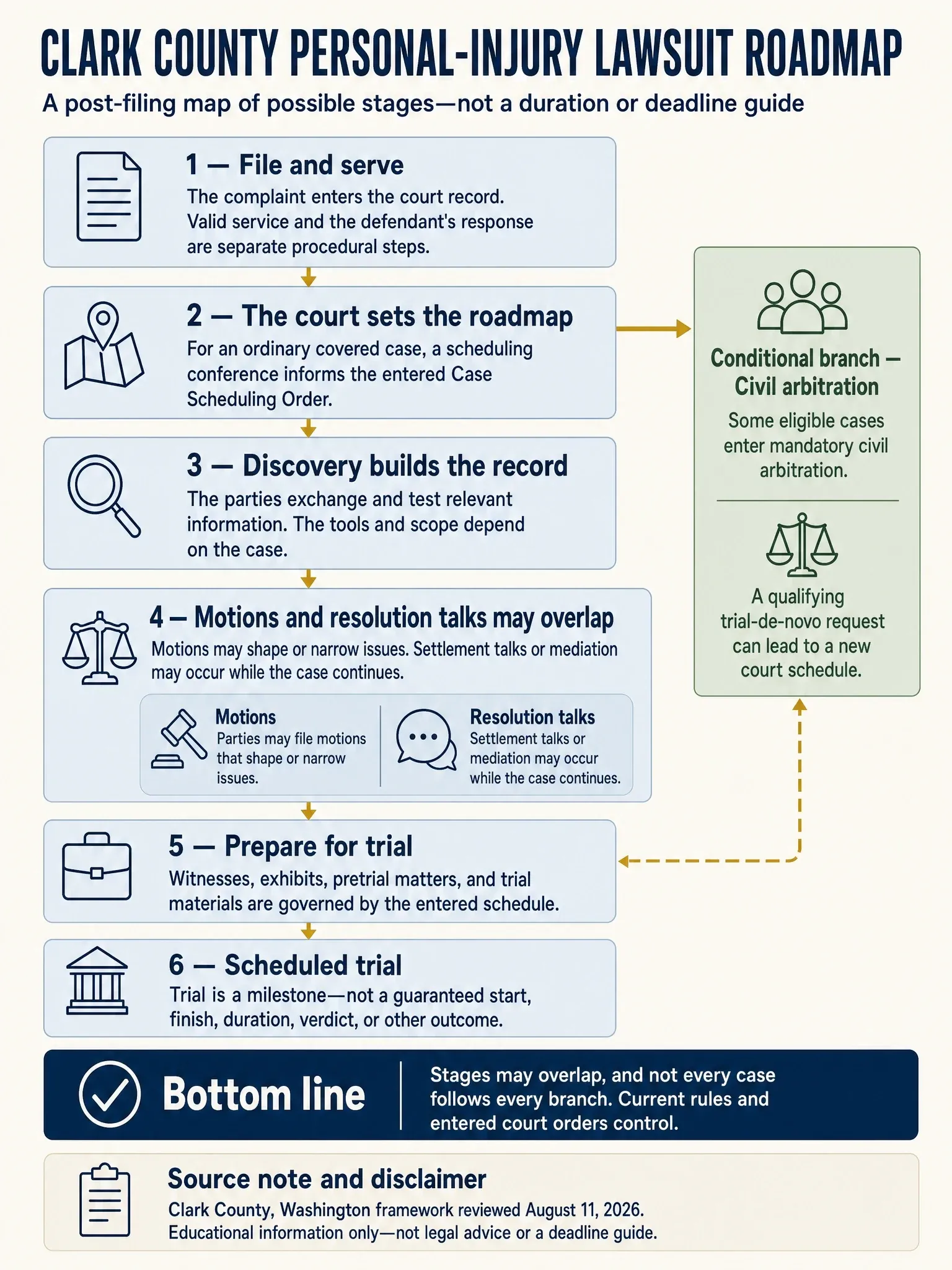
After a personal-injury lawsuit enters Clark County Superior Court, it may move through service, a local scheduling conference, discovery, motions, settlement discussions, mediation or civil arbitration, pretrial preparation, and trial. Some of these stages overlap, and not every case follows every branch.
This article maps the court process for an ordinary personal-injury damages action in Clark County, Washington. It does not predict when a particular case will end. Actual timing depends on the court’s entered Case Scheduling Order, the facts and parties, the dispute-resolution path, motion practice, and court availability.
For the broader path that can begin before a lawsuit and continue through settlement and disbursement, see our Washington personal-injury settlement timeline.
Important: This article provides educational information only, not legal advice. Do not use it to calculate a statute of limitation or any filing, service, response, jury-demand, arbitration, discovery, motion, or trial-de-novo deadline. Rules and local procedures can change, and an entered court order may establish case-specific dates.
First, Separate Legal Time Limits From the Lawsuit’s Procedural Milestones
A statute of limitation and a court’s case schedule answer different questions.
RCW 4.16.080 supplies a general three-year limitations period for many Washington personal-injury actions. But that is not a universal deadline for every injury-related claim. Accrual, tolling, claims involving public entities, medical-negligence claims, wrongful-death claims, minority, and other statutes can change the analysis.
Commencement also requires careful distinctions. Civil Rule 3 generally permits a civil action to be commenced by filing a complaint or by serving a summons and complaint under Civil Rule 4. For limitations purposes, RCW 4.16.170 separately treats filing or service—whichever occurs first—as tentative commencement and generally requires the other step within the period stated by the statute. That rule is not advice to wait.
For a focused car-crash explanation, see Washington’s conditional filing-and-service rule.
Filing, valid service, personal jurisdiction, and limitations tolling are related, but they are not interchangeable. The rest of this article addresses procedural milestones in a lawsuit. Those milestones do not replace or extend the legal time limit for bringing a claim.
Stage 1—Filing in the Proper Court and Serving the Defendant
Why Clark County must be a proper venue
A plaintiff cannot select Clark County solely as a matter of preference. In a personal-injury damages action, RCW 4.12.020(3) generally permits venue where the cause of action, or part of it, arose or where a defendant resided when the action commenced.
Venue can involve more than identifying a convenient courthouse. Our related guide explains Clark County venue and jury selection in greater depth. This timeline assumes Clark County Superior Court is a legally proper venue.
Filing, service, and the defendant’s response
Filing puts the complaint in the court record, but service is a separate step. Civil Rule 4 generally requires the summons and complaint to be served together. Service may be made by a sheriff or deputy, or by a person who is over 18, competent to be a witness, and not a party. Proof of service is also required. RCW 4.28.080 provides methods that depend on the type of defendant and was amended in 2025.
The response period also depends on how service occurred and what the defendant files. A defendant served through the ordinary CR 4 route generally has 20 days to answer. Civil Rule 12 provides 60-day periods for specified forms of publication, out-of-state, Secretary of State, or custodial-facility service. A timely CR 12 motion can also alter when a responsive pleading is due.
These rules are why “the defendant always has 20 days” is not a safe assumption. The applicable rule, service method, and actual filings must be reviewed in the particular case.
Stage 2—The Scheduling Conference Creates the Local Case Roadmap
Clark County’s scheduling process is the most important local feature of this timeline. It turns the case’s current posture into an entered schedule for discovery, motions, pretrial work, and trial.
Case Assignment Notice and scheduling conference
Under the Clark County local-rule framework effective September 1, 2025, the filing party in an ordinary newly filed civil case not excluded by LCR 40(b)(2) files a Case Assignment Notice. The filing party sets a scheduling conference no fewer than four and no more than six months after the initial pleading and serves the notice with the pleading or within 10 days after filing.
This is the researched framework for an ordinary covered case, not a universal schedule for every matter in Superior Court. Excluded case types, civil-arbitration cases, and cases returning after a trial-de-novo request can follow different procedures.
Joint Status Report and the issues before the court
Counsel and self-represented parties ordinarily appear at the scheduling conference. The Joint Status Report must be filed at least 10 court days before the conference, and a courtesy copy must be provided to the assigned department at least 10 days before the conference. The report addresses matters that shape the schedule, including:
- whether service and responsive pleadings are complete;
- whether other parties may be joined;
- whether the case may be subject to civil arbitration;
- whether a jury has been demanded and the required fee addressed; and
- the anticipated length of trial.
The scheduling conference is therefore more than administrative paperwork. It gives the court information needed to place the case on a workable track. Current versions of the Case Assignment Notice and Joint Status Report are available through the Clark County Superior Court forms page.
What the Case Scheduling Order generally organizes
Clark County’s standard LCR 40 framework organizes major events in relation to the trial date. It generally places:
- the discovery cutoff 12 weeks before trial;
- dispositive-motion hearings six weeks before trial;
- witness and exhibit exchange six weeks before trial;
- a pretrial status conference about four to six weeks before trial; and
- motions in limine and trial materials two weeks before trial.
The standard framework places trial no later than 10 months after the scheduling conference. Combined with the four-to-six-month conference window, that can produce a nominal initial framework of roughly 14 to 16 months after filing.
That range is not an average, a promised trial date, or an estimate of when a case will finish. No official Clark County average or median duration for personal-injury cases was identified in the approved research. The entered Case Scheduling Order and later court orders control the actual dates.
Stage 3—Discovery Builds the Evidence
Discovery is the structured exchange and testing of information relevant to the lawsuit. In an injury case, it can address what happened, the claimed physical or mental condition, and damages. The tools used and the amount of work involved depend on the case.
Written discovery and document exchange
Civil Rule 26 and the related Washington Superior Court Civil Rules permit several discovery methods, including interrogatories, requests for documents and electronically stored information, property inspections, and requests for admission. Discovery remains subject to limits involving relevance, privilege, the needs of the case, protective orders, and the case schedule.
Applicable insurance agreements and coverage-related documents may be discoverable under CR 26(b)(2). Discoverability does not make that material automatically admissible at trial.
CR 33 and CR 34 generally use 30-day response periods for interrogatories and document requests, with specified 40-day protection for a newly served defendant. Under CR 36, a matter may be admitted if a timely answer or objection is not served. These are general rule summaries, not dates to apply without reviewing the governing rules and case schedule.
Depositions, medical issues, and examinations
CR 30 governs oral depositions. Whether a deposition is used, and which people are questioned, depends on the evidence and issues in the case.
Discovery can also involve property inspection. When a party’s physical or mental condition is in controversy, CR 35 permits a court-ordered examination upon a showing of good cause. That does not mean every injury case includes such an examination.
Discovery disagreements
Parties may disagree about the proper scope of a request, whether information is privileged, or whether a response is sufficient. Before a discovery motion under CR 26 through CR 37, CR 26(i) generally requires a good-faith conference and certification.
If the parties cannot resolve a dispute and motion practice becomes necessary, the issue can consume time within the existing schedule. That possibility does not establish that either side is being obstructive; the significance depends on the dispute and the court’s ruling.
Stage 4—Motions Can Shape or Narrow the Case
Motions may address discovery, procedural questions, evidence, or legal issues affecting part or all of the lawsuit. Not every case includes every type of motion, and filing a motion does not predict its outcome.
Clark County LCR 6 establishes a briefing sequence for ordinary civil motions, but specific rules can differ. Summary judgment is governed by its own schedule under Civil Rule 56. Under the standard local case schedule, dispositive-motion hearings are placed six weeks before trial.
Motion calendars, confirmation steps, working-copy requirements, hearing arrangements, and other operational details can change. Parties and counsel should consult the current Clark County local rules, the entered scheduling order, and any applicable court instructions rather than relying on a general article.
Stage 5—Settlement Discussions and Mediation May Occur Along the Way
Settlement discussions do not necessarily occupy a single, separate block of the timeline. They may occur while discovery, motions, or trial preparation continues.
Mediation is facilitated negotiation toward a voluntary agreement. Washington’s Uniform Mediation Act, chapter 7.07 RCW, generally protects qualifying mediation communications through privilege, subject to statutory exceptions. Evidence does not become protected merely because a party uses it in mediation.
The rules reviewed did not establish one generally applicable mediation deadline for every ordinary Clark County civil damages case. Parties may mediate voluntarily, and a judge may order alternative dispute resolution in a particular case. Mediation is therefore a possible stage, not a universal requirement or a guarantee of settlement.
Mediation also should not be assumed to pause the rest of the schedule. Clark County’s Civil Division Trial Continuance Policy states that intended alternative dispute resolution or hoped-for settlement ordinarily does not, by itself, establish good cause to continue trial.
An Alternate Path—Mandatory Civil Arbitration and Possible Trial De Novo
Some Clark County civil cases may move into mandatory civil arbitration rather than continuing immediately along the ordinary trial track. Eligibility depends on the complete case, not simply on an informal estimate of one claim.
Which cases may qualify for civil arbitration
Clark County’s mandatory civil-arbitration limit is $100,000, exclusive of attorney fees, interest, and costs. Covered actions generally must be at issue, seek money relief only, and include no claim above that amount.
The analysis considers all claims, counterclaims, cross-claims, requested relief, waivers, and court rulings. A claimant’s informal valuation does not establish eligibility. The governing sources include chapter 7.06 RCW, the Superior Court Civil Arbitration Rules, and Clark County’s local rules.
Transfer, limited discovery, hearing, and award
For an LCR 40(c) case, a party ordinarily must file and serve the Statement of Arbitrability and pay the arbitration fee at least 10 court days before the scheduling conference. The filing party must then promptly send the arbitration coordinator a conformed copy and proof of payment. A contesting response ordinarily is due at least five court days before the conference.
After an arbitrator is assigned, the hearing generally is set no sooner than 21 days and no later than 75 days after assignment unless the parties stipulate otherwise or good cause supports a different setting. SCCAR 4.2 narrows discovery after assignment. The arbitrator’s award generally is filed and served within 14 days after the hearing concludes.
These are deadline-sensitive summaries, not instructions for calculating dates. Current forms and procedures should be checked through the Clark County Superior Court forms page and the court’s civil-arbitration resources.
What a trial-de-novo request changes
Arbitration does not necessarily end the case. Under SCCAR 7.1, an eligible aggrieved party may request a trial de novo within a nonextendable 20-day period. That is a short, consequential deadline and should not be calculated from this article.
The court must assess covered costs and reasonable attorney fees against an appealing party that fails to improve its position at trial de novo. Separate discretionary consequences can apply to withdrawal of the request. This consequence should not be evaluated from a general article. In an ordinary LCR 40(c) case, Clark County requires a new Case Assignment Notice and a scheduling conference between two weeks and two months after the trial-de-novo request.
A trial-de-novo request can therefore put the case on a new court schedule. Civil arbitration should not be described as necessarily final or necessarily faster overall.
Stage 6—Trial Readiness Requires More Than Reaching the Trial Date
The weeks before trial contain their own procedural milestones. Reaching the date on the calendar does not replace the work required by the scheduling order.
Witnesses, exhibits, the pretrial conference, and motions in limine
Under Clark County’s standard framework, the parties exchange witnesses and exhibits six weeks before trial. A pretrial status conference generally occurs about four to six weeks before trial. Motions in limine and trial materials are generally due two weeks before trial.
These dates are tied to the standard schedule. The entered Case Scheduling Order controls in the particular case.
Jury demand and jury selection
A civil jury must be demanded in writing and accompanied by the required fee. For ordinary Clark County non-arbitration cases using the scheduling-conference procedure, LCR 38 treats failure to demand a jury and pay the fee by the scheduling conference as a waiver unless the court grants an extension for good cause. Different timing can apply after a trial-de-novo request or in excluded cases.
Without a proper demand for 12 jurors, Civil Rule 38 provides for an ordinary Washington civil jury of six members, with five required to reach a verdict. The parties may consent to another permitted number. Jury selection involves random panel selection, voir dire, challenges, and judge-permitted questioning under RCW 4.44.120, CR 47, and Clark County LCR 47.
The amount of the jury fee and the operative demand deadline should be confirmed from current rules and case documents rather than this overview.
Stage 7—Trial Is a Scheduled Milestone, Not a Guaranteed Finish Date
Clark County treats civil trial dates as firm. That does not mean every case set for a particular date will necessarily start that day or finish within a predictable period.
Criminal cases have priority. Another trial may run longer than expected, a judge may be unavailable, or resource and interpreter constraints may affect the calendar. The court may also adjust proceedings when orderly administration requires it.
Nor does reaching trial imply any particular outcome. A general timeline cannot predict whether a case will settle, proceed to a verdict, or require later proceedings.
Why the Actual Timeline Can Change
The stages above provide a map, but they do not create a universal duration. Case-driven and court-driven changes can occur without fitting neatly into one milestone.
Case-specific factors
Factors that may affect progression include:
- difficulty completing valid service;
- adding parties;
- a dispute about civil-arbitration eligibility;
- extensive medical or expert discovery;
- discovery motions;
- dispositive motions;
- incomplete damages evidence; and
- a trial-de-novo request after arbitration.
These factors do not affect every case in the same way. Some may overlap, while others may never arise.
Continuances are not automatic
Under Clark County’s civil continuance policy, agreement between the parties, incomplete discovery, anticipated settlement, ongoing treatment, new counsel, or an ordinary scheduling conflict generally is not sufficient by itself to continue a civil trial.
Existing deadlines also remain in place unless the court separately changes them. Whether a judge will grant a continuance depends on the actual request and circumstances; it cannot be predicted from a general article.
Court and resource factors
The court’s calendar can change because criminal matters receive priority, another trial overlaps, a judicial officer is unavailable, resources or interpreters are constrained, or orderly court administration requires an adjustment.
Together, these case-specific and court-driven variables explain why the local rules provide a framework rather than an average completion time.
How Injured People and Families Can Use This Roadmap
The practical value of a court timeline is knowing what questions to ask—not trying to calculate every deadline from a summary.
- Treat the entered Case Scheduling Order and current court rules as the controlling procedural map.
- Keep relevant photos, messages, records, and other materials organized and preserved in their original form.
- Keep track of requests, appointments, and information needed for discovery and trial preparation.
- Ask case-specific questions early about service status, the scheduling conference, discovery, possible mediation or arbitration, jury demand, and trial preparation.
- Check current Clark County forms and instructions because local filing and hearing logistics can change.
People seeking personal-injury help in Vancouver and Clark County can speak with Johnson Law about the facts and procedural posture of a particular matter. Any assessment must be case-specific; no outcome or duration can be promised.
Frequently Asked Questions
How long does a personal-injury lawsuit take in Clark County Superior Court?
There is no reliable universal duration, and the approved research identified no official Clark County average or median for personal-injury cases. The local rules create an initial scheduling framework, but the entered order, service, discovery, motions, mediation or arbitration, trial availability, and other case events control. The nominal framework described above is not a prediction of when a case will begin trial or conclude.
Is the statute of limitation the same as the court’s lawsuit schedule?
No. A statute of limitation concerns timely commencement of a claim. A Case Scheduling Order organizes later procedural milestones after the case enters court. Neither should be calculated from a general article, and one does not substitute for the other.
Does every Clark County personal-injury case have to go to mediation?
No generally applicable mediation requirement for every ordinary civil damages case was identified in the rules reviewed. Parties may mediate voluntarily, and a judge may order alternative dispute resolution in a particular case. Mediation does not necessarily pause the case schedule or produce a settlement.
Will every Clark County personal-injury case go through mandatory civil arbitration?
No. Eligibility depends on the complete pleadings, every form of requested relief, the monetary limit, waivers, and other governing requirements. An informal estimate of a claim’s value is not enough to decide whether a case qualifies.
Can an arbitration award be taken to a jury trial?
An eligible aggrieved party may request a trial de novo. A trial de novo carries a right to jury trial if a jury is properly and timely demanded and the fee is paid under the applicable rules. The trial-de-novo request itself is not a jury demand. The governing deadline is short and nonextendable. The court must assess covered costs and reasonable attorney fees against an appealing party that fails to improve its position at trial de novo; separate discretionary consequences can apply to withdrawal of the request. The deadline and potential consequences must be evaluated from the current rules and actual case record, not this article.
Can the parties move a Clark County civil trial date by agreement?
Agreement alone generally is not sufficient under Clark County’s continuance policy. Existing deadlines remain unless the court separately changes them. Whether a continuance will be granted depends on the circumstances and the court’s decision.
Primary Source Notes
This article relies on the following Washington and Clark County primary materials:
- Washington Superior Court Civil Rules, including CR 3, CR 4, CR 12, CR 26–38, CR 47, CR 48, and CR 56.
- RCW 4.16.080 and RCW 4.16.170 on limitations and tentative commencement.
- RCW 4.12.020 on venue and RCW 4.28.080 on service methods.
- Clark County Superior Court local rules effective September 1, 2025 and the local-rules landing page.
- Clark County Superior Court forms, including current case-assignment, status-report, and arbitration materials.
- Chapter 7.06 RCW, the Superior Court Civil Arbitration Rules, and Clark County civil-arbitration information.
- Chapter 7.07 RCW, Washington’s Uniform Mediation Act.
- Clark County Civil Division Trial Continuance Policy.
- RCW 4.44.120 on civil juries and jury selection.
Currency note: This discussion was reviewed on August 11, 2026, using the Clark County local rules effective September 1, 2025, which the court then identified as current. Check the court’s current local-rules page, forms, and case-specific orders immediately before publication and whenever this article is updated.
Disclaimer
This article is for educational and informational purposes only and is not legal advice. It does not create an attorney-client relationship and should not be used to calculate or act on any legal deadline. Court rules, statutes, local procedures, and case orders can change or apply differently depending on the facts. Consult a qualified Washington attorney about a specific claim or lawsuit.
Client-First Fee Promise
Client First = Bills First, Fees Second
Your unpaid medical bills do not have to make your lawyer's fee bigger. Johnson Law subtracts qualifying medical bills before calculating our fee, helping clients keep more of their settlement.
Applies to qualifying cases. Results vary.