Clark County Jury Demographics and Venue: How Where You File Can Affect Risk

Clark County Jury Demographics and Venue: How Where You File Can Affect Risk
Where an injury lawsuit is filed can affect court procedures, witness logistics, jury selection, and litigation costs. But venue is first a legal question. A person cannot properly choose Clark County merely because someone believes its juries may be more favorable.
Clark County demographic information also cannot predict who will sit on a particular jury, how any juror will view the evidence, or what verdict a jury will return. The county population, the jury source list, people who respond to summonses, the trial panel, and the jurors ultimately selected are different groups.
This article addresses Washington state civil cases, especially personal-injury actions in Clark County Superior Court. It does not address federal venue or removal, federal jury selection, criminal cases, Washington District Court civil jurisdiction, or Oregon law. Those systems have different statutes and procedures.
The Short Answer: Venue Matters, but Demographics Do Not Predict a Verdict
A Washington injury case may have more than one legally proper venue. The available counties depend on facts such as where the injury occurred, where the defendant lived when the action began, whether there are multiple defendants, and whether a defendant is a corporation or nonresident. A claim-specific statute may also control.
Once a case is filed, local procedure matters. Clark County has its own rules governing jury-demand timing, voir dire, and civil arbitration. Witness convenience and the location of evidence may matter as well. Filing in an improper county can result in transfer costs and, in some circumstances, responsibility for the other side’s reasonable attorney fee for changing venue.
Those concrete considerations are different from describing a county as “plaintiff-friendly” or “defense-friendly.” Neither Census figures nor the available Clark County juror survey supports such a label. For broader context on how a claim may move toward resolution, see the Washington personal-injury settlement timeline.
When Is Clark County a Proper Venue for a Washington Injury Case?
The answer depends on the governing venue law and the facts of the case. The general personal-injury rule is an important starting point, but it is not the rule for every type of lawsuit.
The general personal-injury venue options
Under RCW 4.12.020(3), many Washington actions seeking damages for personal injury or injury to personal property may be filed in:
- the county where the cause of action, or some part of it, arose;
- the county where the defendant resided when the action began; or
- if there are multiple defendants, a county where any one defendant then resided.
That means Clark County may be one of several proper choices in some cases. It may be unavailable in others. The analysis must begin with actual connections among the claim, the defendants, and the county—not a prediction about local jurors.
Corporate and nonresident defendants require closer analysis
RCW 4.12.025 contains additional provisions concerning a corporation’s residence and actions against corporations, including provisions related to where a corporation transacts business, maintains an office, or committed the alleged tort.
These provisions are fact-specific. They should not be reduced to a rule that every company doing any business in Clark County can always be sued there.
For a nonresident defendant, Washington Superior Court Civil Rule 82(a) provides additional venue options. Depending on the circumstances, those may include a county where service can be made, where acts supporting long-arm service occurred, or where a plaintiff resides. These are rules for actions against nonresidents, not universal venue options for every lawsuit.
Some claims have different or mandatory venue rules
The general injury rule does not resolve every case. For example, RCW 4.12.010 generally requires specified actions involving possession, title, partition, foreclosure, or injury to real property to begin in the county where the property, or part of it, is located.
Claims involving public entities or officers, probate, family law, land use, contracts with forum-selection clauses, nonresident motorists, or other specially regulated subjects may require separate authority. The correct statute or rule must be identified before deciding whether Clark County is proper.
What Can Happen If a Case Is Filed in the Wrong County?
Improper venue is not the same as a lack of subject-matter jurisdiction. A filing in the wrong Washington county does not necessarily mean automatic dismissal. Washington law instead provides procedures for objecting to venue and changing the place of trial.
A defendant may seek transfer—and may waive the objection
Under CR 82(b), an action filed in the wrong county may nevertheless be tried there unless the defendant requests trial in the proper county under CR 12 and files an affidavit of merits. In other words, an improper-venue objection can be waived if it is not properly preserved and pursued.
Whether and how a party should raise a venue objection is case-specific. Injured people and families should not assume that a venue problem will fix itself or that a court will treat it as a jurisdictional defect.
Transfer is governed by specific grounds, not unrestricted forum shopping
RCW 4.12.030 allows a Washington court to change the place of trial on a motion supported by an affidavit or other satisfactory proof when:
- the complaint identifies an improper county;
- there is reason to believe an impartial trial cannot be had in the original county;
- witness convenience or the ends of justice would be advanced; or
- the judge is disqualified on a ground listed in the statute.
A party seeking transfer on this ground must present an affidavit or other satisfactory proof showing reason to believe an impartial trial cannot be had in the original county; generalized assumptions about county residents do not substitute for that case-specific showing.
If transfer is granted because the case began in an improper county, RCW 4.12.060 directs the case to the county where it should have begun. For another statutory transfer ground, the case goes to the most convenient county where the asserted problem does not exist. Each party ordinarily receives only one change of venue, subject to an exception for a cause that arises later.
The parties may also agree, in a written stipulation or on the record in open court, to move the trial to another Washington county under RCW 4.12.080. That is a consensual transfer, not a right belonging to one side alone.
Improper filing can create costs and attorney-fee exposure
When a case is transferred because it was filed in an improper county, RCW 4.12.090(1) requires the plaintiff to pay transfer and refiling costs. If the court finds that reasonable diligence would have identified the proper county, it must also order the plaintiff to pay the defendant’s reasonable attorney fee for changing venue.
This is one reason to resolve venue from governing law and case facts before filing rather than choosing a county based on perceived strategic appeal.
Where Do Clark County Prospective Jurors Come From?
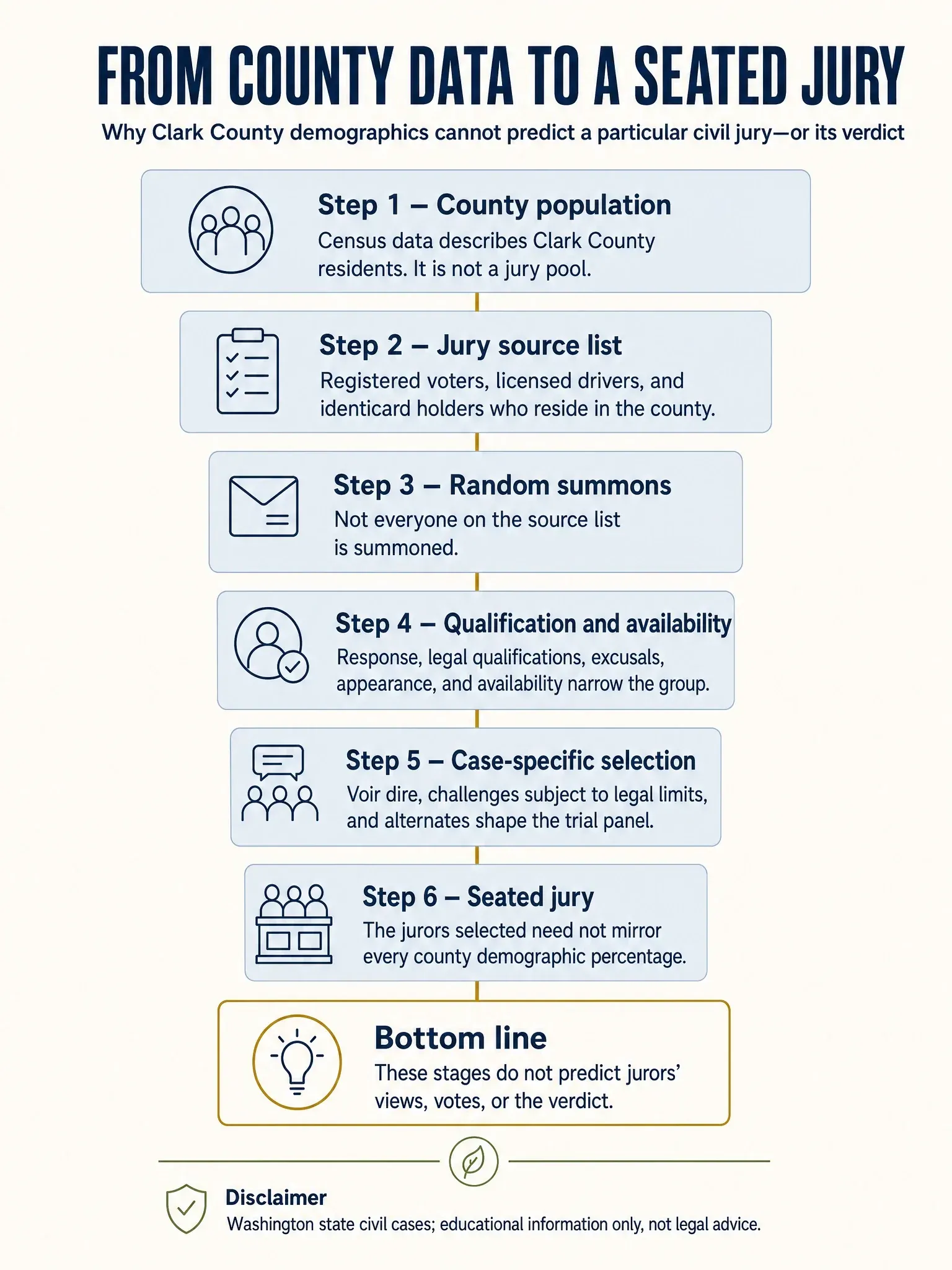
A Clark County jury is not created by selecting a miniature version of the county’s Census population. It emerges from a series of steps, and the group becomes narrower at each one.
The county jury source list
Under RCW chapter 2.36, Washington’s county jury source list combines registered voters with licensed drivers and identicard holders who reside in the county. The superior court compiles and certifies a master jury list and must maintain random selection of the master list and jury panels.
Clark County states that its Jury Coordinator uses a computer program to select prospective jurors from voter-registration, driver-registration, and Washington identicard lists. Clark County LCR 47(k) likewise requires random selection through a properly programmed electronic system.
The approved source review did not verify whether Clark County uses a separate jury-assignment area under RCW 2.36.055. The important point here is that the jury source list is county-based source data, not a Census sample or a prediction of a trial jury.
Qualification, excusal, response, and availability narrow the pool
Under RCW 2.36.070, a person is competent to serve unless the person:
- is under age 18;
- is not a United States citizen;
- is not a resident of the county that summoned the person;
- cannot communicate in English; or
- has a felony conviction and has not had civil rights restored.
Courts make a preliminary qualification determination through a written or electronic declaration. A qualified person may still be excused for undue hardship, extreme inconvenience, public necessity, or another reason the court considers sufficient under the version of RCW 2.36.100 effective through December 31, 2026. That statute changes on January 1, 2027 and should be rechecked for matters arising after that date.
Not everyone on the source list will be summoned. Not everyone summoned will respond, qualify, appear, remain available, or be assigned to a particular case. Each stage creates more distance between countywide population figures and the people available for one trial.
Washington law calls for random juror selection from a fair cross section of the population served by the court and prohibits exclusion from jury service based on protected-class membership recognized by RCW 49.60.030 or economic status. A fair-cross-section policy does not mean that every panel or seated jury must reproduce each county demographic percentage.
Voir dire and challenges focus on the individual and the case
When a Washington civil action is called for trial, potential jurors are selected randomly from summoned people who appeared and were not excused. Voir dire allows the parties and court to identify grounds for challenges for cause and to make informed peremptory challenges. A challenge based on actual bias turns on whether the court is satisfied that the person cannot decide the issues impartially.
Clark County’s LCR 47(a) limits voir dire, as nearly as possible, to matters bearing reasonably directly on prejudice. It bars using questioning to argue or try the case, indoctrinate jurors, build rapport, question jurors about expected legal instructions or theories, or ask what verdict they would return.
Washington General Rule 37 also applies to peremptory challenges in all jury trials. A court must deny a peremptory challenge if, considering the totality of the circumstances, an objective observer could view race or ethnicity as a factor. The rule does not require a finding of purposeful discrimination.
Jury selection must remain case-specific. GR 37 requires denial of a peremptory challenge when an objective observer could view race or ethnicity as a factor, and other constitutional and statutory protections also constrain exclusion from jury service.
What Clark County Demographic Data Can—and Cannot—Show
Demographic sources can describe Clark County or help courts study representation and barriers to jury service. They cannot tell a family who will hear an injury case or how that jury will decide it.
Census data describes county residents, not a jury pool
The U.S. Census Bureau’s QuickFacts page for Clark County reports a July 1, 2025 population estimate of 532,119, compared with a 2020 decennial Census count of 503,311. The newer figure is an estimate and may be revised in a later Census data release.
QuickFacts also reports measures about age, race and origin, language, education, income, and poverty. But those measures do not all cover the same population or reference period. For example, the countywide population includes residents under 18, who are not eligible for jury service. Language-at-home figures cover people age five and older, while education measures cover adults age 25 and older. Hispanic or Latino origin may overlap the Census race categories and should not be added to those categories as though every group were mutually exclusive.
Most importantly, county residents are not interchangeable with jury-eligible residents, people included on source lists, summoned people, respondents, available trial-panel members, or seated jurors. None of these countywide measures supports an inference about any person’s beliefs, credibility assessments, views on damages, or likely vote.
The 2022–2023 voluntary juror survey is informative but limited
Washington’s 2023 Statewide Juror Summons Demographic Survey analyzed 17,498 voluntary Clark County survey responses collected from March 7, 2022 through June 26, 2023. For purposes of that report, the Clark County Superior Court grouping also included Clark County District Court respondents.
The report compared some respondent groups with Citizen Voting Age Population benchmarks. It also reported an average respondent age of 46 and that 57.4% of the Clark County respondents identified some conflict or hardship related to jury service.
Those findings can inform work on jury representation and barriers to service, but the study has important limits:
- participation in the demographic survey was voluntary;
- it included only people who responded to a summons and opted into the survey;
- it excluded people who did not receive or respond to a summons, declined the survey, or responded through excluded methods;
- the Clark County data combined Superior and District Court respondents; and
- it did not track a Clark County Superior Court civil jury from summons through seating and verdict.
The available research did not verify a newer public Clark-specific report with equivalent tables. The 2022–2023 responses should not be described as a current census of Clark County Superior Court civil jurors.
Neither dataset predicts a seated jury or outcome
The eventual jury is narrowed through source-list construction, random summons, qualification review, responses and nonresponses, hardship and excusal decisions, availability, case-specific voir dire, cause challenges, peremptory challenges subject to GR 37, and the use of alternates.
No official dataset was verified that links the demographics of seated Clark County civil juries to verdict direction or award amounts. The Census data and voluntary summons survey therefore cannot support a verdict forecast, settlement premium, expected award, or label such as “plaintiff-friendly.” Protected traits and economic characteristics are not proxies for legal attitudes or likely votes.
How Clark County Jury Procedure Can Affect Case Planning
Rather than trying to predict a result from demographics, families can focus on procedural issues that are concrete and verifiable.
Six jurors is the civil default unless twelve are timely demanded
A Washington Superior Court civil jury ordinarily consists of six people. Under RCW 4.44.120, CR 38, and CR 48, a party may demand a twelve-person jury in writing. The parties may also consent on the record to fewer than six, but not fewer than three.
For an ordinary Washington Superior Court civil verdict, RCW 4.44.380 allows five of six jurors or ten of twelve jurors to return the verdict. The criminal-jury unanimity rule should not be carried over to this civil context.
Clark County jury-demand timing is track-dependent
Clark County LCR 38 ties the jury-demand deadline to the path assigned under LCR 40. For specified non-arbitration cases handled through a Notice to Set, the demand and required fee are due within 30 days after the Notice to Set or response is filed. For other non-arbitration cases and matters following a trial-de-novo request, the deadline is the scheduling conference. Failure is treated as a waiver unless the court previously granted a good-cause extension.
The correct LCR 40 track must be identified before anyone relies on a deadline. Local rules and fees can change and should be checked for the particular case rather than taken from an older article or fee schedule.
Civil arbitration may change the path before a jury trial
Washington law authorizes qualifying civil cases to proceed through court-annexed arbitration in counties that have adopted the process. Clark County has adopted a $100,000 limit. Its official civil-arbitration page describes covered matters as at-issue, civil non-domestic actions—excluding lower-court appeals—that seek only money damages and contain no claim above $100,000, exclusive of attorney fees, interest, and costs.
For a case on the LCR 40(c) track, Clark County requires a Statement of Arbitrability and fee at least 10 court days before the scheduling conference. A party contesting transfer to arbitration must respond at least five court days before that conference. A party requesting a trial de novo after arbitration must also begin the applicable local trial-setting or case-assignment process and satisfy LCR 38 to demand a jury.
These requirements come from RCW 7.06.020 and Clark County LCAR 1.2, 2.1, and 7.1. The current local rules and fees should be rechecked before filing. Arbitration is a procedural path—not proof of a claim’s value and not a forecast of what a later jury would decide. The broader Clark County Superior Court lawsuit process involves additional scheduling, discovery, motion, and trial-preparation steps beyond this venue-and-jury overview.
A More Disciplined Way to Think About Venue Risk
Venue risk is better evaluated through questions grounded in law, procedure, and the case itself.
Is Clark County legally available for this claim and these defendants?
Relevant facts may include where the injury occurred, where each defendant lived when the case began, whether a corporation or nonresident is involved, and whether a claim-specific venue rule applies. There may be more than one proper county, but every available option must have a legal basis.
Could transfer, witness convenience, or local procedure affect cost and preparation?
The analysis may include whether a venue objection has been preserved or waived, what evidence could support a transfer request, where witnesses and evidence are located, and what transfer costs may follow an improper filing. Clark County’s case track, jury-demand deadline, arbitration requirements, and any trial-de-novo procedures may also affect preparation.
What can be learned through case-specific jury selection?
Voir dire and challenges provide tools for addressing actual impartiality and case-related prejudice. Countywide demographic traits do not reliably predict an individual juror’s views or vote.
What remains uncertain?
County statistics, source-list rules, and historical survey responses do not identify the people who will deliberate or the result they will reach. The evidence, credibility issues, court rulings, available witnesses, and individual jurors selected remain case-specific.
Questions About Clark County Venue or Civil Jury Procedure?
Venue questions can arise before filing or after another party challenges the chosen county. Local deadlines may also affect whether a civil case is assigned to arbitration and whether a jury is properly demanded. A timely, case-specific review can help identify the governing venue authority and the Clark County procedures that apply.
Learn more about Vancouver and Clark County personal-injury help.
Frequently Asked Questions
Can I choose Clark County because I think its juries are more favorable?
Clark County must be a legally proper venue under the statute or rule governing the claim and defendants. Perceived strategic advantage is not enough. The available Census and juror-survey data also do not support predictions about who will serve, how jurors will vote, or what a verdict may be.
Where can a Washington personal-injury lawsuit be filed?
For many personal-injury actions, Washington law allows filing where the cause of action or part of it arose, where the defendant resided when the action began, or—if there are multiple defendants—where one defendant then resided. Corporate, nonresident, real-property, and other claim-specific rules may alter that analysis.
What happens if an injury case is filed in the wrong Washington county?
A defendant may request transfer if the venue objection is properly preserved. If the court transfers a case for improper venue, the plaintiff must pay transfer and refiling costs. When reasonable diligence would have identified the proper county, the plaintiff must also pay the defendant’s reasonable attorney fee for changing venue. An improper-venue objection may be waived, so the defect does not automatically require dismissal.
Does Clark County Census data show who will serve on my jury?
No. Census data describes county residents. A trial jury is narrowed through the jury source list, random summons, qualification, response, excusals, availability, voir dire, challenges, and alternates. A seated jury does not have to reproduce every county demographic percentage.
How many jurors decide a Clark County Superior Court civil case?
Six is the Washington Superior Court civil default unless twelve are properly demanded in writing. The parties may consent on the record to fewer than six, but not fewer than three. Ordinarily, five of six or ten of twelve jurors may return a civil verdict.
Will a Clark County injury case go through civil arbitration before trial?
It may if it satisfies Washington and Clark County requirements. Clark County’s program generally covers qualifying at-issue, non-domestic civil actions seeking money damages only, with no claim above the county’s adopted $100,000 limit. Exclusions and track-specific filing rules apply, and the current local rules should be checked for the case.
Primary Source Notes
- RCW chapter 4.12: Washington venue and change-of-venue statutes
- Washington Superior Court Civil Rule 82: venue
- RCW chapter 2.36: jury source lists, qualifications, selection, and demographic collection
- RCW chapter 4.44: Washington civil jury selection, challenges, jury size, and verdicts
- Washington Superior Court Civil Rules
- Washington General Rule 37: jury selection
- Clark County Superior Court local rules
- Clark County Superior Court jury service
- Clark County Superior Court civil arbitration
- U.S. Census Bureau QuickFacts: Clark County, Washington
- Washington Courts 2023 Statewide Juror Summons Demographic Survey materials
- Washington Courts summary of the statewide juror survey
Disclaimer
This article provides general educational information about Washington state civil procedure and Clark County Superior Court. It is not legal advice. Venue, deadlines, court rules, and fees can change, and the correct analysis depends on the particular claims, parties, and facts. Federal court, criminal court, District Court, and Oregon matters follow different rules.
Client-First Fee Promise
Client First = Bills First, Fees Second
Your unpaid medical bills do not have to make your lawyer's fee bigger. Johnson Law subtracts qualifying medical bills before calculating our fee, helping clients keep more of their settlement.
Applies to qualifying cases. Results vary.