Medical Malpractice Wrongful Death in Washington: Proving the Delay Caused the Outcome
Medical Malpractice Wrongful Death in Washington: Proving the Delay Caused the Outcome
When a patient dies after a delayed diagnosis, treatment, transfer, escalation, monitoring response, or communication, the central legal question is not simply whether a delay occurred. It is whether a provider failed to meet the applicable professional standard of care and whether that failure caused a legally recognized injury.
Washington law provides two distinct causation paths that may matter. Traditional causation asks whether the breach more likely than not caused the death. A loss-of-chance theory asks whether the breach more likely than not caused a measurable reduction in the patient’s chance of survival. Under the second theory, the compensable injury is the lost chance—not automatically the entire death.
Neither path can be established from the timing or outcome alone. The analysis ordinarily depends on a patient-specific medical timeline, a medically supported account of what timely care would have looked like, and qualified expert testimony.
Educational information only: This article provides general information about Washington law. It is not legal advice and does not determine whether any provider was negligent or whether a particular delay caused a death or loss of chance.
The Short Answer: A Delay Is Not the Same as Proof of Causation
Under Washington’s medical-negligence law, a claimant generally must prove two separate points:
- The health care provider failed to exercise the care, skill, and learning expected of a reasonably prudent Washington provider in the same profession or class and in similar circumstances.
- That failure proximately caused an injury.
A delay, changed diagnosis, or poor result does not establish either point by itself. Even if a delay departed from the standard of care, the evidence must still connect that departure to the death or another legally recognized injury, such as a measurable lost chance of survival.
Proximate cause includes cause in fact and legal causation. In an ordinary medical-negligence analysis, cause in fact generally asks whether the injury would have occurred but for the breach. As the Washington Supreme Court explained in Dunnington v. Virginia Mason Medical Center, “substantial factor” is not a general replacement for that inquiry and has a narrower role.
Questions the evidence must answer
A useful investigation starts with questions rather than assumptions:
- What did each provider know, and when?
- What information was recorded, communicated, or available but not acted upon?
- What did reasonably prudent care require at each relevant point?
- If proper care had occurred, when would testing, consultation, treatment, escalation, or transfer likely have happened?
- Would timely care probably have changed the patient’s outcome or chance of survival, and if so, how?
These questions cannot usually be answered through hindsight or general medical statistics alone. They require patient-specific evidence and qualified expert analysis.
Two Different Causation Paths Under Washington Law
Washington distinguishes between proving that negligence caused a death and proving that negligence caused a lost chance to survive. The theories are related, but they do not define the same injury or require the same ultimate showing.
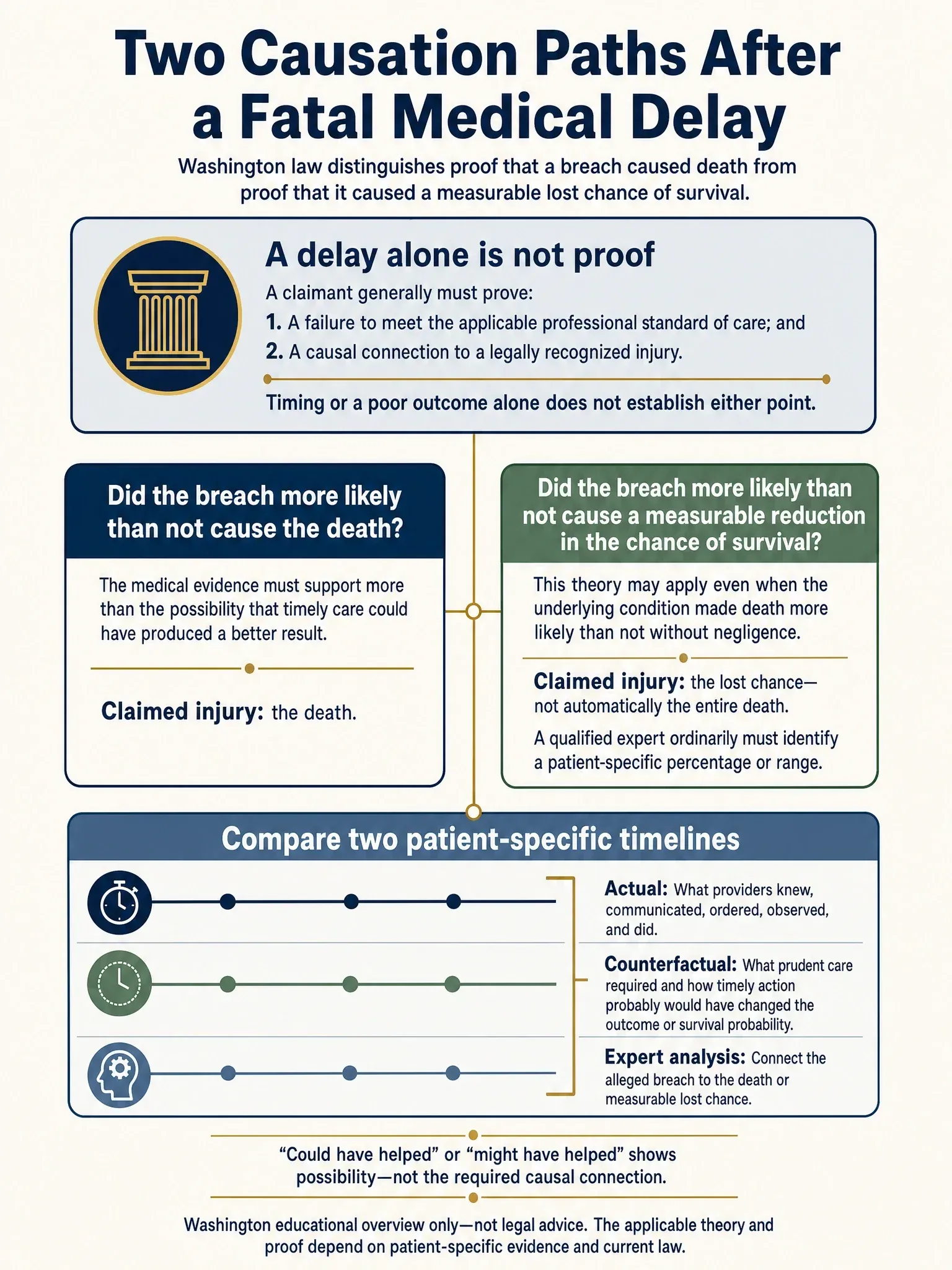
Traditional causation: Did the breach more likely than not cause the death?
Traditional causation seeks to show that the provider’s breach more likely than not caused the death. Under the ordinary cause-in-fact inquiry, the question is whether the death would have occurred but for the breach.
This requires more than evidence that timely care could have produced a better result. The medical evidence must support the conclusion that, more likely than not, the patient would not have died when and as the patient did if the provider had met the standard of care.
Loss of chance: Did the breach probably reduce the chance of survival?
Washington also recognizes a distinct lost chance of survival. This theory can apply even when the underlying condition made death more likely than not without negligence.
The causation requirement does not disappear. The claimant still must show that the provider’s breach probably caused a reduction in the patient’s chance of survival. It is not enough for an expert to say that earlier care “might have helped.”
- Traditional causation: The breach more likely than not caused the death.
- Loss of chance: The breach more likely than not caused a measurable reduction in the chance of survival.
Under a loss-of-chance theory, the claimed injury is that reduced chance. It is not automatically the entire death or all damages associated with it.
Why measuring the lost chance matters
Loss-of-chance proof ordinarily requires a qualified expert to identify a percentage or range that permits proportional damages to be calculated. That measurement must be connected to the patient and alleged breach. A general statement that earlier treatment sometimes improves outcomes does not quantify whether this patient experienced a reduced chance of survival because of the alleged delay or, if so, the size of that reduction.
The supported causation theory also affects the damages methodology and jury instructions. Those questions must be resolved from the evidence and claims actually presented rather than from a generic formula.
Building the Actual and Counterfactual Medical Timelines
Causation after a fatal medical delay is often evaluated by comparing two timelines:
- The actual timeline: what providers knew, communicated, ordered, observed, and did.
- The counterfactual timeline: what reasonably prudent care required and whether, and if so how, timely action probably would have changed the outcome or survival probability.
This comparison helps organize the evidence, but it does not itself prove negligence or causation. Both sides ordinarily need medical support.
The actual timeline
Depending on the case, relevant evidence may include hospital and clinic charts, EMS and transfer records, imaging and laboratory results, pathology and pharmacy data, monitor waveforms, portal messages, electronic audit trails, and death-investigation materials.
The purpose is to determine what information was available, who received it, what action followed, and when. A written treatment timeline can help a family organize events and identify gaps, but it is not a substitute for expert causation analysis.
The medically supported counterfactual
The counterfactual asks what likely would have happened if the applicable standard of care had been met. A useful analysis should address:
- what prudent care required;
- when the missed or delayed action should have occurred;
- what intervention probably would have followed; and
- whether, and if so how, that intervention likely would have changed either the outcome or the patient’s chance of survival.
This is not an invitation to reconstruct the case with hindsight. The comparison must be grounded in the information available at the relevant time, the patient’s condition, and qualified medical opinions.
Why generic possibilities are not enough
An opinion that earlier care “could have” or “might have” helped identifies a possibility, not the required causal connection. A useful expert opinion must explain why the alleged breach probably caused the death under traditional causation or probably caused a measurable lost chance.
The Role of Qualified Medical Experts
Qualified expert testimony is required in nearly all Washington medical-negligence cases because the professional standard of care and medical causation generally fall outside ordinary lay knowledge. The limited exceptions concern matters jurors can understand without specialized medical evidence.
Establishing the standard of care and departure
An expert addressing breach should identify the care, skill, and learning expected of a reasonably prudent Washington provider in the same profession or class and similar circumstances. The expert must then explain how the care departed from that standard and connect the opinion to the record.
Connecting the departure to death or a measurable lost chance
Proof of a departure is not proof of causation. The expert must make the next connection:
- For traditional causation, did the departure more likely than not cause the death?
- For loss of chance, did the departure more likely than not cause a measurable reduction in survival probability?
For a loss-of-chance claim, the expert ordinarily must also provide a percentage or range that can support proportional damages. Under either theory, the opinion must be patient-specific and more than a bare conclusion.
Qualifications depend on the issue
Whether an expert is qualified depends on the opinion offered. Specialty, scope of practice, education, training, and experience may matter. In Frausto v. Yakima HMA, LLC, the Washington Supreme Court held that an advanced registered nurse practitioner was not categorically barred from giving a causation opinion if qualified under the evidence rules. The point is that qualification is issue-specific—not that any professional may address every question.
How Wrongful-Death and Survival Claims Fit the Causation Analysis
“Wrongful death” and “survival” are not interchangeable labels. They address different losses, even when both arise from the same medical events.
Wrongful death addresses beneficiary-specific losses
The decedent’s personal representative maintains a Washington wrongful-death action for statutory beneficiaries. Under RCW 4.20.020, the first beneficiary tier consists of the decedent’s spouse, state registered domestic partner, children, and stepchildren. Parents or siblings may benefit only if no first-tier beneficiary exists.
Wrongful-death damages address losses beneficiaries sustained because of the death. Depending on the evidence and beneficiary, these may include economic losses and relationship losses involving support, companionship, society, services, care, attention, protection, or advice. The personal representative is not necessarily a beneficiary, and not every relative is automatically entitled to recover. Families can find a broader overview of wrongful death and survival claims in Vancouver, but representative, beneficiary, and claim questions still require individual analysis.
Survival claims address injuries suffered before death
Washington’s general and special survival statutes preserve certain claims based on injuries the decedent suffered before death. Wrongful-death and survival claims may both be pleaded, but damages must be allocated to avoid double recovery. Which survival statute applies, what damages may be sought, and how proceeds are distributed are claim-specific questions.
Conscious predeath suffering requires evidence
Survival noneconomic damages require suffering the decedent actually experienced before death. An estate cannot recover for postdeath loss of enjoyment or shortened life expectancy the decedent did not consciously experience. Estate of Otani v. Broudy discusses this distinction.
Records and Evidence to Address Early
Records can establish the actual timeline and give experts the material needed to evaluate the counterfactual. Families should not assume that ordering “the medical chart” captures every potentially relevant source.
Who may request a deceased patient’s records
Under RCW 70.02.140, a deceased patient’s personal representative may exercise the patient’s Washington health-information rights. If there is no personal representative, specified health-care decision-makers may be able to exercise those rights. Records access does not itself establish who has authority to maintain a wrongful-death or survival action.
What a routine chart request may miss
A Washington provider generally must respond to a proper written records request within 15 working days by producing records or taking another action authorized by RCW 70.02.080. A routine chart production still may not include native imaging files, monitor waveforms, electronic audit logs, messaging exports, policies, or information maintained by another entity.
A medical records request letter may help organize a request, but it does not replace identifying the specific systems and entities that may hold relevant evidence.
Targeted preservation without overpromising
Promptly identifying evidence holders and sending focused preservation requests may reduce the risk that relevant material is lost through routine processes. Families may also want to retain their own communications, portal downloads, bills, calendars, and notes.
Washington does not recognize an unlimited general prelitigation duty to preserve every potentially relevant item. Whether a remedy is available for lost evidence depends on issues including duty, relevance, culpability, and prejudice. A request therefore does not guarantee that every item exists, will be retained, or will be admissible.
Hospital retention is not the same as complete evidence preservation
Under RCW 70.41.190, effective July 27, 2025, Washington hospitals must retain medical records for at least 26 years from creation, including older records they still retained on that date. The statute treats all information collected at each unique visit as a medical record for this purpose. Whether a particular audit log, native image, waveform, message export, policy, or other system data falls within that definition or another retention rule requires item-specific analysis.
The rule is hospital-specific, does not recreate records lawfully destroyed before it took effect, and does not mean a routine production includes every retained item. Retention, production, and litigation preservation are different questions.
Washington Filing Deadlines Require Individual Review
A family should not assume that the deadline runs three years from the patient’s death. Nor should it wait to request an evaluation until every record has been collected.
The general limitation framework is not “three years from death”
The enforceable portions of RCW 4.16.350 generally require a medical-negligence action to be filed within three years of the alleged act or omission or within one year after the patient or representative discovered, or reasonably should have discovered, that the injury was caused by the act or omission—whichever period expires later.
Applying that framework requires claim-specific dates and facts. The alleged omission, discovery circumstances, claims asserted, and status of any claim the patient had before death may all matter.
Tolling and predeath claim history may change the analysis
Potential tolling issues include fraud, intentional concealment, qualifying foreign-body facts, disability, and minority. In addition, before a chapter 7.70 action is filed, a written, good-faith mediation request made on the prospective defendant or an authorized agent tolls RCW 4.16.350 for one year if the statutory and case-law requirements are satisfied. Validity, timing, recipient, good faith, and claim coverage require individual analysis; a mediation request should not be treated as a self-help deadline extension. See RCW 4.16.190 and RCW 7.70.110.
It may also matter whether a predeath claim had expired, settled, been released, resulted in a judgment, or entered litigation.
Government-related providers can add separate procedures
Covered claims involving Washington State or local governmental actors can require formal tort-claim presentment and a 60-calendar-day waiting period before suit is commenced. The claim must be properly presented to the correct recipient within the applicable limitation period; the limitation period is tolled during the statutory waiting period. For limitation purposes, the statutes also provide specific treatment for an action commenced within five court days after that period. Defendant status and the proper recipient must be verified. See RCW 4.92.110 and RCW 4.96.020.
Not every hospital or clinician is governmental. Federal and tribal providers may involve separate legal regimes outside this article’s scope.
Printed and invalidated requirements must not be confused with current procedures
Several distinct rules are easy to confuse:
- Washington does not enforce the former 90-day presuit notice requirement for ordinary court-filed malpractice actions.
- The former certificate-of-merit filing requirement is also not enforced.
- RCW 7.70.100 separately requires mediation before a superior-court trial, subject to listed arbitration exceptions.
- A qualifying written, good-faith prefiling mediation request may toll the limitation period.
- A claim involving a qualifying government defendant may require separate presentment and a waiting period.
RCW 4.16.350 still prints an eight-year outside limit, but the Washington Supreme Court held that repose provision unconstitutional in Bennett v. United States. These date-sensitive points should be checked against current Washington law before reliance.
Practical Next Steps for a Washington Family Evaluating a Fatal Medical Delay
A careful early review can preserve information and identify unanswered questions without assuming what the evidence will prove:
- Identify the personal representative and possible beneficiary tier. Records authority, authority to maintain an action, and beneficiary status are related but distinct.
- Write down the actual timeline. Include symptoms, visits, calls, messages, tests, reported results, transfers, changes in condition, and involved people or entities.
- Request available records. Ask which systems hold chart and other information rather than assuming one production is complete.
- Identify evidence outside a routine chart production. Consider EMS records, native imaging, laboratory or pathology material, pharmacy data, waveforms, portal messages, audit trails, transfer records, and death-investigation materials.
- Preserve family-held information. Retain communications and other materials that may establish what happened and when.
- Seek a timely, claim-specific evaluation. The review may need to address the proper causation theory, qualified experts, potential defendants, wrongful-death and survival claims, predeath claim history, and filing requirements.
No checklist can determine whether a delay caused a death or a measurable lost chance. That conclusion must come from Washington law and patient-specific evidence.
A Vancouver and Clark County note
Washington substantive law controls the causation issues discussed here. If a general civil case is properly filed in Clark County Superior Court, current local rules generally call for a case-assignment notice, scheduling conference, and court-ordered schedule.
The Clark County Superior Court personal-injury lawsuit timeline offers a general procedural overview after filing. It does not establish medical-malpractice deadlines or proof requirements. Local rules should be checked at filing.
Frequently Asked Questions
Does a Washington family always have to prove that a medical delay caused the death?
Not under every theory. Traditional causation seeks proof that the breach more likely than not caused the death. A distinct loss-of-chance theory may apply when negligence more likely than not caused a measurable reduction in the patient’s chance of survival. Causation remains required under both theories.
What is a loss-of-chance claim in Washington?
It is a claim based on a measurable reduction in a patient’s chance of survival that the provider’s negligence probably caused. It may be available even when the underlying condition made death more likely than not without negligence. The compensable injury is the lost chance, not automatically the entire death.
Is proof that earlier treatment might have helped enough?
No. A possibility is not the same as likely causation. Qualified expert testimony ordinarily must connect the breach to the death or lost chance. For loss of chance, the proof ordinarily must also identify a percentage or range that permits proportional damages to be calculated.
Who files a Washington medical-malpractice wrongful-death action?
The decedent’s personal representative maintains the action for statutory beneficiaries. The first tier consists of a spouse, state registered domestic partner, children, and stepchildren. Parents or siblings may benefit only if no first-tier beneficiary exists. Authority to request records does not, by itself, establish authority to file the action.
What records may matter when a fatal medical delay is suspected?
The medical chart may be only one source. Depending on the case, EMS and transfer records, native imaging, lab and pathology information, pharmacy data, monitor waveforms, portal messages, audit trails, and death-investigation materials may also matter. Their relevance and availability are case-specific.
Is the deadline three years from the patient’s death?
No. RCW 4.16.350 generally uses an act-or-omission and discovery framework, not a simple period measured from death. Tolling, mediation history, predeath claim status, defendant identity, and other facts can affect the analysis. A specific deadline should be evaluated promptly rather than calculated from this general information.
Source Notes
- RCW 7.70.040: Washington medical-negligence standard and causation elements.
- Chapter 4.20 RCW: wrongful-death and survival framework.
- Dunnington v. Virginia Mason Medical Center, 187 Wn.2d 629 (2017), together with Herskovits v. Group Health Cooperative and Mohr v. Grantham, 172 Wn.2d 844 (2011): traditional causation and loss of chance.
- Rash v. Providence Health & Services, 183 Wn. App. 612 (2014): quantification of a lost chance.
- Frausto v. Yakima HMA, LLC, 188 Wn.2d 227 (2017), and Reyes v. Yakima Health District, 191 Wn.2d 79 (2018): expert testimony and qualification.
- Estate of Otani v. Broudy, 151 Wn.2d 750 (2004): wrongful-death and survival distinctions.
- RCW 4.16.350, Fast v. Kennewick Public Hospital District, and Bennett v. United States: medical-negligence timing and the unconstitutional repose provision.
- RCW 4.16.190, RCW 7.70.100, and RCW 7.70.110: disability tolling, pretrial mediation, and qualifying prefiling-mediation tolling. See also Schroeder v. Weighall, 179 Wn.2d 566 (2014).
- RCW 4.92.110 and RCW 4.96.020: covered state and local government claim presentment.
- RCW 70.02.080, RCW 70.02.140, and RCW 70.41.190: records access, response, and hospital retention.
- Seattle Tunnel Partners v. Great Lakes Reinsurance (UK) PLC, 26 Wn. App. 2d 319 (2023): limits on prelitigation preservation duties and spoliation remedies.
Disclaimer: This article is for educational information only and is not legal advice. Medical causation, claim structure, beneficiary status, damages, and filing requirements depend on the facts and current law. Reading this article does not create an attorney-client relationship.
Client-First Fee Promise
Client First = Bills First, Fees Second
Your unpaid medical bills do not have to make your lawyer's fee bigger. Johnson Law subtracts qualifying medical bills before calculating our fee, helping clients keep more of their settlement.
Applies to qualifying cases. Results vary.