Security Camera Retention in Portland: How Fast Footage Gets Deleted (and Who Has It)
Security Camera Retention in Portland: How Fast Footage Gets Deleted (and Who Has It)
There is no universal Oregon or Portland retention period for ordinary private security-camera footage. A store, apartment building, private garage, nearby business, or resident may use a system that overwrites recordings on its own schedule. City-controlled recordings and TriMet video follow different rules and procedures.
That means the most useful first question is not “How many days do I have?” It is “Who controls each camera that may have captured something relevant?” Once you identify the likely holder, you can use the preservation, public-records, or legal process appropriate to that source.
Acting promptly matters, but a request does not guarantee that footage exists, will be preserved, or must be released. Retention, preservation, production, public disclosure, and admissibility are separate issues.
This article provides educational information about Oregon and Portland procedures. It is not legal advice for any individual claim.
The Short Answer: Retention Depends on Who Controls the Camera
Research current through July 27, 2026, did not identify an Oregon statute or Portland ordinance that gives ordinary private cameras one universal retention period. It would therefore be misleading to rely on a supposed “standard” window for stores, apartments, private garages, neighboring businesses, or residential cameras.
Whether a recording still exists may depend on the particular system, storage settings, camera, and actions taken after the incident. Someone may also have exported a clip for security, an investigation, insurance, or risk-management purposes before the source system overwrote its copy. That possibility is worth investigating, but it should not be assumed.
Public systems require a different analysis:
- Covered City surveillance records: Oregon’s City General Records Retention Schedule sets minimum periods for a defined city record series, including a 30-day minimum for certain recordings not used in a listed investigation or proceeding. That is not a private-camera rule or a safe waiting period.
- TriMet video: Oregon public-records retention authority sets a 30-day minimum for covered routine surveillance recordings, with longer event-based periods when recordings are used as evidence or for an internal investigation. TriMet nevertheless warns that surveillance data is generally available only for a limited time before automatic overwrite and directs people to request video promptly. Neither the legal minimum nor TriMet’s request page guarantees that a particular recording exists, falls within that records series, remains retrievable, or will be disclosed.
- Private footage: A preservation request may ask a holder to stop routine overwrite for identified material, but the request itself does not compel preservation or production.
Even if a recording has been preserved, a separate question remains: can the requester obtain it? A public record may be withheld or redacted under an applicable exemption. Private footage may require cooperation or, once a civil action is pending, formal discovery. If the video is eventually used in a proceeding, it may also need to be authenticated.
Who May Have the Footage? A Portland Source Map
The person working at the location may not administer the camera system. In some settings, ownership, daily operation, security, record storage, and authority to export footage belong to different entities.
| Possible source | Who may possess or control footage | What to investigate | Path to consider |
|---|---|---|---|
| Private store or business | Local business, corporate loss prevention, property owner or manager, security contractor, or system/cloud vendor | Who owns the cameras, administers the recorder, and can export clips | A precise preservation request; cooperation or later civil discovery may be needed for production |
| Apartment or shared commercial property | Building owner, property manager, tenant business, security contractor, or vendor | Cameras in entrances, halls, common areas, loading areas, and parking facilities | Identify each possible holder rather than sending one general request |
| Private parking garage | Property owner, garage operator, management company, security provider, or vendor | Whether camera and garage operations are divided among contractors | Preservation outreach to the correct holder or holders; later process depends on the claim |
| SmartPark garage | The City, an operating or managing contractor, security personnel, or more than one entity | Which entity possesses or controls the relevant system and which City bureau is the records custodian | Operational outreach plus the proper City public-records process may both deserve attention |
| Nearby property | Storefront, apartment common area, loading dock, parking operator, resident, or transit facility | Whether another camera could show approach, departure, conditions, response, or witnesses | Prompt canvassing and a source-specific preservation request |
| TriMet vehicle or facility | TriMet or a system-specific records custodian | Vehicle, route, direction, run or location, date, time, station, platform, transit center, or elevator | TriMet’s public-records process; charges and disclosure limits may apply |
| City-controlled facility or camera | The responsible City bureau or records custodian | Exact facility, camera area, date, time, and whether an investigation or proceeding exists | A sufficiently specific request through Portland’s permitted public-records channel |
This map identifies possibilities, not proof. A camera may not have existed, worked, faced the relevant area, recorded continuously, used an accurate timestamp, or retained the clip.
Private Business or Store Cameras
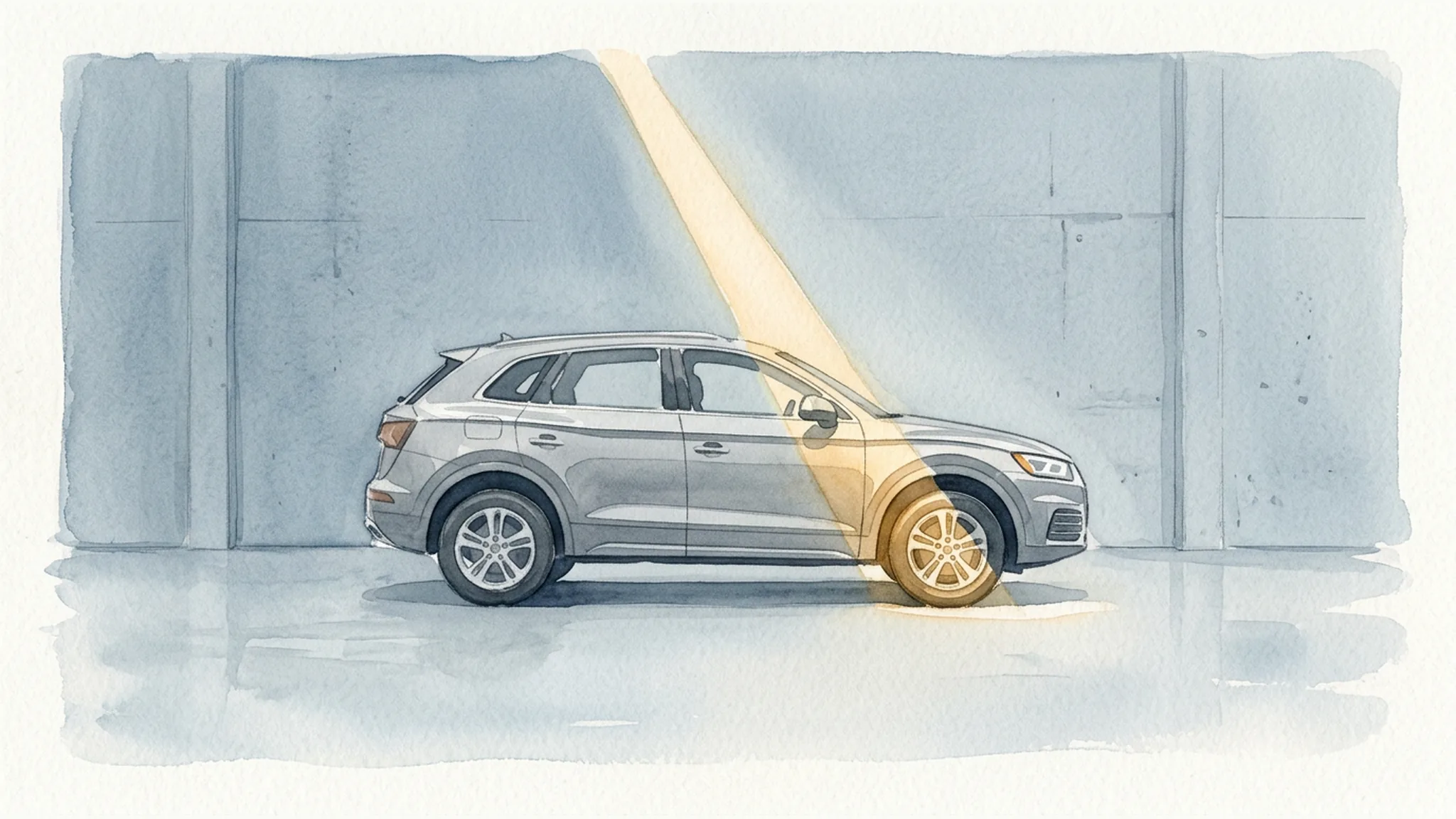
For a private-business incident, identify the actual system administrator rather than assuming the front desk controls the recording. A corporate loss-prevention department, landlord, contracted security company, or outside platform may administer or store the files. When the event is a parking-lot pedestrian collision involving a backing driver, camera mapping should be considered alongside the vehicle path, pedestrian route, sightlines, and control of the lot.
This article’s role is to help map that holder. For premises-specific guidance on the hazard timeline, inspections, cleanup, notice, and the contents of a private preservation request, see preserving private surveillance footage after a slip-and-fall.
Apartment, Parking Garage, and Shared-Property Cameras
Shared properties often have divided responsibilities. A retail tenant may occupy the space where an injury happened, while the building owner controls an exterior camera. A property manager may oversee common areas, a separate company may operate the garage, and a security contractor may monitor the system.
Portland’s SmartPark system illustrates why ownership and operations should be mapped carefully. The City says SmartPark consists of five downtown, City-owned public parking garages, while its current page lists separate contacts for garage customer service and security, the managing contractor, and the City-listed SmartPark General Manager. For a specific incident, one should not assume the contractor is the only custodian. Operational outreach and the City’s formal public-records route may address different needs.
Nearby Cameras May Matter Even If They Missed the Injury
A camera does not have to show the moment of injury to contain relevant information. Depending on its actual field of view, footage from a nearby storefront, apartment common area, loading dock, parking facility, doorbell system, traffic-facing camera, or transit facility might show:
- the approach to or departure from the location;
- the response after an incident; or
- possible witnesses in the area.
That makes a prompt canvass useful, but it does not establish that any nearby system captured relevant or usable video.
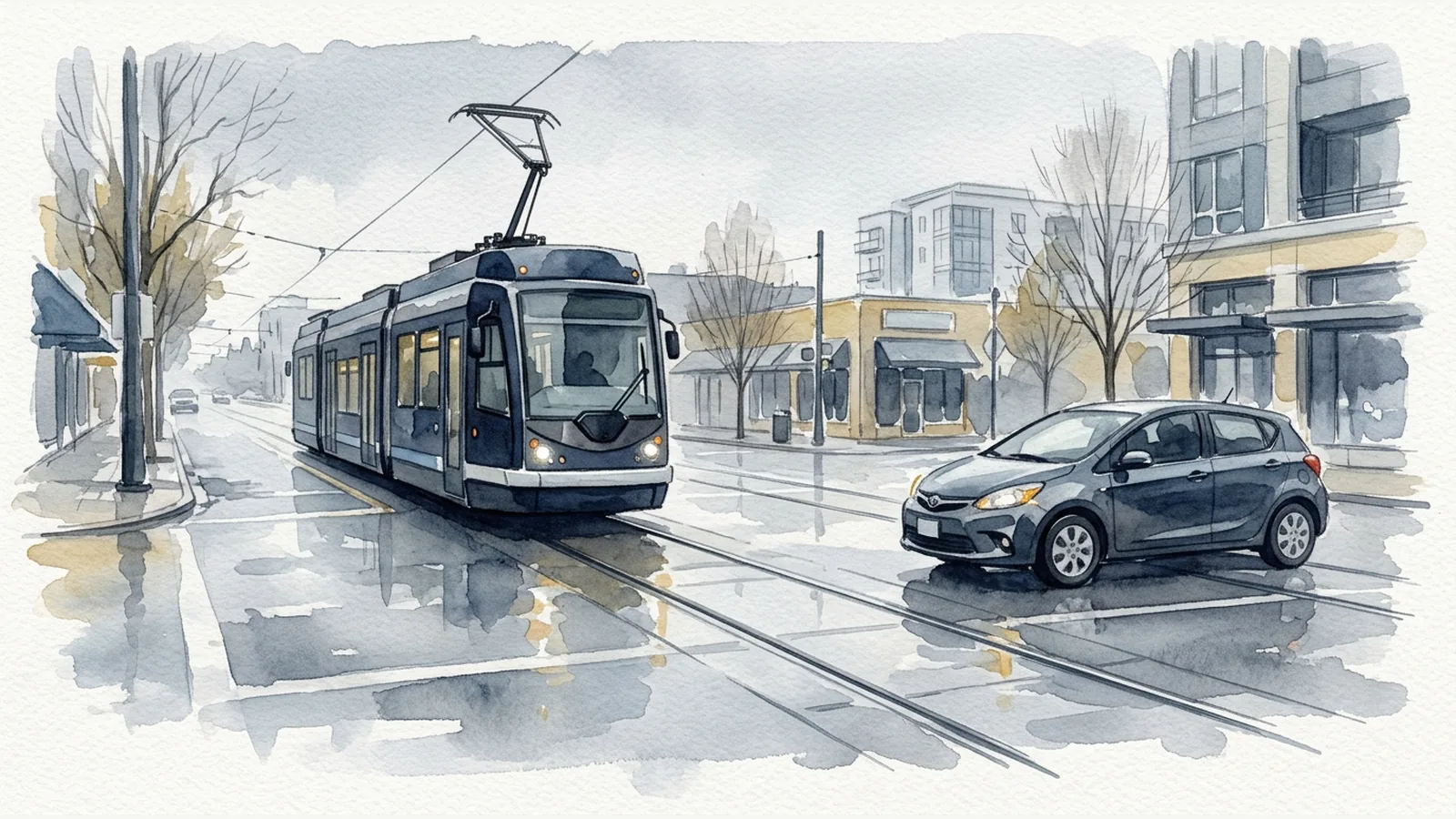
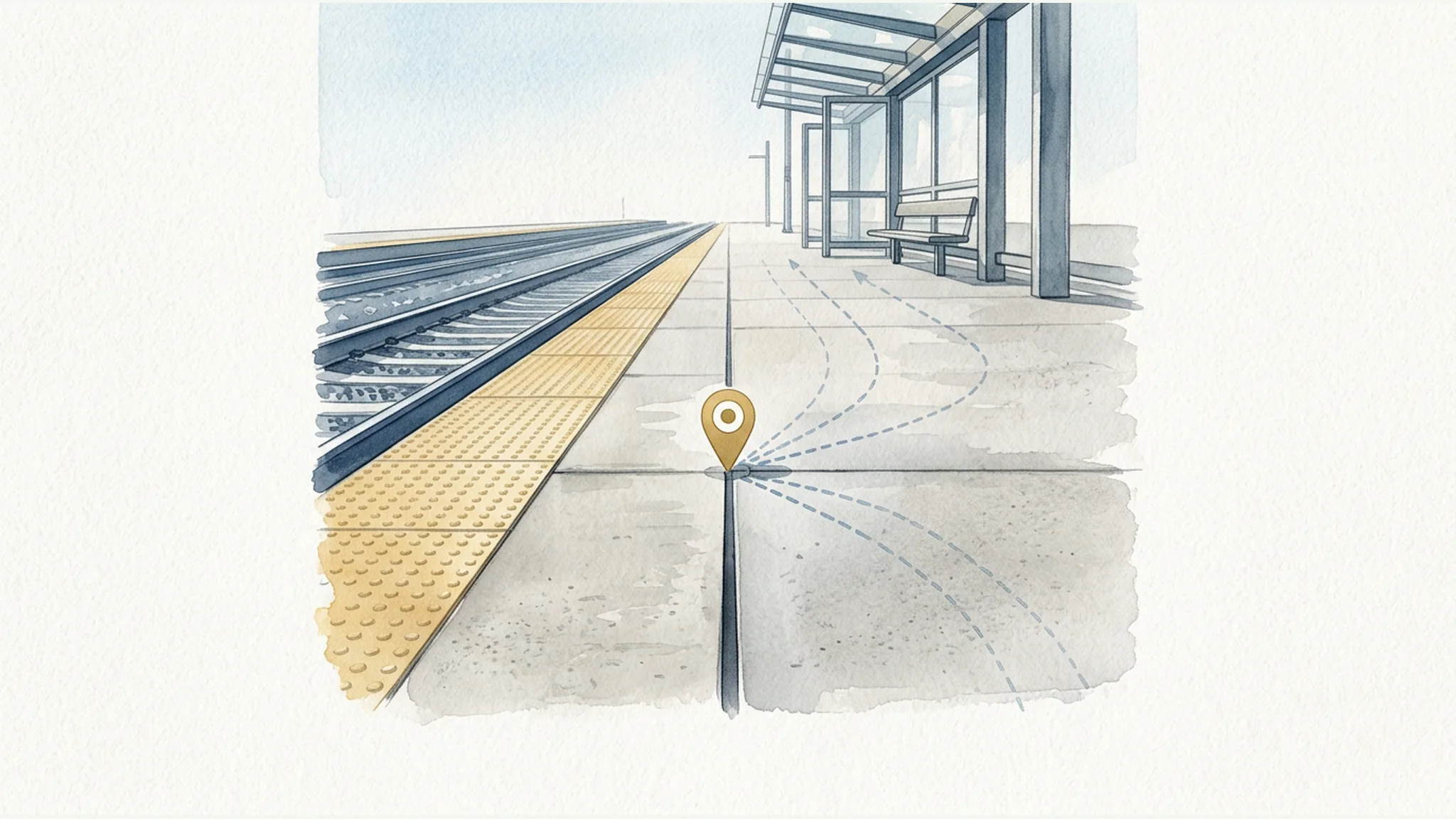
TriMet Vehicles, MAX Stations, Transit Centers, and Elevators
TriMet reports that more than 10,000 security cameras monitor MAX stations, transit centers, elevators, buses, and trains. This broad camera presence does not prove that a particular camera covered an event or that footage remains available.
TriMet’s public-records page warns that surveillance data is generally available for only a limited time before automatic overwrite and says video requests should be submitted promptly. Separately, Oregon’s State Archivist has authorized all agencies to use a “Video Surveillance Recordings” series covering video monitoring of agency-operated or public facilities, structures, roads, parking lots, and similar locations. That authority sets a 30-day minimum for other covered recordings, retention until final disposition for recordings used as evidence, and retention until an internal investigation closes for recordings used in that investigation.
TriMet is a mass-transit district and public body under Oregon law, but the 30-day authority should not be converted into a guaranteed retrieval window for every bus, train, station, elevator, or camera system. A particular recording may not exist, may not fall within that series, may not be technically retrievable, or may be governed by a system-specific schedule, investigation, legal hold, or other requirement. The current County and Special District schedule and any TriMet-specific schedule should be reconfirmed before publication. Prompt requests remain important.
A request should identify the vehicle or location as closely as possible, together with the date, time, route or direction when known, and a reasonable interval surrounding the incident. TriMet says some onboard-video requests incur a minimum charge for each pulled vehicle data pack and that labor charges to extract requested data or convert it into a generally readable format apply. TriMet provides a cost estimate and proceeds after prepayment and written confirmation. Current procedures and charges should be checked before submitting a request.
Claims involving a transit agency also raise issues beyond camera access. See the guide to Portland transit injury claims involving TriMet, MAX, or Streetcar for that broader framework.
City-Controlled Cameras and Public Facilities
Oregon’s City General Records Retention Schedule sets these minimum periods for the covered city video-surveillance record series:
- until final disposition when a recording is used as evidence in an ongoing criminal investigation or court proceeding;
- until an internal investigation closes when a recording is used for that investigation; and
- 30 days for other recordings covered by the series.
Those are minimum periods for covered City records. They do not apply to ordinary private systems. Separate statewide public-records authority supplies comparable minimums for covered agency surveillance recordings, including covered TriMet recordings, while the precise schedule classification for a particular TriMet system should be confirmed. A 30-day minimum also does not mean every covered recording will be destroyed on day 30—or that waiting until day 29 is safe. A recording may never have existed, may not fall within that record series, or may already have been lawfully disposed of before a request arrived.
For Portland records, a formal public-records request generally must use the City portal or another written method permitted by City rule. A call to operational staff may help identify the right bureau or system, but it should not be mistaken for completing the formal records-request procedure.
How Fast Can Footage Be Deleted or Overwritten?
There is no single countdown that answers this question for Portland.
For ordinary private cameras, no universal period was verified. The responsible entity and system must be identified. A vendor default, another store’s practice, or a policy described in an unrelated lawsuit should not be treated as the rule for the camera in question.
For covered TriMet surveillance recordings, Oregon retention authority provides a 30-day minimum for routine recordings and event-based minimums for recordings used as evidence or in an internal investigation. TriMet also expressly warns of automatic overwrite and asks for prompt requests. These points are not contradictory: a legal minimum is not a promise that a particular camera recorded the event, that its footage falls within the covered series, that the data remains technically retrievable, or that it will be disclosed. The schedule applicable to the specific TriMet system should be confirmed rather than treating 30 days as a safe waiting period.
For covered City surveillance records, the schedule supplies minimums, not a guaranteed destruction date. Certain covered recordings have a 30-day minimum, while recordings used for specified investigations or proceedings have event-based minimum periods. Other legal or operational reasons may require longer retention.
In practice, urgency should come from uncertainty. It should not depend on an invented deadline.
What to Do Now: Route the Request to the Right Holder
1. Record the Location and Time Precisely
Write down the incident date, approximate time, time zone, exact location, direction of travel, and relevant entrances or exits. Identify a reasonable period before and after the incident that may supply context.
Also note possible camera areas—not only cameras that may have faced the event, but systems that could show approaches, exits, response, or witnesses. Photographs or a simple location diagram may help preserve where cameras appeared to be, but they do not prove the systems were operating.
2. Identify the Camera Owner and Actual System Administrator
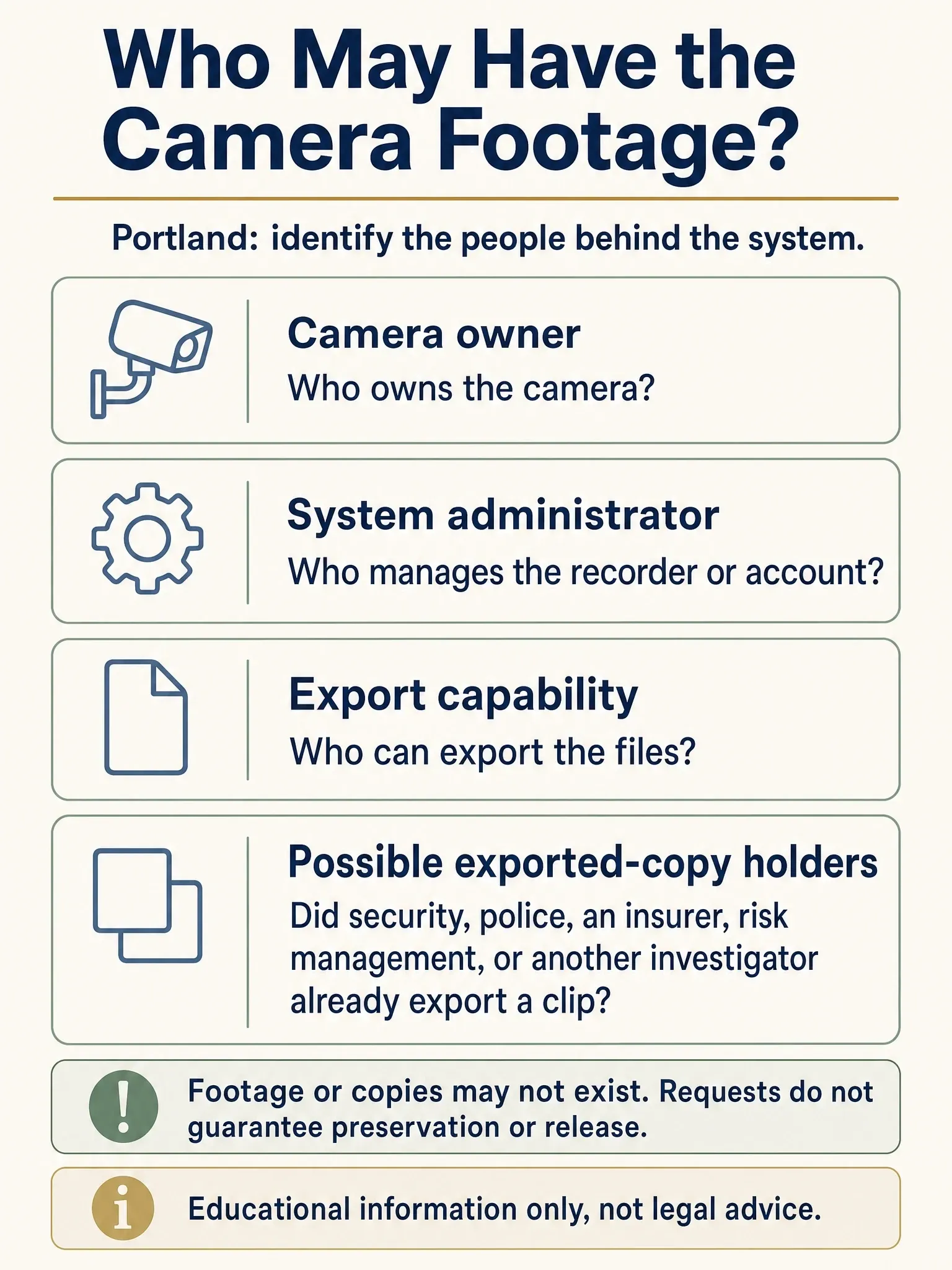
Ask who owns the camera, who administers the recorder or account, and who can export files. Determine whether access belongs to a corporate office, landlord, property manager, contractor, or third-party platform rather than the person at the scene.
It may also be useful to ask whether security, police, an insurer, risk management, or another investigator already exported a clip. Do not assume such a copy exists; the question is meant to identify possible additional holders.
3. Separate Private Preservation From Public-Records Access
For a private camera, a narrow written preservation request may be appropriate, but private-premises strategy depends on the incident and the evidence the footage could show. The companion slip-and-fall surveillance guide covers that task in detail.
For a City, TriMet, or SmartPark source, identify the proper public custodian and use the applicable public-records channel. Operational outreach may help locate a system, but it is not necessarily the formal records request.
4. Use the Correct Public-Records Channel for City or Transit Records
For City records, distinguish urgent operational outreach from the formal public-records request. Portland says public-records requests concern existing records; the City is not required to create a new record in response. The request generally must be made through its portal or another permitted written method.
Oregon’s records-management rule requires a public body to suspend scheduled destruction of specifically requested records while the public-records request or pending litigation remains unresolved. That protection depends on identifying the records and reaching the proper public body. It cannot recover footage overwritten before the request arrived.
Oregon law generally requires a public body to acknowledge a qualifying written request or complete its response within five business days. It then generally has another 10 business days to complete the response or provide a written status and reasonable estimated completion date. This is not an absolute 15-business-day production deadline: clarification, fees, staffing or volume constraints, statutory suspensions, and impracticability can affect timing.
There is another limited but important rule. If a requester is already a party to a civil proceeding involving the public body—or has filed formal notice under ORS 30.275(5)(a)—and knowingly requests a related public record, ORS 192.314(2) requires the written request to go to the records custodian and simultaneously to the public body’s attorney.
For a deeper example of separating preservation, records access, and claim notice, see targeted public-records requests for time-sensitive video and logs.
5. Track the Custodian, Request, and Response
Keep the portal confirmation, request text, custodian name, fee estimate, clarification requests, and response together. If footage is produced, preserve the file and any accompanying system or export information without needless alteration. The broader Oregon evidence-preservation framework explains why related materials may matter too.
Evidence requests also do not pause separate claim deadlines or public-body notice requirements. If an injury may involve a business, property owner, government agency, contractor, or multiple entities, prompt claim-specific advice can help identify the right preservation and legal paths.
Why a Request Does Not Guarantee You Will Receive the Video
Preservation and production serve different purposes. Preservation is about keeping material from being lost. Production is about whether and through what process another person can obtain it.
Public-records law does not promise immediate or complete release. Oregon law begins with a right to inspect public records but permits withholding or redaction under fact-dependent exemptions. Private footage follows a different preservation and, when applicable, discovery path; the private-premises surveillance guide explains that route.
A 2025 Multnomah County District Attorney order provides a local example of the distinction. The order reported that TriMet had pulled video from its ordinary purge process for a personnel investigation, but concluded that the preserved video could remain exempt from public disclosure in those circumstances. In short, footage can be preserved without being publicly releasable.
Public-Body Video Raises a Separate Claim-Deadline Issue
If a potential injury claim involves Portland, TriMet, or another Oregon public body or its officer, employee, or agent, a public-records request and a preservation request are not substitutes for Oregon Tort Claims Act notice.
ORS 30.275 generally requires notice within 180 days for claims other than wrongful death and within one year for wrongful death, subject to the statute’s detailed rules and exceptions. Requesting or waiting for video does not extend those periods. It also does not extend the time to commence a lawsuit.
These are separate clocks: a claim deadline does not create a matching duty for a camera holder to retain footage, and a retention schedule does not protect a claimant from a notice or filing deadline.
Bottom Line: Identify the Source, Then Use the Right Path
There is no universal private-camera retention period and no single request method for every Portland camera. The practical sequence is:
- Map the cameras and nearby areas that may contain useful footage.
- Identify who possesses or controls each system.
- Describe the location, date, time, cameras, and context precisely.
- Use the City, TriMet, SmartPark, or other source-specific route; use the companion private-premises guide when a business controls the footage.
- Keep production rules and separate claim deadlines in view.
Prompt action can improve the chance that the right holder receives a useful request before routine overwrite, but it cannot guarantee that footage exists, survives, must be released, or will affect a claim. An Oregon attorney can provide advice about the appropriate procedure and deadlines for a specific situation.
This article is for educational purposes only and is not legal advice. Laws, agency procedures, fees, contacts, and retention practices can change, and their application depends on the facts.
Frequently Asked Questions
How long do Portland businesses keep security-camera footage?
There is no verified universal Oregon or Portland retention period for ordinary private-business cameras. The answer depends on the particular owner, recording system, storage settings, camera, and whether someone preserved or exported a clip.
Does Portland require private businesses to keep surveillance video for 30 days?
No such universal private-business requirement was identified. The 30-day minimum discussed in this article comes from public-records retention authority for covered government surveillance recordings, including covered City and TriMet recordings. It is not a rule for private stores, apartments, garages, or residents, and it is not a guarantee that any particular public-body recording exists or remains available.
How long does TriMet keep bus or MAX camera footage?
Oregon public-records retention authority sets a 30-day minimum for covered routine surveillance recordings, including covered TriMet recordings. Recordings used as evidence must be retained until final disposition, and recordings used for an internal investigation must be retained until that investigation closes. TriMet also warns that surveillance data is generally available for only a limited time before automatic overwrite and asks people to submit requests promptly. The 30-day minimum is not a guarantee that a particular recording exists, falls within that series, remains retrievable, or will be disclosed; the schedule governing the specific system should be confirmed.
Who should receive a request for parking-garage video?
It depends on ownership and control. Possible holders include the property owner or manager, garage operator, security contractor, and system vendor. For a City-owned SmartPark garage, the proper City public-records route may deserve attention in addition to operational contacts.
Does a preservation letter force a business or agency to give me the video?
No. A preservation request asks the recipient to keep identified material. It does not itself compel production. Access may depend on voluntary cooperation, public-records law, or formal discovery, and objections or exemptions may still apply.
If footage was overwritten, does that automatically prove spoliation?
No. Oregon consequences for missing evidence are fact-specific. Issues may include who controlled the footage, what notice that person had, whether the recording was relevant, whether any loss was willful, whether another party was prejudiced, and the procedural posture of the case.
Sources and Source Notes
Research and links below are current through July 27, 2026. Agency policies, contacts, charges, statutes, court rules, and records schedules should be checked again before relying on them.
- Oregon Rules of Civil Procedure, including ORCP 36, 37, 43, and 55 — custody and control, evidence-perpetuation procedure, party production, ESI issues, and nonparty subpoenas.
- Oregon Evidence Code — authentication, originals and duplicates, and the rule concerning willfully suppressed evidence.
- Oregon Public Records Law — access, response timing, exemptions, segregation, and the dual-recipient rule in the circumstances described by ORS 192.314(2).
- OAR 166-030, including suspension of scheduled public-records destruction — minimum retention principles and the hold for specifically requested public records while a request or pending litigation remains unresolved.
- Oregon City General Records Retention Schedule — minimum periods for the covered city video-surveillance record series.
- ORS 267.200 — the public-body and local-government status of an Oregon mass-transit district.
- Oregon State Archivist’s June 2023 supplementary schedule — minimum periods for covered agency video-surveillance recordings.
- Oregon Secretary of State records-retention schedules — continued authorization for all agencies to use the supplementary series until it is integrated into the appropriate general schedules.
- OAR 166, Division 150: County and Special District Records Retention Schedule — the general schedule that must be checked, together with supplementary and agency-specific authority, for a particular special-district record.
- City of Portland Administrative Rule ARA-8.03 — formal request methods and the existing-record limitation.
- Portland Bureau of Transportation: SmartPark Garages — City ownership and listed operational, management, and PBOT contacts.
- TriMet: Security on TriMet — TriMet’s reported security-camera count and covered types of facilities and vehicles.
- TriMet: Request for Inspection of Public Records — limited availability before automatic overwrite, prompt-request direction, conditional onboard data-pack charges, and applicable extraction or conversion labor charges.
- Kerr v. Board of Psychologist Examiners, 304 Or App 95 (2020) — distinction between preserving material and requiring its disclosure.
- Multnomah County District Attorney Public Records Order 25-22 — fact-specific example of TriMet video preserved for an investigation but not publicly disclosed.
- ORS 30.275 — Oregon Tort Claims Act notice requirements and exceptions.
Client-First Fee Promise
Client First = Bills First, Fees Second
Your unpaid medical bills do not have to make your lawyer's fee bigger. Johnson Law subtracts qualifying medical bills before calculating our fee, helping clients keep more of their settlement.
Applies to qualifying cases. Results vary.