Oregon Store Parking-Lot Pedestrian Claims: What Evidence Matters After a Backing Crash
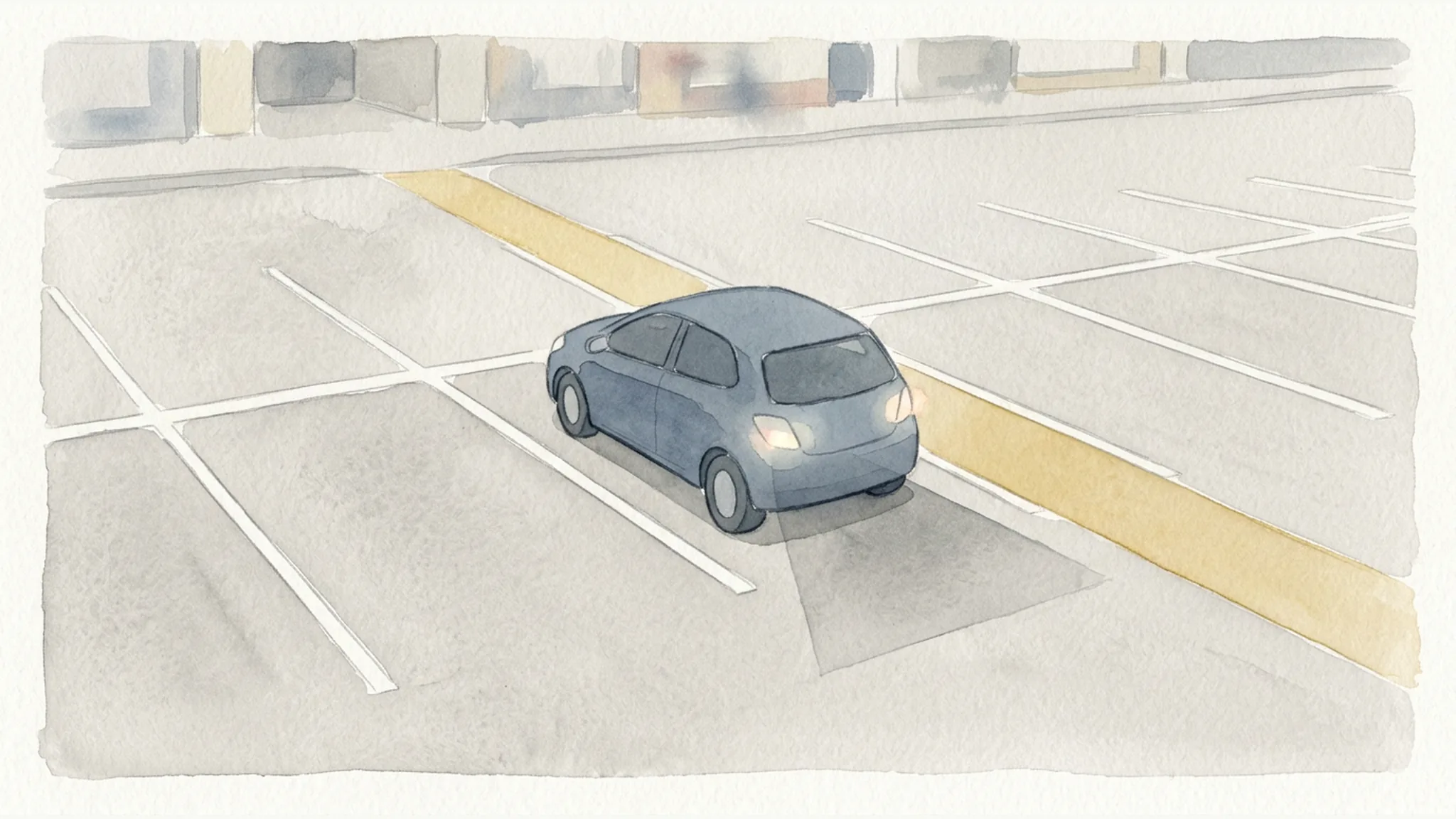
Oregon Store Parking-Lot Pedestrian Claims: What Evidence Matters After a Backing Crash
A pedestrian-vehicle collision in a private Oregon retail parking lot may raise questions about the driver’s conduct, a condition on the property, or both. But no one is automatically liable merely because the driver was backing or because the impact happened outside a store.
After addressing immediate safety and medical needs, an early priority for evaluating a potential claim is to preserve evidence. The exact point of impact, the routes taken by the pedestrian and vehicle, available camera views, parked vehicles or other sightline obstructions, lighting conditions, and records showing who controlled the lot can determine which theories the facts actually support. These questions are often central to Oregon pedestrian injury claims.
This article concerns vehicle-pedestrian impacts in private retail lots. It does not address trip-and-fall claims or negligent-security claims involving criminal conduct.
Educational information only: This article provides general educational information, not legal advice. The duties, deadlines, available claims, and evidence issues in a particular Oregon collision depend on its facts.
Start With the Exact Location and Movement—not the Store’s Name
“A driver hit me in a store parking lot” identifies the general setting, but it does not establish where the collision occurred or which rules apply.
Under ORS 801.400, “premises open to the public” includes publicly or privately owned premises open to the general public for motor-vehicle use. An open retail lot will often fit that definition, but gates, restricted access, construction, store hours, or other controls may make the lot’s status at the time a factual question.
The precise impact point matters too. Contact within a parking stall or drive aisle may present different questions than contact on a raised sidewalk, at a driveway apron, or where the lot connects to a public road.
Map the impact point and both routes
Create a simple scene diagram while the event is still fresh. Support it with photographs or video when possible. Mark:
- the parking stall and direction the vehicle faced;
- the vehicle’s path and the pedestrian’s route;
- the point of contact and where each person or vehicle stopped;
- traffic arrows, stop signs, speed controls, markings, entrances, and exits;
- nearby vehicles, cart corrals, signs, landscaping, columns, displays, loading activity, or other obstructions; and
- whether the lot was open to general public vehicle use at the time.
Small location details can change the analysis. For example, the Oregon Driver Manual’s guidance for a driver leaving a parking lot and crossing a road is most directly relevant to an exit or driveway connection—not every movement within an internal aisle.
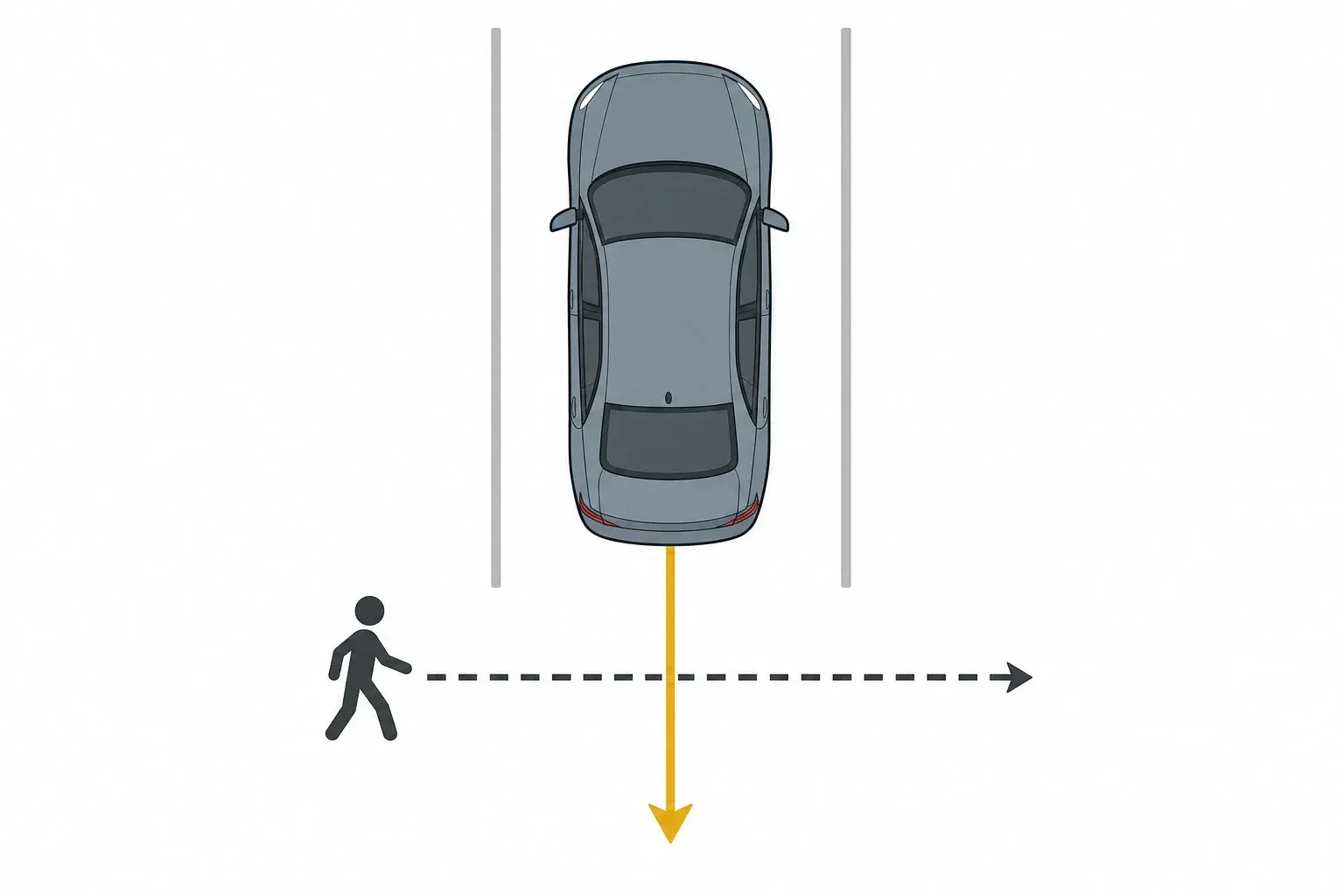
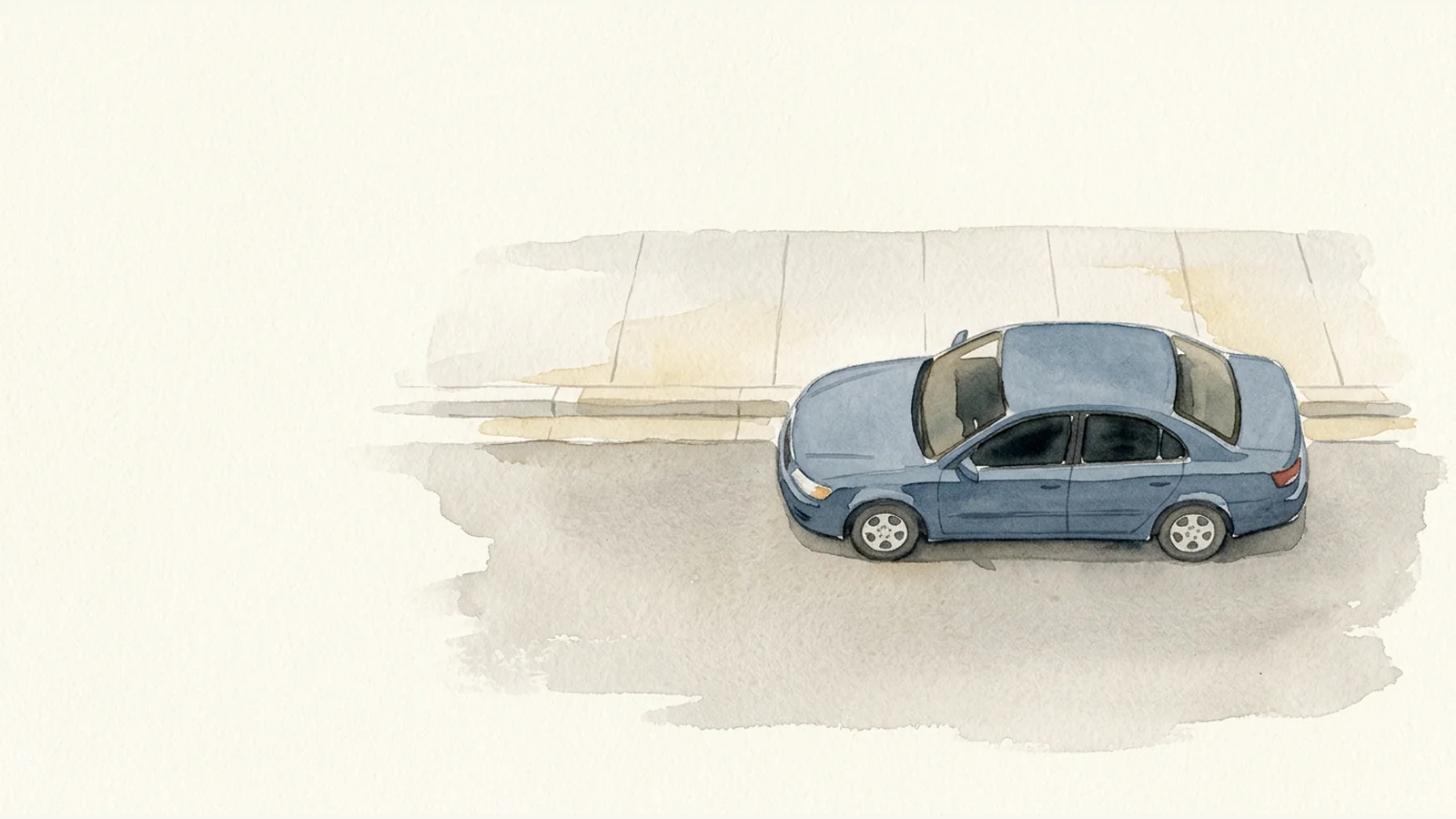
Illustrative paths cross behind a reversing car in a parking aisle.
Do not treat an internal painted walkway as a statutory crosswalk or sidewalk
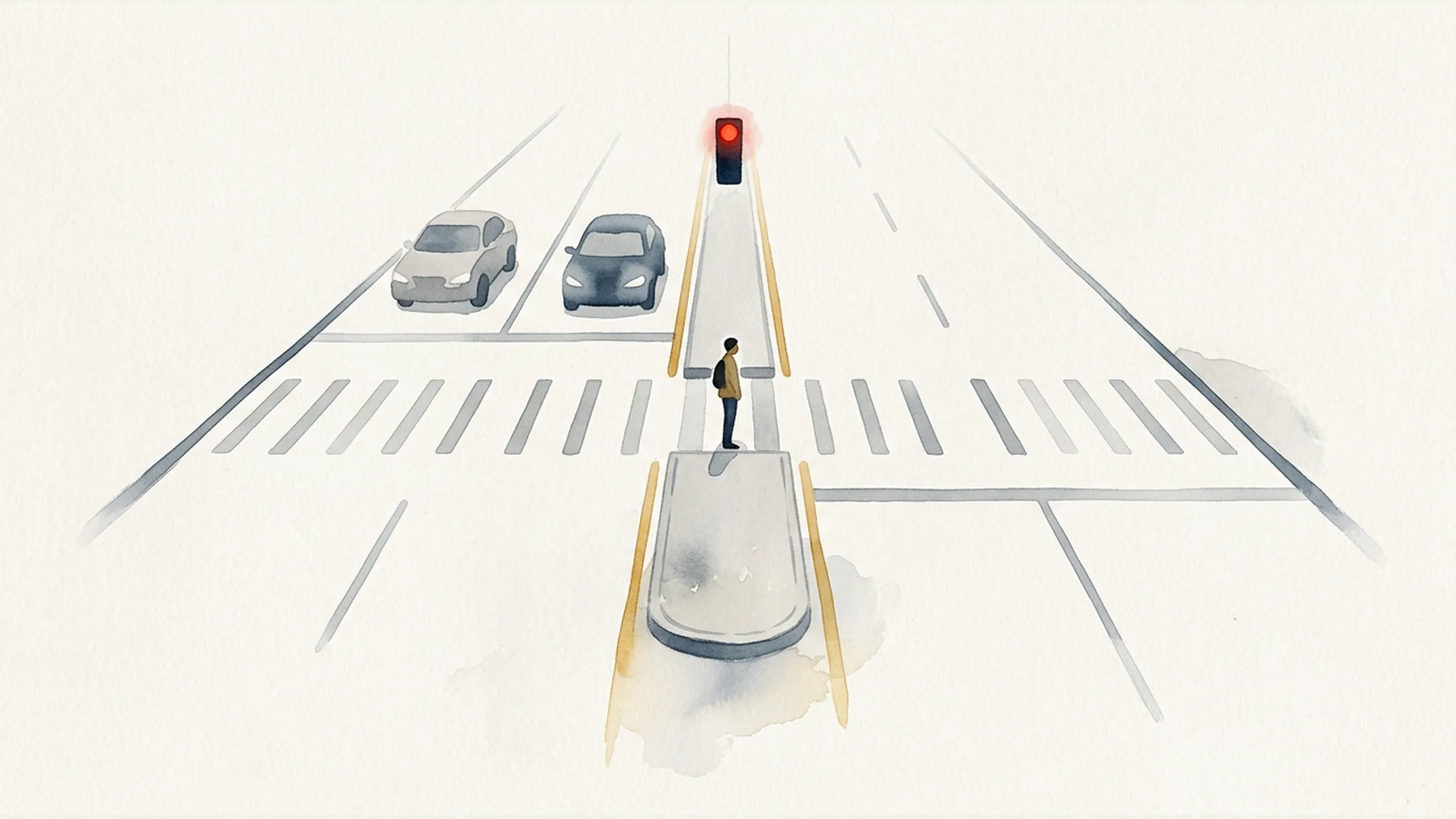
Oregon’s Vehicle Code defines a crosswalk as part of a roadway and defines a sidewalk by reference to an area beside a highway. Because an ordinary private retail lot is generally premises used by permission rather than a highway open for vehicular use as a matter of right, a painted or raised pedestrian path wholly inside the lot is not a statutory Vehicle Code crosswalk or sidewalk merely because it looks like one. It may still be important evidence of the intended pedestrian route, site design, warnings, and reasonable care.
The analysis changes at the lot boundary. If the collision occurred where a driveway crosses a public-street sidewalk, in a roadway crosswalk, or in another area within highway boundaries, ORS 811.025 or other highway pedestrian provisions may apply. Photograph and map whether contact occurred in a stall, internal aisle, internal marked walkway, raised path, driveway apron, public sidewalk, or roadway crosswalk.
Preserve the Evidence That Can Change First
Parking-lot proof can disappear or become harder to interpret before anyone has decided which claim to pursue. Cameras may overwrite recordings, vehicles may move, landscaping may be trimmed, lights may be repaired, temporary displays may be removed, and witnesses’ memories may fade. Johnson Law’s broader guide explains additional considerations for preserving accident evidence before it disappears.
Oregon generally requires many personal-injury actions to be commenced within two years under ORS 12.110(1). “Commenced” is not always the same as merely filing a complaint: ORS 12.020 generally requires filing and service, while allowing qualifying service completed within 60 days after filing to relate commencement back to the filing date.
A claim involving an Oregon public body may carry a much shorter notice deadline. ORS 30.275 generally requires Oregon Tort Claims Act notice within 180 days for claims other than wrongful death and within one year for wrongful-death claims, subject to the statute’s requirements and exceptions. Qualifying public-body actions generally must be commenced within two years. A public agency’s ownership, control, maintenance, or involvement should therefore be identified promptly rather than assumed from the property’s appearance.
Accrual rules, tolling, defendant identity, minority, and other provisions may also change the analysis. More importantly, a claim deadline does not tell you how long the evidence will remain available.
Identify every likely video source and custodian
Do not limit the inquiry to a single store camera or ask only for “the crash clip.” Identify cameras that might show the stall, drive aisle, pedestrian’s route, vehicle approach, lot entrances, or events immediately before and after contact. Potential sources may include:
- the retailer or franchisee;
- the parcel owner or landlord;
- a property manager or security contractor;
- adjacent businesses;
- cameras facing an entrance or public area;
- delivery vehicles, fleet vehicles, or dashcams; and
- other vehicles or witnesses with relevant recordings.
A focused inquiry may ask who operates each system, whether a cloud or third-party vendor is involved, which cameras cover the area, the available time window, overwrite settings, system-clock accuracy, metadata, audit information, and export format. These are questions to investigate—not promises that every item exists or can be obtained. The related guide to security-camera retention and identifying the right footage holder explains why retention and access depend on the source; its Portland-specific public-records discussion does not create a statewide private-camera deadline.
When video is available, technical details can matter. NIST’s CCTV export recommendations discuss preserving native quality, metadata, and information about a system clock’s offset. SWGDE’s digital-video-recorder guidance discusses native or proprietary exports, associated player software or codecs, playback verification, system documentation, transfer documentation, and chain of custody. Those publications are technical guidance, not Oregon liability law.
Request preservation without overstating what the request does
A preservation request can identify relevant custodians, systems, dates, camera views, and a reasonable period before and after impact. It can also ask that native files, metadata, proprietary players, audit information, and records about overwrite risks be preserved.
But an informal pre-suit letter does not, by itself, compel a retailer or vendor to produce evidence. ORCP 43 governs requests for documents, electronically stored information, images, tangible things, and property inspections in civil litigation. Legal authority and procedure determine whether and how evidence must be produced.
No universal Oregon retention period for ordinary surveillance video held by a private retailer was verified for this article. Actual retention may depend on the equipment, settings, company policy, cloud vendor, and preservation steps taken.
Missing footage also does not automatically prove fault or deliberate destruction. The disputable presumption in OEC 311(1)(c), codified at ORS 40.135, concerns evidence willfully suppressed. Routine overwrite or unavailable video does not by itself establish willful suppression, liability, admissibility, or entitlement to an adverse inference.
Preserve scene, witness, official, and vehicle evidence
Video is only one part of the proof. Depending on what exists and can lawfully be obtained, useful evidence may also include:
- Scene evidence: photographs or measurements of vehicle positions, stalls, signs, arrows, striping, cart corrals, landscaping, columns, parked vehicles, temporary displays, loading activity, glare, shadows, and visibility from each person’s position.
- Witness and timing evidence: names, contact details, contemporaneous notes, receipts, loyalty records, delivery records, or employee schedules that may establish who was present and when.
- Official and incident records: 911 or dispatch records, emergency-medical records, police materials, body-worn-camera footage, citations, a driver DMV report, a retailer incident report, photographs, or employee communications, if created.
- Vehicle-related evidence: vehicle position, steering angle, reverse lights, braking, warning systems, backup-camera condition, event data, telematics, event video, phone data, or fleet, rideshare, and delivery-app records when relevant and lawfully obtainable.
Not every vehicle records every type of data. Nor is every potentially useful item automatically accessible, discoverable, authentic, or admissible.
Driver Negligence Is the First and Separate Question
The driver-focused inquiry asks whether the person operating the vehicle used reasonable care under the circumstances. It does not depend on proving that the retailer or another property-related party did something wrong.
ORS 811.005 makes clear that Oregon Vehicle Code provisions do not relieve either a pedestrian or a driver from exercising due care. ORS 811.135 addresses careless driving on a highway or other premises open to the public when driving endangers or would likely endanger people or property.
What evidence may show an unsafe backing movement
The 2026–2027 Oregon Driver Manual advises that mirrors do not provide a complete view while backing. It recommends turning and looking rearward, checking both sides for pedestrians and approaching traffic, and backing slowly. It also warns that parked vehicles can obstruct a driver’s view.
That manual summarizes or paraphrases law and includes safety recommendations; it is not legal precedent or an automatic civil standard. Still, the evidence can be organized around practical questions such as:
- Did the driver look rearward and check both sides?
- How quickly did the vehicle move?
- What could the driver see through mirrors or a backup-camera display?
- Did parked vehicles, carts, signs, landscaping, or loading activity create blind areas?
- Were reverse lights or audible warnings operating?
- When did the pedestrian become visible, and how did the driver respond?
- What do braking evidence, witness accounts, vehicle position, and available video show?
The answers—not the mere fact that the vehicle was in reverse—shape the negligence analysis.
Why ORS 811.480 generally does not govern backing wholly inside an ordinary private retail lot
ORS 811.480 defines illegal backing as backing when it is unsafe or when it interferes with other traffic on a highway. Oregon’s broader applicability rule matters: under ORS 801.020(9), Vehicle Code provisions concerning vehicle operation apply exclusively on highways and the designated ocean shore unless the code specifically says otherwise.
An ordinary private retail lot may be “premises open to the public” under ORS 801.400, but it is not ordinarily a “highway,” which ORS 801.305 generally defines as a public way open for vehicular use as a matter of right. ORS 811.480 therefore should not be presented as governing a backing movement wholly within an ordinary private retail lot. ORS 811.135 expressly reaches premises open to the public, and ordinary reasonable-care principles remain the clearer starting points inside the lot. If the backing occurred on a public street or another area that qualifies as a highway, ORS 811.480 may apply.
A citation is evidence, not the entire civil claim
A careless-driving citation may be relevant, but it does not decide a civil negligence claim by itself. The absence of a citation is not conclusive either. The civil analysis still depends on the available evidence about movement, lookout, visibility, warnings, response, and causation.
A Property-Control Theory Requires Different Proof
A driver claim and a property-control claim are distinct. Evidence that a driver failed to keep an adequate lookout does not establish that a retailer, landlord, parcel owner, property manager, or contractor controlled or negligently maintained the lot. Johnson Law’s premises liability overview provides broader context for unsafe-property claims, but a vehicle impact still requires a fact-supported, collision-specific theory.
In Woolston v. Wells, the Oregon Supreme Court stated that a possessor must make premises reasonably safe for an invitee, including using reasonable care to discover conditions creating an unreasonable risk and either eliminating the condition or warning of it. The invitee also must use reasonable care. Appleyard v. Port of Portland treats the possessor’s duty and the invitee’s duty as separate. But a collision occurring near a branded storefront does not prove a property claim.
A supported property-control theory generally needs evidence of:
- a specific condition presenting an unreasonable risk;
- possession or control by the particular person or entity against whom the claim is made;
- relevant knowledge or notice where the theory requires it; and
- a causal connection between that condition and the collision.
Was there an unreasonable property condition that contributed to the impact?
The investigation might examine traffic arrows, stop signs, speed controls, stall and aisle configuration, loading activity, striping, signs, cart corrals, vegetation, columns, recurring parked-vehicle patterns, fixture outages, glare, or shadows.
ORS 801.045 provides that the Vehicle Code provisions described there do not prevent an owner of private property used by the public for vehicular travel by permission from prohibiting that use, imposing different or additional conditions, or otherwise regulating the permissive use. Private arrows, signs, speed controls, and loading rules may therefore be relevant to notice, intended traffic flow, and reasonable care, but ORS 801.045 does not by itself make each private sign an official Vehicle Code traffic-control device or establish civil fault.
The key is not whether a condition looks imperfect in isolation. The evidence must connect it to the impact. A burned-out fixture, overgrown shrub, or confusing arrow can exist without having affected what either person could see or do in this collision.
Who actually controlled that condition?
Storefront branding does not show who designed, owned, striped, lit, inspected, repaired, landscaped, monitored, or managed a common parking area.
Relevant records may include deeds, leases, common-area clauses, property-management agreements, maintenance contracts, approval rights, vendor responsibilities, and evidence of actual supervisory practices. Potential actors may include a retailer or franchisee, landlord or parcel owner, property manager, or a relevant maintenance, lighting, or camera vendor. Each should be evaluated based on a fact-supported duty and fault theory—not added merely because of its label.
Oregon control analysis is fact-specific. Buoy v. Kim illustrates the potential relevance of lease provisions, approval authority, retained control, maintenance duties, knowledge, and actual practices. That case involved a residential mobile-home setting, not a retail parking-lot collision, so it is useful only for general control principles rather than as a direct holding about store lots.
What did the controlling party know, and what records could show it?
Depending on the theory, relevant information might include prior similar incidents, near misses, complaints, employee reports, insurance claims, inspection records, outage reports, repair tickets, and requests or decisions about traffic flow, sightlines, signs, striping, landscaping, cameras, or lighting.
Prior incidents are not necessarily required for every theory, and the existence of a record does not make it automatically discoverable or admissible. The purpose is to identify evidence that may show whether the appropriate party knew or should have known about the specific risk asserted.
Treat Sightlines and Lighting as Evidence Questions
Visibility should be reconstructed from the positions of both the pedestrian and the driver. General statements such as “the lot was dark” or “the driver had a backup camera” are rarely enough to show what either person could actually detect.
Reconstruct sightlines from both perspectives
Photograph and, where appropriate, measure the scene from the pedestrian’s path and the driver’s position. Account for:
- the height and placement of parked vehicles;
- the vehicle’s steering angle and backing path;
- carts and cart corrals;
- landscaping, signs, columns, dumpsters, and temporary displays;
- delivery vehicles or loading activity; and
- any object that blocked or delayed a view.
Whenever practical, recreate relevant vehicle positions rather than relying only on empty-lot photographs. Tie every claimed obstruction to the actual routes and timing involved.
Recreate nighttime conditions carefully
For a nighttime collision, matching conditions matter. Relevant work may include returning at a similar time, noting weather and fixture operation, photographing glare and shadows from relevant positions, and documenting outages before repairs occur. The related article on nighttime pedestrian visibility arguments discusses how visibility evidence and comparative-fault arguments may be evaluated more broadly.
Property-specific records may include local development or land-use approvals, incorporated standards, photometric plans, fixture schedules, control settings, inspection logs, outage reports, and repair records. Local requirements vary, and no universal statewide numeric lighting minimum for every private Oregon retail lot was verified for this article.
FHWA’s Pedestrian Lighting Primer explains that lighting can affect detection and recognition of pedestrians and discusses vertical illuminance, contrast, and glare. It concerns pedestrian facilities and roadway networks. It is nonbinding guidance—not a universal Oregon private-lot code or an independent civil standard of care.
Comparative Fault Makes Evidence About Both People Important
Examining the pedestrian’s route and response is not an assumption of blame. Oregon requires attention to the conduct of everyone whose fault may have contributed to the harm.
Oregon’s not-greater-than rule
Under ORS 31.600, claimant fault does not bar recovery when it is not greater than the combined fault compared under the statute. Any recoverable damages are reduced in proportion to the claimant’s assigned percentage of fault.
In practical terms, a claimant found 50% at fault may recover an amount reduced by 50%. A claimant found 51% at fault is barred under the statute’s not-greater-than rule. Allocation among a driver and any properly supported property-related defendants is case-specific.
Evidence relevant to competing accounts
Evidence about the pedestrian may include route, pace, attention, phone use, clothing visibility, carried items, pauses, warnings, eye contact, and response to vehicle movement. Evidence about the driver may include lookout, speed-related evidence, braking, warnings, sightlines, and response time.
No one fact decides fault by itself. A pedestrian’s duty to use care does not erase a driver’s or possessor’s separate duty. Likewise, proof of a driver’s or possessor’s duty does not remove comparative-fault questions.
Reporting Rules and Claim Deadlines Are Not the Same as Evidence Time
Under the current text of ORS 811.705, a driver involved in a collision that injures or kills a person has duties that include stopping, remaining at the scene, exchanging required information, and rendering reasonable assistance as required by the statute.
ORS 811.720 makes an injury or death collision on a highway or premises open to the public subject to DMV reporting. Under ORS 811.725, the driver must submit the required Oregon Traffic Collision and Insurance Report to DMV within 72 hours. Oregon DMV states that a law-enforcement report does not replace the driver’s DMV report and currently lists $2,500 thresholds for specified property-damage circumstances.
A separate, faster duty also applies. Under ORS 811.745 and ORS 811.748, a physically capable driver involved in an injury or death collision on a highway or premises open to the public must notify a police officer or law-enforcement agency immediately by the quickest available means. For serious injury or death, immediate notice to the emergency communications system satisfies that requirement. This police report is additional to, not a substitute for, the DMV report.
Oregon law also assigns limited fallback reporting duties to an owner or vehicle occupant in circumstances described in ORS 811.730, ORS 811.735, and ORS 811.750. These driver, owner, and occupant duties do not ordinarily make the struck pedestrian responsible for filing the vehicle report. A pedestrian claimant may seek related police, 911, or collision records if they exist.
These prompt reporting rules are separate from the commencement and notice deadlines discussed earlier. Do not assume that having more time to pursue a claim means there is more time to preserve video, vehicle data, scene conditions, maintenance records, or witness memories.
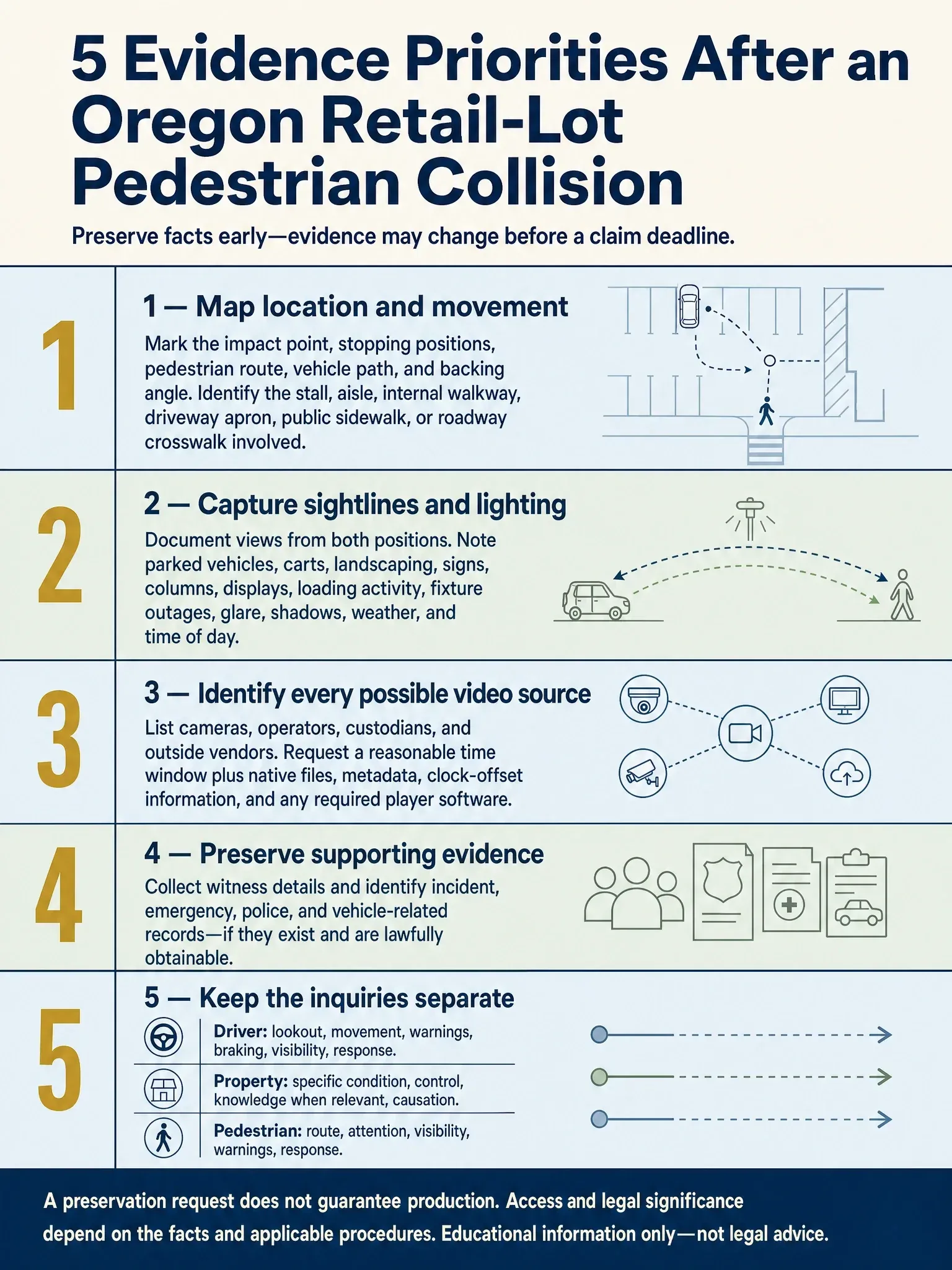
A Practical Evidence Checklist After a Retail-Lot Pedestrian Collision
This checklist is a focused starting point, not a guarantee that any item exists, can be obtained, or establishes a viable claim.
Document
- Exact point of impact and where the vehicle and pedestrian came to rest
- Pedestrian route and vehicle path, including the backing angle
- Stall, aisle, internal raised path, internal painted walkway, driveway apron, public sidewalk, or roadway crosswalk involved
- Signs, arrows, striping, stop controls, and loading-zone markings
- Parked vehicles, carts, corrals, landscaping, signs, columns, displays, and other sightline obstructions
- Lighting, fixture outages, glare, shadows, weather, and time of day
- Visible injuries and property damage
- Witness names, contact details, and contemporaneous accounts
Identify and request preservation
- Every possible camera, camera operator, property custodian, and outside vendor
- A reasonable video window before and after impact—not only the moment of contact
- Native video, metadata, clock-offset information, audit information, and required player software
- Retailer incident reports, photographs, witness lists, and employee communications, if created
- Police, dispatch, emergency, body-camera, citation, and driver-report records, if they exist
- Relevant vehicle, telematics, event-video, phone, fleet, rideshare, or delivery-app data, where available and lawfully obtainable
- Lighting, inspection, outage, repair, striping, landscaping, and traffic-plan records relevant to the claimed condition
A request to preserve evidence does not guarantee production. Legal procedures govern access, and prompt advice may be important when evidence is at risk of changing.
Separate the potential claim paths
- Driver conduct: Lookout, backing or other movement, speed-related evidence, warnings, braking, visibility, blind areas, and response.
- Property-related conduct: A specific unreasonable condition, who possessed or controlled it, relevant knowledge, and how it contributed to the impact.
- Pedestrian and comparative fault: Route, attention, visibility, warnings, and response—without assuming that any one fact establishes blame.
Frequently Asked Questions
Is a backing driver automatically at fault for hitting a pedestrian in an Oregon store parking lot?
No. The analysis depends on the driver’s lookout, speed, backing path, visibility, warnings, response, and the pedestrian’s movement. ORS 811.135 may apply when the lot qualifies as premises open to the public. ORS 811.480 generally does not govern backing wholly within an ordinary private retail lot because ORS 801.020(9) limits vehicle-operation provisions to highways unless the code specifically provides otherwise.
Does a painted walkway inside a store parking lot count as a legal crosswalk?
No. A painted or raised pedestrian path wholly inside an ordinary private retail lot is not a statutory Vehicle Code crosswalk or sidewalk merely because it resembles one. The marking may still show an intended route or bear on site design, warnings, and reasonable care. If contact occurred where a driveway crosses a public-street sidewalk, in a roadway crosswalk, or elsewhere within highway boundaries, ORS 811.025 or other highway pedestrian provisions may apply.
Is the store liable because the collision happened in its parking lot?
No automatic store liability follows from location or branding. A property-related claim requires evidence of a specific unreasonable risk, the particular defendant’s possession or control, relevant knowledge where applicable, and a causal connection to the collision.
How long does an Oregon retailer have to keep parking-lot surveillance video?
No universal statewide retention period for ordinary private-retailer parking-lot video was verified for this article. Retention and overwrite timing may depend on the system, settings, policies, and outside vendors. Prompt identification and preservation efforts may therefore matter.
Can poor lighting establish liability for a nighttime parking-lot collision?
Not by itself. The investigation should address actual visibility, fixture condition, glare, shadows, matching-time observations, applicable local requirements or approvals, control, relevant knowledge, and causation. FHWA lighting guidance is not a binding private-lot standard.
Can an Oregon pedestrian recover if partly at fault?
Potentially. Under ORS 31.600, damages are reduced by the claimant’s percentage when claimant fault is not greater than the combined fault compared under the statute. A claimant found 50% at fault may recover a 50%-reduced amount; a claimant found 51% at fault is barred under that rule.
Preserve First, Then Determine Which Theory the Facts Support
A driver claim may exist without a property claim. A property-control theory requires more than proof that the collision happened outside a store. It needs evidence tying a specific condition to a party that possessed or controlled it and connecting that condition to the impact.
Preserving the exact location, routes, video, scene conditions, sightlines, lighting, vehicle information, witness accounts, and property-control records can make a more reliable evaluation possible. Because evidence may change well before a claim deadline, an Oregon attorney can help evaluate the individual facts, identify appropriate preservation steps, and distinguish between possible driver and property-related claims.
This article is for educational purposes only and is not legal advice. Reading it does not create an attorney-client relationship, and no result is promised.
Source Notes
- Oregon Legislature, ORS Chapter 801, including ORS 801.020, 801.045, 801.220, 801.305, 801.400, 801.450, and 801.485: https://www.oregonlegislature.gov/bills_laws/ors/ors801.html
- Oregon Legislature, ORS Chapter 811, including ORS 811.005, 811.025, 811.135, 811.480, 811.705, 811.720, 811.725, 811.730, 811.735, 811.745, 811.748, and 811.750: https://www.oregonlegislature.gov/bills_laws/ors/ors811.html
- Oregon Legislature, ORS Chapter 12, including ORS 12.020 and ORS 12.110: https://www.oregonlegislature.gov/bills_laws/ors/ors012.html
- Oregon Legislature, ORS Chapter 30, including ORS 30.275: https://www.oregonlegislature.gov/bills_laws/ors/ors030.html
- Oregon Legislature, ORS Chapter 31, including ORS 31.600, 31.605, and 31.610: https://www.oregonlegislature.gov/bills_laws/ors/ors031.html
- Oregon Legislature, ORS 40.135 and OEC 311(1)(c): https://www.oregonlegislature.gov/bills_laws/ors/ors040.html
- Oregon Legislature, Oregon Rules of Civil Procedure, ORCP 43: https://www.oregonlegislature.gov/bills_laws/SiteAssets/ORCP.html
- Oregon DMV, 2026–2027 Oregon Driver Manual: https://www.oregon.gov/odot/Forms/DMV/37.pdf
- Oregon DMV, Collision Reporting and Responsibilities: https://www.oregon.gov/odot/dmv/pages/driverid/accidentreport.aspx
- Oregon Supreme Court, Woolston v. Wells, 297 Or 548 (1984), public case archive: https://hallapproved.com/or/cases/supreme/1984/1389441/
- Oregon Court of Appeals, Appleyard v. Port of Portland, 311 Or App 498 (2021): https://ojd.contentdm.oclc.org/digital/api/collection/p17027coll5/id/30394/download
- Oregon Court of Appeals, Buoy v. Kim, 227 Or App 189 (2009), public case archive: https://law.justia.com/cases/oregon/court-of-appeals/2009/a137017.html
- National Institute of Standards and Technology, NISTIR 8161 Rev. 1: https://nvlpubs.nist.gov/nistpubs/ir/2019/NIST.IR.8161r1.pdf
- Scientific Working Group on Digital Evidence, Best Practices for Data Acquisition from Digital Video Recorders: https://www.swgde.org/documents/published-complete-listing/17-v-002-1-4/
- Federal Highway Administration, Pedestrian Lighting Primer: https://highways.dot.gov/safety/pedestrian-bicyclist/safety-tools/pg-1-8-pedestrian-lighting-primer
Client-First Fee Promise
Client First = Bills First, Fees Second
Your unpaid medical bills do not have to make your lawyer's fee bigger. Johnson Law subtracts qualifying medical bills before calculating our fee, helping clients keep more of their settlement.
Applies to qualifying cases. Results vary.