NHTSA 2027 Pedestrian Crashworthiness: Results Explained
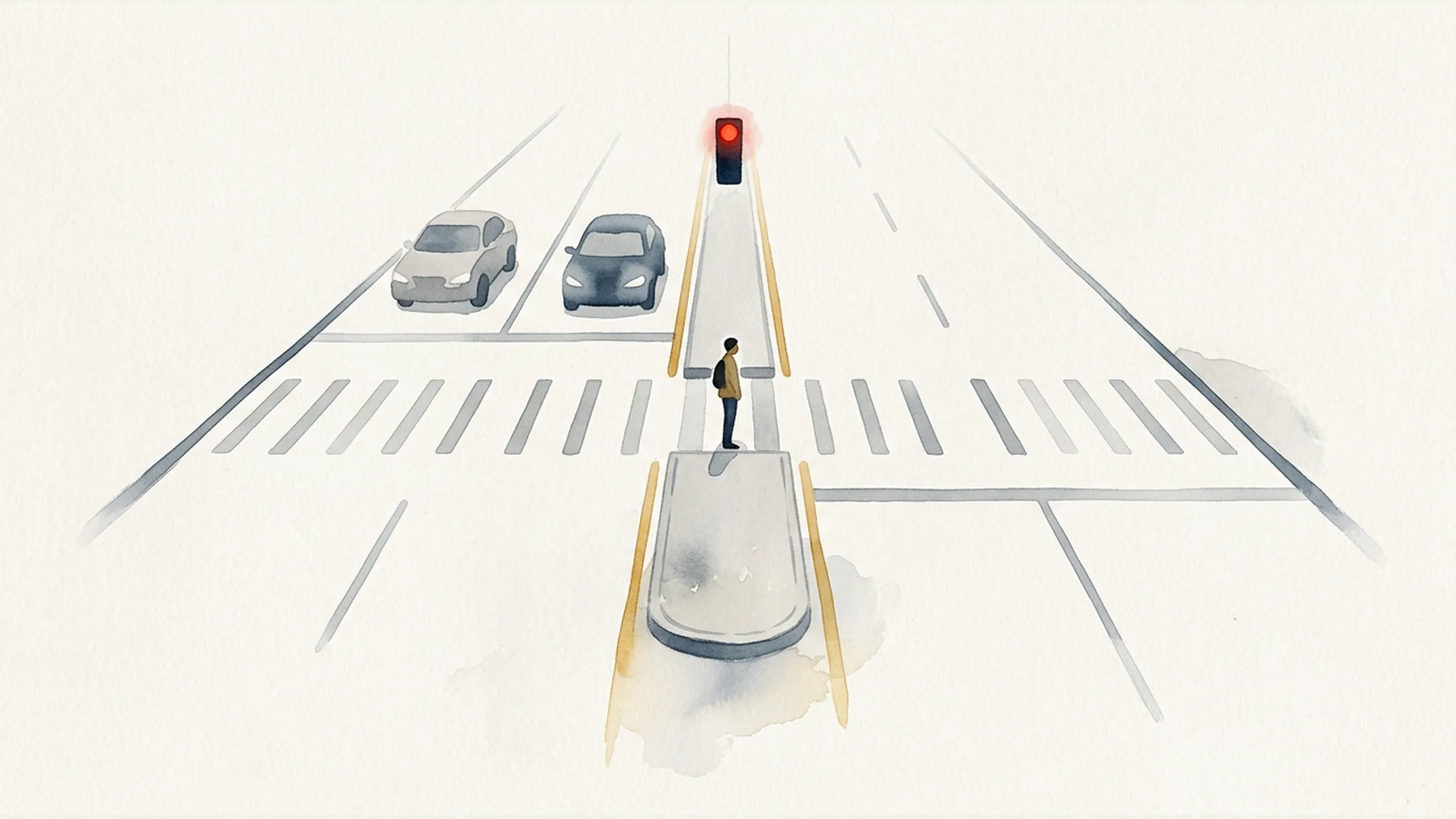
NHTSA’s pedestrian crashworthiness assessment looks at how a vehicle protects a pedestrian during an impact. Passing means meeting criteria for assessed head, upper-leg and lower-limb impacts—not a guarantee that a pedestrian will avoid injury in a collision.
In its September 18, 2026 announcement, NHTSA said 102 model-year 2027 models from 10 manufacturers met the criteria. That count does not establish the total number of eligible models or mean NHTSA physically tested all 102. Here is how to read the result labels, understand the points threshold and distinguish impact protection from automatic braking.
Impact protection and automatic braking measure different things
NHTSA lists pedestrian crashworthiness separately from pedestrian automatic emergency braking (PAEB):
| Assessment | What it looks at |
|---|---|
| Pedestrian crashworthiness | Protection against injury when a vehicle makes contact with a pedestrian. |
| Pedestrian automatic emergency braking (PAEB) | Detecting a pedestrian and braking to help avoid a collision. |
When comparing results, check which assessment you are reading. An impact-protection result does not tell you how the vehicle’s automatic braking performs.
Which impacts does the assessment cover?
The assessment covers head, upper-leg and lower-limb impacts. These scenarios do not cover every real collision or predict whether a particular person would be injured. The announcement also does not establish an observed reduction in real-world injuries.
How to read pass, fail, pending and not submitted
NHTSA distinguishes four result labels:
| Label | How to read it |
|---|---|
| Pass | The assessment criteria are met. |
| Fail | The assessment criteria are not met. |
| Pending | The status is pending; do not count it as a failure. |
| Not submitted | No result has been submitted; this is not a failed test. |
The label alone does not explain why a result is pending or not submitted. Neither status establishes a vehicle defect or a manufacturer’s motives.
What the 60% threshold actually measures
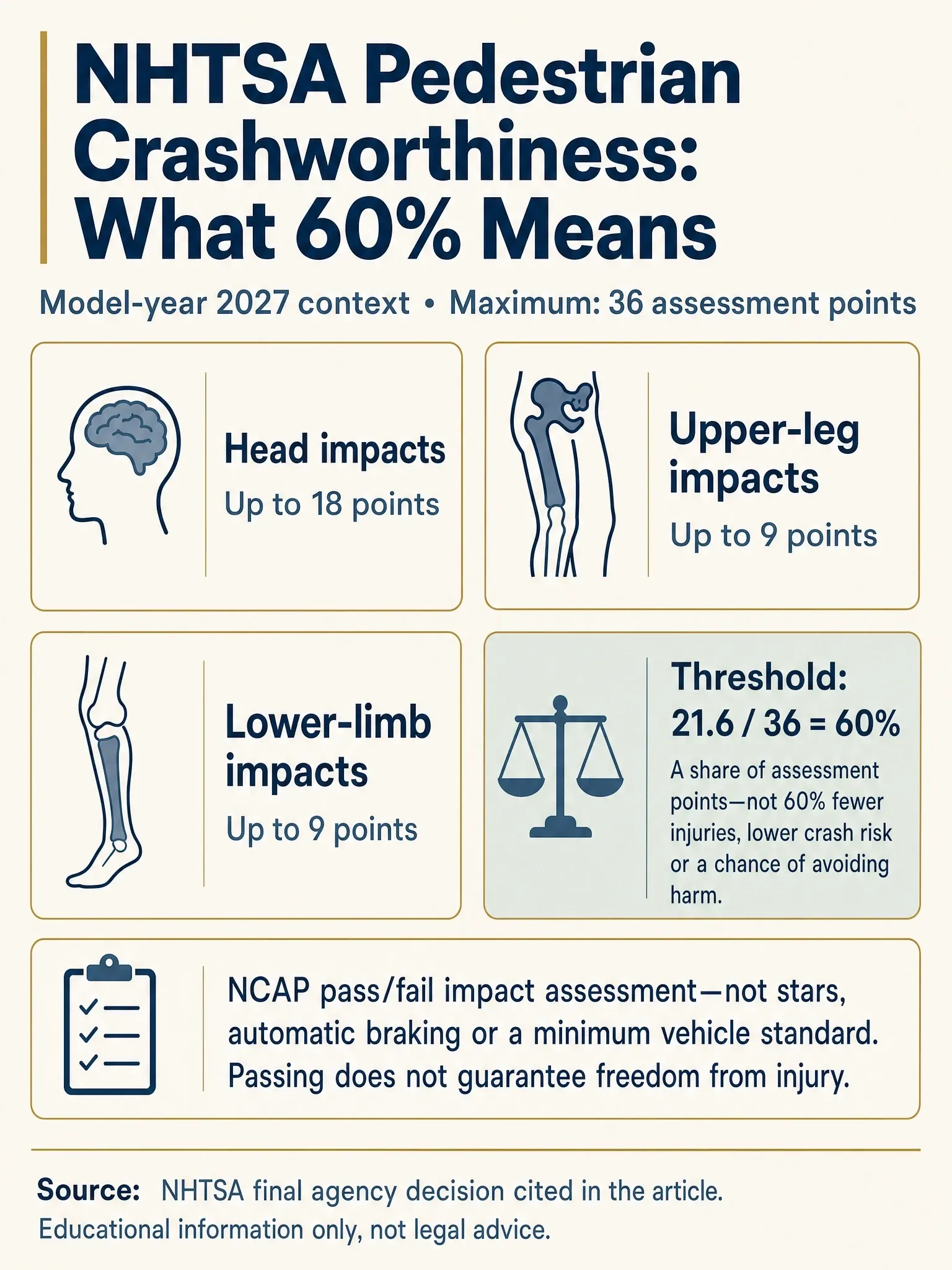
Section II.F of NHTSA’s final agency decision describes a maximum of 36 assessment points:
- Head impacts: up to 18 points.
- Upper-leg impacts: up to 9 points.
- Lower-limb impacts: up to 9 points.
A vehicle meets the threshold at 21.600 out of 36 points (60%). That is a share of the available assessment points—not a 60% reduction in injuries or crash risk, or a 60% chance of avoiding harm.
This is a pass/fail assessment, not a pedestrian star rating. Although the broader New Car Assessment Program (NCAP) uses five-star branding, a pedestrian pass does not award stars or rank a vehicle against other passing models.
Who supplies the results, and what does NHTSA verify?
Sections II.D and II.E of the final agency decision describe how manufacturers submit results and NHTSA checks selected vehicles:
- Manufacturers submit their own results. Results based on modeled predictions require evidence validating those predictions through physical testing.
- NHTSA verifies selected vehicles to check the submitted results.
This article has not independently checked individual model or configuration results or which vehicles NHTSA selected for verification.
A quick checklist for reading a result
Before drawing a conclusion from a pedestrian safety entry:
- Check the assessment: is it about impact protection or automatic braking?
- Read the status: pass, fail, pending and not submitted have different meanings.
- Keep the score in context: 60% refers to assessment points, not a reduction in injury risk.
These are NCAP consumer results, not a new minimum vehicle standard or a determination of compliance with Federal Motor Vehicle Safety Standards (FMVSS).
An assessment result also does not establish what a driver could see during a collision. For that separate issue, see visibility questions in a pedestrian collision.
For legal questions, see Johnson Law’s information on Portland pedestrian injury claims. An NCAP result alone does not determine responsibility for an injury.
This article provides educational information only, not legal advice.
Sources
- NHTSA, first pedestrian safety test results, September 18, 2026: announced model and manufacturer counts, impact scenarios, status labels and distinction from PAEB.
- NHTSA final agency decision, Federal Register, November 25, 2024: executive summary and sections II.D–II.F on threshold results, submissions, verification and scoring.
- Official published decision PDF: alternate official format of the same decision.
Client-First Fee Promise
Client First = Bills First, Fees Second
Your unpaid medical bills do not have to make your lawyer's fee bigger. Johnson Law subtracts qualifying medical bills before calculating our fee, helping clients keep more of their settlement.
Applies to qualifying cases. Results vary.