Slip and Fall With Pre-Existing Knee or Back Issues: How to Prove Aggravation in Oregon

Slip and Fall With Pre-Existing Knee or Back Issues: How to Prove Aggravation in Oregon
A pre-existing knee or back problem does not automatically prevent someone from bringing an Oregon slip-and-fall claim. The central question is not whether the person was in perfect health before the fall. It is what injury or worsening the defendant’s conduct caused.
Answering that question usually requires a careful comparison. What symptoms, treatment, restrictions, and abilities existed before the fall? What changed immediately afterward and over time? Do the medical history, clinical findings, treatment course, and day-to-day effects support a temporary flare, a lasting aggravation, a new injury on top of the old condition, or some combination?
This article addresses Oregon ordinary negligence and premises-liability claims. It does not address Oregon workers’ compensation claims, which operate under different statutes and standards.
A Prior Condition Does Not End the Claim—but It Changes the Proof Question
Oregon’s previous-infirm-condition principle is sometimes called the “eggshell” principle. In general terms, a defendant may be responsible for the full extent of an injury the defendant caused even if the injured person was unusually susceptible to harm. But that principle does not make a defendant responsible for every symptom or limitation the person had before the fall.
It helps to separate two related ideas:
- Susceptibility concerns a person’s vulnerability to a greater new injury than someone without the prior condition might have experienced.
- Aggravation concerns the worsening of an existing injury or disability.
Oregon also distinguishes an asymptomatic bodily condition that made a person unusually susceptible from a pre-existing injury or disability that was already causing symptoms or loss. If an asymptomatic condition becomes painful because of a fall, the previous-infirm-condition principle may permit recovery for the full injury caused by the fall without assuming that pre-fall pain or disability must be deducted. If an existing symptomatic injury or disability is worsened, damages are limited to the consequences of that worsening and do not include harm attributable solely to the earlier injury. How the condition is characterized depends on the evidence and the theory of the case.
A claim may involve susceptibility, aggravation, a new injury superimposed on an earlier condition, or a combination. Oregon decisions including Crismon v. Parks and Winn v. Fry illustrate why the evidence must distinguish an asymptomatic prior infirmity from an injury or disability that was already producing symptoms or loss. The evidence still must connect the defendant’s conduct to the injury or worsening for which compensation is sought.
Keep Premises Fault Separate From Medical Aggravation
Proof that a fall worsened a knee or back condition is not proof that the property owner or another defendant was negligent. A claimant must separately establish the applicable fault and harm requirements, such as unreasonable conduct or a dangerous condition attributable to the defendant. Control, notice, foreseeability, comparative fault, immunity, and other defenses may also matter.
Those issues are addressed in more detail in this overview of the separate Oregon premises-liability questions. This article focuses on the medical and functional before-and-after comparison.
What But-For Causation Means in an Oregon Negligence Claim
In most Oregon negligence cases, factual causation uses the but-for test. The practical question is whether the claimed injury or worsening would have occurred without the defendant’s conduct.
The defendant’s conduct does not have to be the only cause or even the predominant cause. A prior vulnerability or another contributing cause therefore does not automatically defeat causation. At the same time, showing that pain appeared after a fall does not, by itself, prove that the defendant’s conduct caused the pain or a particular diagnosis. Prior symptoms, degenerative change, another event, natural progression, or other plausible explanations may need to be considered.
Why “Substantial Factor” Is Not the Routine Test
“Substantial factor” is sometimes used loosely when more than one cause may be involved. That is not the usual Oregon test.
After the Oregon Supreme Court’s decision in Haas v. Estate of Carter, substantial-factor reasoning is principally reserved for exceptional concurrent-cause situations in which each cause independently would have produced the identical result. It is not a shortcut for an ordinary case simply because the injured person had a pre-existing condition. In most negligence cases, the analysis should remain focused on but-for causation.
Start With an Honest Pre-Fall Baseline
The strongest comparison begins with an accurate account of the person’s condition before the fall. That history does not need to show a pain-free or treatment-free life. Forcing the facts into a “nothing was wrong before” narrative can obscure the real change.
Oregon law does not prescribe a universal checklist for proving aggravation. Depending on the facts, a useful baseline may address the following areas.
Prior Symptoms, Treatment, and Restrictions
Relevant questions may include:
- Where were the earlier symptoms located?
- How often did they occur, and how severe were they?
- When was the last symptom-free period, if there was one?
- What earlier knee or back injuries had occurred?
- What treatment, medication, or medical follow-up was already in place?
- Were there existing medical restrictions?
- Were symptoms stable, improving, worsening, or variable before the fall?
Prior medical records may help, but they need to be read in context. A gap in treatment does not necessarily establish the absence of symptoms. Likewise, a prior diagnosis does not reveal, by itself, how the condition affected that person’s life immediately before the fall.
Complete disclosure matters. Prior symptoms, treatment, injuries, and other events provide information needed to make a reliable comparison and evaluate alternative explanations honestly.
Prior Day-to-Day Function
Function often makes the baseline understandable. Before the fall, could the person:
- walk or stand for ordinary periods;
- use stairs;
- lift or carry typical items;
- perform job duties;
- sleep without the current interruption;
- exercise or participate in recreation; or
- complete household tasks and other routine activities?
Specific examples are generally more informative than broad statements such as “my back was fine.” Records and firsthand accounts may show that symptoms existed but were manageable, intermittent, or less limiting. For practical ideas on documenting day-to-day function beyond chart notes, see Johnson Law’s related guide.
Identify What Changed After the Fall
The “after” side should be just as specific as the baseline. Relevant evidence may include chronology, symptoms, examination findings, treatment changes, and functional loss. No single item is required or conclusive, and the fact that one event followed another is relevant but not enough on its own to establish medical causation.
Immediate Symptoms and a New or Worsened Pattern
Contemporaneous reports can help establish when a change was first noticed. Depending on the knee or back issue, the comparison might examine:
- pain in a new location or of a different intensity or frequency;
- a new distribution of symptoms, including radiating pain;
- instability, locking, bruising, or swelling;
- new weakness, numbness, or loss of use;
- an altered gait; or
- increased difficulty with activities that were previously possible.
These are examples of changes to investigate and document—not a diagnostic list. A person can testify about pain, numbness, weakness, and loss of use that they personally experienced. That testimony does not necessarily establish the medical cause of a complicated knee or back condition.
Examination Findings, Treatment Changes, and Clinical Course
Clinical evidence may include measured changes in range of motion, strength, reflexes, sensation, gait, bruising, or swelling. A change in treatment or medically appropriate testing may also provide context. The importance of any finding depends on the full history and clinical picture; no particular finding automatically proves or disproves aggravation.
It is also important to distinguish treatment documentation from a developed causation analysis. A chart entry such as “pain after fall” may accurately record chronology while saying little about whether the fall caused a new injury, worsened a prior condition, or coincided with another process. Treating clinicians focus on diagnosis and care. A legal specific-causation opinion may require a separate analysis of the prior history, mechanism, course, and plausible alternatives.
Functional Change That Other People Can Observe
Family members, coworkers, friends, or other observers may be able to describe concrete changes, such as:
- walking differently or using stairs less often;
- needing help with household tasks;
- missing work or performing duties differently;
- waking or changing position because of symptoms; or
- stopping or reducing exercise and recreation.
These observations can corroborate the before-and-after account. They do not necessarily resolve a medically complex causation question. Accuracy is more useful than advocacy: the witness should describe what they actually observed, including limitations that existed before the fall.
A pain and symptom journal can help organize specific changes in symptoms and function without relying only on memory.
Use Imaging as Context, Not a Verdict
MRI and other imaging can contribute to an assessment and, for some lesions, may show features consistent with a recent or traumatic injury. Its ability to estimate timing varies by the structure, finding, scan timing, and available comparison studies; many degenerative findings and meniscal tears cannot be dated reliably. Imaging ordinarily cannot by itself determine that one particular fall caused an individual’s symptoms. An abnormal scan is not automatic proof of traumatic injury, and a normal or unchanged scan does not automatically disprove painful or functional aggravation.
Imaging should follow clinical need—not a strategy of creating evidence for a claim.
Degenerative Findings Can Exist Without Symptoms
Research involving people without symptoms helps explain why imaging must be interpreted with the person’s history, examinations, and clinical course.
One systematic review estimated that disc degeneration appeared in 37% of asymptomatic 20-year-olds and 96% of asymptomatic 80-year-olds. Estimated disc-bulge prevalence in those age groups was 30% and 84%, respectively. A separate systematic review involving 5,397 asymptomatic knees estimated cartilage defects in 24% and meniscal tears in 10% overall, with greater prevalence in older groups.
Those are population-level findings. They cannot establish whether a specific person’s finding was painful, pre-existing, traumatic, or caused by a particular event. Nor does a statistical association between an MRI finding and pain establish specific causation for one patient.
Normal or Nonspecific Imaging Does Not Decide the Claim Either
The American College of Radiology states that uncomplicated acute low-back pain generally does not warrant imaging and that nonspecific lumbar abnormalities are common in people without symptoms. The absence of a new structural lesion therefore does not necessarily answer whether a fall caused pain or a functional change.
The point is not that imaging lacks value. It is that a scan is one part of a larger record. This related article explains why MRI results are only part of the pain and function record.
When Medical Causation Requires a Qualified Expert
Not every injury requires expert testimony. Oregon decisions recognize that lay evidence can sometimes support causation when an event, immediate symptoms, and a simple injury fall within ordinary experience.
But distinguishing traumatic aggravation from degenerative progression in a previously symptomatic knee or back will commonly present a complicated medical question. In that setting, qualified medical evidence may be needed to connect the fall to the claimed new injury or worsening. Symptoms described by the injured person and changes observed by others remain relevant, but they may not establish the medical cause.
Reasonable Medical Probability, Not Possibility
When a causal issue is medically complex, the evidence must permit a finding of causation to a reasonable medical probability rather than mere possibility. Oregon does not require an expert to recite particular words or assign a numerical percentage; the opinion’s substance and foundation must show probability, not speculation.
The key distinction is between an opinion that identifies what could have happened and one that, based on an adequate foundation, addresses what probably caused the condition or change at issue.
What Makes a Causation Opinion Better Grounded
Oregon Evidence Code 702 permits qualified expert testimony when specialized knowledge will help the factfinder. OEC 703 allows experts to rely on appropriate facts or data that they perceived or that were made known to them. Relevant records from before and after the fall can therefore be important to the foundation of an opinion.
As a practical matter, an opinion is better grounded when the provider:
- has an accurate history of the prior condition and post-fall changes;
- reviews relevant pre-fall and post-fall records;
- considers the fall’s mechanism and the clinical course;
- addresses plausible alternative causes; and
- explains the degree and limits of the opinion.
This is not a mandatory Oregon checklist. The necessary foundation depends on the question and the case. Oregon’s scientific-evidence decisions focus on the validity of the expert’s reasoning and methodology, not merely the conclusion. Treating-provider status alone does not guarantee an adequate foundation, admissibility, or recovery.
Address Other Plausible Explanations Directly
A sound aggravation analysis should not ignore facts that complicate the timeline. Relevant questions may include:
- Was the prior condition already progressing?
- Did another injury or event occur before or after the fall?
- Did activity levels change?
- Is there another medical condition that could explain part of the change?
- Are the pre-fall and post-fall examinations or scans genuinely comparable?
Differences in timing, imaging methods, examinations, and clinical context may limit a comparison. The existence of another plausible explanation does not automatically defeat causation, just as the timing of symptoms does not automatically establish it. The task is to evaluate alternatives rather than conceal or dismiss them.
Be Precise About Duration and Limits
The evidence may support a temporary flare, a lasting worsening, a new injury superimposed on the earlier condition, or a combination. Those possibilities should not be treated as interchangeable.
Persistent symptoms alone do not establish permanence. Claims involving future treatment, permanent restrictions, or other future effects require support beyond the fact that symptoms continued for a period of time. A careful account should acknowledge what the available evidence can—and cannot—show.
A Focused Evidence Plan for the Before-and-After Question
The goal is not to collect the largest possible file. It is to build an accurate, consistent comparison. Depending on the facts, useful steps may include:
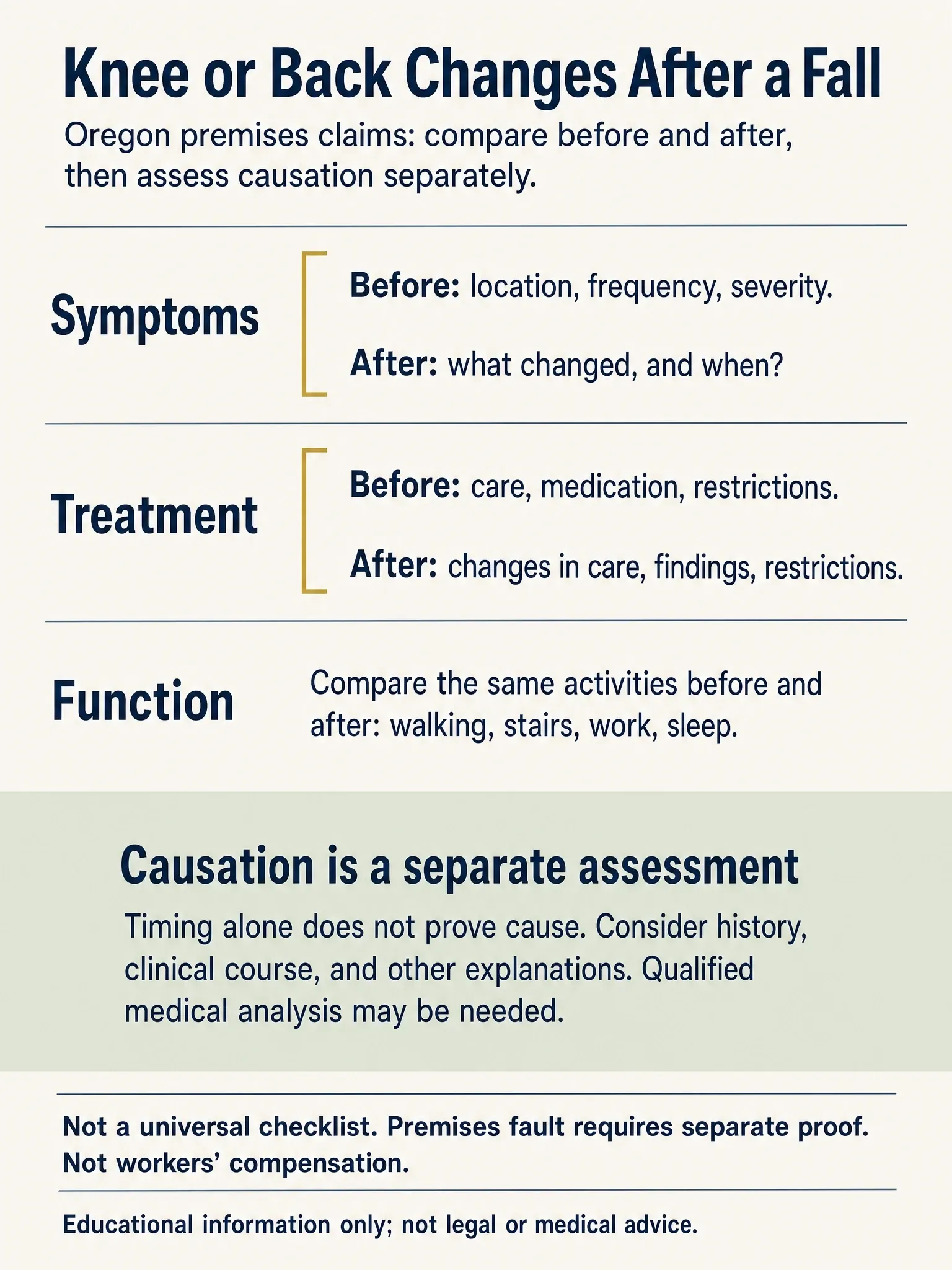
- Gather relevant pre-fall information. Identify earlier symptoms, injuries, treatment, medication, restrictions, and functional ability.
- Record the post-fall chronology. Note when symptoms appeared or changed, when care occurred, and how the clinical course developed. A treatment timeline can help organize treatment chronology.
- Use concrete functional examples. Compare the same activities before and after the fall, such as walking, stairs, lifting, work, sleep, household tasks, and recreation.
- Identify firsthand observers. Focus on people who can accurately describe specific changes they saw rather than offer medical conclusions.
- Preserve relevant records and disclose other events. Prior records, post-fall records, and information about possible alternative causes can support a more reliable analysis.
- Keep testing clinically driven. Imaging and other testing should occur when medically appropriate, not merely to build a claim.
- Evaluate whether qualified medical analysis is necessary. The need for expert evidence depends on the medical complexity and the specific causal question.
This medical before-and-after evidence serves a different purpose from preserving the store and scene evidence, which may help evaluate the property condition, store timeline, and fault.
No record, witness, scan, or opinion guarantees that causation, fault, or damages will be established. The necessary proof depends on the person’s actual history, the medical issues, and the facts surrounding the property condition.
Frequently Asked Questions
Can I bring an Oregon slip-and-fall claim if my knee or back already hurt?
Potentially. A prior condition does not automatically defeat an ordinary negligence claim. The claimant must still prove what new injury or worsening the defendant’s conduct caused and must separately prove the applicable premises-liability elements.
What does but-for causation mean when I had a pre-existing condition?
The usual question is whether the claimed injury or aggravation would have occurred without the defendant’s conduct. That conduct does not have to be the only or predominant cause. But the fact that symptoms appeared after a fall does not establish causation by itself.
Does Oregon’s eggshell principle mean the defendant pays for all of my prior symptoms?
No. The principle may make a defendant responsible for the full extent of the injury the defendant caused to a susceptible person. An asymptomatic condition is not automatically treated as pre-fall pain or disability that must be deducted. When the claim instead involves worsening an already symptomatic injury or disability, damages do not include harm attributable solely to the earlier condition.
Do I need a doctor or other qualified expert to prove aggravation?
Not in every case. Lay evidence can sometimes support causation for an immediate, uncomplicated injury. Medically complex questions—such as whether a fall traumatically aggravated a degenerative knee or back condition—will commonly require qualified medical evidence whose substance and foundation show reasonable medical probability rather than speculation.
Can an MRI prove that a slip and fall worsened my knee or back?
An MRI can be relevant and, depending on the finding, may show features consistent with a recent or traumatic injury. Its ability to estimate timing varies, and a scan ordinarily cannot determine by itself that one particular fall caused an individual’s symptoms. It should be considered with the history, examinations, clinical course, comparison studies when available, and other evidence.
What before-and-after evidence may help show aggravation?
Relevant evidence may include prior and post-fall symptoms, treatment, restrictions, examination findings, and specific changes in work and daily function. Oregon law does not prescribe a universal checklist, and no single item is conclusive.
Educational Disclaimer
This article provides general educational information about Oregon ordinary negligence and premises-liability claims. It does not address Oregon workers’ compensation law, does not provide medical guidance, and is not legal advice. Medical evaluation, treatment, and imaging decisions should be based on clinical need and made with an appropriate healthcare professional. The law and the evidence required may vary with the facts of a particular matter.
Source Notes
- Haas v. Estate of Mark Steven Carter, 370 Or 742 (2023) — but-for causation, the limited role of substantial-factor reasoning, and Oregon’s previous-infirm-condition principle.
- Crismon v. Parks, 238 Or App 312 (2010) and Winn v. Fry, 77 Or App 690 (1986) — the distinction between previous infirmity or susceptibility and aggravation of an existing injury or disability.
- Martin v. Burlington Northern, Inc., 47 Or App 381 (1980) — historical secondary support concerning aggravation damages; a FELA case involving an Oregon uniform instruction, not a recent premises-liability decision.
- Joshi v. Providence Health System of Oregon Corp., 342 Or 152 (2006), Chouinard v. Health Ventures, 179 Or App 507 (2002), Ouma v. Skipton, 267 Or App 406 (2014), Pinkerton v. Tri-Met, 203 Or App 525 (2005), and Baughman v. Pina, 200 Or App 15 (2005) — expert proof, medical probability, and the limited circumstances in which an uncomplicated injury may be established without expert testimony.
- Skeeters v. Skeeters, 237 Or 204 (1964) and the Oregon State Bar’s “Pain and Suffering Damages” — firsthand symptom testimony and observer evidence of functional changes.
- Oregon Evidence Code 702 and 703 (ORS 40.410 and 40.415) and Marcum v. Adventist Health System/West, 345 Or 237 (2008) — expert qualifications, foundation, reasoning, methodology, and plausible alternative causes.
- Fazzolari v. Portland School District No. 1J, 303 Or 1 (1987) — the separate negligence and resulting-harm framework.
- Brinjikji et al., “Systematic Literature Review of Imaging Features of Spinal Degeneration in Asymptomatic Populations” and “MRI Findings of Disc Degeneration Are More Prevalent in Adults with Low Back Pain than in Asymptomatic Controls” — prevalence and interpretation limits of spinal MRI findings.
- Culvenor et al., “Prevalence of Knee Osteoarthritis Features on Magnetic Resonance Imaging in Asymptomatic Uninjured Adults” — population-level prevalence of asymptomatic knee MRI findings.
- Albano et al., “Imaging of Musculoskeletal Injury: Timing Estimation and Medico-Legal Issues” — lesion-specific limits and uses of imaging when evaluating injury timing.
- American College of Radiology Appropriateness Criteria—Low Back Pain — clinical imaging guidance and nonspecific lumbar findings.
- Federal Judicial Center and National Academies, Reference Manual on Scientific Evidence, “Reference Guide on Medical Testimony” — the distinction between treatment chronology and developed specific-causation analysis.
Client-First Fee Promise
Client First = Bills First, Fees Second
Your unpaid medical bills do not have to make your lawyer's fee bigger. Johnson Law subtracts qualifying medical bills before calculating our fee, helping clients keep more of their settlement.
Applies to qualifying cases. Results vary.