Slipped on an Unmarked Freshly Mopped Floor: Can an Oregon Store Be Liable?
Slipped on an Unmarked Freshly Mopped Floor: Can an Oregon Store Be Liable?
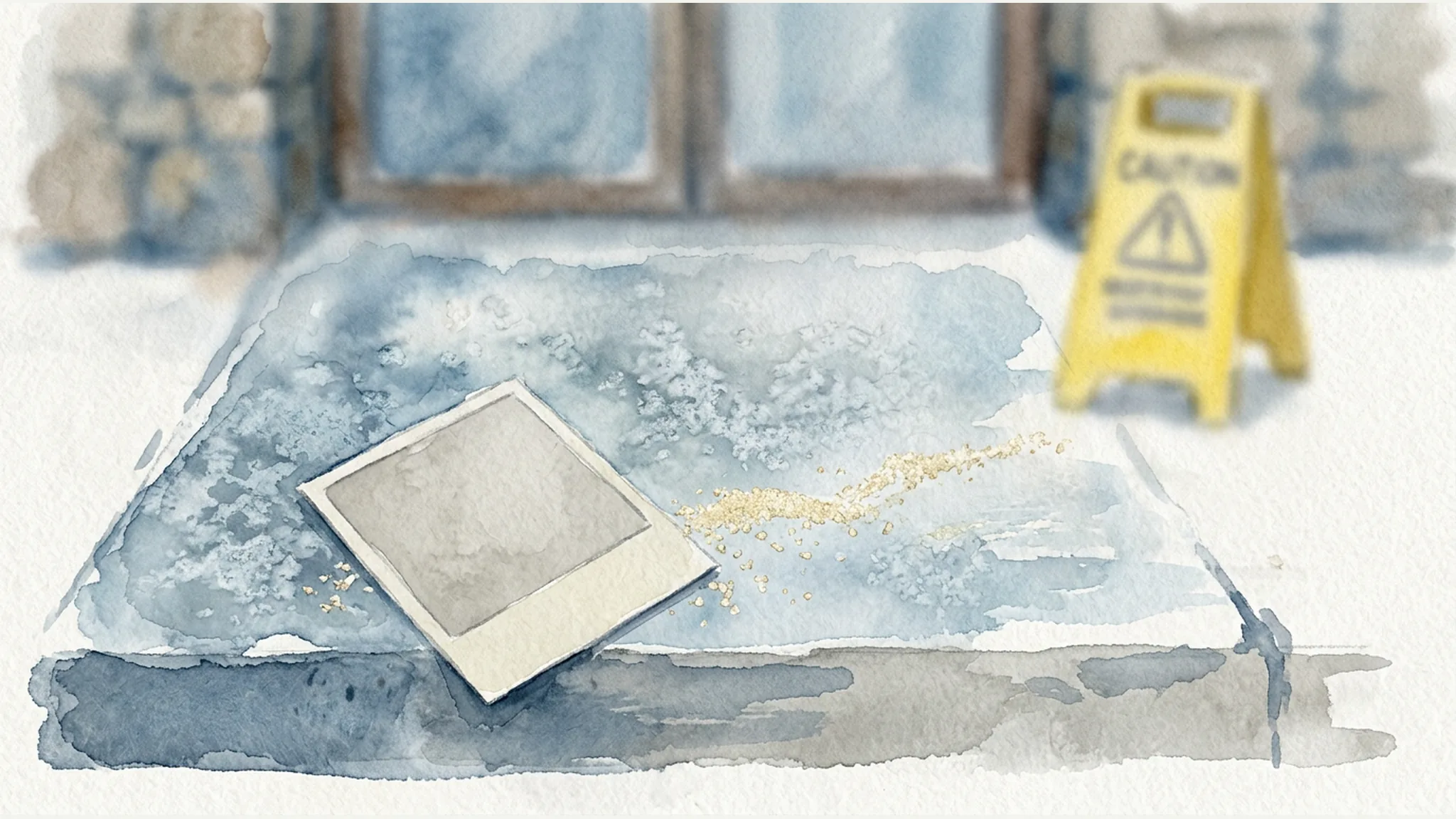
Yes, an Oregon store may be liable when its employee mops a customer area and leaves the floor slippery without reasonable protection. If an outside cleaning contractor did the work, responsibility may depend on control, agency, the parties’ relationship, and each entity’s conduct. Neither “we were cleaning” nor “there was no wet-floor sign” decides the claim by itself.
The central questions are more specific:
- Who created the particular wetness that caused the fall?
- Who controlled the area and the cleaning work?
- Was the floor an unreasonable risk under the circumstances?
- Were the warning, barrier, drying process, and available route reasonable for the actual wet area?
- Did the condition cause an injury and resulting damages?
- Did the shopper’s own conduct contribute to the fall?
No located published Oregon appellate opinion addresses this exact scenario: a retail shopper falling on an employee-created, freshly mopped floor with no sign or barricade. The analysis instead comes from Oregon decisions addressing duties to shoppers, foreign substances, wet flooring, warnings, and comparative fault. Those authorities make one point clear: the label “cleaning” does not resolve whether reasonable care was used.
“The Store Was Cleaning” Does Not Decide Liability
A shopper visiting a store for its business purposes is ordinarily a business invitee. Under the Oregon premises-liability framework, a possessor generally must use reasonable care to discover premises conditions creating an unreasonable risk of harm and either eliminate the condition or provide an adequate warning so foreseeable shoppers can avoid it.
Routine cleaning can make a store safer. At the same time, the manner and timing of cleaning can create a temporary risk. The relevant question is not whether mopping was a proper activity in the abstract. It is whether the person or business controlling the area used reasonable care while the floor was wet and drying.
That may require looking at when the area was cleaned, how much of the floor was wet, whether customers still had to pass through it, and what measures were used to protect them. A store is not an insurer of every shopper’s safety, and the fact that someone fell does not itself prove negligence.
A Freshly Mopped Floor May Create a Temporary Slipping Risk
Oregon appellate authority recognizes the common-sense inference that linoleum can become slippery while being mopped and that ordinary tile or vinyl may become slippery when wet. That does not mean every wet floor is negligent as a matter of law. It does mean a factfinder may consider the temporary slipping risk when deciding what reasonable care required.
A narrow damp area with a clear, visible warning and an open dry route may present a different case from a broad wet path left open to customer traffic with no effective warning or way around it. The surrounding facts matter.
Proving Who Created the Particular Wetness Changes the Notice Question
In an Oregon foreign-substance case, a shopper generally may proceed by showing that the occupant placed the substance there, actually knew it was there and failed to act with reasonable diligence, or should have discovered and removed it because it remained long enough.
If store employees mopped the precise area and left the water or cleaning solution involved in the fall, that creation evidence may satisfy the first route and may help establish the store’s knowledge of the condition. If an outside contractor performed the work, attribution and each entity’s responsibility require separate analysis. The shopper may not need to prove how long an unidentified customer spill sat on the floor when legally attributable creation is established.
That distinction matters. Duration is especially important when no one knows who caused a spill and the claim depends on constructive notice. Readers dealing with that situation can learn more about proving notice of an unidentified grocery-store spill.
Direct and Circumstantial Proof of Mopping
The evidence must connect the store or its cleaner to the particular wetness involved—not merely show that employee creation was possible. Depending on the facts, relevant direct or circumstantial evidence may include:
- an employee or witness who saw the area being mopped;
- a mop, bucket, or cleaning cart nearby;
- surveillance footage showing the cleaning and the shopper’s approach;
- a cleaning log, task record, or work order;
- the direction and pattern of moisture, streaks, or footprints;
- cleaning-product residue; and
- the timing between the cleaning and the fall.
The combined circumstances may support an inference about who created the wet area. Speculation is not enough, however. An unclear comment made after the fall may also be insufficient by itself to prove that an employee knew about the condition beforehand.
Creation Does Not Prove the Rest of the Claim
Even persuasive evidence that store personnel created the wet floor does not establish automatic liability. Creation and knowledge are only part of the analysis. The injured person still must prove that the condition presented an unreasonable risk, the responsible defendant failed to use reasonable care, the condition factually and legally caused the fall and injury, and the injury resulted in damages. Control, agency, and available defenses may also affect the outcome.
Was the Warning or Protection Reasonable for the Actual Wet Area?
There is no universal Oregon rule in the reviewed authorities requiring a particular number, color, type, or placement of wet-floor signs—or a barricade every time a customer-area floor is mopped. Instead, warning adequacy depends on context.
Useful questions include:
- Could a customer see the warning before reaching the wet floor?
- Was it close enough to identify the actual hazard rather than some other area?
- Could shoppers approach the wet area from a direction where the warning was hidden?
- Did lighting, sight lines, merchandise, or ordinary store distractions affect visibility?
- How large was the wet area?
- Did the warning remain in place while the floor was still wet?
- Was there a reasonably safe dry route around the condition?
The absence of a sign may be important evidence, but it is not an automatic win for the shopper. Likewise, the presence of a sign does not automatically defeat a claim. A sign that customers could not see until they were already on the wet surface may not provide the same protection as a warning positioned before every reasonable approach.
Signs, Cones, Barriers, and Dry Routes Serve Different Functions
A warning tells shoppers about a risk. A barrier or taped-off area controls access. Cleaning only part of a passage can leave a dry route open. Other measures may help remove or reduce the condition while the floor dries.
What reasonable care required depends on the circumstances. A visible cone may be sufficient in one setting. In another, the size or location of the wet area may call for access control, a safe alternate route, assistance with drying, or another feasible precaution. Oregon authority recognizes that when a condition cannot be encountered with reasonable safety even after it is known, a simple warning may not always be enough.
That is not a rule that every mopped floor must be barricaded. It is a reason to examine what each precaution actually accomplished for customers approaching the area.
Safety Guidance and Store Procedures Are Context, Not the Legal Standard
NIOSH retail-safety guidance recommends practical measures such as placing signs or cones around a wet area, leaving them until the area is dry, cleaning one side of a passage at a time, and keeping a route open. Separate NIOSH guidance discusses barriers or caution tape to prevent entry during floor cleaning.
These recommendations are principally worker-focused safety guidance. They are not an Oregon shopper-protection statute and do not automatically establish negligence.
Internal cleaning policies, product instructions, training materials, and contractor procedures may also help show what happened and what precautions were feasible. But a policy violation is not automatically negligence, just as following an internal policy does not automatically prove that reasonable care was used in the circumstances.
Who Controlled the Area and the Cleaning Work?
The responsible party may not always be limited to the store whose name appears above the entrance. Depending on the property and cleaning arrangement, potentially relevant actors may include the store operator, landlord, property manager, mall operator, or an outside cleaning company.
The details matter: Who possessed and controlled the precise area? Who directed the cleaning? Was the person who mopped a store employee or an independent contractor? What did the contracts and actual working relationship assign to each entity? Did one business control customer access while another performed the cleaning?
Those questions can affect which entities may be responsible and on what basis. A cleaning contractor is not automatically the store’s agent, and the existence of a contractor does not by itself resolve the store’s own conduct. For a deeper discussion of potentially different roles, see how an operator and cleaning vendor may have different responsibilities.
What Mopping-Specific Evidence Should Be Preserved?
Freshly mopped-floor evidence can change quickly as the surface dries, people walk through the area, equipment moves, and signs or barriers are repositioned. When possible, promptly and safely document:
- the exact boundaries of the wet area;
- streaks, footprints, residue, or moisture patterns;
- any nearby mop, bucket, cleaning cart, or supplies;
- all signs, cones, mats, tape, or barriers and their locations;
- each reasonable approach path, including lighting and sight lines;
- the identities of employees and witnesses;
- visible camera locations;
- receipt and incident-report information; and
- footwear, clothing, injuries, and related documentation.
Preserve original photo and video files rather than altering them, and do not discard relevant physical items. A broader guide explains evidence that can disappear after a retail aisle fall.
If the fall allegedly worsened an earlier knee or back problem, the scene evidence serves a different role from the before-and-after proof of a pre-existing condition’s aggravation. Fault and medical causation require separate support.
Records May Clarify Who Mopped, When, and What Precautions Were Used
Potentially relevant records may include surveillance footage, cleaning and inspection logs, work orders, employee schedules and messages, training materials, product records, contractor documents, and incident materials. A recent mopping entry may help establish a timeline, but neither an entry nor a gap in a log proves liability by itself. More detail is available on what a cleaning log can—and cannot—prove.
Once litigation begins, Oregon’s civil rules permit parties to request relevant documents, electronically stored information, images, recordings, and tangible items within another party’s possession, custody, or control. That discovery process is not the same as having an immediate pre-suit right to store records.
A prompt and specific preservation request may be prudent because relevant recordings or records can be routinely overwritten. It does not guarantee access or ensure that every requested item exists. Readers seeking more detail can review this guide to preserving relevant cleaning-route and approach footage.
Do Not Overstate Missing or Later-Created Evidence
Missing video does not automatically prove negligence or liability. Oregon’s evidence rules distinguish willful suppression from routine overwrite, accidental loss, or evidence that never existed. The reason for the loss, timing, control, relevance, and procedural setting may all matter.
Similarly, the fact that employees placed cones, mats, signs, or barriers after a fall does not necessarily prove they were negligent beforehand. Later precautions may qualify as subsequent remedial measures and generally cannot be used to prove negligence, although they may have other permissible uses. It can still be useful to document what changed and when, leaving admissibility questions for legal analysis.
How Oregon Comparative Fault May Affect the Claim
Oregon evaluates the shopper’s and the defendant’s conduct before comparing fault. Evidence that a shopper ignored an effective warning, crossed a genuine barrier, rushed, was distracted, or failed to keep a reasonable lookout may support comparative fault if that conduct contributed to the harm or the relevant risk.
Under Oregon’s modified comparative-fault statute, a claimant may recover when the claimant’s fault is not greater than the combined fault of the people being compared, but any damages are reduced according to the claimant’s percentage of fault. If the claimant’s fault is greater, recovery is barred. With one at-fault defendant and no other compared person, 50% claimant fault permits reduced recovery; more than 50% bars it.
Visible moisture or knowledge of a wet floor is not automatically a complete defense. Obviousness, what the shopper knew, and how easily each side could have avoided the harm are relevant to reasonable care and comparative fault. They do not erase the store’s duty by themselves.
The Practical Questions That Usually Matter Most
An unmarked freshly mopped-floor claim often turns on a short, evidence-based set of questions:
- Who mopped the precise area where the fall occurred?
- What substance was applied, and what was the moisture pattern?
- How close in time were the cleaning and the fall?
- What warnings or barriers were in place before the fall?
- Could a customer approaching from each direction see the warning and use a reasonably safe dry route?
- Who controlled the area and directed the cleaner?
- What evidence connects the wet condition to the fall, injury, and resulting damages?
Prompt action may matter because the floor can dry and video or records may disappear well before a lawsuit deadline. Oregon generally provides a two-year limitations period for an ordinary personal-injury claim that is not otherwise specially addressed, but that is not a video-retention period or advice to wait. Special rules, including shorter notice requirements in some cases, may apply depending on the defendant and circumstances.
A fact-specific legal evaluation can help identify the responsible entities, preservation priorities, deadlines, and strengths or gaps in the available proof. No single fact—not the cleaning, the missing sign, or the fall itself—guarantees a particular outcome.
Educational disclaimer: This article provides general educational information about Oregon law and is not legal advice. Laws, deadlines, and outcomes depend on the particular facts and may change. Reading this article does not create an attorney-client relationship.
Frequently Asked Questions
Is a Store Automatically Liable If There Was No Wet-Floor Sign?
No. The absence of a sign may matter, but Oregon’s reasonable-care analysis also considers the size and location of the wet area, customer approach paths, visibility, barriers, available dry routes, and the surrounding circumstances. No universal Oregon sign-placement rule was located in the approved research.
Does an Oregon Shopper Have to Prove How Long a Freshly Mopped Floor Was Wet?
Not necessarily. When evidence shows that store personnel or an agent created the particular wetness, the shopper may rely on that creation route. Duration is especially important when the source is an unidentified spill and the claim depends on showing that it remained long enough for the store to discover it.
Can a Wet-Floor Sign Defeat a Slip-and-Fall Claim?
Not automatically. The warning must be adequate in context and enable a foreseeable shopper to avoid the harm. Its visibility, placement, timing, coverage, and relationship to a safe alternate route may matter. Some conditions may call for a stronger feasible precaution than a warning alone.
What Evidence Can Show That Store Employees Mopped the Area?
Employee or witness accounts, video, a nearby mop or bucket, cleaning records, moisture patterns, cleaning-product residue, and timing may provide direct or circumstantial proof. The evidence must make employee or legally attributable contractor creation of the particular wetness more than a speculative possibility.
Who May Be Responsible If an Outside Cleaning Company Did the Mopping?
Responsibility depends on facts such as possession, control, direction, agency, contract allocation, and each entity’s conduct. The store, contractor, landlord, property manager, or another property controller may have different roles. The contractor’s involvement does not automatically determine responsibility.
Can Seeing the Wet Floor or a Warning Prevent Recovery in Oregon?
Not categorically. A shopper’s knowledge and conduct may support comparative fault, which can reduce or sometimes bar recovery. But an obvious condition is not automatically a no-duty or no-liability rule under modern Oregon premises law.
Source Notes
- Woolston v. Wells, 297 Or 548, 687 P2d 144 (1984) — Oregon’s reasonable-care duty to invitees and treatment of known or obvious conditions under comparative fault.
- Kummer v. Fred Meyer Stores, Inc., 337 Or App 720 (2025) — Oregon’s three routes for foreign-substance claims and the duration requirement when constructive notice of an unidentified substance is at issue.
- Van Den Bron v. Fred Meyer, Inc., 86 Or App 329, 738 P2d 1011 (1987) — circumstantial evidence that employees placed water on the floor.
- Dodge v. Tradewell Stores, Inc., 256 Or 514, 474 P2d 745 (1970) — inference that common flooring may become slippery while being mopped or when wet.
- Ault v. Del Var Properties, LLC, 281 Or App 840, 383 P3d 867 (2016) — unreasonable-risk analysis and context-specific protective measures.
- Appleyard v. Port of Portland, 311 Or App 498, 492 P3d 71 (2021) and ORS 31.600 — comparative fault in Oregon premises cases and the statutory recovery rule.
- ORCP 43, ORS 40.135 / OEC 311, and ORS 40.185 / OEC 407 — discovery, willful suppression, and subsequent remedial measures.
- NIOSH, Preventing Slips, Trips, and Falls in Wholesale and Retail Trade Establishments — practical safety guidance, not an Oregon civil-liability statute.
Client-First Fee Promise
Client First = Bills First, Fees Second
Your unpaid medical bills do not have to make your lawyer's fee bigger. Johnson Law subtracts qualifying medical bills before calculating our fee, helping clients keep more of their settlement.
Applies to qualifying cases. Results vary.