Icy Sidewalk Outside an Oregon Business: Weather Isn’t an Automatic Defense
Icy Sidewalk Outside an Oregon Business: Weather Isn’t an Automatic Defense
Quick Answer: Weather Can Matter, But It Does Not End the Liability Question
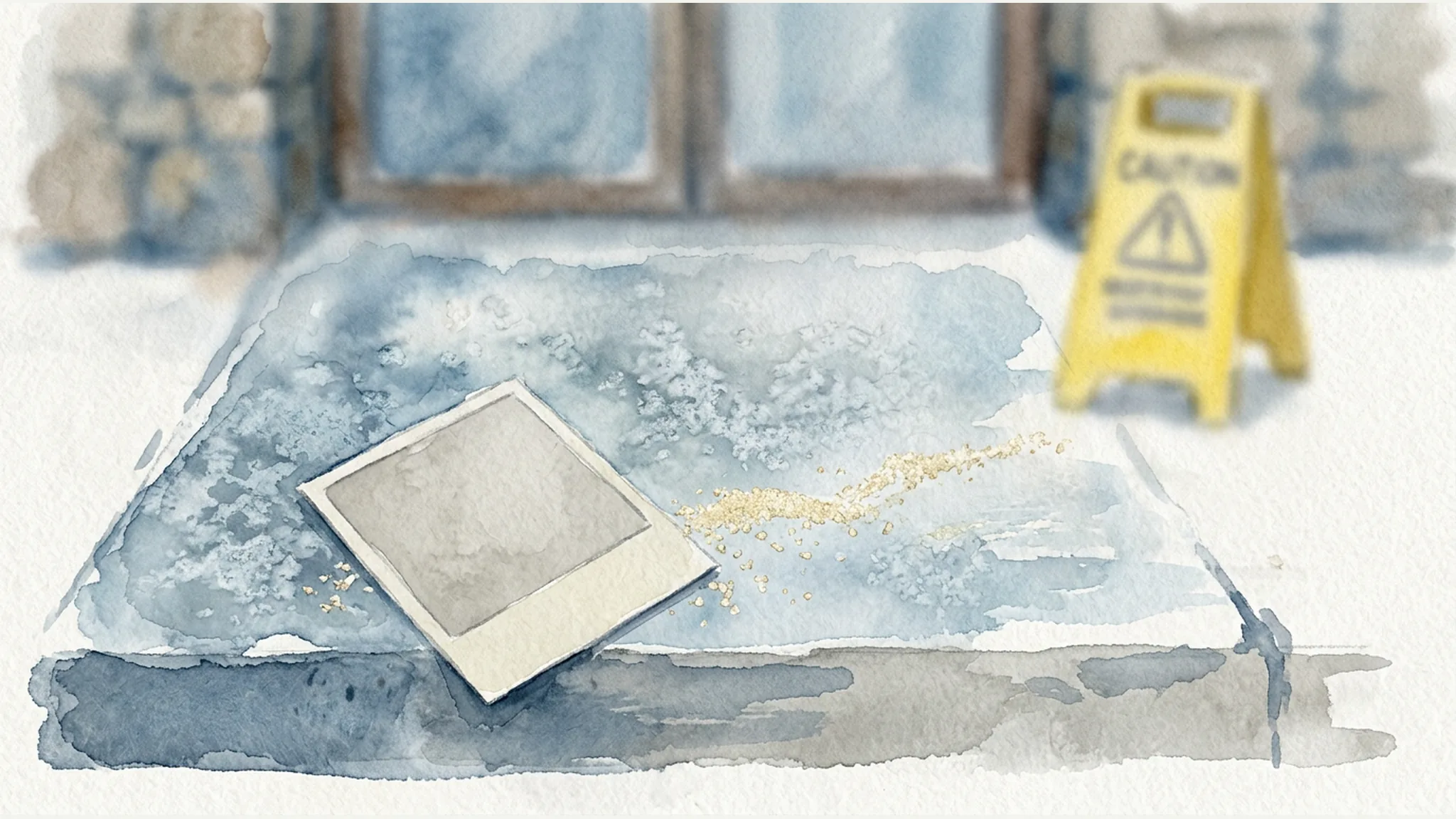
Snow, freezing rain, and freeze-thaw cycles are common in Oregon. But “the weather caused it” is not always the end of an icy-sidewalk case outside a business.
The real questions are usually more specific: Where exactly did the fall happen? Who controlled that area? Was the condition unreasonably dangerous? Did the business, owner, or occupant know—or have reason to know—that customers would encounter ice there? Was there a reasonable opportunity to remove it, treat it, block it off, reroute customers, or warn them? Did a local sidewalk code set a clearer duty?
At the same time, Oregon law does not make every business automatically responsible for every icy patch near its doors. A business is not an insurer of customer safety, and a public sidewalk can raise different issues from a private walkway, parking lot, or store entrance. For broader context, see Johnson Law’s overview of Oregon premises liability claims and Portland slip-and-fall claims.
This article is educational information about Oregon law and is not legal advice for any specific incident.
Start With the Exact Location of the Fall
“I slipped outside a business” is a starting point, not a legal conclusion. The location may affect who owed a duty, what rules applied, and what evidence is needed.
Public Sidewalk vs. Business Premises
An Oregon business is not necessarily liable just because natural snow or ice accumulated on a public sidewalk next to the business.
In Fitzwater v. Sunset Empire, Inc., the Oregon Supreme Court addressed an Astoria ordinance requiring abutting owners to remove snow and ice. The court held that the ordinance, as written, created a duty to the city rather than civil liability to the injured pedestrian. That case is an important caution: a sidewalk rule does not always mean a private damages claim exists, and liability can depend on control, special use, affirmative creation of the hazard, or the specific wording of a local ordinance.
That does not mean public-sidewalk cases are impossible. It means the analysis is more fact-specific. A sidewalk immediately outside a storefront may involve questions about an owner, tenant, occupant, city, shopping center, or another party—and different legal rules may apply if the defendant is a public body. For that public-body distinction, see our separate guide to Portland city sidewalk defect claims.
Store Entrance, Private Walkway, Parking Lot, or Customer Approach
The analysis often looks different when the icy area is part of the customer-facing business premises: a private walkway, entry ramp, parking lot, store entrance, or approach customers are expected to use.
In Dawson v. Payless for Drugs, the Oregon Supreme Court allowed an icy parking-lot case to go to a jury. The evidence included snow, repeated precipitation in the days before the fall, and freezing at night. The case supports a practical point: weather may explain why ice formed, but recurring winter conditions can also give a business reason to anticipate a hazard in an area used by customers.
Oregon cases involving wet or slippery business premises also focus on notice and reasonable diligence. In Pribble v. Safeway Stores, Inc., a rainy-day wet entrance could present a jury question where store personnel knew the floor became wet and slippery during rain. Weather was part of the story, but it did not automatically excuse the store from taking reasonable steps.
Leased Storefronts and Common Areas Require Control Facts
Many icy-sidewalk incidents happen outside leased storefronts, in shopping-center walkways, or near shared entrances. In those settings, responsibility may depend on who had possession or control of the area: the property owner, commercial tenant, occupant, property manager, maintenance contractor, or another party.
Some local codes refer to both “owners” and “occupants.” For example, Portland’s snow-and-ice sidewalk code uses owner-and-occupant language. But the practical question still often requires looking at control, lease terms, maintenance practices, and who actually handled winter treatment.
Apartment or residential sidewalk claims can involve different landlord-tenant, lease, common-area, and statutory/control questions, so this post focuses on business/customer premises rather than icy apartment sidewalk claims.
Why “It Was Icy Everywhere” Is Not the Whole Defense
Businesses are not expected to control the weather. They may, however, have to respond reasonably when winter weather creates an unreasonable danger in a place customers are invited or expected to walk.
Oregon Law Does Not Make Businesses Insurers
Oregon premises law is not strict liability. A business does not become legally responsible simply because someone fell.
The condition must be unreasonably dangerous, and the proposed precaution must be reasonable under the circumstances. Feasibility matters. A sudden flash freeze minutes before a fall may look different from days of precipitation, overnight freezing, visible ice at the entrance, and customer traffic through the same area.
Obvious Ice Is Not Always an Automatic Loss for the Customer
Businesses often argue that ice was open and obvious, or that the injured person knew the sidewalk was slick. That argument can matter, but it is not always a complete defense.
In Dawson, the Oregon Supreme Court recognized that a possessor of business premises may still have a duty when it should anticipate harm despite the invitee’s knowledge or the obviousness of the condition. In plain English: even visible ice can be dangerous enough that a business may need to take reasonable precautions if customers still have to encounter it.
The customer’s conduct still matters. Oregon uses modified comparative negligence under ORS 31.600. If the injured person is partly at fault, damages may be reduced by that percentage. If the person’s fault is greater than the combined fault of the defendants and other specified persons, recovery may be barred. In an icy-sidewalk case, a defense may focus on footwear, whether the person saw the ice, whether a safer route was available, and whether the person acted reasonably.
Recurring Weather Conditions Can Support Notice
A business may have notice even if no one reported the exact patch of ice. Recurring weather conditions can matter.
Evidence of recent snow, repeated precipitation, freezing temperatures, refreezing overnight, customer traffic, drainage patterns, or a known slippery entrance can help show that the business should have anticipated the problem. That is why icy-sidewalk cases often depend on timelines: when precipitation fell, when temperatures dropped, when the business opened, when employees arrived, and when the fall happened.
Similar notice questions come up in other store-entry cases, including wet-floor and missing-cone claims where the proof often turns on inspections, complaints, timing, and what employees knew.
Notice and Reasonable Time: The Proof Problem in Icy-Sidewalk Claims
Many Oregon slip-and-fall disputes turn on notice. Did the business know about the hazard? If not, was the hazard there long enough that a reasonably careful business should have discovered and addressed it?
Actual Notice
Actual notice means the business knew about the condition. In an icy-sidewalk case, that might be shown through evidence such as:
- an employee seeing the ice;
- a customer complaint;
- a prior fall or near fall;
- a maintenance call or work order;
- a manager’s inspection;
- an employee applying some treatment before the fall; or
- statements that staff knew the area became icy during similar weather.
Under the Oregon notice framework reflected in cases such as Pribble, a claimant may try to show that the business knew of a dangerous condition and failed to use reasonable diligence to remove or address it.
Constructive Notice
Constructive notice means the business may not have admitted actual knowledge, but the condition existed long enough—or was predictable enough—that a reasonably careful business should have discovered it.
This is where many cases become evidence-heavy. In Diller v. Safeway Stores, Inc., the Oregon Supreme Court affirmed judgment for the store where there was no evidence that ice or water had been on the floor long enough for the store, using reasonable diligence, to discover and remove it. The fact that the area had not been swept for more than an hour did not prove how long the specific hazard had been present.
For icy sidewalks, that means general statements like “it was cold that day” may not be enough. Stronger evidence may show when the ice formed, how long it was visible, whether employees had passed by, whether the business had opened hours earlier, whether other customers complained, or whether the area had a history of refreezing.
Reasonable Time to Act Is Not One Statewide Clock
Oregon does not have one statewide deadline that tells every business exactly when to clear snow or ice from every sidewalk.
Local rules can vary. Beaverton, for example, prohibits an owner or person in charge of abutting property from allowing snow to remain longer than the first four hours of daylight after the snow falls. It also prohibits ice from remaining on a public sidewalk for more than four hours of daylight after formation unless the ice is removed or covered with sand, ashes, or other suitable material to assure safe travel.
Bend’s official guidance states that commercial properties must clear snow and ice from sidewalks within six daylight hours after snowfall. Portland’s code uses different wording and assigns snow-and-ice responsibility to owners and occupants “notwithstanding any time limitations.”
The takeaway is not that one city’s clock applies everywhere. The takeaway is that timing, daylight, local code, customer traffic, weather conditions, and feasibility all matter.
Local Oregon Sidewalk Rules Can Change the Analysis
Local sidewalk codes can be important in icy-sidewalk cases, especially when they assign responsibility to owners or occupants or include express liability language. But city rules must be read carefully.
Portland: Owners and Occupants, Snow/Ice Removal, and Express Liability Language
Portland provides one of the clearest local examples.
Portland City Code § 17.28.025 states that owners and occupants of land adjacent to any street are responsible for snow and ice removal from sidewalks abutting or immediately adjacent to the land, “notwithstanding any time limitations.” The same section states that property owners and occupants are liable for damages to a person injured or otherwise damaged as a result of failure to remove snow and/or ice accumulations from covered sidewalks.
That express liability language is materially different from the ordinance discussed in Fitzwater, where the Oregon Supreme Court construed the Astoria ordinance as creating a duty to the city rather than a private damages claim.
Portland also has a broader sidewalk-maintenance rule. Portland City Code § 17.28.020 makes owners of land abutting a street responsible for constructing, reconstructing, maintaining, and repairing sidewalks, curbs, driveways, and parking strips abutting or immediately adjacent to the land, and it assigns liability for injuries caused by defective sidewalk conditions or failure to keep them safe and in good repair. That may matter if an icy fall also involves a drainage issue, uneven slab, defective approach, or other maintenance condition.
Beaverton, Eugene, Bend, and Salem Examples
Other Oregon cities use different approaches.
In Beaverton, the code includes specific daylight-hour limits for snow and ice on public sidewalks abutting property. For ice, the code allows removal or covering the ice with sand, ashes, or other suitable material to assure safe travel.
In Eugene, Eugene Code § 7.375 requires the owner of land abutting a sidewalk to maintain the sidewalk and curb in good repair and safe condition, and it makes the owner liable for injury, damage, or loss caused by negligent failure to comply. The code also states that the owner’s duty and liability are not dependent on notice from the city to reconstruct or repair.
Salem’s official sidewalk guidance says property owners must keep sidewalks free of construction materials, vehicles, debris, vegetation, snow, and ice at all times. Bend’s official guidance says commercial properties must clear snow and ice from sidewalks within six daylight hours after snowfall. Those are useful local examples, but a final legal analysis should check the current code language for the city where the fall occurred.
Code Violations Are Useful, But the Civil-Liability Question Can Be City-Specific
A local code can help frame what a business, owner, or occupant was expected to do. It may also provide strong evidence that a hazard should have been addressed.
But not every ordinance automatically creates a private right to damages. Fitzwater is the cautionary example. The exact wording of the local rule, the type of sidewalk, the party being sued, and the facts of control all matter.
What Reasonable Winter Precautions Might Look Like
Reasonable precautions depend on the facts. A business is not required to do every possible thing in every winter storm. But when an icy condition is foreseeable and customers are expected to use the area, reasonable steps may include more than doing nothing.
Remove, Treat, Sand, Barricade, Reroute, or Warn
Depending on the location and conditions, reasonable precautions may include:
- shoveling or scraping snow and ice;
- applying de-icer, salt, sand, or another traction material where appropriate;
- inspecting customer entrances and approaches during winter weather;
- placing warning signs or cones;
- blocking off a dangerous walkway;
- directing customers to a safer entrance;
- fixing a drainage or refreezing problem; or
- calling a maintenance contractor when the business cannot safely handle the condition itself.
The point is not that every step is required in every case. The point is that Oregon liability often turns on whether the response was reasonable compared with the risk, the timing, the business’s knowledge, and the available options.
Feasibility and Timing Matter
Timing can change the analysis.
A sheet of ice that forms minutes before a store opens during an unexpected weather event may be harder to attribute to unreasonable conduct. A customer approach that remains icy hours after daylight, after repeated freezing nights, or after employee complaints may look different.
That is why cases like Dawson and Diller are both important. Dawson shows that recurring winter weather and customer use can support a claim. Diller shows that a claimant still needs evidence connecting the business to knowledge, reasonable discovery, or an opportunity to act.
Evidence to Preserve After an Icy Fall Outside a Business
Icy-sidewalk evidence can disappear quickly. Ice melts. Sand gets applied. Video is overwritten. Employees’ memories fade. If you are physically able, or if someone can help you, preserve evidence as soon as possible.
Photos and Video
Photos should capture more than a close-up of the ice. Useful images may show:
- the exact spot where you fell;
- the business entrance, walkway, parking lot, or sidewalk layout;
- the path customers were expected to use;
- the ice pattern and whether it looked old, dirty, refrozen, or repeatedly walked on;
- footprints, tire tracks, slush, standing water, or drainage;
- warning signs, cones, barricades—or the lack of them;
- sand, salt, de-icer, or untreated areas;
- lighting conditions;
- nearby gutters, downspouts, ramps, mats, or uneven pavement; and
- nearby security cameras.
Video may be especially important because it can show when the hazard appeared, whether employees inspected the area, whether other customers slipped, or whether treatment occurred after the fall. Surveillance footage may be deleted or overwritten quickly, so preservation should happen early. Our separate guide explains how fast slip-and-fall surveillance footage may be deleted and how to preserve it.
Witnesses, Employees, Complaints, and Inspection Records
Witnesses can help prove timing and notice. Get names and contact information for anyone who saw the fall, saw the ice before the fall, heard employees discuss it, or noticed prior slips in the same area.
Employees may also have relevant information. They may know when the store opened, whether anyone inspected the entrance, whether customers had complained, whether a contractor was called, or whether the same area freezes during similar weather.
Inspection records, incident reports, maintenance logs, work orders, snow-removal contracts, and complaint records can all matter. In many cases, those records are not available to the injured person right away, which is one reason early legal help can be useful.
Weather Data and Local Code Records
Weather data can help establish whether the business had a reasonable opportunity to act. Important details may include:
- when snow or freezing rain started;
- total precipitation or snowfall;
- temperatures before and after the fall;
- overnight freezing;
- thaw-and-refreeze patterns;
- daylight hours; and
- weather conditions at the nearest reliable station.
NOAA’s National Centers for Environmental Information offers Climate Data Online, which provides historical weather and climate data. NOAA/NWS NOWData can be useful for preliminary research, but the National Weather Service explains that NOWData is not itself the official certified source. For litigation-grade proof, finalized or court-certified weather data may need to come from NCEI or a Regional Climate Center.
Local code records also matter. The applicable city or county rule may affect what the owner or occupant was expected to do, whether a fixed daylight-hour period applied, and whether the code includes express liability language.
Medical Care and Deadline Awareness
Get medical care and document your symptoms, diagnosis, treatment, and limitations. Gaps in treatment can become disputed later.
Oregon’s general statute of limitations for personal injury claims is two years under ORS 12.110(1), but exceptions and special defendants can change the analysis. If the potential defendant is a city, county, state agency, transit district, public university, or other public body, separate notice rules may apply and should be evaluated promptly. For more general timing context, see our guide to the statute of limitations in Oregon injury cases.
Common Defense Arguments in Oregon Icy-Sidewalk Cases
Understanding likely defenses can help explain why evidence matters so much.
“The Ice Was Open and Obvious”
A business may argue that the customer saw the ice or should have seen it. That can affect the case, especially under Oregon comparative-fault principles.
But obviousness is not always the end of the claim. Under the principle recognized in Dawson, a business may still have a duty if it should anticipate that customers will encounter the condition despite its obviousness. The outcome depends on the facts: the available route, lighting, warnings, customer necessity, and whether reasonable precautions were taken.
“We Didn’t Have Enough Time to Fix It”
This defense focuses on notice and reasonable opportunity. If ice formed suddenly and the business had no fair chance to discover or treat it, liability may be harder to prove.
That is why weather timelines, photos, witness statements, and local-code deadlines can be important. A four-hour daylight rule in one city, a six-daylight-hour commercial guidance in another, and Portland’s “notwithstanding any time limitations” language can frame the timing question differently.
“The City Owns the Sidewalk”
If the fall happened on a public sidewalk, the business may argue that the city—not the business—owned or controlled it. That issue needs careful review.
Public-sidewalk cases may involve local sidewalk codes, owner/occupant duties, public-body notice rules, and distinctions between natural accumulation, defective sidewalks, and hazards created or worsened by a business. Claims against government entities can raise different deadlines and procedural requirements from claims against private businesses.
When to Talk With an Oregon Slip-and-Fall Lawyer
An icy fall outside a business can look simple at first: there was ice, someone fell, and the business says the weather was to blame. The legal analysis is usually more detailed.
A lawyer can help evaluate:
- the exact location of the fall;
- whether the area was public, private, leased, or common space;
- who had possession or control;
- what local code applied;
- whether the business had actual or constructive notice;
- whether reasonable winter precautions were feasible;
- whether surveillance video or inspection records need to be preserved;
- whether weather data supports the timing of the hazard; and
- whether any special deadline or public-body notice issue applies.
If you were hurt on ice outside an Oregon business, consider getting advice before evidence disappears. The answer may depend less on the fact that it was icy and more on what the business knew, what it could reasonably do, and what the local rules required.
FAQ
Are Oregon businesses automatically liable when a customer slips on ice outside?
No. Liability depends on facts such as location, control, notice, unreasonable danger, feasible precautions, local code, and comparative fault. Oregon law does not make businesses insurers of customer safety.
Does bad weather excuse an Oregon business from treating an icy sidewalk?
Not automatically. Weather may explain how ice formed, but the business may still need to take reasonable steps if it knew or should have known customers would encounter an unreasonable danger and had a reasonable opportunity to respond.
Is there a statewide Oregon deadline for businesses to clear snow or ice from sidewalks?
No single statewide deadline is supported by the sources for this article. Local rules differ. Beaverton uses four daylight-hour rules for snow and ice; Bend’s official guidance refers to six daylight hours for commercial properties; Portland uses broader owner-and-occupant responsibility language.
What evidence helps prove an icy-sidewalk claim against a business?
Useful evidence may include photos, video, witness names, employee statements, complaints, inspection records, maintenance logs, local code provisions, and historical weather data showing precipitation, temperature, snowfall, and freeze-thaw timing.
What if I saw the ice before I fell?
Seeing the ice does not automatically end every Oregon claim, but it can matter. The defense may argue comparative fault. The analysis may also consider whether the business should have anticipated that customers would still encounter the hazard and whether safer alternatives or warnings were available.
What if the fall happened on a city sidewalk rather than a private business walkway?
Public sidewalks can raise separate issues, including local owner-or-occupant duties, city responsibility, and possible public-body notice rules. The analysis should distinguish business/customer premises claims from claims involving government defendants or city sidewalk defects.
Sources
- Dawson v. Payless for Drugs, 248 Or 334, 433 P2d 1019 (1967)
- Pribble v. Safeway Stores, Inc., 249 Or 184, 437 P2d 745 (1968)
- Diller v. Safeway Stores, Inc., 274 Or 735, 548 P2d 1304 (1976)
- Fitzwater v. Sunset Empire, Inc., 263 Or 276, 502 P2d 214 (1972)
- Portland City Code § 17.28.025 – Snow and ice removal
- Portland City Code § 17.28.020 – Sidewalk and curb maintenance
- Beaverton Code § 5.05.085 – Snow and ice on sidewalks
- Eugene Code § 7.375 – Sidewalk maintenance
- ORS 31.600 – Comparative negligence
- ORS 12.110 – General two-year personal injury limitation
- NOAA/NCEI Climate Data Online
- National Weather Service NOWData FAQ
Client-First Fee Promise
Client First = Bills First, Fees Second
Your unpaid medical bills do not have to make your lawyer's fee bigger. Johnson Law subtracts qualifying medical bills before calculating our fee, helping clients keep more of their settlement.
Applies to qualifying cases. Results vary.