Stage 3 and Stage 4 Pressure Injuries in Washington Nursing Homes: What the Care Timeline Can Show

Stage 3 and Stage 4 Pressure Injuries in Washington Nursing Homes: What the Care Timeline Can Show
Learning that a nursing-home resident has a Stage 3 or Stage 4 pressure injury can be alarming. These stages describe the depth of tissue damage. They do not, by themselves, show when the wound began, whether it was avoidable, or whether anyone was negligent.
A carefully reconstructed care timeline can still be valuable. By putting assessments, care plans, daily care records, wound measurements, nutrition and hydration information, notifications, and treatment changes in order, a family can better understand what risks were known, what care was planned, what the records say occurred, and how the facility responded as the resident’s condition changed. A timeline may identify important questions or conflicts, but neither a stage nor a missing chart entry automatically proves neglect.
This article concerns Washington nursing homes, including those serving residents in Vancouver and Clark County. Federal requirements are identified separately and generally apply to Medicare- or Medicaid-certified nursing facilities. This is educational information, not legal advice.
What Stage 3 and Stage 4 Mean Clinically
A pressure injury is localized damage to the skin and underlying soft tissue caused by intense or prolonged pressure, or pressure combined with shear. It often develops over a bony prominence or in connection with a medical or other device. Tissue tolerance may also be affected by nutrition, blood flow, moisture, medical conditions, and the condition of the tissue itself.
The National Pressure Injury Advisory Panel’s staging definitions describe the type and depth of tissue damage clinicians can identify. They do not assign fault.
Stage 3: Full-Thickness Skin Loss
In a Stage 3 pressure injury, there is full-thickness skin loss and adipose tissue is visible. Granulation tissue and rolled wound edges are often present. Slough or eschar may be visible, and the wound may have undermining or tunneling.
Fascia, muscle, tendon, ligament, cartilage, and bone are not exposed in a Stage 3 classification. If slough or eschar blocks a clinician’s view of the extent of tissue loss, the injury is classified as unstageable rather than Stage 3.
Stage 4: Full-Thickness Skin and Tissue Loss
A Stage 4 pressure injury involves full-thickness skin and tissue loss. Fascia, muscle, tendon, ligament, cartilage, or bone is exposed or can be directly felt. Slough, eschar, rolled edges, undermining, and tunneling may also be present.
The visible depth can vary with the injury’s anatomical location. As with Stage 3, obscuring slough or eschar may prevent a Stage 4 classification until the full extent can be seen.
Why Stage Does Not Tell the Whole Story
Stage is not a clock. Pressure injuries do not have to move through a visible, orderly sequence from Stage 1 to Stage 4. An unstageable injury may conceal Stage 3 or Stage 4 tissue loss until obscuring tissue is removed. A deep tissue pressure injury may also evolve rapidly and reveal its actual extent even when treatment is being provided.
For those reasons, the first chart entry calling a wound “Stage 3” or “Stage 4” does not necessarily establish its onset date. Nor can the stage alone establish that the injury worsened through each lower stage while facility staff failed to respond. The clinical consensus report on the staging system specifically cautions against treating stages as a required linear progression.
First Confirm What Kind of Wound It Is
AHRQ wound-classification guidance explains that pressure-injury staging applies after pressure, or pressure combined with shear, has been identified as a cause. Not every open wound is a pressure injury.
Clinical reviewers may also need to consider arterial, venous, diabetic or neuropathic, moisture-associated, traumatic, dermatologic, device-related, and mixed causes. Proposed non-pressure related skin failure in the critically ill or end-of-life skin changes may also be considered, but these concepts remain diagnostically uncertain and should not be inferred from appearance alone. Pressure may coexist with another cause or with conditions that make healing more difficult.
This distinction matters. The cause and stage of a wound are clinical questions. Whether the facility provided appropriate resident-specific care is another question. Each requires evidence rather than assumptions.
Why an Advanced Pressure Injury Does Not Automatically Prove Neglect
A Stage 3 or Stage 4 injury is a serious clinical finding. But a serious outcome is not the same as proof of avoidability, regulatory noncompliance, professional negligence, vulnerable-adult neglect, or causation.
Avoidability Is a Resident-Specific Care Question
For nursing facilities participating in Medicare or Medicaid, 42 CFR 483.25(b) requires assessment-based care consistent with professional standards to prevent pressure ulcers unless the resident’s clinical condition demonstrates they were unavoidable. It also requires necessary treatment and services to promote healing, prevent infection, and prevent new ulcers.
CMS survey guidance for this requirement focuses on the resident-specific process. Reviewers consider whether the facility accurately assessed the resident’s condition and risk factors, selected appropriate interventions, implemented them, monitored and evaluated the results, and revised the approach when needed.
A facility’s use of the word “unavoidable” does not settle those questions. At the same time, the existence of an advanced wound does not establish that it was avoidable. The federal regulation and CMS survey guidance help frame a review of care, but they do not by themselves decide civil liability under Washington law.
Clinical Constraints and Resident Choices Matter
The care that is appropriate and feasible can depend on the resident’s individual circumstances. Relevant considerations may include:
- frailty and immobility;
- impaired perfusion or vascular disease;
- diabetes, incontinence, infection, and medications;
- nutrition and hydration problems;
- serious or terminal illness and medical instability;
- the necessity of a medical device;
- a resident’s refusal or informed choices;
- hospice or comfort-focused goals; and
- the burdens or contraindications of a proposed treatment.
These factors should be investigated, not treated as automatic excuses or automatic proof of deficient care. When choices, refusals, goals, or clinical barriers affect treatment, the records may help show what was discussed, what alternatives were considered, and how the resident was monitored.
Civil Responsibility Requires More Than a Serious Outcome
In a Washington professional-negligence action arising from health care, RCW 7.70.040 requires proof of a failure to meet the applicable standard of care and that the failure was a proximate cause of injury. Washington vulnerable-adult law likewise defines neglect through qualifying conduct or inaction—not the medical outcome alone. A fact-specific remedy may be available under RCW 74.34.200 when its requirements are met.
An advanced stage, charting gap, or regulatory deficiency may be evidence. None is automatically conclusive about breach, causation, or liability.
What Washington Nursing Homes Are Expected to Assess, Plan, and Provide
Washington nursing-home rules and federal participation requirements both create records that can become part of the care timeline. They are separate sources of authority and should not be conflated.
Assessment and Reassessment
WAC 388-97-1000 requires Washington nursing homes to conduct a systematic, comprehensive, interdisciplinary assessment. The assessment includes physical function, continence, diagnoses, nutrition, skin condition, medications, and special treatments.
Under the Washington rule, the assessment must be completed within 14 days after admission, promptly after a significant change, and at least annually, with a review at least quarterly. Medicare- or Medicaid-certified facilities also have a parallel federal assessment framework under 42 CFR 483.20.
For a family reviewing an advanced pressure injury, the practical question is whether assessments accurately captured the resident’s risks and changing condition at the relevant times.
A Measurable, Resident-Specific Care Plan
WAC 388-97-1020 requires a comprehensive plan with measurable objectives and timetables, interdisciplinary participation, identified responsible disciplines, resident participation and informed choice, and review at least quarterly. Washington rules also call for immediate care for a new admission while the comprehensive process is completed.
For participating facilities, 42 CFR 483.21 separately requires a baseline care plan within 48 hours after admission and a comprehensive person-centered plan developed under its federal timing and team requirements.
Depending on the resident, a plan relevant to pressure-injury risk may address mobility, repositioning or offloading, support surfaces, skin checks, continence care, nutrition and hydration, wound treatment, pain, device pressure, and professional consultations. The important question is not whether every plan contains identical interventions, but whether it responds measurably to that resident’s assessed needs and choices.
Delivered Care and Response to Change
WAC 388-97-1060 requires necessary individualized care and services consistent with the resident’s assessment and care plan, including in the areas of skin, nutrition, hydration, continence, and range of motion.
Nutrition and hydration may affect both risk and healing. For participating facilities, federal requirements separately address assessment-based support for nutritional status and sufficient fluid intake. Still, poor intake or weight loss alone does not prove that a facility caused a wound.
The timeline should examine whether ordered and planned interventions were carried out, evaluated, and modified when the resident’s condition or wound changed.
The Repositioning Question: No Universal Two-Hour Rule
Families are sometimes told that every nursing-home resident must be turned every two hours. The approved research did not locate a federal or Washington rule imposing that schedule on every resident. A 2026 Cochrane evidence summary also reports that current evidence does not establish one best repositioning interval for everyone.
Repositioning frequency should be individualized to the resident’s condition, mobility, tissue tolerance, support surface, preferences, comfort, and response. Better timeline questions include:
- What repositioning schedule or offloading approach was planned or ordered?
- Was that plan carried out across shifts?
- Were refusals, interruptions, or clinical contraindications documented?
- Did staff reassess the approach after a skin change or worsening wound?
- Were support surfaces and pressure-relieving devices used as planned?
A missed planned turn may matter. The point is that its significance comes from the resident-specific plan and circumstances, not from a universal two-hour rule.
How to Build the Care Timeline
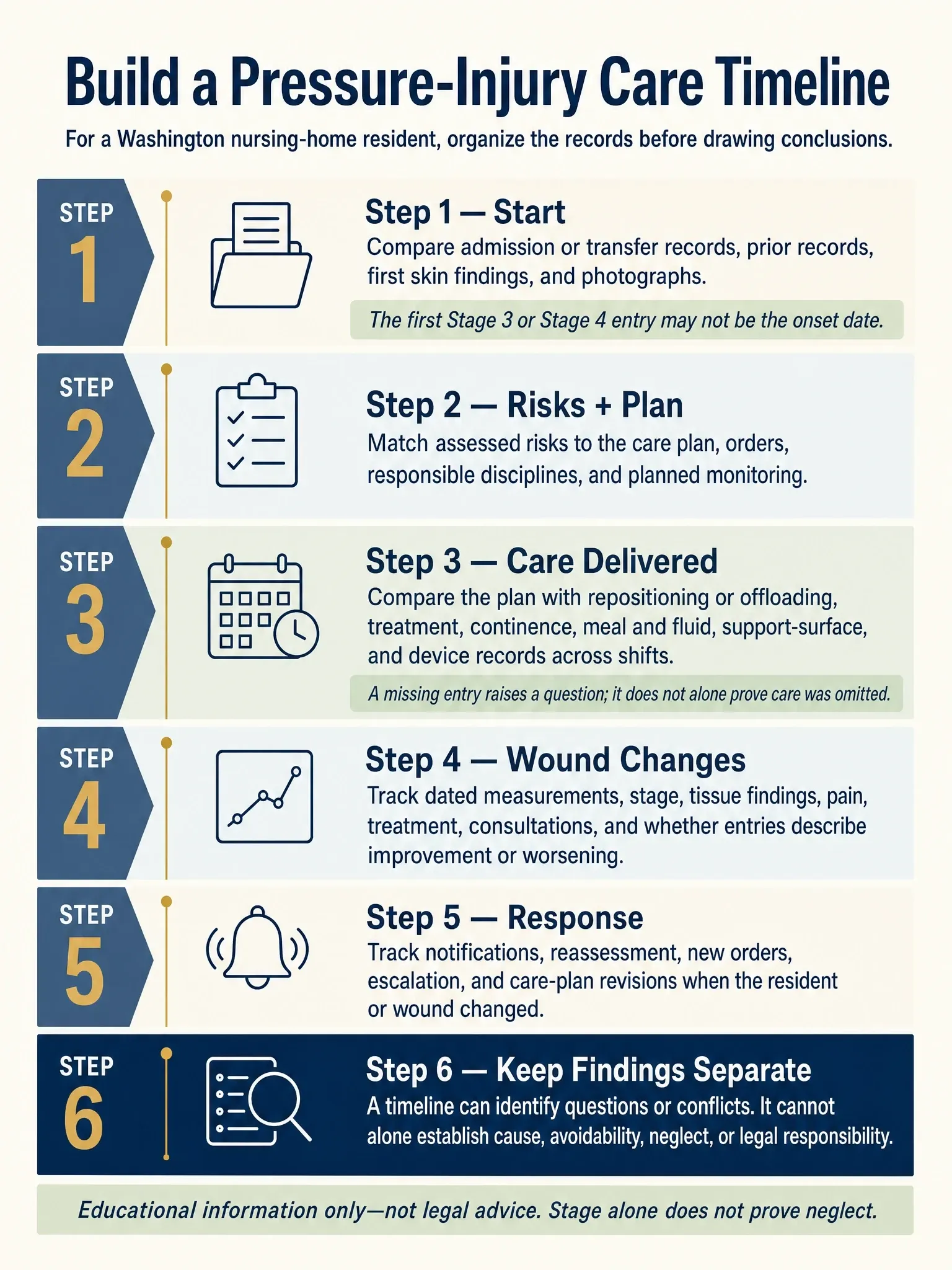
Washington requires resident records to include care plans and changes, assessments, evaluations, progress notes, treatments and services, and illness or injury information with the date, time, and action taken. Those records can be arranged chronologically to compare risk, plan, implementation, wound change, notification, and response.
The following is an organizing method, not a checklist that determines liability.
1. Establish the Starting Point
Begin with admission or the resident’s return from a hospital. Look for present-on-admission skin documentation, prior-provider records, transfer documents, and the first objective skin finding.
Compare the recorded onset date, location, initial description or stage, photographs, and previous records. Ask whether a dressing or eschar obscured the area and whether a deep tissue pressure injury could account for later visible depth. Do not assume that the date of the first Stage 3 or Stage 4 entry was necessarily the date the injury began.
2. Map the Resident’s Risks and the Plan
Arrange assessments and any Minimum Data Set and Care Area Assessment information in date order. Relevant subjects may include:
- mobility and ability to reposition independently;
- continence and moisture exposure;
- skin and wound history;
- nutrition, hydration, and weight;
- pain, diagnoses, medications, and blood-flow concerns;
- support surfaces; and
- pressure associated with medical devices.
Then match each identified risk to the care plan, orders, responsible discipline, and planned monitoring. Include supported information about preferences, refusals, informed choices, advance directives, hospice or comfort goals, and clinical contraindications.
3. Compare the Plan With Care Delivered Across Shifts
Review repositioning or offloading records, activities-of-daily-living and continence records, treatment administration, meal and fluid records, weights, support-surface use, and device management. Compare those materials with orders, care plans, flowsheets, audit trails, photographs, witness information, and objective wound changes.
A blank or missing entry can raise a legitimate question. It does not alone establish that care was omitted. Different records may support, contradict, or explain one another.
4. Track the Wound’s Objective Changes
Organize the wound information by date. Useful fields may include:
- stage and dimensions;
- wound edges, undermining, and tunneling;
- necrotic tissue, drainage, and surrounding skin;
- granulation and epithelialization;
- pain and healing status;
- treatment and adjunctive therapies; and
- consultations.
The AHRQ pressure-ulcer assessment model recommends evaluation weekly and whenever a change occurs. That is clinical guidance, not a Washington law requiring every nursing home to use that exact form or frequency.
The chronology may show whether the wound was described as stable, improving, or worsening and whether the measurements and narrative entries are internally consistent.
5. Review Notification, Escalation, and Revision
Track when the physician or advanced-practice clinician, wound specialist, dietitian, therapists, hospital, resident, and authorized representative were notified or involved.
WAC 388-97-0320 separately requires a Washington nursing home to immediately inform the resident, consult the resident’s physician, and notify a known surrogate decision maker—and, when appropriate and with the resident’s consent, interested family members—when specified changes occur. These include a significant change in the resident’s physical, mental, or psychosocial status or a need to alter treatment significantly. Whether a particular pressure injury triggers the rule depends on the resident’s clinical change and treatment needs, not on the stage label alone.
Ask:
- Were new orders carried out?
- Did a significant change prompt reassessment?
- Was the care plan revised when an intervention was ineffective or the resident’s condition changed?
- If infection, transfer, or another complication appeared, when was it recognized and how did the facility respond?
Timing can be important, but sequence alone does not prove that one event caused another.
6. Separate Timeline Findings From Conclusions
A chronology may reveal early recognition and consistent follow-through. It may also identify gaps that need explanation, delayed escalation, conflicting documentation, or a failure to revise an ineffective approach.
What the timeline cannot establish by itself is the wound’s cause, avoidability, a standard-of-care breach, proximate cause, or damages. Those conclusions may require review by qualified clinical and legal professionals familiar with the resident-specific evidence.
Records to Request and Evidence to Preserve Promptly
Resident Records
RCW 74.42.420 requires a Washington nursing home’s resident record to contain the comprehensive care plan and changes, examinations, assessments, evaluations, progress notes, treatments and services, and illness or injury information including the date, time, and action taken.
Under WAC 388-97-0300, a resident may make an oral or written request to access all records pertaining to the resident, including clinical records, within 24 hours. The rule also permits the resident to purchase photocopies with two working days’ advance notice at no more than 25 cents per page.
A family member’s or representative’s right to obtain records depends on the resident’s consent, the person’s legal authority, privacy law, and, after the resident’s death, applicable estate authority.
Practical Preservation Checklist
Depending on the circumstances, a prompt written request may identify:
- the complete resident chart;
- MDS and CAA information;
- care plans and revisions;
- skin and wound assessments and original photographs;
- treatment administration records;
- repositioning, offloading, ADL, and continence records;
- meal, fluid, weight, nutrition, and hydration records;
- provider orders and consultations;
- hospital-transfer records;
- incident and investigation materials;
- staffing assignments;
- electronic health-record audit trails and relevant communications;
- available surveillance video; and
- support-surface, medical-device, or device-data records.
This is a preservation checklist. It does not mean every item exists or that every item is part of the record the resident is entitled to access under the Washington rule.
Why Prompt Preservation May Matter
RCW 18.51.300 generally requires a nursing home to retain records directly related to a patient’s care and treatment for at least eight years after the most recent discharge, with special rules in some circumstances.
That clinical-record period does not guarantee that video, audit trails, communications, staffing materials, or device data will be retained for the same length of time. Identifying potentially relevant materials promptly can help preserve the available evidence without assuming that anything has been lost or destroyed.
Safety Concerns, Reporting, and Washington Complaint Options
When Immediate Safety Comes First
Call 911 for an emergency. For a non-emergency safety concern, a family can write down what it observed and when, ask the facility what immediate protective and clinical steps are being taken, and consider an external report where appropriate.
Facility and Mandated-Reporter Duties Are Fact-Specific
Facility reporting and individual mandated-reporter duties are separate. Under WAC 388-97-1640(1)(a), a Washington nursing home must immediately notify DSHS’s Home and Community Living Administration of allegations of resident abandonment, abuse, or neglect, including substantial injuries of unknown source. Under RCW 74.34.035, a mandated reporter must immediately report to DSHS when there is reasonable cause to believe abandonment, abuse, financial exploitation, or neglect of a vulnerable adult has occurred.
For Medicare- or Medicaid-certified facilities, 42 CFR 483.12(c) separately requires reporting of all alleged violations involving abuse, neglect, exploitation, or mistreatment, including injuries of unknown source. The federal report must be made immediately and no later than two hours if the alleged violation involves abuse or results in serious bodily injury, and no later than 24 hours in other cases; investigation results must be reported within five working days. A Stage 3 or Stage 4 label alone does not establish an allegation of neglect, a substantial injury of unknown source, or the statutory reasonable-cause threshold; the facts control.
Where Washington Families Can Raise Concerns
Washington nursing-home residents may voice grievances and complain to DSHS, the long-term care ombuds, the Attorney General’s Office, or law enforcement without interference, discrimination, or reprisal. Washington rules also prohibit retaliation.
The DSHS page for reporting vulnerable-adult concerns provides a 24-hour online reporting option. DSHS’s current statewide Complaint Resolution Unit number for concerns about a person living in a nursing home or other listed facility is 1-800-562-6078. DSHS states that proof is not required to make a report and anonymous reports are accepted.
For Vancouver and Clark County, the Washington Long-Term Care Ombudsman Southwest Region serves Clark and nearby counties. The program currently lists 360-694-9007 for the Southwest Region and 1-800-562-6028 as its statewide toll-free number.
A DSHS report or ombudsman complaint may help address resident safety and may result in investigative records. It does not file a civil lawsuit, guarantee a particular finding, or necessarily pause a deadline for a civil claim.
When to Seek Individualized Legal Guidance
Individual advice may be useful when a family needs help evaluating wound cause, avoidability, facility conduct, causation, potential defendants, preservation issues, or serious complications.
Washington deadline analysis is claim- and fact-specific. RCW 4.16.350 expressly includes nursing homes and supplies rules relevant to professional-negligence actions, but it should not be treated as a single deadline for every matter. Claim characterization, multiple acts, discovery, death, representative knowledge, public defendants, tolling, notice, and service rules can change the analysis.
Families considering a claim should seek individualized guidance promptly. A facility grievance, ombudsman contact, or agency complaint does not necessarily preserve civil rights or pause an applicable deadline.
A Practical Next Step for Vancouver and Clark County Families
A calm first sequence may be:
- Address immediate medical and resident-safety needs.
- Write down what the family observed, learned, and asked—and when.
- Request the relevant records and preserve original photographs and other available evidence.
- Organize the information into a chronology of risk, plan, care, wound change, notification, and response.
- Seek clinical, regulatory, or legal guidance that fits the family’s goal.
Johnson Law’s Vancouver and Clark County personal-injury information provides general local service information. It is not a substitute for resident-specific clinical assessment or legal advice.
The care timeline can sharpen the questions and preserve evidence. Conclusions about neglect and causation still depend on the resident’s complete circumstances.
Frequently Asked Questions
Does a Stage 4 pressure injury automatically mean nursing-home neglect?
No. Stage 4 is a serious clinical classification describing full-thickness skin and tissue loss with certain deeper structures exposed or directly palpable. Neglect, regulatory noncompliance, professional negligence, and causation each require separate, fact-specific analysis.
Can the stage tell when a pressure injury began?
No. Stages describe tissue damage, not wound age. An unstageable injury may conceal deeper loss, and a deep tissue pressure injury may reveal its extent rapidly. Stages are not a required linear progression.
Must every Washington nursing-home resident be turned every two hours?
The approved research did not locate a universal federal or Washington two-hour rule for every resident, and current evidence does not establish one best interval for everyone. The more useful questions are whether there was an appropriate individualized repositioning or offloading plan, whether it was followed, and whether it was reassessed as the resident responded or changed.
Which records can help reconstruct the care timeline?
Useful materials may include assessments, MDS and CAA information, care plans, wound measurements and photographs, treatment and repositioning records, ADL and continence records, nutrition and hydration information, orders, consultations, notifications, transfers, incident materials, and available audit trails or device records.
How can a Washington family report a nursing-home concern?
Call 911 for an emergency. For non-emergency concerns, Washington families may contact DSHS’s Complaint Resolution Unit or the Washington Long-Term Care Ombudsman. DSHS accepts reports without requiring the person reporting to prove the concern, and anonymous reports are accepted. Current contact information is available through the linked official Washington sources above.
How long does a family have to bring a claim?
There is no single answer that is safe for every matter. The applicable period may depend on the legal claim, the relevant acts or omissions, discovery, the parties, and other notice, tolling, and service rules. Agency and ombudsman complaints do not necessarily preserve a civil claim, so individualized advice should be obtained promptly.
Sources and Source Notes
- National Pressure Injury Advisory Panel, “Pressure Injury and Stages” — clinical definitions for pressure injury, Stage 3, Stage 4, unstageable injury, and deep tissue pressure injury.
- Revised NPUAP Pressure Injury Staging System consensus report — staging limitations and the non-linear-progression point.
- AHRQ, “Wound Classification” — differential assessment before applying pressure-injury staging.
- NPIAP, “Non-Pressure Skin Failure in the Critically Ill” — diagnostic uncertainty concerning proposed non-pressure-related skin failure and end-of-life skin changes.
- 42 CFR 483.25 and CMS Appendix PP, F686 — federal skin-integrity requirement for participating facilities and related survey guidance.
- WAC 388-97-0320, WAC 388-97-1000, WAC 388-97-1020, and WAC 388-97-1060 — Washington nursing-home notification, assessment, care-planning, and individualized-care requirements.
- RCW 74.42.420, WAC 388-97-0300, and RCW 18.51.300 — resident-record content, access, and general retention provisions.
- AHRQ, “On-Time Pressure Ulcer Assessment” and CMS Form CMS-20078 — clinical assessment fields and record-review categories useful for timeline reconstruction.
- Cochrane, “How often should a patient’s position be changed?” — evidence summary concerning individualized repositioning rather than a single best interval.
- WAC 388-97-1640, RCW 74.34.020, RCW 74.34.035, and RCW 74.34.200 — Washington facility reporting, vulnerable-adult definitions, individual mandated reporting, and the fact-specific civil remedy.
- DSHS, “Report Concerns Involving Vulnerable Adults” and Washington Long-Term Care Ombudsman, “Find an Ombuds” — current complaint and assistance channels.
This article provides general educational information and is not legal advice. Pressure-injury cause, avoidability, quality of care, reporting duties, legal responsibility, and deadlines require analysis of the resident’s specific facts and applicable law.
Client-First Fee Promise
Client First = Bills First, Fees Second
Your unpaid medical bills do not have to make your lawyer's fee bigger. Johnson Law subtracts qualifying medical bills before calculating our fee, helping clients keep more of their settlement.
Applies to qualifying cases. Results vary.