PTSD and Anxiety After a Crash: When Emotional Harm May Be Compensable in Washington

PTSD and Anxiety After a Crash: When Emotional Harm May Be Compensable in Washington
A serious crash can affect more than the body. A survivor may experience anxiety, disrupted sleep, recurring thoughts, concentration problems, anger, sadness, fear of driving, or other changes. Some people improve with time, and not everyone who goes through a traumatic event develops post-traumatic stress disorder (PTSD). Symptoms also do not look or begin the same way for everyone.
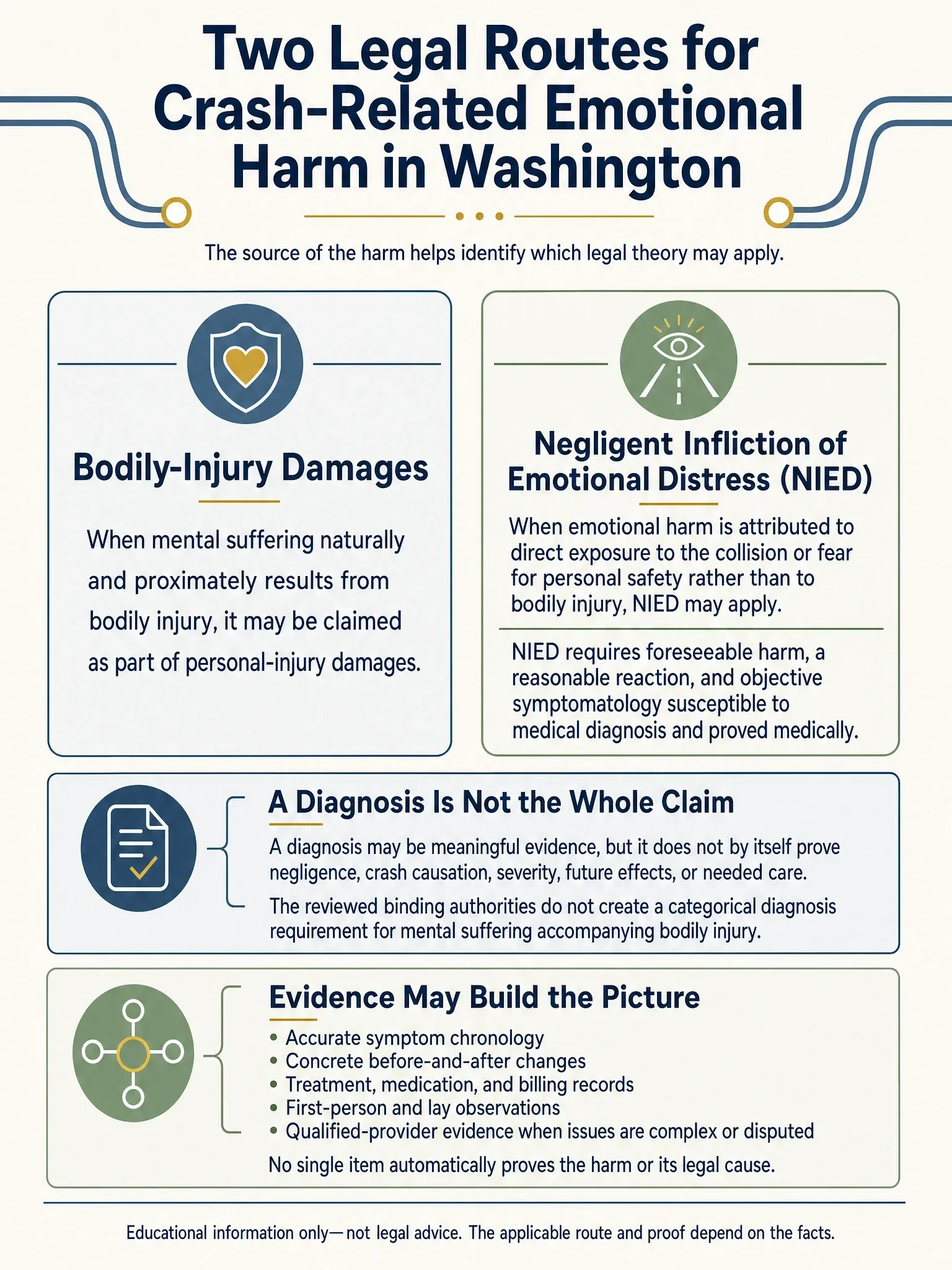
Washington recognizes distinct routes for crash-related emotional harm. Mental suffering that naturally and proximately results from a physical injury may be recovered as part of the personal-injury damages described in Green v. Floe. Emotional harm caused by the negligent event itself, rather than by the physical injury, may instead implicate negligent infliction of emotional distress and its separate requirements. In either route, the claimant must prove the required causal connection and damages.
This distinction also matters: emotional harm claimed as part of a bodily-injury case is not the same as a claim for negligent infliction of emotional distress, commonly called NIED. The two theories have different legal requirements.
Can Emotional Harm Be Included in a Washington Crash Claim?
Potentially. In the automobile-collision case Green v. Floe, the Washington Supreme Court explained that damages for physical injury may include mental anguish or suffering when it results so directly from the injury that it is a natural, legitimate, and proximate consequence.
Washington’s pattern jury instructions similarly identify past and future mental pain and suffering as potential elements of personal-injury damages. But the instructions also emphasize two important limits:
- The person bringing the claim has the burden of proving each claimed element of damage.
- Compensation is limited to harm proximately caused by the defendant’s negligence. Claimed future harm must be shown with reasonable probability, not mere possibility.
The relevant pattern instructions are WPI 30.01.01 and WPI 30.06. They are pattern instructions that guide courts, not statutes. The publicly available versions linked here are older editions whose comments still refer to former RCW 4.56.250; that statute was repealed in 2023. This article relies on the instructions’ causation, burden, and pain-and-suffering language, not on the repealed statute.
In practical terms, the issue is not simply whether emotional symptoms appeared after a crash. The evidence must address what happened, any physical injury, whether the emotional harm is attributed to that injury or to direct exposure to the collision, when the effects began, how they changed the survivor’s life, and whether the requirements of the applicable theory can be established. For broader context on this category of damages, see this guide to Washington pain-and-suffering damages.
The Source of the Emotional Harm Affects the Legal Route
The source of the claimed emotional harm matters to the legal theory. If mental suffering naturally and proximately results from bodily injury, Green supports treating it as an element of personal-injury damages. If PTSD or other distress is attributed primarily to direct exposure to the collision or fear for personal safety rather than to the bodily injury, the claim may implicate Washington’s separate NIED rules, including foreseeable harm, a reasonable reaction, and objective symptomatology.
Two Washington insurance-coverage decisions illustrate why policy wording can produce a separate issue. In Daley v. Allstate Insurance Co., the Washington Supreme Court recognized that emotional distress arising from physical injury may fall within policy language covering damages for bodily injury, but it found no coverage under the policy for distress unrelated to the insured’s physical injuries. In Trinh v. Allstate Insurance Co., a published Court of Appeals decision held that PTSD with physical manifestations could qualify as bodily injury under the particular UIM policy at issue.
Daley and Trinh address UIM policy coverage and should not be treated as complete rules of tort liability. A person who was directly exposed to the collision or feared for personal safety may need to evaluate Washington’s NIED rules even if the distress did not result from bodily injury. Which route applies—and whether its requirements can be proved—remains fact- and evidence-dependent.
Symptoms, Screening, and Diagnosis Are Different Questions
General information from the National Institute of Mental Health identifies anxiety, sadness or anger, trouble concentrating or sleeping, and recurring thoughts among possible reactions to a traumatic event. PTSD symptoms often begin within three months, but they may emerge later. Diagnosis involves more than the presence of one symptom; it considers matters such as duration, groups of symptoms, interference with daily function, and alternative explanations.
This medical information provides context only. It cannot diagnose an individual or establish legal causation, severity, or compensability.
A self-report screening measure is also different from a professional diagnosis. For example, the VA National Center for PTSD describes the PCL-5 as a self-report measure and identifies a structured clinical interview, such as CAPS-5, as the diagnostic gold standard. A screening score can provide information, but it should not be treated as definitive proof that someone has PTSD.
Is a PTSD or Anxiety Diagnosis Required?
The reviewed binding Washington authorities do not establish a categorical rule that a formal PTSD or anxiety diagnosis is always required before mental suffering accompanying bodily injury may be considered as damages. That is a conclusion from the authorities reviewed—not an express Washington Supreme Court holding that a diagnosis can never be required.
Professional evidence may still be important. A qualified provider may help document or explain:
- the nature and severity of symptoms;
- whether diagnostic criteria are met;
- the relationship between symptoms and the crash or physical injury;
- other possible causes;
- treatment needs and response; and
- prognosis or reasonably probable future effects.
The more medically complex or disputed the diagnosis, causation, permanency, or future treatment becomes, the more important qualified evidence may be.
A Diagnosis Does Not Prove the Whole Claim
A diagnosis can be meaningful evidence, but it does not by itself establish that another person was negligent, that the crash caused the condition, how severe the resulting harm is, whether it will continue, or what future care will be needed.
When expert medical testimony is needed and offered to establish medical causation, the opinion generally must support reasonable medical probability—often expressed as “more likely than not”—rather than mere possibility. Expert testimony is not invariably required for every claimed pain-and-suffering or future-damages issue; whether it is needed depends on whether the issue requires specialized medical knowledge. The complete claim therefore depends on the diagnosis, if any, together with the chronology, other evidence, and the causal and proof requirements of the applicable legal theory.
Emotional-Harm Damages Are Not the Same as NIED
The distinction between bodily-injury damages and NIED can prevent a significant misunderstanding.
When a crash survivor seeks compensation for mental suffering that naturally and proximately results from bodily injury, the emotional harm is being claimed as an element of damages in the bodily-injury case.
NIED is different. In that theory, emotional distress is itself the injury. It may be relevant when a directly endangered occupant attributes the harm to direct exposure to the collision or fear for personal safety rather than to bodily injury. Washington requires distress within the foreseeable scope of harm, a reasonable reaction, and objective symptomatology. Under Hegel v. McMahon, objective symptomatology for NIED need not always involve physical manifestations, but the distress must be susceptible to medical diagnosis and proved medically. Bylsma v. Burger King Corp. also addresses this framework.
The Washington Supreme Court clarified in M.N. & G.T. v. MultiCare Health System, Inc. that the objective-symptomatology requirement applies to NIED claims—not every claim requesting emotional-distress damages. M.N. was a health-care case, and its separate disease-transmission analysis should not be imported into crash cases.
In short, NIED’s specific medical-proof rule should not be recast as a universal requirement for all emotional harm claimed with bodily injury. At the same time, sustaining a physical injury does not automatically convert event-caused emotional harm into damages flowing from that injury; the source of the harm and the applicable legal route still matter.
A Family Member’s Bystander Claim Is Also Distinct
Bystander NIED is a separate and limited theory. Under Colbert v. Moomba Sports, Inc., it may apply to a family member who personally experiences the immediate aftermath of a loved one’s traumatic injury at the scene. Learning about the event later is not enough under that rule.
This means a directly injured occupant’s claim for mental suffering should not be confused with a relative’s potential bystander claim. It also means that emotional distress experienced by a family member does not automatically create an independent claim.
What Evidence Can Help Show Crash-Related Emotional Harm?
No single record, statement, screening result, or diagnosis automatically proves emotional harm or its legal cause. Useful evidence instead tends to build a reliable picture of chronology, observable changes, daily function, treatment, causation, and likely future effects.
The Survivor’s Own Account and Observable Changes
An injured person may testify about subjective pain and suffering. People who know the survivor may also describe changes they observed, such as disrupted routines, sleep difficulty, avoidance of driving, concentration problems, missed activities, or changes in relationships.
Washington’s Bitzan v. Parisi supports the use of first-person and lay evidence concerning subjective suffering and observable limitations. That case concerned physical pain and disability, not PTSD, so it should be used narrowly. Family members, friends, coworkers, and other lay witnesses can describe what they saw; they should not attempt to diagnose a psychiatric condition.
Helpful descriptions are usually concrete and accurate. “She stopped taking the highway after the collision” says more about an observed change than a witness’s unsupported conclusion that “she has PTSD.”
Treatment, Clinical, Medication, and Billing Records
Ordinary health records may help establish when symptoms were reported, what a clinician observed, any diagnosis given, changes in function, treatment plans, progress, medication history, and costs. Billing records may help document the services received and associated charges.
Federal HIPAA guidance generally gives people access to medical and billing information in a designated record set, including clinical case notes. The U.S. Department of Health and Human Services explains that separately maintained psychotherapy notes are excluded from this federal access right. Psychotherapy notes are not interchangeable with ordinary records about diagnosis, symptoms, function, treatment plans, progress, or billing. HIPAA access rules also are not the same as the rules governing civil discovery.
A Practical Before-and-After Record
A clear chronology can help identify what changed and when. Depending on what exists and is available, useful material may include:
- accurate, dated descriptions of symptom onset and duration;
- notes about effects on sleep, driving, avoidance, panic, concentration, relationships, attendance, and daily activities;
- treatment, medication, and billing records;
- collision reports;
- photographs or video;
- vehicle data;
- witness names and contact information;
- 911 or dispatch materials; and
- insurance communications.
This is not a requirement to create a perfect diary or produce every type of record. Records may be unavailable, incomplete, or created for purposes unrelated to litigation. The goal is to preserve what exists and describe experiences honestly, without exaggeration or self-diagnosis.
If Care Did Not Begin Immediately
A gap or delay in care does not justify blame. Trauma symptoms may emerge later, people respond differently, and treatment decisions are personal. A decision not to pursue a particular mental-health treatment is not automatically unreasonable under Washington law.
Timing can still become part of the proof. It may help to describe, as accurately as possible:
- when symptoms first appeared;
- whether and how they changed;
- how they affected daily life;
- when care was sought; and
- what the available records do and do not show.
Washington mitigation law is fact-specific. A defendant seeking to reduce damages based on an asserted failure to mitigate must support the claim that a treatment decision was unreasonable, that an alternative was available, and that some harm could have been avoided. Delayed care or declining one treatment should not be treated as an automatic bar.
What If Anxiety, Depression, or Trauma Existed Before the Crash?
A preexisting mental-health history does not produce one automatic answer. The important questions often include the person’s baseline before the crash, what changed afterward, and whether the evidence connects an activation or aggravation to the collision.
Dormant Vulnerability or Unusual Susceptibility
Washington’s eggshell principle may apply when a crash activates a dormant, asymptomatic condition. In Harris v. Drake and Bennett v. Messick, the Washington Supreme Court addressed harm involving dormant conditions and unusual susceptibility.
The principle can extend to mental susceptibility. In Fox v. Evans, the Court of Appeals addressed a preexisting mental condition or personality profile that had not been causing pain or disability but made the claimant more susceptible to psychological injury.
This does not mean that every symptom after a crash is compensable. The claimant still must prove that the crash activated or caused the claimed harm.
Active Symptoms or Disability Before the Crash
If anxiety, depression, trauma symptoms, sleep problems, or another condition was already active and causing symptoms or disability, the analysis is different. The claim concerns the crash-related aggravation and other proximately caused harm—not unrelated prior disability.
Sutton v. Shufelberger reflects Washington’s distinction between a preexisting condition that was already causing problems and the aggravation caused by a later event. Before-and-after records may therefore matter, including records of treatment, medication, work or school attendance, driving, sleep, relationships, and daily function.
The evidence may also need to address later stressors or competing causes. How active prior symptoms, crash-related aggravation, later events, and treatment choices should be separated is case-specific.
Treatment Choices, Claim Development, and Timing
Health decisions should be based on a person’s needs, not on pressure to create a legal record. At the same time, accurate treatment and symptom records may help explain what the person experienced and how the condition progressed.
Prognosis, future effects, and treatment needs may take time to evaluate. Washington’s pattern instruction requires reasonably probable—not merely possible—future harm. That is one reason claim development may depend on the available medical and functional picture. This overview explains more about why a Washington injury claim’s timeline can vary.
Claim development time and legal filing deadlines are separate issues. Waiting for symptoms or treatment to stabilize does not necessarily extend the time to take required legal action.
Washington Deadlines Can Depend on Who Was Involved
Washington generally provides a three-year limitations period for an action involving injury to a person or their rights. But that general rule should not be used to calculate an individual’s deadline without examining the facts. Accrual, tolling, claimant status, defendant identity, and other law may change the analysis. Later-emerging emotional symptoms should not be assumed to restart the period.
Additional procedures can apply when a government body or employee may be responsible:
- A tort claim against a local government must be presented to its designated agent, followed by a 60-calendar-day waiting period before suit. The limitations period is tolled during that waiting period under RCW 4.96.020.
- A tort claim against Washington State must be presented to the Office of Risk Management and generally has its own 60-calendar-day waiting period, with tolling during that period. See RCW 4.92.100 and RCW 4.92.110.
These are presentment and waiting requirements, not generic rules that every crash victim has only 60 days to act. Government involvement—for example, a potentially responsible Vancouver, Clark County, or state employee—can make early, individualized deadline review especially important.
Vancouver and Clark County Records to Consider Preserving
For crashes in and around Vancouver, official sources identify several places to request records:
- The Washington State Patrol provides collision-report requests.
- The Clark County Sheriff’s Office Public Disclosure Unit directs people to Washington State Patrol for collision reports, CRESA for 911 and dispatch materials, and Vancouver Police for incidents within Vancouver city limits.
The existence and availability of any particular report, recording, or other record will vary. Preserving request details and any records received can help maintain an accurate account of the collision.
Practical Next Steps for a Washington Crash Survivor
After a crash, a calm sequence of steps can help protect both health and information:
- Attend to health needs. Seek care based on your symptoms and circumstances. Do not assume that you must diagnose yourself or pursue a particular treatment for legal reasons.
- Record changes accurately. Note when symptoms began and how they affected sleep, travel, concentration, work or school, relationships, and daily activities. If memories or timing are uncertain, say so rather than filling gaps.
- Preserve available material. Keep crash reports, photographs, video, witness information, 911 or dispatch records, insurance communications, treatment records, medication information, and bills that are available to you.
- Keep the legal theory clear. Emotional suffering caused by bodily injury is different from distress attributed to direct exposure to the collision, which may implicate NIED. A family member’s potential bystander claim is different from both.
- Consider individualized guidance when the issues are disputed. Questions involving complex causation, preexisting symptoms, future care, government responsibility, or deadlines may require a case-specific assessment.
For readers in Southwest Washington, this Vancouver car-accident guidance offers additional local information.
Frequently Asked Questions
Can PTSD or Anxiety Be Compensated After a Washington Car Crash?
Potentially. Mental suffering that naturally and proximately results from physical injury may be included in personal-injury damages. Emotional harm attributed to the negligent event itself rather than to the physical injury may implicate NIED and its separate proof requirements. A diagnosis may be important evidence, but no reviewed binding Washington authority creates a categorical diagnosis requirement for mental suffering recoverable as a consequence of bodily injury.
Do I Need a Formal PTSD Diagnosis to Claim Emotional Harm?
No reviewed binding Washington authority establishes a categorical diagnosis requirement for mental suffering recoverable as a consequence of bodily injury. But that does not mean a diagnosis or professional evidence is never needed. Qualified evidence may be important when diagnosis, competing causes, severity, prognosis, future effects, or treatment needs are disputed. NIED has separate requirements, including objective symptomatology that must be susceptible to medical diagnosis and proved medically.
What If PTSD Symptoms Started Weeks or Months After the Crash?
General medical guidance recognizes that PTSD symptoms may emerge later. An accurate chronology of onset, duration, functional effects, treatment timing, and other possible causes may help evaluate the evidence. Later onset should not be assumed to restart or extend a legal filing deadline.
Can Family Members Describe Changes They Observed After the Crash?
Yes. Family members and other lay witnesses may describe observable changes and limitations, such as altered sleep, routines, driving, concentration, or activities. They should describe what they observed rather than diagnose PTSD, anxiety, or another condition.
What If I Had Anxiety, Depression, or Trauma Before the Collision?
A prior history does not automatically end the inquiry. A dormant vulnerability and an active preexisting condition are analyzed differently. In either situation, the evidence should address the pre-crash baseline, the change after the crash, and what the collision caused or aggravated.
Is Emotional Distress in an Injury Claim the Same as NIED?
No. Mental suffering claimed as a consequence of bodily injury is different from negligent infliction of emotional distress, which may apply when emotional injury is attributed to the negligent event itself and has its own requirements. Bystander NIED for a family member is a distinct and narrower theory.
Source Notes
The principal Washington authorities supporting this article include:
- Green v. Floe and Washington Pattern Jury Instructions WPI 30.01.01 and WPI 30.06 for causation, the burden of proof, and mental suffering as a potential bodily-injury damages component. The linked public WPI versions are older editions, and this article does not rely on their references to former RCW 4.56.250, which was repealed in 2023.
- Hunsley v. Giard, M.N. & G.T. v. MultiCare Health System, Inc., Hegel v. McMahon, and Bylsma v. Burger King Corp. for the distinct NIED route and its requirements.
- Anderson v. Akzo Nobel Coatings, Inc. for the reasonable-medical-probability standard when expert medical testimony is needed and offered to prove medical causation, and Bitzan v. Parisi for the separate point that lay evidence may support pain-and-suffering or future-damages issues and expert testimony is not invariably required.
- Harris v. Drake, Fox v. Evans, and Sutton v. Shufelberger for dormant susceptibility, mental vulnerability, active preexisting conditions, aggravation, and mitigation considerations.
- RCW 4.16.080, RCW 4.96.020, and RCW 4.92.100-.110 for general limitation and government-claim procedures.
- The National Institute of Mental Health, VA National Center for PTSD, and U.S. Department of Health and Human Services for general medical, screening, and health-record context. These sources do not establish Washington liability or diagnose an individual.
This article provides educational information only and is not legal advice. The application of Washington law, claim requirements, and deadlines depends on the specific facts.
Client-First Fee Promise
Client First = Bills First, Fees Second
Your unpaid medical bills do not have to make your lawyer's fee bigger. Johnson Law subtracts qualifying medical bills before calculating our fee, helping clients keep more of their settlement.
Applies to qualifying cases. Results vary.