Missing Handrail on a Staircase: When a Washington Fall Becomes a Building-Code Case
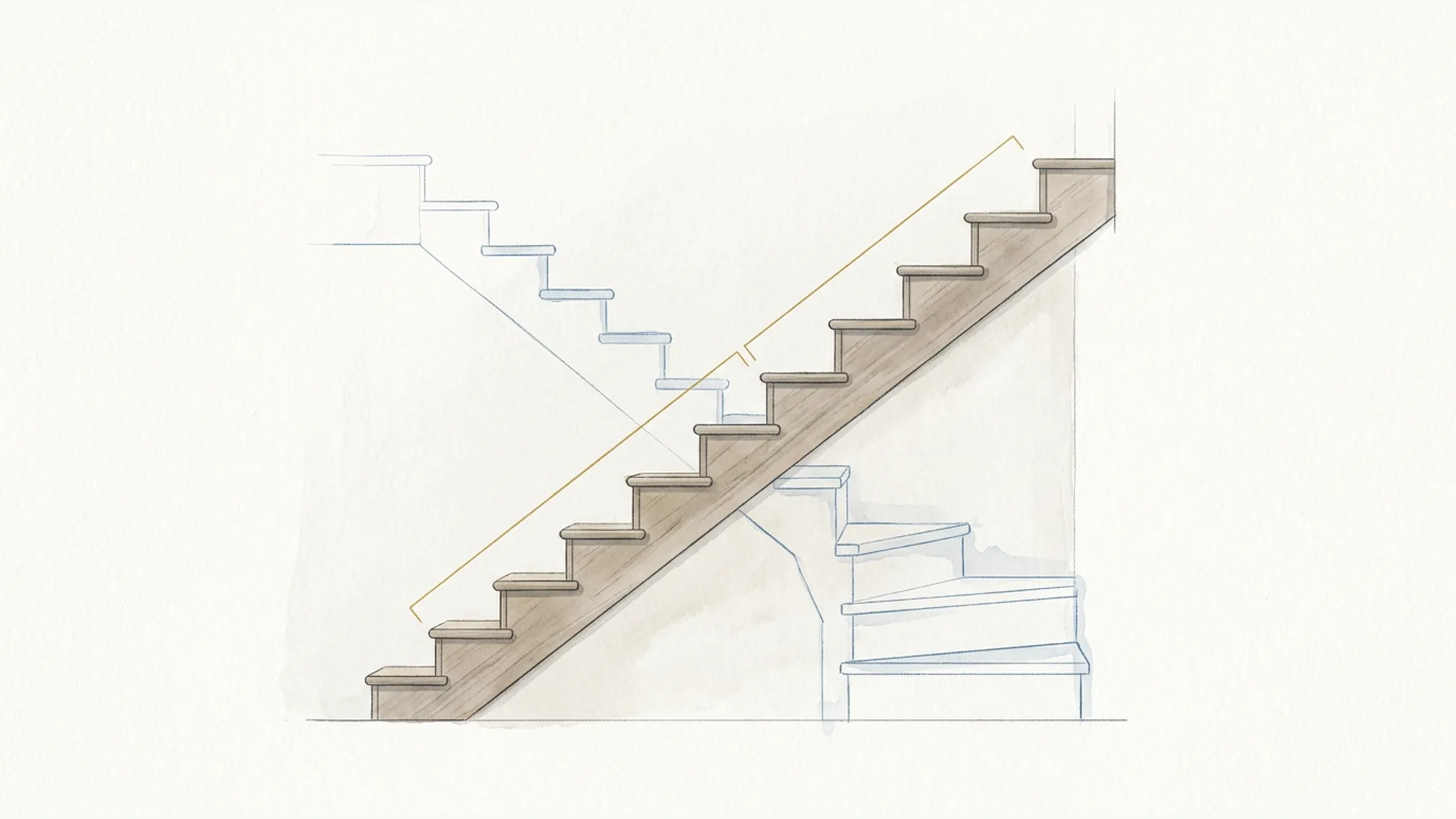
Missing Handrail on a Staircase: When a Washington Fall Becomes a Building-Code Case
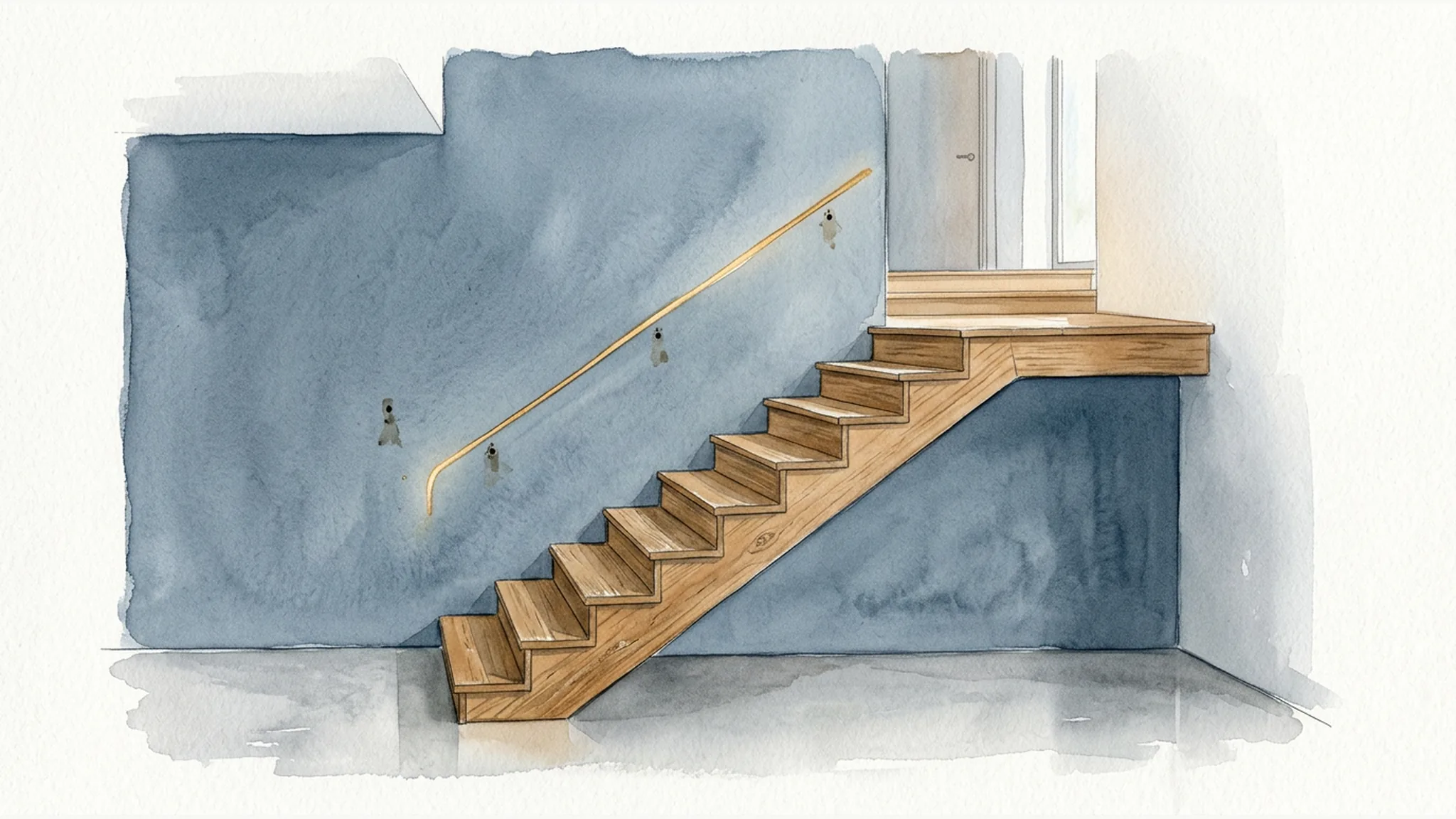
A missing handrail can be important after a staircase fall, but its absence alone does not prove that the stair violated a building code or that someone is legally responsible for an injury.
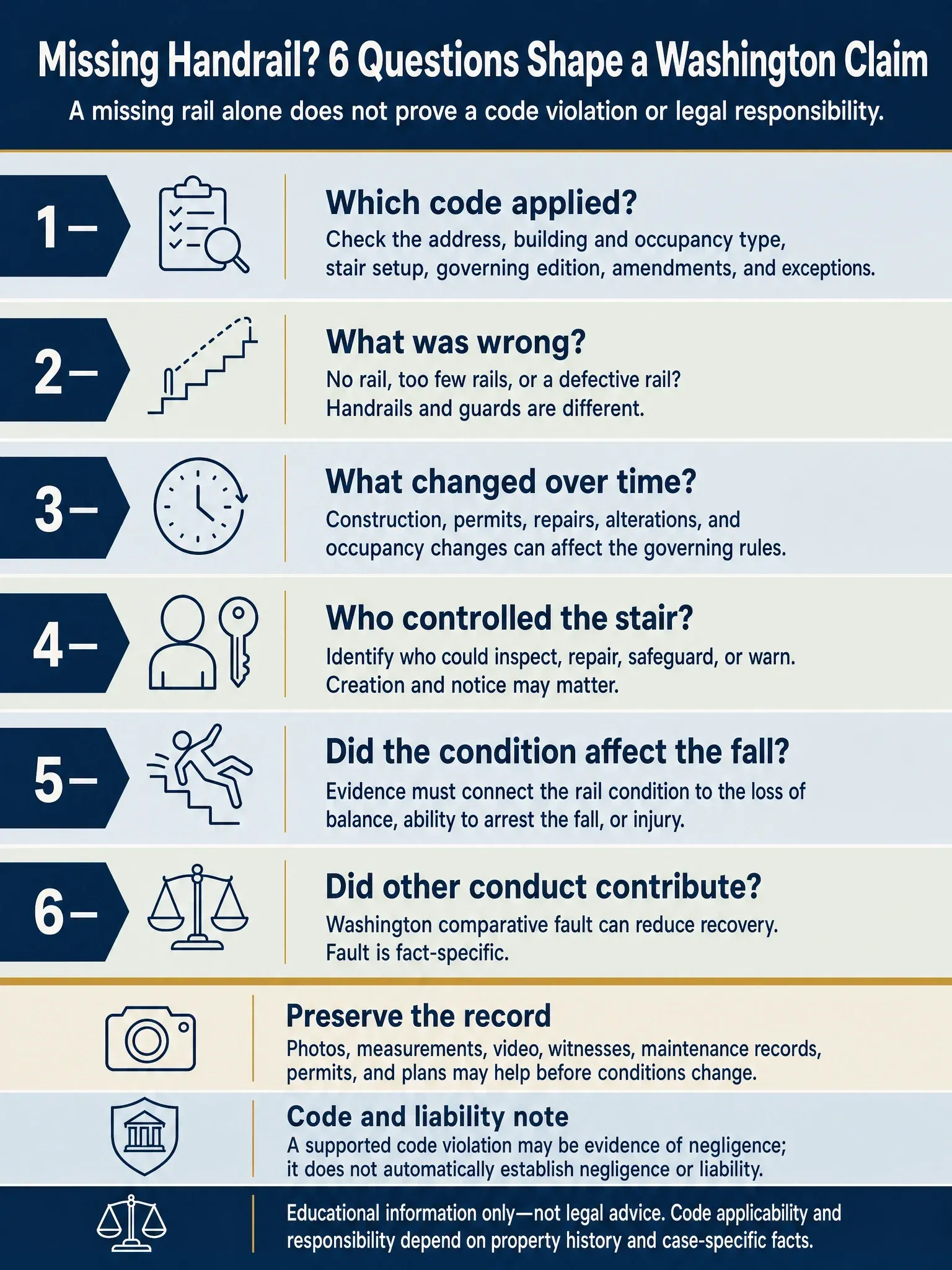
The investigation usually requires several separate questions:
- Which building code applied to the stair when it was built or altered?
- Did that code require a handrail for this building and stair configuration?
- Was the issue a completely missing rail, too few rails, or a defective rail?
- Who possessed or controlled the stair and had the ability to inspect, repair, or warn?
- Did that person or organization know—or reasonably should it have known—about the condition?
- Could a proper handrail have prevented the fall, helped the person arrest it, or reduced the resulting injury?
- Did the injured person’s conduct contribute to what happened?
For a fall in Vancouver or elsewhere in Clark County, photographs and measurements are only part of the picture. The property’s address, occupancy, construction and alteration history, permit records, and the identity of the party controlling the stair may all affect the analysis.
Does a Missing Handrail Automatically Mean the Stair Violated Code?
No. Washington’s State Building Code includes the International Building Code (IBC) and International Residential Code (IRC), as adopted and amended by the state. The model-code language and Washington amendments must be read together. Which framework applies can depend on the property’s jurisdiction, building and occupancy type, stair use and configuration, number of risers, and any relevant exception.
That means a person generally cannot determine code compliance from a photograph showing no rail. Measurements and project history matter, and the rule for one kind of residence should not be assumed to govern a commercial, public, or multifamily staircase.
IBC Versus IRC: Why the Building Type Matters
The current Washington IRC applies within the scope set out in WAC 51-51-01010, including detached one- and two-family dwellings, adult family homes, and townhouses not more than three stories above grade plane with a separate means of egress, subject to the listed exceptions. The IBC governs buildings and structures outside the IRC’s scope. That means an IRC-scoped townhouse should not be assumed to use the IBC, and an apartment building should not be assumed to use the IRC.
Under the 2021 IBC, Section 1011.11 generally requires handrails on each side of stairways, subject to its listed exceptions. Under the 2021 IRC, Section R311.7.8 generally requires a handrail on at least one side of each continuous run of treads or flight with four or more risers, subject to the governing edition, Washington amendments, and exceptions.
The IRC’s four-riser rule is therefore not a universal Washington rule for every staircase. Before relying on either standard, the investigation should establish the type of building, the stair’s function and configuration, and the code provisions that governed the relevant work.
Missing, One-Sided, or Defective Handrails Are Different Questions
“Missing handrail” can describe more than one condition. A stair may have:
- no handrail at all;
- one handrail where the governing code may have required two; or
- a rail that is allegedly too high, discontinuous, non-graspable, too close to another surface, improperly extended, or structurally inadequate.
Under Washington’s current IBC amendment, handrail height generally must be uniform and at least 34 inches but no more than 38 inches above the stair-tread nosings, subject to stated transition exceptions. Height is only one possible issue, however, and that current measurement should not be treated as the historical rule for an older stair unless the evidence shows that the provision governed the relevant construction or alteration.
Handrail or Guard? The Terms Are Not Interchangeable
A handrail is a graspable support along a stair. A guard addresses fall exposure at an open-sided walking surface.
One staircase can raise separate handrail and guard questions. For example, the need for graspable support and the need for protection along an open side are not necessarily decided by the same provision. Guard requirements depend on elevation and code context, so calling every stair barrier a “handrail” or “guardrail” can obscure the actual issue.
Which Code Edition Applied to the Stair?
The code in effect on the date of a fall does not automatically establish the requirements that governed an older, unchanged staircase. The relevant inquiry may include:
- the date of original construction;
- later permit applications;
- alterations, repairs, or replacement work;
- additions;
- changes in the building’s occupancy or use; and
- the existing-building rules applicable to that work.
Existing-building rules may allow some previously lawful conditions to continue while requiring changes when specified work occurs. That is why a generic statement that an older stair was “grandfathered” is not a reliable answer. Without the exact address, occupancy, stair measurements, and construction or alteration history, the applicable historical code may remain unresolved.
Current Washington, Vancouver, and Clark County Code Context
As of August 17, 2026, Washington was operating under the 2021 code cycle. WAC 51-50-008 and WAC 51-51-008 state that the 2021 IBC and IRC became effective in all Washington counties and cities on March 15, 2024. Vancouver also identifies March 15, 2024. Although Clark County’s Permit Center page displays March 14, 2024, that date conflicts with the binding statewide implementation rules and should not be treated as a coequal legal effective date. The Washington State Building Code Council identifies May 3, 2027, as the planned effective date for the 2024 codes; that future date should be rechecked before reliance. Vancouver Municipal Code Title 17 or applicable Clark County provisions may also require review for a specific property or project.
These current dates still do not answer which code governed a staircase built years earlier and left unchanged.
How Permits and Alteration Records Help
Permit applications, plans, inspection records, correction notices, certificates, and alteration records may help establish when work occurred and which code applied to it. They may also clarify the approved scope of a renovation or whether stair work was part of a larger project.
The correct records office depends on the address. Properties inside Vancouver use city records. Clark County’s building program generally serves unincorporated Clark County and Yacolt.
A permit or inspection approval can be relevant, but it does not necessarily establish that the stair complied in every respect. Nor does it automatically eliminate a possible negligence claim. The actual condition, the approved plans, the inspection history, and the work performed may need to be compared.
A Code Violation May Be Considered Evidence — It Does Not Automatically Establish Negligence or Liability
Under RCW 5.40.050, a breach of a duty imposed by statute, ordinance, or administrative rule shall not be considered negligence per se but may be considered by the trier of fact as evidence of negligence, subject to the statute’s listed exceptions. Ordinary staircase-handrail requirements are not among the listed exceptions. A claimant still must prove the other elements of the applicable claim.
In practical terms, even a supported handrail-code violation generally does not end the liability analysis. An injured person still must establish the applicable legal duty, a breach of that duty, factual and legal causation, and damages. Questions about possession, control, creation of the condition, and notice may remain disputed.
Code evidence can help show what safety measures were required, but it does not make a property possessor the insurer of every visitor’s safety.
Who Controlled the Stair, and Who Knew About the Condition?
The record owner’s name does not necessarily resolve responsibility. Depending on the property and agreements in place, the relevant parties could include an owner, commercial tenant, residential landlord, property manager, maintenance contractor, homeowners’ association, or another party assigned responsibility by a lease or management agreement.
Possession and control matter because they can identify who had the practical ability and duty to inspect, repair, provide safeguards or warnings, or restrict access.
Notice also matters. Actual notice may arise from a complaint, repair request, inspection, or direct knowledge. Constructive notice generally asks whether the condition existed long enough that a reasonable inspection should have discovered it. If the possessor or its agent created the alleged dangerous condition, separate proof of notice of the condition is ordinarily not required. In business-invitee cases, a fact-specific reasonable-foreseeability exception may also apply where the nature of the business and its methods of operation make the specific unsafe condition reasonably foreseeable; that exception is not per se and does not eliminate the remaining negligence elements. An omitted or long-standing structural feature may present a different creation-and-notice history from a temporary spill.
For invitees, Washington premises law may require reasonable inspection for dangerous conditions and appropriate repair, safeguards, or warnings. A visitor’s legal status and the circumstances of the visit can affect the precise duty, so the same analysis should not be assumed for every customer, tenant, contractor employee, social visitor, or other entrant.
Residential Landlord and Common-Area Questions
Washington residential landlords have duties under RCW 59.18.060 that include substantial compliance with applicable codes for conditions that endanger or impair the tenant’s health or safety, maintenance of structural components in reasonably good repair, and maintenance of common areas reasonably safe from defects that increase fire or accident hazards. The statute does not, however, itself give a tenant’s guest an implied personal-injury cause of action; a guest’s common-law premises-liability claim must be analyzed separately.
The lease, the location of the stair, control over repairs, prior tenant notice, and whether the stair was in a common area or a tenant-controlled space may all affect responsibility. Premises-liability principles and statutory landlord duties can overlap without being identical.
Structural Conditions Versus Temporary Hazards
A handrail omitted during construction or absent for an extended period differs from a spill that appeared shortly before a fall. The evidence of who created the condition and how long it existed may be very different. Readers evaluating a temporary condition can learn more about Washington claims involving transient wet-floor conditions, but those cleaning-log issues do not establish the rules for staircase handrails.
Could a Handrail Have Prevented or Arrested the Fall?
Showing that a handrail was required is only part of a potential case. There must also be a supportable connection between the missing or defective rail and the fall or injury.
Useful questions may include:
- Did the person reach for a handrail or expect one to be present?
- On which side would the rail have been needed?
- Could a properly placed rail have been reached and grasped?
- Did the absence of a rail contribute to the initial loss of balance, prevent the person from arresting the fall, or worsen the injuries?
- Can qualified code or biomechanical analysis reliably address those questions?
In Mehlert v. Baseball of Seattle, Inc., evidence about code-required handrails and expert testimony that a handrail could have allowed the plaintiff to arrest her fall created a triable causation issue even though she could not remember precisely why she fell. The decision illustrates how code and qualified causation evidence can work together. It does not establish liability whenever a handrail is absent, guarantee that expert testimony will be accepted, or mean that an expert is necessary in every case.
Comparative Fault Usually Reduces Recovery, but the Intoxication Statute Can Create a Complete Defense
Washington generally follows pure comparative fault. Under RCW 4.22.005, contributory fault ordinarily reduces compensatory damages proportionately but does not bar recovery.
A separate statutory rule can apply when intoxication is at issue. Subject to RCW 5.40.060(2), subsection (1) provides a complete defense if the injured person was under the influence, that condition was a proximate cause of the injury, and the person is found more than 50 percent at fault. Intoxication alone does not establish the defense.
Depending on the evidence, other disputed circumstances might include lighting, footwear, phone use, familiarity with the stairs, pace, available supports, and whether the condition was visible. No single factor necessarily establishes fault.
Likewise, describing a missing rail or stair condition as open and obvious does not invariably eliminate a property possessor’s duty. Washington law recognizes that foreseeable distraction, forgetfulness, or a person’s need to encounter a condition may matter. At the same time, the visibility or obviousness of the condition can support comparative-fault arguments. Both questions are fact-specific.
What Evidence Should Be Preserved After a Stair Fall?
Stair conditions can be repaired or altered quickly. Prompt preservation may help establish what was present at the time, although a request does not guarantee that records or video exist or will be produced.
Potentially useful evidence includes:
- Photographs and measurements: Document the entire stair flight, approaches, both sides, each landing, available rails or barriers, and lighting conditions. Record the number of risers, stair width and slope, and relevant rail placement rather than relying only on visual impressions.
- Video and incident records: Identify surveillance footage, photographs taken by others, and incident reports that may document the scene.
- Witness information: Preserve names and contact details for people who saw the fall, the condition, prior incidents, or earlier complaints.
- Property and maintenance records: Consider prior complaints, repair requests, maintenance records, inspection documents, leases, and management agreements that may bear on notice and control.
- Permit history: Request relevant permit applications, approved plans, inspection records, correction notices, certificates, and alteration records from the correct city or county office.
Later repairs should be documented factually. They should not be described as an admission of negligence without a separate evidence-law analysis. Similarly, the destruction or alteration of the condition can create serious evidentiary gaps, but it does not automatically create an inference of negligence in every staircase case.
Useful Photographs and Measurements
Photographs are most helpful when they provide context, not just a close-up of the spot where someone fell. If it can be done safely, capture:
- the full flight from the top and bottom;
- the approach from the injured person’s direction of travel;
- both sides of the stairs;
- each landing;
- lighting and visibility; and
- measurements relevant to the stair and any existing rail.
Informal measurements do not replace qualified analysis. Their purpose is to preserve the condition so it can be evaluated after the scene changes.
Special Caution for Falls on Government Property
A fall in a government-owned or -controlled building may involve special claim-presentation rules before suit, but the procedure depends on the government entity. RCW 4.96.020 governs claims against Washington local governments, while RCW 4.92.100 and RCW 4.92.110 govern claims against the State of Washington. Both statutory schemes generally require presentation and a sixty-calendar-day waiting period before suit, with statutory tolling rules. Federal, tribal, or other public property may be governed by different procedures. Presenting a claim is not the same as filing a lawsuit, and the ordinary three-year period should not be used as the entire timing analysis.
Washington ordinarily has a three-year limitations period for actions involving injury to a person. But accrual, tolling, the claim-presentation procedure for the particular government entity, construction claims, and other exceptions can change the analysis. A universal filing deadline should not be calculated from that general rule alone. Prompt, case-specific review is especially important when any government entity may own or control the property.
The Practical Questions That Shape a Washington Missing-Handrail Claim
A careful evaluation usually starts with facts rather than a conclusion. The most useful questions include:
- What is the exact property address, and is it inside Vancouver or in unincorporated Clark County?
- What type of building and occupancy was involved?
- How many risers were there, and what were the stair’s dimensions and configuration?
- Was there no rail, only one rail, or an allegedly defective rail?
- When were the building and stairs constructed?
- Were the stairs later repaired, replaced, altered, permitted, or affected by a change in occupancy?
- Who possessed and controlled the stair?
- Were there earlier complaints, repair requests, inspections, or correction notices?
- Are photographs, video, witness accounts, maintenance records, permits, or plans available?
- How could the missing or defective rail have affected the loss of balance, the ability to arrest the fall, or the resulting injury?
For readers seeking local context, Johnson Law provides additional Vancouver personal-injury information. The central point remains the same: a Washington building-code case is assembled from the governing code, the property’s history, responsibility and notice, causation, comparative fault, and preserved evidence—not from the absence of a rail alone.
Frequently Asked Questions
Does every staircase in Washington need a handrail?
No. The answer depends on whether the IBC or IRC applies, the building and occupancy, stair configuration and riser count, the governing code edition, Washington amendments, and any applicable exceptions.
Does a missing handrail automatically prove negligence in Washington?
No. Even if the governing code required a handrail, Washington law generally provides that a code violation may be considered by the trier of fact as evidence of negligence, not negligence per se. Duty, breach, causation, damages, possession or control, and notice may still need to be established.
What is the difference between a handrail and a guard?
A handrail is a graspable support along stairs. A guard addresses fall exposure at an open-sided walking surface. A staircase may raise one or both issues under different provisions.
Which building code applies to an older staircase?
The current code does not automatically govern an older, unchanged stair. The analysis may require the original construction date, permits, later alterations or repairs, additions, occupancy changes, and the existing-building rules applicable to that work.
Can a claim proceed if I do not remember exactly why I fell?
Possibly, but causation still requires evidence. Mehlert shows that code evidence and qualified expert testimony may create a triable issue in some circumstances even when the injured person cannot recall the precise reason for the fall. It does not guarantee that result in another case.
What if the staircase was in a government building?
Special claim-presentation procedures may apply before suit, and the procedure depends on the government entity. Washington local-government claims are governed by RCW 4.96.020, while claims against the State of Washington are governed by RCW 4.92.100 and RCW 4.92.110. Federal, tribal, or other public property may involve different rules. The ordinary personal-injury limitations period should not be treated as the entire deadline analysis.
Sources and Source Notes
- RCW 19.27.031 — adoption of the Washington State Building Code, including the IBC and IRC as adopted and amended.
- Washington State Building Code Council — date-sensitive statewide code-cycle information.
- 2021 IBC Chapter 10 and 2021 IRC Chapter 3 — model-code stair and handrail provisions, which must be read with Washington amendments and applicable exceptions.
- WAC 51-50-008, WAC 51-51-008, and WAC 51-51-01010 — the March 15, 2024 statewide implementation date for the 2021 IBC and IRC, and Washington’s current IRC scope.
- WAC 51-50-1011 and WAC 51-50-1014 — Washington IBC amendments addressing stairways and handrails.
- City of Vancouver Building Codes and Regulations and Clark County Permit Center — local code-cycle and permit-record context.
- RCW 5.40.050 — treatment of statutory, ordinance, and administrative-rule violations as evidence of negligence, subject to listed exceptions.
- Tincani v. Inland Empire Zoological Society and Iwai v. State — Washington premises duties, inspection, notice, and open-and-obvious principles.
- Lian v. Stalick, RCW 59.18.060, and Gerlach v. The Cove Apartments, LLC — possession and control, residential-landlord duties, and the treatment of a tenant guest’s claimed statutory personal-injury remedy.
- Mehlert v. Baseball of Seattle, Inc. — a fact-specific illustration involving handrail code evidence and fall-arrest causation testimony.
- RCW 4.22.005, RCW 5.40.060, and RCW 4.16.080 — comparative fault, the intoxication defense, and the ordinary personal-injury limitations period.
- RCW 4.96.020, RCW 4.92.100, and RCW 4.92.110 — separate claim-presentation procedures for Washington local governments and the State of Washington.
This article provides general educational information, not legal advice. Building-code applicability, legal responsibility, and filing or claim-presentation requirements depend on the specific property, project history, parties, and circumstances.
Client-First Fee Promise
Client First = Bills First, Fees Second
Your unpaid medical bills do not have to make your lawyer's fee bigger. Johnson Law subtracts qualifying medical bills before calculating our fee, helping clients keep more of their settlement.
Applies to qualifying cases. Results vary.