Tualatin’s Pumpkin Regatta: Can a Pumpkin Really Be a Boat?
A man dressed as Buddy from Elf climbs into a giant pumpkin and wins a boat race. It sounds like the end of a story someone made up for a child. It is also a fair summary of Gary Kristensen’s first-race win at Tualatin’s 2025 Giant Pumpkin Regatta.
The Associated Press reported his pumpkin’s weight as 936 pounds. The costume was festive. The paddle was real. So was the pumpkin.
This is the sort of local event that makes it a pleasure to be curious. How do people grow these things? Who first looked at one and thought it needed a passenger? How does it stay afloat?
Then the lawyer part of the brain joins in: Does Oregon law count a pumpkin as a boat? Would calling it a raft change anything? If a fun day ends with someone hurt, who might have to pay?
Tualatin holds the regatta on Lake of the Commons, a human-made lake. The boats are grown, scooped out, and launched with a costumed paddler aboard.
The next one is announced for October 18, 2026. Before those pumpkins reach the water, each has already had quite a life.
First, grow your boat
The regatta began in 2004, when the Pacific Giant Vegetable Growers wanted a place for an end-of-season paddle. They had a handful of giant pumpkins. Tualatin provided the setting, and the growers still supply the fruit, according to the city’s event history.
The urge to grow one starts well before the urge to paddle it. Co-founder Jim Sherwood told OPB in 2024 about seeing a former employee’s giant pumpkins near Canby in 2000. They reached sizes of 800 and 900 pounds. Sherwood, an arborist, was “hooked at first sight.”
It is easy to see the appeal. A familiar garden plant has done something so far beyond its usual scale that it invites a closer look. For a grower, it also invites a challenge: could you grow one yourself?
Oregon State University Extension traces the growing story through Howard Dill, who spent about 30 years breeding pumpkins for size. He chose plants for the traits he wanted, season after season. That patient work helped give growers the giants they tend today.
A garden with one very large goal
OSU’s growing guide gives a sense of the work: up to 1,200 square feet of space, up to 500 gallons of water a week, and more than 130 days to reach maturity. That is a lot of garden for one fruit.
The grower helps flowers get pollen by hand. Once a promising pumpkin is growing, other fruit can be removed so the plant can put its effort into the chosen one. That means giving up a pile of small pumpkins in pursuit of a single giant.
The vine helps, too. University of Minnesota Extension explains that new roots can grow where the vine’s joints touch soil. Growers can cover those spots with soil to help roots form. Roots take in water and nutrients, so the plant can draw support from points along the vine as well as its original base.
At peak growth, a giant pumpkin may gain as much as 30 pounds in a day, according to Minnesota Extension. For that stretch, a grower may be tending a fruit that adds the weight of a substantial bag of groceries every day.
By fall, the months of work lead to a weigh-off. The city has announced Pumpkins and Pints and the PGVG Terminator Weigh-Off at Stickmen Brewing Company on October 17, the day before this year’s regatta. Many of the weighed pumpkins go on to become boats.
Size has been the goal for months. Now shape gets its turn.
How do you put a person inside a pumpkin?
A giant pumpkin has no tidy seat waiting under its stem. Someone has to make room, and first they need to find out how it sits in the water.
In a 2017 account in The Clackamas Print, pumpkins were moved with forklifts, floated, and spun to find their upright position before an opening was cut. That is a lovely detail: the water helps decide which side becomes the top.
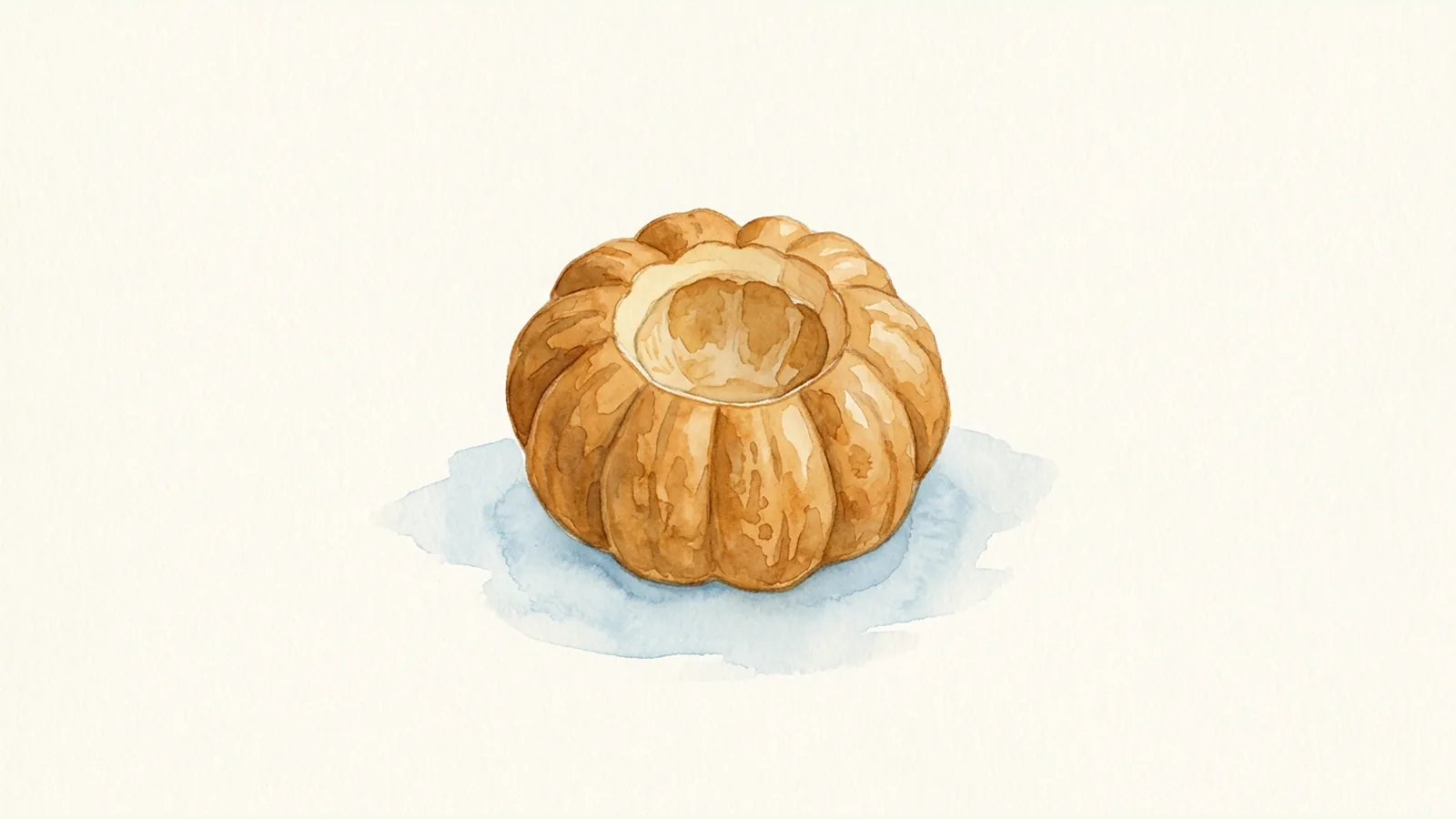
Then comes a task familiar to anyone who has carved a Halloween pumpkin, on a scale few kitchen tables could handle. Seeds are saved. Pulp is scooped out. The AP’s 2025 report describes heavy machinery, saws or knives, and people working with spoons, scrapers, or bare hands.
There is something satisfying about that mix. Months of careful growing lead to heavy lifting, then to the same messy work found inside a much smaller pumpkin. The opening must now make room for a person with a paddle instead of a candle.
Once the insides come out and a paddler climbs in, the pumpkin has a new job: holding that person above the water.
Why does it float?
A pumpkin has a hollow space inside it. That space holds air. Taken together, its shell and air-filled center can be light enough for their size to float.
The Canada Agriculture and Food Museum’s pumpkin-boat activity explains this idea. As a pumpkin pushes water aside, the water pushes up on it. If that upward push can support the weight, the pumpkin floats. The name for this lift is buoyancy.
A whole pumpkin can float before anyone carves it. Once it becomes a boat, the water must support the pumpkin, the paddler, and their gear together.
Staying upright is another challenge. Think about the difference between something resting on the water and someone shifting their weight inside it. A pumpkin can float and still tip. Its grown shape matters once it becomes a boat.
Jon Sestak had a view on that after winning a race dressed as a taco in 2024. In KATU’s report, he credited his ship-shaped pumpkin with traveling straight. He had been growing for four years and had finished second twice.
The outfit gets the photo. The grower may be thinking about the hull.
Is a pumpkin legally a boat?
Probably, when it carries a paddler across the lake.
Oregon’s boat definition is broad. It covers watercraft used, or able to be used, to carry people or things on water, with some exclusions for things such as water toys. A hollow pumpkin used to carry a racer would likely fit.
The useful idea is simple: what it does matters. A pumpkin on a scale is being weighed. A pumpkin carrying a person across a lake is doing the work of a boat.
Calling it a raft would not necessarily change that. The Oregon State Marine Board lists rafts among nonmotorized boats. Those categories can overlap. A paddle alone does not make it a motorboat; machinery is what brings a craft into Oregon’s motorboat definition.
“Vehicle” depends on which rule you mean. Oregon’s road-code definition deals with devices that carry people or property on public highways. For this race, the boat definition gives us the more useful starting point.
None of that requires the racer to have grown up dreaming of boat ownership. It is enough to have grown the boat.
A little room for a family rivalry
Once the craft is ready, the costume and decorations give it a second character.
In 2014, Steve Daletus and his daughter Stacey Wiltermood shared a pumpkin with a duck head at one end and a beaver tail at the other. She was a Ducks fan. He was a Beavers fan. Daletus steered it Beaver-end first.
The family had found room for both teams in one boat. Direction of travel remained a matter of some importance.
That shared ride belongs to the event’s history. This year’s rules allow one person per pumpkin. The old story is still a fine example of how much thought can go into a craft with such a short racing career.
The race tasks have added their own fun. The 2017 Clackamas Print account describes colored-ball retrieval and rubber-duck races. Steering a pumpkin is one thing. Making it go where a small floating target happens to be adds another problem.
These details are part of why the event rewards a longer look. The growers bring months of work. The paddlers bring costumes and ambition. The pumpkins bring their own shapes, which no amount of enthusiasm can turn into identical racing hulls.
Has anyone been hurt?
The reports give us clear examples of people going into the water.
In 2019, Jeff Johnson of Boring was dressed as Spiderman and nearly three-quarters finished when his pumpkin took on water and rolled him out. He left the partly submerged pumpkin and swam ashore.
In 2017, The Clackamas Print described a pumpkin sinking and a paddler getting a ride back with a safety kayaker. The 2014 Valley Times story also recorded discomfort: Calli Halbert said she could not feel her feet or legs after struggling to avoid a capsize.
The reports we reviewed through October 14, 2026 describe these mishaps but no confirmed physical injuries; they are not a complete safety record.
The city is clear that a pumpkin may capsize. Its current paddling guidance requires racers to be at least 18 and to wear the provided life jacket. Paddlers should have strong swimming skills. The pumpkin and paddle are provided, too.
Costumes must be family-friendly and allow swimming. Inflatable costumes are banned. The city also recommends suitable footwear, a towel, and dry clothes. Questions about a particular outfit are best put to the organizers.
There is a limit even the growers cannot settle far ahead of time. Your Oregon News reported in August, quoting the city’s website, that the number of usable pumpkins is not known until race morning. The public Quest entry deadlines have passed, and selection does not guarantee a boat.
If someone gets hurt, who might pay?
This is where a lawyer’s questions become more practical. What happened? Who had control over it? Did someone fail to take reasonable care, and did that failure cause the injury?
Those questions follow Oregon’s basic negligence rule. Negligence means a failure to use reasonable care. Hosting a fun event does not automatically make the host responsible for every injury. The same goes for growing a pumpkin, owning the land, or sponsoring a race. Each person’s actions matter.
Imagine a paddler carelessly striking someone with a paddle. That made-up example would raise questions about the paddler’s conduct. An injury caused by someone else’s careless work would lead to questions about that work instead. The point is to follow what caused the harm, rather than choose a name from the event poster.
More than one person can share fault. Under Oregon law, each responsible person generally owes their share, with exceptions. An injured person’s own fault can reduce payment and, if it exceeds the combined fault of the people included in the legal comparison, prevent recovery. Our guide to what makes a personal injury claim goes into the basic questions in more detail.
Insurance may help pay a covered claim. The Oregon insurance regulator’s business insurance guide explains liability coverage for injuries caused by negligent acts or failures to act. The answer depends on whose policy applies and what it covers.
What about the waiver?
A waiver is an agreement to give up certain legal rights. The city’s currently posted special-guest form includes a broad release. It is for specified groups and invited guests, so it does not establish what every paddler signs.
Oregon changed its recreational-waiver law on April 7, 2026. The law gives qualifying written releases a firmer footing when people freely agree to clear terms that explain the risks and release ordinary-negligence claims tied to those risks. Boating and swimming are among the covered activities.
Limits remain. For example, the law excludes claims involving conduct worse than ordinary negligence, certain failures to maintain or inspect supplied safety gear, and careless safety training that causes injury. The wording of the agreement and the cause of an injury still need a close look.
Public events can raise other rules, too. Oregon has recreational-land protections that may limit liability, and claims involving a public body can have early notice requirements. Free admission alone does not settle who must pay.
If an actual injury leaves you with those questions, Johnson Law can discuss the facts with you. This article is educational information, not legal advice.
Back to the pumpkins
The upcoming regatta is scheduled for October 18, 2026, from 10 a.m. to 4 p.m., with races at noon and 2 p.m. Admission is free. It takes place at Lake of the Commons, 8325 SW Nyberg Street in Tualatin. The official festival page has current event information.
There is plenty here for a curious lawyer. There is even more for anyone who likes seeing people take a delightful idea seriously enough to make it happen.
Somewhere between tending a vine and picking up a paddle, a grower’s giant fruit becomes a small boat. The law can help us name it. The regatta gives us a reason to watch.
Source notes
Event history, plans, and paddling rules come from the City of Tualatin. Historical race accounts are linked to AP, OPB, KATU, the Valley Times, and The Clackamas Print. Your Oregon News supplies the quoted pumpkin-availability guidance and past Quest deadlines.
Growing facts come from university extension sources; the museum source explains flotation. Legal sources include Oregon’s boat definitions and the recreational-release law effective April 7, 2026.
Brief term explanations draw on Cambridge Dictionary and NC State Extension.
Client-First Fee Promise
Client First = Bills First, Fees Second
Your unpaid medical bills do not have to make your lawyer's fee bigger. Johnson Law subtracts qualifying medical bills before calculating our fee, helping clients keep more of their settlement.
Applies to qualifying cases. Results vary.