
How to Choose a Personal Injury Lawyer in Oregon

How to Choose a Personal Injury Lawyer in Oregon
After a serious injury, choosing a lawyer is not just about finding someone nearby. The better question is whether the lawyer is a good fit for your type of Oregon injury claim, communicates clearly, understands the evidence, and is prepared for the possibility that the insurer will dispute fault, causation, or damages.
This guide explains practical selection criteria for Oregon personal injury cases. It is educational information only, not legal advice. The right choice depends on the facts of your accident, injuries, insurance coverage, deadlines, and goals.
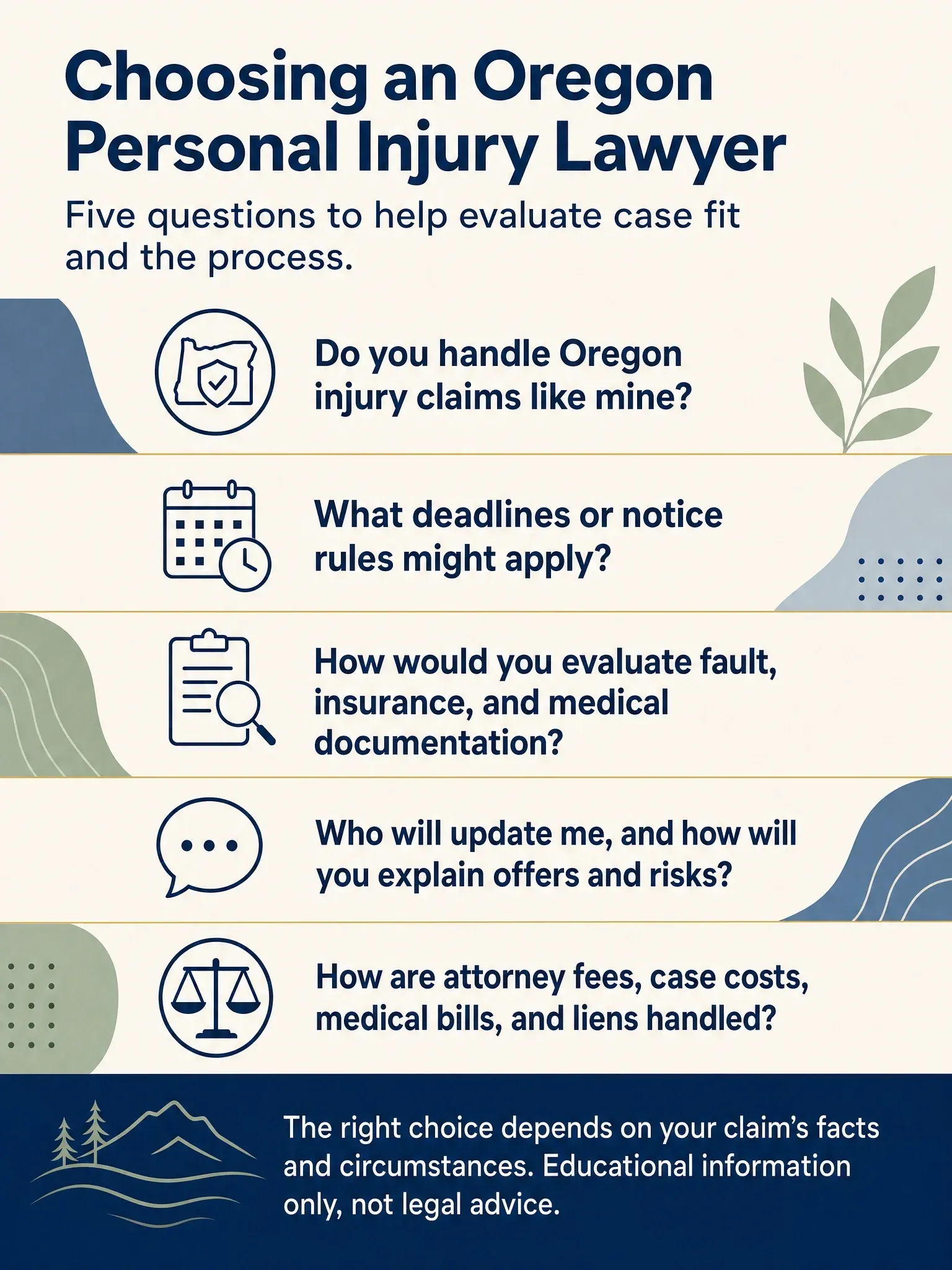
Key Takeaways
- Look for a lawyer who regularly handles Oregon personal injury claims similar to yours.
- Ask how the lawyer evaluates fault, insurance coverage, medical documentation, and deadlines.
- Trial readiness can matter even when most cases resolve before trial.
- Clear communication expectations should be discussed before you sign a fee agreement.
- Preserve evidence early, especially photos, witness information, insurance letters, medical records, and lost-wage documentation.
1. Start With Case Fit, Not Advertising Language
Search results and ads can be a starting point, but they should not be the end of your evaluation. A lawyer who is a strong fit for one type of injury case may not be the right fit for another.
When you contact a firm, ask whether it handles cases like yours, such as:
- car, truck, motorcycle, bicycle, or pedestrian crashes;
- dog bites;
- unsafe property or premises-liability injuries;
- workplace-adjacent third-party claims; or
- serious injury claims involving long-term treatment, lost income, or disputed medical causation.
Johnson Law’s broader personal injury practice page explains the kinds of Oregon injury claims the firm handles. If your injury came from a crash, you may also want to review the firm’s Oregon car accident claim information.
2. Ask Oregon-Specific Deadline Questions Early
Deadlines are one reason it can be risky to wait too long before getting legal guidance. Oregon personal injury claims can involve several timing rules, and the correct deadline depends on the claim type and defendant.
For example, many Oregon injury claims based on negligence are subject to a two-year limitations period under ORS 12.110. Claims involving a public body may require much faster notice under the Oregon Tort Claims Act, including the notice rules in ORS 30.275.
During a consultation, consider asking:
- What deadlines might apply to my type of claim?
- Are there any notice requirements because of who caused the injury?
- What information do you need to check the deadline?
- What should I avoid signing or saying before the claim is evaluated?
No blog post can calculate your deadline. If a deadline may be approaching, get advice promptly.
3. Evaluate How the Lawyer Handles Fault and Insurance Disputes
Oregon injury claims often involve more than proving that an accident happened. Insurers may argue that you were partly at fault, that your injuries were preexisting, that treatment was unrelated, or that your damages are lower than claimed.
Oregon uses a comparative-fault system. Under ORS 31.600, fault percentages can affect whether and how much an injured person may recover. That makes evidence and case framing important from the beginning.
Ask a potential lawyer how they would approach issues such as:
- police reports or incident reports that are incomplete or inaccurate;
- photos, video, and witness statements;
- medical records and gaps in treatment;
- lost wages, reduced earning capacity, and household impact;
- insurer requests for recorded statements; and
- comparative-fault arguments.
For more background, see Johnson Law’s guide to Oregon comparative fault after a car accident and the guide on what happens if an insurance company denies your claim.
4. Ask About Trial Readiness Without Assuming Every Case Goes to Trial
Many personal injury cases resolve without a trial. Still, trial readiness can matter because the lawyer’s preparation affects how the case is investigated, documented, negotiated, and presented.
Useful questions include:
- Have you handled cases with similar liability or injury issues?
- How do you decide whether settlement negotiations are reasonable?
- What would make a case more likely to require litigation?
- If a lawsuit becomes necessary, who will be responsible for the case?
- How do you prepare clients for deposition, mediation, or trial?
Past results do not guarantee future outcomes. Every claim depends on its own facts, available insurance, evidence, medical proof, and applicable law. If you review a firm’s case results, use them as one data point—not as a prediction of your claim.
5. Discuss Communication Before You Hire the Lawyer
Communication problems are one of the most common frustrations in legal matters. Before hiring a personal injury lawyer, ask how the firm keeps clients updated and who will answer day-to-day questions.
Consider asking:
- Will I communicate directly with an attorney, a case manager, or both?
- How often should I expect updates when there is no major development?
- What is the preferred method for questions: phone, email, text, or client portal?
- Who should I contact if I receive an insurance letter or medical bill?
- How will you explain settlement offers and case risks?
You should feel comfortable asking questions and receiving plain-English explanations. A lawyer does not need to promise a result to give you a clear process.
6. Understand Fees, Costs, and Medical Bills
Do not rely on a website summary alone when deciding whether to hire a lawyer. Ask for the written fee agreement and make sure you understand how attorney fees, case costs, medical liens, and unpaid bills will be handled.
For eligible personal injury matters, Johnson Law, P.C. uses a contingency fee structure. Clients do not pay attorney fees unless there is a recovery, subject to the written fee agreement. Johnson Law also calculates its attorney fee after outstanding medical bills are paid, according to the written fee agreement.
Good questions include:
- What percentage or formula applies under the written fee agreement?
- Are case costs separate from attorney fees?
- How are medical bills, liens, and health-insurance reimbursement claims handled?
- What happens if there is no recovery?
- Will I receive a written settlement breakdown before funds are distributed?
The details matter. Ask the lawyer to walk through the agreement before you sign it.
7. Bring the Right Information to the First Consultation
You do not need a perfect file before contacting a lawyer, but organized information helps the lawyer evaluate your claim efficiently.
If you have them, gather:
- crash reports, incident reports, or animal-control reports;
- photos and videos of the scene, vehicles, injuries, hazards, or property damage;
- names and contact information for witnesses;
- insurance cards, claim numbers, and adjuster letters;
- medical records, discharge instructions, and billing notices;
- employer notes, wage records, or missed-work documentation;
- repair estimates or property-damage records; and
- a short timeline of what happened and what symptoms developed afterward.
Do not delay legal guidance just because you are missing some documents. Evidence can disappear, video may be overwritten, witnesses may become harder to locate, and deadlines can continue running.
8. Red Flags to Watch For When Choosing a Lawyer
No single factor decides whether a lawyer is the right fit, but some warning signs deserve attention:
- promises of a specific settlement amount before the evidence is reviewed;
- pressure to sign immediately without time to read the fee agreement;
- vague answers about who will handle the case;
- unwillingness to discuss deadlines, risks, or weaknesses;
- little explanation of how medical bills and liens affect the final recovery; or
- communication that leaves you more confused than informed.
A careful lawyer should be willing to discuss both strengths and risks. Balanced advice is usually more useful than a sales pitch.
Questions to Ask an Oregon Personal Injury Lawyer
Here is a short checklist you can use during a consultation:
- Have you handled Oregon injury claims like mine?
- What facts or documents do you need before evaluating liability?
- What deadlines or notice rules might apply?
- How do you handle comparative-fault arguments?
- What evidence should I preserve right now?
- Who will communicate with me about the case?
- How are attorney fees, case costs, medical bills, and liens handled?
- What are the main risks or unknowns you see at this stage?
- What happens if the insurer denies the claim or makes a low offer?
- What decisions will I need to make during the case?
Final Thoughts
Choosing a personal injury lawyer in Oregon is a practical decision. Look for relevant experience, clear communication, deadline awareness, careful evidence review, and a fee agreement you understand. Avoid judging a lawyer by unsupported ranking claims or generic promises.
If you would like to discuss an Oregon injury claim with Johnson Law, you can contact the firm to request a consultation. This article is general educational information and does not create an attorney-client relationship.
Source Notes
- ORS 12.110 — Oregon limitations periods for certain actions, including many injury claims.
- ORS 30.275 — Oregon Tort Claims Act notice provision for claims involving public bodies.
- ORS 31.600 — Oregon comparative-fault statute.
- Johnson Law internal fee-language guidance for describing contingency fees and the firm’s medical-bills-paid-first fee calculation.
Client-First Fee Promise
Client First = Bills First, Fees Second
Your unpaid medical bills do not have to make your lawyer's fee bigger. Johnson Law subtracts qualifying medical bills before calculating our fee, helping clients keep more of their settlement.
Applies to qualifying cases. Results vary.