Apartment Complex Assault: Can You Sue the Landlord for Broken Gates or Ignored Threats?
Apartment Complex Assault: Can You Sue the Landlord for Broken Gates or Ignored Threats?
Educational information only, not legal advice. Oregon negligent security law is fact-specific and case-dependent. Verify details with applicable Oregon statutes, Oregon case law, and an attorney if you have a specific situation.
You were assaulted at your apartment complex.
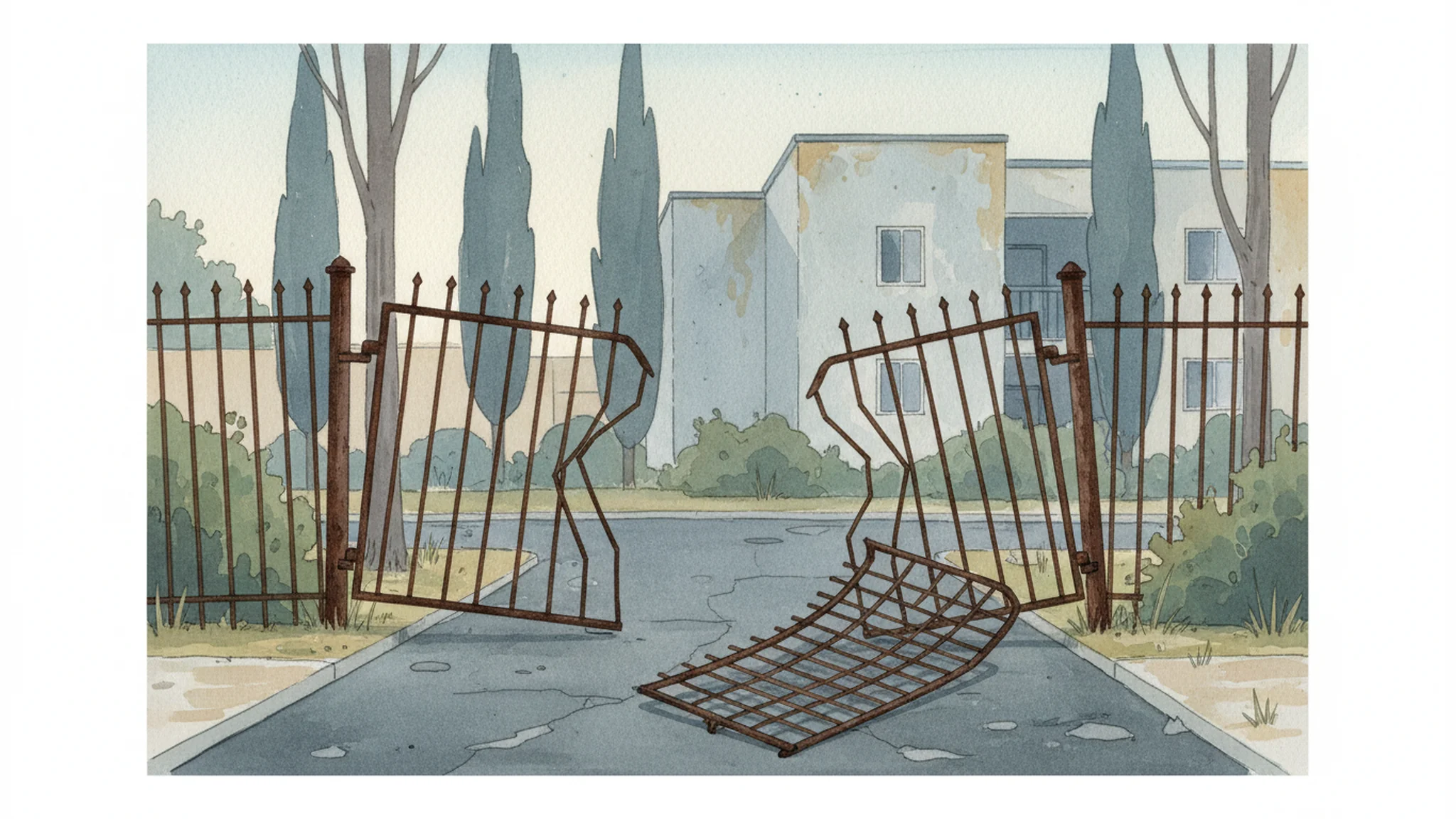
The gate was broken. The lock on your building didn’t work. You had told management about threats before — and nothing happened.
Now the question isn’t just who attacked you — although that matters, too. The question is:
Can the landlord or property manager be held legally responsible?
The short answer in Oregon is: sometimes.
The longer answer depends on whether the attack was “foreseeable” — a legal concept that can affect whether a landlord had a duty to take reasonable steps in response to known conditions, warnings, or prior incidents. It turns on specific facts, documented complaints, prior incidents, and physical evidence like maintenance records.
In this article, we walk through the Oregon legal standard, what evidence makes a difference, and the common defenses the landlord’s insurer may raise.
If you want the broader negligence framework first, see our Oregon personal injury law overview. For a general guide to preserving evidence after an incident, including what to document before records disappear, see that post.
1) Quick answer
Landlords in Oregon are not insurers of tenant safety. There is no blanket rule that says a landlord is automatically responsible whenever someone gets hurt on their property.
But Oregon law does recognize that landlords and property managers can be legally liable for harm caused by third parties — including criminal assaults — when certain conditions are met:
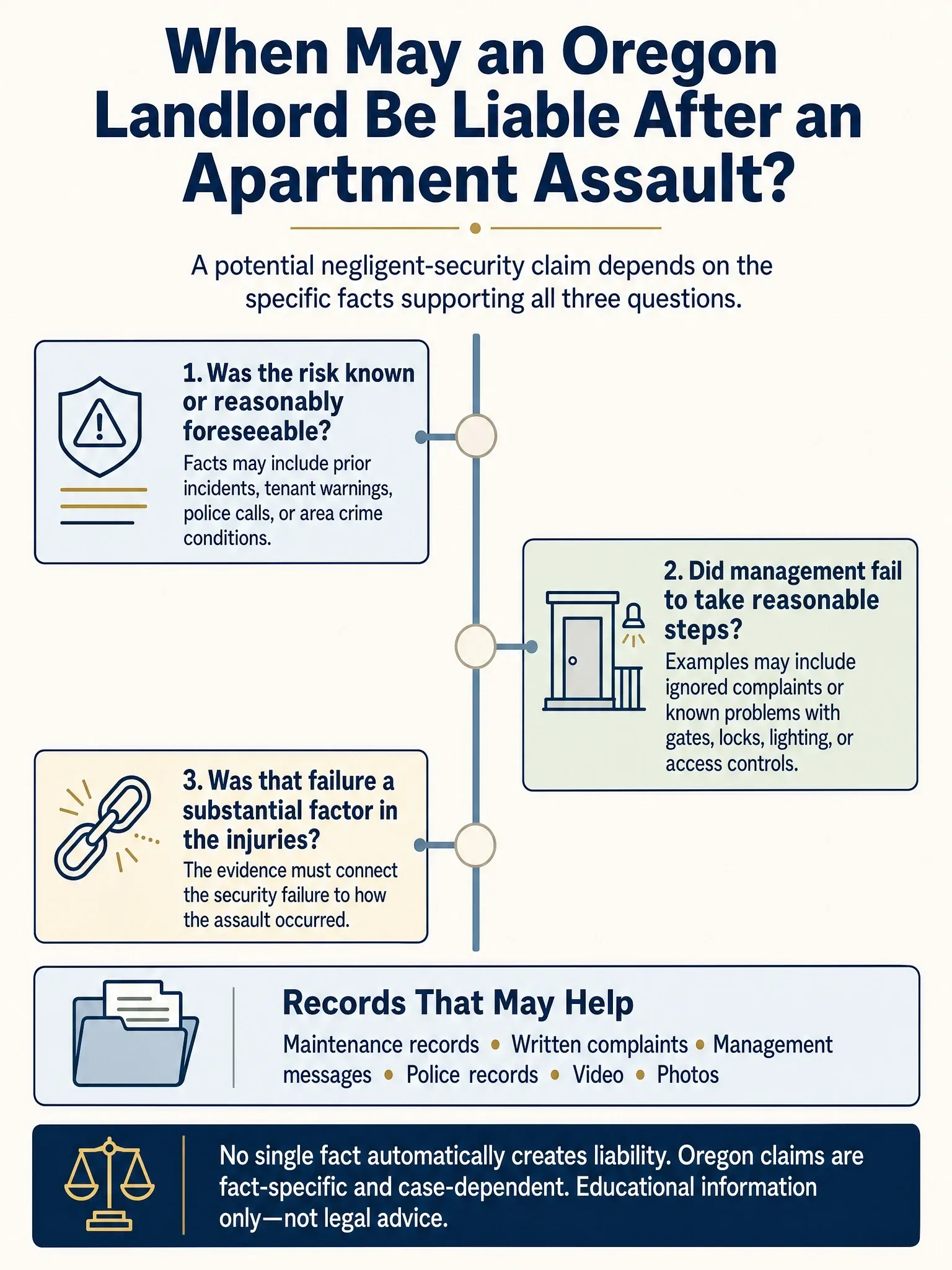
- The landlord had a duty to protect tenants from a known or reasonably foreseeable risk.
- The landlord knew or should have known about the risk and failed to take reasonable steps to prevent it.
- That failure was a substantial factor in causing your injuries.
If those conditions are met, a negligent security claim — a type of premises liability lawsuit — may be available.
If they are not, the landlord’s insurance company will likely argue that the assault was simply unforeseeable and no duty existed.
The line between “unfortunate crime” and “legally actionable negligence” usually comes down to what the landlord knew, when they knew it, and what they did — or didn’t do — about it.
2) Oregon’s legal framework: the “general foreseeability” test
The foundation: Fazzolari
Every negligence case in Oregon starts with the same question: did the defendant’s conduct unreasonably create a foreseeable risk of the kind of harm that occurred?
The Oregon Supreme Court established this framework in Fazzolari v. Portland School Dist. No. 1J, 303 Or. 1, 734 P.2d 1326 (1987). Unless a special relationship or statute creates a more specific duty, liability turns on whether the harm was reasonably foreseeable.
In the negligent security context, courts ask: could the defendant have anticipated, or reasonably should have anticipated, a foreseeable risk of the kind of harm that occurred — and did the defendant fail to take reasonable preventive steps?
No blanket duty to protect from criminal acts
Oregon property owners do not have a general obligation to protect people from third-party criminal attacks. (Uihlein v. Albertson’s, Inc., 282 Or. 631, 580 P.2d 1014 (1978)).
A duty to provide security arises only when the risk is known or should have been known. Under Oregon law — following Restatement (Second) of Torts § 344 as applied by Uihlein and other Oregon decisions — the defendant must have actual or constructive notice of the risk before a duty to provide security arises. That notice most often comes from:
- Prior criminal incidents at or near the property
- Complaints or warnings from tenants
- Police reports or calls for service
- The general crime conditions in the area
Without some basis for foreseeability, an assault — no matter how tragic — may be treated as an intervening criminal act for which the landlord is not responsible.
3) The leading Oregon case: McPherson (2007)
Among Oregon cases addressing negligent security at apartment complexes, McPherson v. Oregon Dept. of Corrections, 210 Or.App. 602, 152 P.3d 918 (2007) is the most frequently cited.
In McPherson, an escaped convict entered a stand-alone laundry shed at a Salem apartment complex and assaulted tenants, including a mother and her teenage son. The trial court had granted summary judgment for the defendants, ruling there was no evidence the harm was reasonably foreseeable.
The Court of Appeals reversed.
A rational juror could find the harm reasonably foreseeable based on a combination of factors:
- The complex was located in a high-crime area
- Gunshots, car break-ins, and thefts had occurred in the area
- A tenant had threatened another tenant with an ax
- Management had received reports of suspicious or illegal activity, including vandalism and trespass in the laundry facility where the attack occurred
- The laundry shed had neither windows nor peepholes — a known vulnerability that landlords were generally aware of
- Exterior lighting at the complex was dimly lit
- On the night of the attack, management observed suspicious activity and did not investigate
No single one of those facts was enough on its own. But taken together, they created a picture from which a jury could conclude that the defendants knew or should have known that their complex attracted criminal activity, that the laundry shed was poorly designed for tenant safety, and that suspicious activity on the night of the attack warranted action.
That totality-of-circumstances approach is key to Oregon negligent security claims. You generally do not need proof that the exact same crime happened before. You need proof of enough circumstances to show the general risk of criminal assault was foreseeable and the landlord failed to address it.
4) What evidence makes an assault “foreseeable”
An assault becomes legally “foreseeable” when enough facts show the landlord had notice of a danger and failed to respond.
Prior incidents and crime patterns in the area
Prior criminal activity — whether on the exact property or in the immediate vicinity — is one of the strongest indicators of foreseeability.
In McPherson, the court noted gunshots, break-ins, and thefts in the surrounding area. In Uihlein, the store manager described the location as “the roughest store” where he had worked and stated he had personally requested security protection.
Crime statistics, police records, and neighborhood incident databases are frequently obtained through public-records requests or litigation discovery to establish whether a property sits in a documented high-crime zone.
Known trouble spots and physical conditions
The physical layout and condition of security infrastructure on a property play a central role.
Common physical factors Oregon courts consider:
- Broken or non-functioning gates — a gate meant to restrict access may become important evidence if management knew it was broken and failed to address it within a reasonable time
- Faulty locks on main entrances or individual buildings
- Dim or nonexistent exterior lighting — particularly in areas like parking lots, stairwells, alleys, or shared corridors. For a deeper look at the crime-liability side of this issue, see our guide to poor lighting and negligent security claims
- Unsecured buildings or facilities that lack windows, peepholes, or other means for occupants to see who is nearby
- Areas where criminal activity concentrated — whether a loading dock behind a building, or an open area where loitering occurred
These conditions don’t create liability by themselves. They become central to a claim when combined with evidence that the landlord knew about them and didn’t fix them.
Complaints and reports the landlord failed to act on
This is where many negligent security claims gain real traction.
If tenants reported:
- Threats from specific individuals
- Unusual activity or suspicious loitering
- Prior break-in attempts or property damage
- Broken gates, lights, locks, or intercoms that were repeatedly repaired poorly or never repaired at all
Then the landlord’s response, or lack of response, may become important evidence of notice and whether reasonable steps were taken.
Written complaints — emails to management, maintenance requests, letters, or security incident logs — are treated as especially valuable because they can show exactly when the landlord knew the condition existed and how long it persisted.
The McPherson court emphasized that even when no exact parallel crime had occurred before, the cumulative report of suspicious activity and the landlord’s failure to investigate warranted a jury question.
Oregon’s landlord maintenance duties
A separate but reinforcing layer of argument centers on Oregon’s landlord-tenant statutes.
ORS 90.320 requires landlords to maintain dwelling units and landlord-controlled areas in habitable condition. For ordinary apartment housing, that statute specifically requires:
- Keys and locks for outer doors that work properly
- Common areas that are safe for typical use
- Walls, floors, ceilings, stairs, and railings in good repair
- Freedom from fire hazards and pest infestations in common areas
While these statutes don’t independently create a cause of action for third-party criminal assault — that remains a common-law tort claim — they provide a foundational argument about what the landlord was already obligated to maintain, and how failure to provide working locks, proper lighting, and safe common areas undermines the basic measure of tenant protection.
5) What records and evidence show failure to act
If you’ve been through an assault at your apartment complex, the following types of records are often critical to whether a negligent security claim holds together:
Maintenance and repair records
Maintenance tickets for broken gates, burned-out lights, malfunctioning locks, and damaged entry intercoms are foundational. They can show:
- When the problem was first reported
- How many times it was reported
- Whether it was ever actually fixed
- How long the unsafe condition existed before the assault
A broken gate that was reported three times over six months and never repaired tells a stronger story than one that was reported the day before a random crime.
Tenant complaints and management communications
Written correspondence between tenants and management — whether formal complaints, emails, text exchanges, or maintenance request forms — shows the landlord’s actual knowledge.
Orally reported complaints are also relevant, but written evidence is typically more persuasive and harder for the defense to dispute.
Police reports and calls for service
Prior police calls to the apartment complex — whether for disturbances, break-ins, domestic violence, drug activity, or other incidents — establish an independent record of crime that goes beyond what any single tenant may have known.
Some of these records may be available through public-records requests to the local police department, often without needing to wait for formal litigation.
Security camera footage and site documentation
If cameras existed and functioned, their footage may capture:
- The attacker’s entry route, including use of a broken gate
- Prior suspicious activity in the area
- Lighting conditions at the time of the assault
- Whether security staff responded
If no cameras existed, their absence may be relevant in some cases, depending on the property layout, crime history, industry practices, and other available security measures.
Photographs, lighting measurements, and property inspection reports
Documenting the physical state of the property — including the condition of gates, lighting levels, visibility of trouble spots, and accessibility of multiple entry points — is important before conditions change.
For detailed guidance on what to document and preserve, see our post on preserving evidence after an incident.
6) Common defenses your landlord’s insurance company will raise
A landlord’s liability insurer typically raises several defenses. Knowing what they usually argue helps you understand what evidence matters most.
For a broader framework on these arguments, see our guide to how property owners use the “we can’t control crime” defense.
“The assault was not foreseeable”
This is the most common defense. The insurer will argue that the property had no history of the exact type of crime that occurred, that prior incidents were relatively minor, and that the criminal act was unpredictable.
“Intervening criminal act broke the chain of cause”
Even when a court finds a duty existed, the insurer may argue that the most direct cause of the harm was the third party’s criminal act — not the landlord’s security deficiency — and that the landlord’s conduct was too attenuated to constitute the actual cause.
Oregon courts have recognized this argument. In Miller ex rel. Miller v. Tabor West, for example, the Court of Appeals affirmed summary judgment for apartment owners where the assault occurred off the apartment premises and the landlord lacked notice of the attacker’s dangerousness at a time when it could exercise control. By contrast, cases like McPherson show that security-related premises conditions, combined with notice of criminal activity, can create a jury question about whether the landlord’s conduct was a substantial factor in the harm.
“We provided reasonable security for the circumstances”
The defense will argue that the property had adequate lighting, functioning access controls, and security features appropriate for the area, and that no reasonable amount of security could have prevented this specific crime.
These defense arguments often involve comparisons to similar properties or industry standards for apartment security.
“The plaintiff was contributorily negligent”
In Oregon, a plaintiff’s own conduct is factored in under the state’s modified comparative fault rule (ORS 31.600). If you are found less than 51% at fault, your recovery is reduced by your percentage of fault. If found 51% or more at fault, you cannot recover.
The insurer may argue that you failed to lock your door, ignored previous warnings about visiting certain areas, or took unreasonable risks yourself.
A practical note on pleading requirements
Under Moore v. Willis, 307 Or. 254, 767 P.2d 62 (1988), Oregon courts require that a complaint for negligence allege specific facts from which a factfinder could determine foreseeability — not simply conclusions like “the landlord should have known.” The complaint must describe what happened, what the landlord knew, and why a reasonable person should have anticipated the risk.
7) What damages might be recoverable
A successful negligent security claim may allow recovery of standard categories of damages available under Oregon tort law, depending on the facts and proof.
Economic damages
These cover quantifiable financial losses:
- Current and future medical expenses
- Current and future rehabilitation or counseling costs
- Lost wages and lost future earning capacity
- Property damage suffered during the assault
Non-economic damages
These address losses that are not purely financial:
- Pain and suffering
- Emotional trauma and psychological injury
- Scarring or disfigurement
- Loss of enjoyment of life
In cases involving particularly severe or intentional conduct, punitive damages may also be available, though Oregon courts apply a high evidentiary standard for this form of recovery.
8) The two-year deadline
Oregon’s statute of limitations for personal injury claims, including many premises liability claims, is generally two years from the date of the injury (ORS 12.110(1)).
In many assault-related premises cases, the deadline is calculated from the date of the assault, not from the later discovery of maintenance records or ignored complaints. Different rules may apply if the assault involved sexual assault, child abuse, a government defendant, incapacity, or other tolling issues, so anyone with a potential claim should verify the applicable deadline promptly.
Two years may seem like a long time, but maintenance records can be overwritten, security footage is routinely deleted in days or weeks, and management personnel can change or leave. Evidence you can preserve today, independently of any lawsuit, will matter more than evidence that has disappeared by the time you’re ready to file.
9) Frequently asked questions
Can I sue if the assault happened in the parking lot?
A parking lot attached to your apartment complex is generally treated as a common area under the landlord’s control. If the assault occurred there, a negligent security claim may be viable. The same foreseeability analysis applies: what did the landlord know, and did they fail to address the risk. For a commercial setting with similar evidence issues, see our post on parking garage negligent security claims.
Do I need prior incidents of the exact same crime?
No. Oregon courts evaluate the “totality of the circumstances.” A pattern of break-ins, property crime, loitering, and tenant threats can collectively support a finding that criminal assault was reasonably foreseeable, even if no identical assault had occurred before. (McPherson).
I reported threats and nothing was done. Does that help?
Written complaints to management that were ignored are among the strongest pieces of evidence in a negligent security case. They show the landlord had specific knowledge of the risk, which the defense is harder to dispute than a general allegation that the risk “should have been known.”
How long do I have to file a lawsuit in Oregon?
Generally two years from the date of the injury, under ORS 12.110(1), for many premises-liability injury claims. Different rules may apply in sexual-assault, child-abuse, government-defendant, incapacity, or tolling situations. Because evidence can degrade quickly, it is usually wise to evaluate preservation steps as soon as possible.
What if I was partly responsible?
Oregon applies modified comparative fault (ORS 31.600). If you are found less than 51% at fault, your recovery is reduced by your share. If you are found 51% or more at fault, you cannot recover.
What if the assault happened inside my apartment unit?
An in-unit assault is not automatically a landlord-liability case. It may support a negligent-security claim only if evidence shows a landlord-controlled security failure — such as a broken dwelling-entry lock, unsecured building access, or ignored specific threats — made the assault reasonably foreseeable and was a substantial factor in allowing it to occur.
Sources
- Fazzolari v. Portland School Dist. No. 1J, 303 Or. 1, 734 P.2d 1326 (Or. 1987)
- McPherson v. Oregon Dept. of Corrections, 210 Or.App. 602, 152 P.3d 918 (Or. App. 2007)
- Uihlein v. Albertson’s, Inc., 282 Or. 631, 580 P.2d 1014 (Or. 1978)
- Miller ex rel. Miller v. Tabor West, 223 Or. App. 700, 196 P.3d 1049 (Or. App. 2008)
- Moore v. Willis, 307 Or. 254, 767 P.2d 62 (Or. 1988)
- ORS 90.320 (Landlord to maintain premises in habitable condition)
- ORS 31.600 (Modified comparative fault)
- ORS 12.110(1) (Two-year statute of limitations for personal injury)
- Oregon State Bar, Oregon Law Help — “Your Right to a Safe and Healthy Rental Home”
This article is provided for educational purposes only and does not constitute legal advice. For information specific to your situation, contact a qualified Oregon personal injury attorney.
Client-First Fee Promise
Client First = Bills First, Fees Second
Your unpaid medical bills do not have to make your lawyer's fee bigger. Johnson Law subtracts qualifying medical bills before calculating our fee, helping clients keep more of their settlement.
Applies to qualifying cases. Results vary.