Fatal Truck Crash Case Value Drivers: What Evidence Decides the Ceiling

Fatal Truck Crash Case Value Drivers: What Evidence Decides the Ceiling
After a fatal truck crash, families often want to know what the case may be “worth.” That question is understandable. It is also one of the hardest questions to answer honestly at the beginning of a case.
There is no reliable average settlement that can value an Oregon fatal truck crash claim. The practical ceiling usually depends on evidence: who can be held responsible, how Oregon fault rules apply, what insurance or assets are actually collectable, which wrongful-death damage categories can be proved, and whether trucking records show safety problems that affected the crash.
This article explains those value drivers without promising a number. It is general educational information, not legal advice for any specific family or case.
There Is No Reliable “Average” Fatal Truck Crash Case Value
Fatal truck crash cases are sometimes discussed online as if they can be valued by a range, multiplier, or average settlement figure. That framing can be misleading, especially for grieving families who need accurate information rather than a number that may not fit their facts.
Two cases involving the same type of crash can have very different practical values because the evidence is different. Important differences may include:
- whether the truck driver, motor carrier, or another defendant can be proven at fault;
- whether the defense can shift part of the fault to the decedent, another driver, or another entity;
- what insurance policies, excess coverage, self-insurance, or assets are actually available;
- which Oregon wrongful-death damage categories apply and can be documented;
- whether there is evidence of conscious pain, economic dependency, household services, or loss of companionship;
- whether trucking records show hours-of-service violations, maintenance failures, unsafe hiring or retention, impairment issues, or ignored safety risks; and
- whether liens, costs, distribution rules, or coverage disputes affect what beneficiaries ultimately receive.
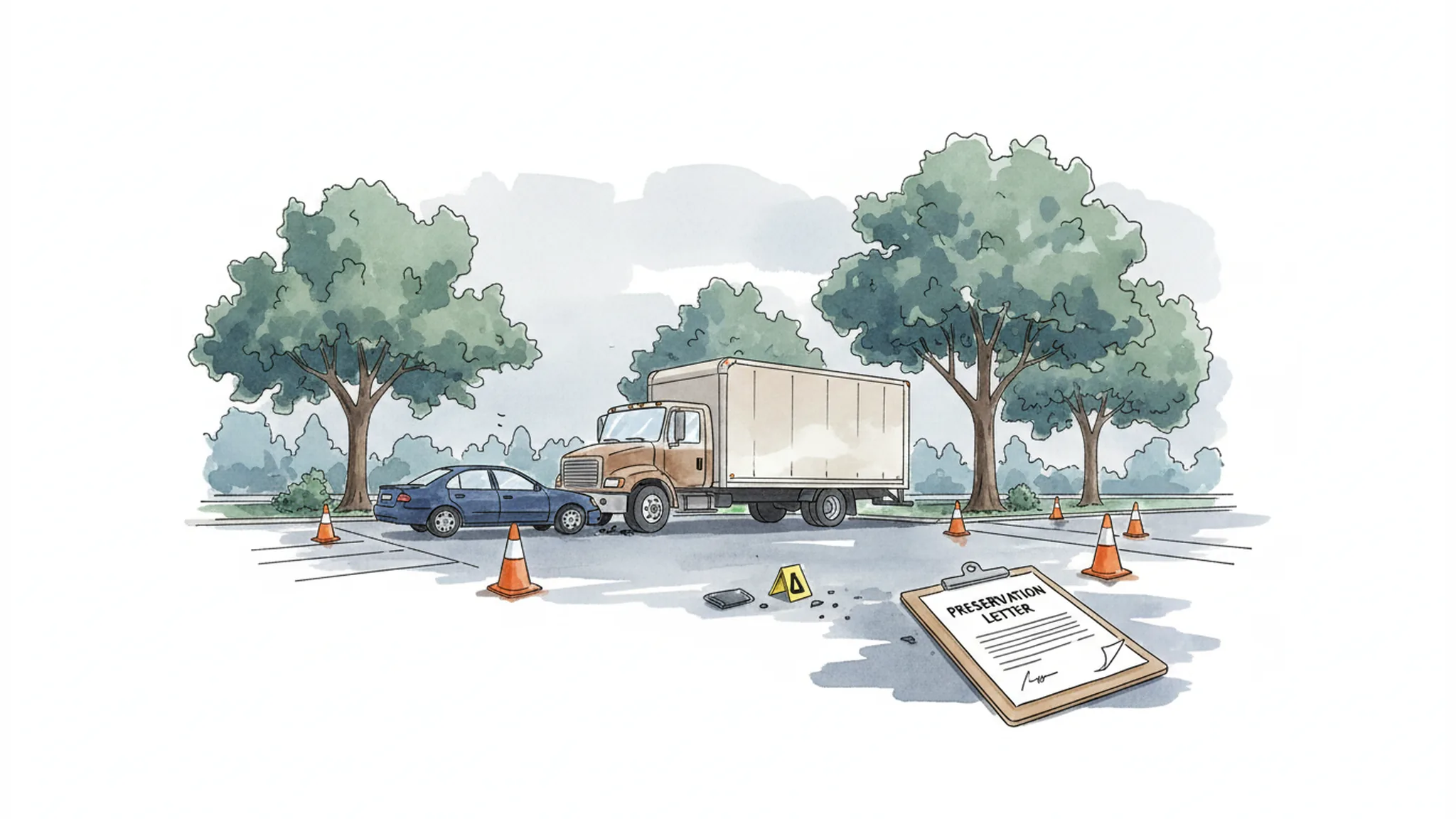
For the personal-representative process, available damage categories, immediate family steps, and an early preservation timeline, see Johnson Law’s family guide after an Oregon fatal truck crash. This post instead owns the liability, collectability, caps, punitive-damages, and valuation-evidence questions that can shape or limit available recovery.
First Ceiling: Can Liability Be Proven Against the Right Defendants?
A devastating loss does not automatically establish legal responsibility. Case value begins with proof that one or more defendants caused the crash and that their fault can be connected to the death.
In a commercial truck case, potentially relevant defendants may include the driver, the motor carrier, another motorist, a maintenance provider, or another entity whose conduct is legally and factually connected to the crash. The right defendant list depends on the evidence. It should not be assumed from the fact that a truck was involved.
Comparative fault can reduce or defeat recovery
Oregon uses a comparative-fault framework. Under ORS 31.600, contributory negligence does not bar recovery for injury or death if the claimant’s fault is not greater than the combined fault of specified others, but damages are reduced in proportion to the claimant’s percentage of fault.
In practical terms, fault allocation can change the ceiling. If the evidence strongly supports that the truck driver or carrier caused the crash, the case starts from a different position than a case where the defense has credible evidence of substantial fault by someone else. Crash reconstruction, vehicle data, scene evidence, witness statements, video, police reports, and trucking records can all matter.
Several liability makes defendant identification important
Oregon’s several-liability statute, ORS 31.610, generally requires judgment to be entered against each liable party based on that party’s percentage of fault, with statutory procedures for some uncollectible shares.
That makes defendant identification more than a technical issue. If a crash involved unsafe dispatch, poor maintenance, another vehicle, or a separate company with a legally supported role, those facts may affect both liability and collectability. At the same time, broker, shipper, maintenance-provider, or employer-liability theories should be evaluated carefully. They require case-specific facts and admissible proof.
Second Ceiling: What Insurance, Assets, and Coverage Are Actually Available?
Even when liability and damages are strong, collectability can create a practical ceiling. A case may involve large losses, but the available insurance, assets, policy language, and defendant structure can affect what can realistically be recovered.
Federal law and regulations set minimum financial-responsibility requirements for many motor carriers. For covered for-hire interstate or foreign-commerce property carriers with vehicles rated 10,001 pounds or more, 49 CFR 387.9 lists minimums that include $750,000 for nonhazardous property, $1,000,000 for certain oil or hazardous-material categories, and $5,000,000 for specified high-risk hazardous substances or materials.
Those numbers are minimums. They are not a case value. They also do not prove the full insurance available in a specific crash. A fatal truck crash may involve excess or umbrella coverage, self-insurance, endorsements, an MCS-90 issue, trailer or intermodal coverage questions, multiple defendants, exclusions, or coverage disputes. Some cases may involve intrastate operations or exceptions that require separate analysis.
Early insurance work often asks what primary liability policy applies, whether there is excess or umbrella coverage, whether the motor carrier is self-insured, whether trailer or leased-vehicle coverage issues exist, whether multiple companies or drivers are legally responsible, and whether an insurer is disputing coverage, exclusions, or policy limits.
These questions are not just administrative. They can define the practical ceiling of recovery and influence settlement strategy. But they must be investigated; they should not be assumed from the federal minimum alone.
Third Ceiling: Oregon Wrongful-Death Damage Categories
Oregon wrongful-death claims are statutory. Under ORS 30.020, the claim is brought by the decedent’s personal representative for statutory beneficiaries when the death was caused by another person’s wrongful act or omission and the decedent could have brought a claim had the decedent lived.
Family members may be beneficiaries, but the Oregon wrongful-death action is not usually a set of separate lawsuits filed by each beneficiary. Beneficiaries can include the surviving spouse, surviving children, surviving parents, certain intestate heirs, and stepchildren or stepparents whether or not they would inherit personal property through intestacy.
ORS 30.020 identifies categories of recoverable damages. Each category depends on proof.
Medical, burial, memorial, and pre-death losses
Oregon wrongful-death damages may include reasonable charges for doctors, hospitals, nursing, other medical services, burial services, and memorial services rendered for the decedent. Evidence often includes medical bills, lien information, health-insurance records, estate records, funeral invoices, memorial invoices, and related payment documentation.
Oregon law also allows damages for what would have fairly compensated the decedent for disability, pain, suffering, and loss of income during the period between injury and death. If the decedent survived for a period after the crash, evidence may address consciousness, pain, disability, medical treatment, and income loss between injury and death. Medical records, emergency-response records, witness accounts, and employment information may be important.
Estate and beneficiary losses
ORS 30.020 permits recovery for pecuniary loss to the decedent’s estate. It also permits recovery for pecuniary loss to the decedent’s spouse, children, stepchildren, stepparents, and parents.
Economic proof may include income history, benefits, work-life assumptions, taxes, employment records, business records, household financial documents, and expert analysis when appropriate. For beneficiaries, dependency proof is not limited to wages. Household services, caregiving, transportation, child support, elder support, home maintenance, and other practical contributions may matter if supported by evidence.
Oregon’s wrongful-death statute also recognizes loss of the decedent’s society, companionship, and services for specified beneficiaries. This is a deeply human category, but it still needs careful proof. Family relationships, shared responsibilities, caregiving roles, household services, and the decedent’s day-to-day place in the family may help explain the loss without reducing it to a generic number.
The total amount recovered in a wrongful-death case is not always the same as the amount ultimately distributed to beneficiaries. ORS 30.030 addresses payment or reimbursement of prosecution and enforcement costs and reasonable medical, burial, and memorial charges before distribution of certain beneficiary-loss portions and the remainder under the statute or a beneficiary agreement.
Oregon’s Wrongful-Death Noneconomic-Damages Cap Needs Careful Framing
One Oregon-specific ceiling issue deserves direct attention: noneconomic damages in wrongful-death cases.
ORS 31.710 states that, except for claims subject to the Oregon Tort Claims Act and ORS chapter 656, noneconomic damages in a civil action for the wrongful death of one person may not exceed $500,000. The statute remains enacted, was not held facially invalid in the 2026 decisions discussed below, and says the jury is not advised of the limitation.
In Estate of James Ritchie v. Helbig, the Oregon Court of Appeals upheld the cap as applied where the jury awarded $2,891,588 in economic damages and $2,108,412 in noneconomic damages. Applying the cap left $3,391,588 before allocation of fault, which the court held was a constitutionally substantial remedy on that record. The Oregon Supreme Court denied review on May 21, 2026; that denial was not a merits opinion adopting the Court of Appeals’ reasoning.
In Estate of Grant Raymond Fisher v. Lee, decided July 1, 2026, the Court of Appeals held the cap unconstitutional as applied on a materially different record: a $20 million noneconomic award was reduced to $500,000, with no remaining economic award. Fisher rejected the argument that the cap is invalid in every wrongful-death case and did not create a percentage or award-ratio test. The two cases show that the cap is neither categorically inapplicable nor inevitable in every claim.
The cap issue therefore requires case-specific review. Claims subject to the OTCA follow a different, date-sensitive limit system, and the ORS chapter 656 exception does not automatically cover every work-connected death or third-party claim. Economic damages and punitive damages are outside this particular cap, but economic losses still require proof and punitive damages have separate substantive and procedural requirements. For a focused explanation, see the 2026 Oregon wrongful-death cap decisions.
Fourth Ceiling: Trucking Evidence That Can Strengthen or Limit the Case
Commercial truck cases often turn on records that are not obvious from the crash scene alone. Some records may show fatigue, unsafe dispatch, missing safety checks, poor maintenance, inadequate driver qualification, or post-crash testing issues. Other records may weaken a claim or show that a suspected theory is not supported.
Because some federal retention periods are short, early preservation can matter.
Hours-of-service, ELD, and supporting documents
Hours-of-service and electronic logging device evidence may help answer questions such as where the driver had been, how long the driver had been working, whether logs match the route, and whether fatigue or log integrity is an issue.
Federal rules require motor carriers to retain records of duty status and supporting documents for each driver for at least six months from receipt. ELD rules require covered carriers to use registered ELDs, require proper login, and require retention of a backup copy of ELD records for six months on a separate device from the original data.
Fuel receipts, bills of lading, dispatch records, toll records, mobile communications, GPS or telematics data, and delivery records can test whether logs match reality. For a deeper look at this category, see Johnson Law’s discussion of ELD and logbook evidence.
Drug and alcohol testing, driver qualification, and safety history
Federal rules require post-accident testing in certain fatal commercial motor vehicle crashes. After a fatal crash involving a commercial motor vehicle operating on a public road in commerce, the employer must test each surviving driver performing safety-sensitive functions for alcohol and controlled substances as soon as practicable, regardless of whether a citation was issued. The rules also include timing and documentation requirements if testing is delayed.
Federal rules also require motor carriers to maintain driver qualification files and make certain early employment inquiries, including licensing-authority checks and investigation of certain safety-performance history from prior DOT-regulated employers. These materials may matter if they show warning signs that should have been addressed and if those warning signs are causally connected to the crash. They do not automatically prove negligent hiring, retention, or supervision by themselves.
Maintenance, accident registers, and public FMCSA data
Federal maintenance rules require motor carriers and intermodal equipment providers to systematically inspect, repair, and maintain vehicles and equipment under their control. Brake, tire, steering, lighting, underride-guard, and repair-history evidence can be important when a mechanical issue contributed to the crash. More detail on this evidence category is available in Johnson Law’s guide to maintenance records after a truck crash.
Federal rules require motor carriers to maintain an accident register for three years after each qualifying accident. FMCSA public data can also provide leads about crash, inspection, investigation, and registration history. But public data has limits. Recent data can be provisional, public files may omit sensitive or private information, and public data is not a substitute for admissible case-specific discovery.
Punitive Damages Can Affect the Ceiling, But Only With Specific Evidence
Punitive damages are sometimes discussed after a fatal truck crash, but they should not be treated as automatic or likely simply because the result was tragic.
In an Oregon wrongful-death action, punitive damages are limited to punitive damages the decedent would have been entitled to recover from the wrongdoer if the decedent had lived. Oregon generally requires clear and convincing proof that the defendant acted with malice or showed reckless and outrageous indifference to a highly unreasonable risk of harm and conscious indifference to the health, safety, and welfare of others.
Oregon also has a separate pleading procedure. A civil pleading may not request punitive damages at filing. The party must move to amend and support the motion with affidavits and documentation. The court must deny the motion if the showing lacks specific facts supported by admissible evidence adequate to avoid a directed verdict.
In a truck case, punitive-damages evidence might involve facts such as impairment, knowingly unsafe dispatch, repeated hours-of-service violations, ignored maintenance defects, or similar conduct. But those facts must be proved, tied to the crash, and presented through the required procedure. A fatal outcome alone is not enough.
Immediate Family Steps Are Covered in the Process Guide
Families should not have to investigate a fatal truck crash alone. This valuation article addresses why particular proof can raise, limit, or clarify the recovery ceiling; it does not repeat the general first-days checklist. For report numbers, family documents, insurer communications, preservation priorities, and a 24-hour-to-30-day timeline, use the fatal truck crash family process guide.
The valuation point is narrower: ELD, telematics, dispatch, maintenance, testing, coverage, income, services, and relationship evidence matter only to the extent they support or limit a legally available theory. Their existence and effect cannot be assumed.
How Johnson Law Evaluates Value Drivers Without Promising a Number
Johnson Law does not need to promise a case value to take a fatal truck crash seriously. A careful evaluation usually begins with four questions:
- Liability and fault: What evidence proves how the crash happened, and how might Oregon comparative fault apply?
- Coverage and collectability: What insurance, assets, self-insurance, or coverage disputes may affect the practical ceiling?
- Oregon wrongful-death damages: Which statutory categories apply, who are the beneficiaries, and what evidence supports medical, burial, estate, economic, companionship, and services losses?
- Trucking records: What carrier, driver, maintenance, testing, ELD, dispatch, and public-data evidence may strengthen or limit the claim?
For families looking for individualized guidance, a Portland truck accident lawyer can help evaluate deadlines, evidence preservation, coverage questions, and Oregon wrongful-death issues. Families outside Portland may also need Oregon wrongful-death guidance tailored to where the crash occurred, where the probate matter is handled, and who the statutory beneficiaries are.
Because Oregon deadlines and federal record-retention periods can matter, families may benefit from case-specific advice before important evidence or deadlines are affected. This article is educational information only and is not legal advice.
FAQ
Is there an average settlement for a fatal truck crash in Oregon?
There is no reliable average that can value a specific Oregon fatal truck crash claim. The practical value depends on proof of liability, comparative fault, Oregon wrongful-death damage categories, available insurance or assets, liens and costs, and trucking evidence.
Who brings an Oregon wrongful-death claim after a fatal truck crash?
Under ORS 30.020, the decedent’s personal representative brings the wrongful-death action for statutory beneficiaries. Beneficiaries may include a surviving spouse, children, parents, certain intestate heirs, and stepchildren or stepparents, but the statutory claim is maintained through the personal representative.
Does Oregon cap wrongful-death damages?
ORS 31.710 remains enacted and states a $500,000 limit on wrongful-death noneconomic damages, subject to its OTCA and ORS chapter 656 exceptions. In 2026, Ritchie upheld the cap as applied on one record, while Fisher held it unconstitutional as applied on materially different facts. Neither decision establishes a universal result or formula. Economic and punitive damages are outside this particular cap, but they remain subject to separate proof and legal requirements.
Can punitive damages increase a fatal truck crash case value?
Possibly, but only with specific evidence and court permission to plead them. Oregon generally requires clear and convincing proof of malice or reckless and outrageous indifference to a highly unreasonable risk of harm and conscious indifference to safety. A fatal crash alone does not make punitive damages automatic.
What trucking records matter most after a fatal crash?
Depending on the facts, important records may include ELD and hours-of-service records, supporting documents, dispatch records, post-accident drug and alcohol testing records, driver qualification and safety-history materials, maintenance and inspection records, accident registers, telematics data, and public FMCSA data used as investigative leads.
Do federal trucking insurance minimums decide case value?
No. Federal minimum financial-responsibility rules may be relevant, but they are only minimums for covered carriers. Actual recovery can depend on primary coverage, excess or umbrella policies, self-insurance, multiple defendants, MCS-90 issues, exclusions, coverage disputes, assets, and the strength of the evidence.
Source Notes
- ORS 30.020 and ORS 30.030 — Oregon wrongful-death structure, beneficiaries, timing, damage categories, payment, reimbursement, and distribution concepts.
- ORS 31.600 and ORS 31.610 — Oregon comparative fault and several liability.
- ORS 31.710; Estate of James Ritchie v. Helbig; Estate of Grant Raymond Fisher v. Lee — Oregon’s enacted wrongful-death noneconomic-damages limit and current case-specific constitutional overlay.
- ORS 31.725 and ORS 31.730 — Oregon punitive-damages pleading and proof requirements.
- 49 CFR 387.9 and 49 U.S.C. § 31139 — federal motor-carrier minimum financial responsibility.
- 49 CFR 390.15, 391.23, 391.51, 382.301, 382.303, 395.8, 395.11, 395.22, and 396.3 — accident registers, driver qualification and safety history, testing, hours-of-service/ELD records, supporting documents, and maintenance evidence.
- FMCSA Analysis & Information Online and FMCSA Open Data Program — public-data context and limitations.
Client-First Fee Promise
Client First = Bills First, Fees Second
Your unpaid medical bills do not have to make your lawyer's fee bigger. Johnson Law subtracts qualifying medical bills before calculating our fee, helping clients keep more of their settlement.
Applies to qualifying cases. Results vary.