Blind Spot “No-Zone” Truck Crashes in Oregon: How to Prove the Driver Should Have Seen You
Blind Spot “No-Zone” Truck Crashes in Oregon: How to Prove the Driver Should Have Seen You
On modern highways, passenger vehicles share lanes with commercial trucks weighing up to 80,000 pounds. That size mismatch matters. But the bigger legal issue in many truck crashes is visibility mismatch: where a passenger car can become effectively invisible to a truck driver during lane changes, merges, or wide turns.
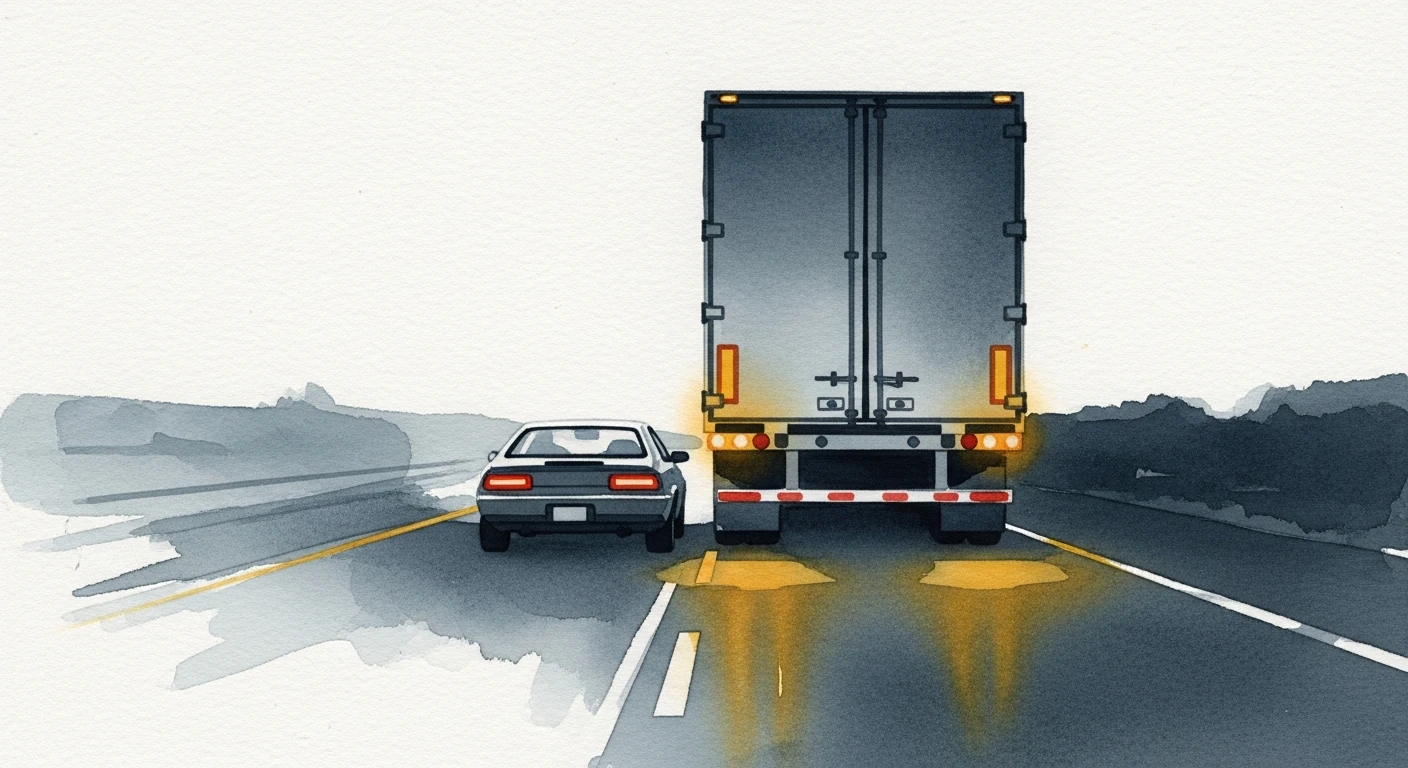
These are commonly called No-Zone crashes. They are often severe and frequently disputed. Truck drivers may say the car “came out of nowhere,” while the passenger driver may say the truck moved over without warning. In Oregon, proving what really happened requires more than a basic crash report. It often requires engineering analysis, electronic data, and precise use of Oregon lane-change and comparative-fault law.
This guide breaks down how No-Zone crashes happen, what evidence proves visibility, and how liability is built in real claims.
If you want a visual companion, explore our interactive infographic:
Executive summary
- Commercial trucks have large No-Zones on all sides; the right side is usually the largest and most dangerous.
- Oregon 2024 crash data shows sideswipes are a major non-fatal truck crash pattern, strongly tied to lane-change errors and blind-spot conflicts.
- Oregon crash timing and configuration data show these events are often systemic (rush-hour density + tractor-trailer articulation), not random anomalies.
- Federal law requires rear-vision systems (traditionally mirrors), but the industry is shifting toward Camera Monitor Systems (CMS) and blind-spot detection tools.
- Human factors still matter: even with mirrors or advanced cameras, rushed scanning and cognitive overload can cause missed vehicles.
- Liability is usually proven through 3D reconstruction, sightline analysis, and telematics data (EDR/ECM/ELD).
- Oregon’s modified comparative negligence rule (51% bar) makes fault allocation critical in every No-Zone claim.
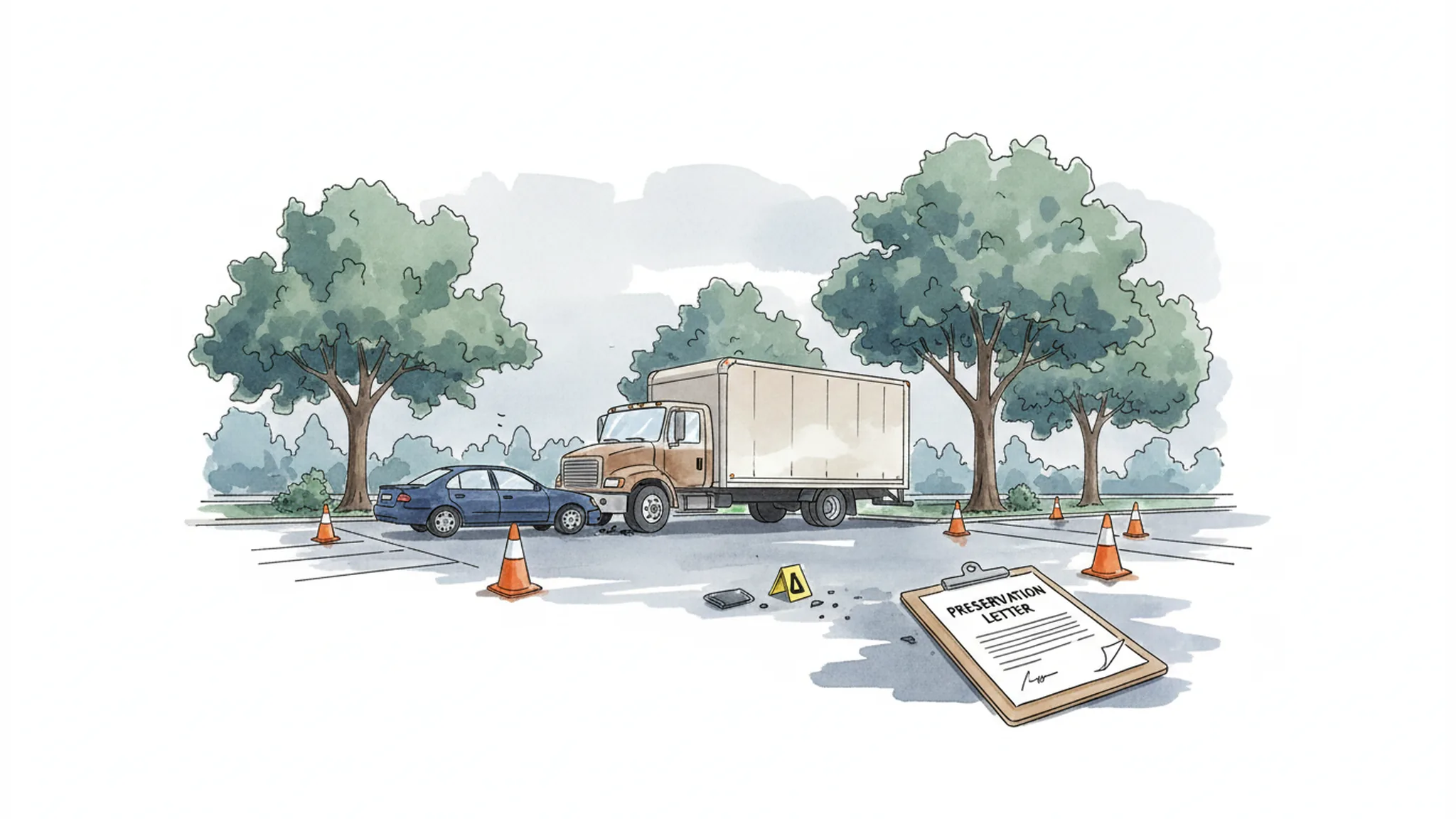
- Fast evidence preservation is essential because electronic and physical evidence can be overwritten or altered quickly.
One practical rule still holds: if you cannot see the truck’s side mirrors, the truck driver generally cannot see you.
What is a truck “No-Zone”?
“No-Zone” is the safety term used for a truck’s major blind areas. Unlike passenger cars, heavy trucks have large invisibility zones created by cab height, trailer length, mirror limitations, and driver seating position.
When a passenger vehicle is in one of these zones, collision risk rises dramatically if the truck changes lanes, turns wide, or brakes hard.
The four major No-Zones
1) Front No-Zone
- Can extend up to about 20 feet in front of the truck.
- Common risk: a car merges too closely in front of a loaded truck.
- Why severe: trucks need much longer stopping distances, so short gaps eliminate safe braking room.
2) Rear No-Zone
- Extends at least about 30 feet behind the trailer.
- Common risk: tailgating and sudden truck braking.
- Why severe: high underride risk in rear impacts.
- Safety shorthand: if you cannot see one or both of the truck’s side mirrors, you are likely in a danger zone.
3) Left-side No-Zone
- Runs from behind the driver’s door toward the trailer midpoint.
- Common risk: sideswipe during leftward lane movement.
- Note: left visibility is better than right, but still incomplete.
4) Right-side No-Zone (largest)
- Begins near the passenger side of the cab and can fan outward toward multiple lanes along trailer length.
- Common risk: right-side sideswipe or wide-right-turn crush.
- Why severe: driver sits opposite this side and has the worst angular view.
No-Zone quick reference
| No-Zone location | Typical spatial extent | Primary crash risk | Safer driver action |
|---|---|---|---|
| Front | Up to ~20 feet ahead | Rear-end crush by truck | Do not cut off truck; merge with extra space |
| Rear | ~30 feet or more behind trailer | Underride after sudden braking | Avoid tailgating; keep truck mirrors visible |
| Left side | Driver’s door to trailer midpoint | Sideswipe in left merge | Pass steadily; do not pace trailer |
| Right side | Cab-front area to trailer rear, widest fan | Sideswipe / wide-turn crush | Avoid passing right; anticipate wide turns |
Oregon crash patterns: why No-Zone claims are common
ODOT’s 2024 motor carrier quick facts reinforce the real-world pattern:
- 1,696 total Oregon crashes involving commercial motor vehicles.
- 488 non-fatal injuries.
- 73 fatalities.
- Sideswipe crashes were the most common non-fatal/property-damage pattern, accounting for 25.47% of non-fatal motor carrier crashes.
- By contrast, head-on crashes were the most common fatal pattern at about 30.50% of fatalities.
That matters because sideswipes are closely connected to lane changes and blind-spot conflicts.
ODOT’s truck-driver fault trends also align with No-Zone risk dynamics:
- Failure to remain in lane ranked #2 among at-fault errors.
- Following too closely ranked #3.
- Improper lane changes ranked #6.
These rankings reinforce that lateral control and lane-transition errors are central contributors in Oregon motor-carrier crash patterns.
Oregon 2024 crashes by truck configuration
| Commercial vehicle configuration | Total crashes | Injuries | Fatalities |
|---|---|---|---|
| Tractor/Semi Trailer | 982 | 264 | 48 |
| Truck (Single Unit) | 435 | 126 | 14 |
| Truck/Trailer Doubles | 121 | 46 | 8 |
| Truck & Trailer | 121 | 41 | 3 |
| Bobtail | 20 | 8 | 0 |
| Truck/Trailer Triples | 10 | 3 | 0 |
Tractor-trailers dominate the totals, and their articulation introduces a major visibility complication: when the trailer angle changes, mirrors may temporarily “blind” by reflecting trailer body instead of adjacent lanes.
ODOT timing data also identifies a notable peak window: Tuesday, 8:00–8:59 AM. That aligns with heavy commuter density, when passenger cars are frequently boxed in near trucks and cannot easily clear No-Zones before an exit, merge, or route change.
Federal visibility rules: mirrors, then cameras
To prove a truck driver “should have seen” a vehicle, investigators start with the applicable standard of care.
Baseline legal requirement
Federal rule 49 CFR § 393.80 requires rear-vision systems on each side of trucks and truck tractors. Mirrors and replacements must satisfy applicable FMVSS No. 111 requirements for field of view and performance.
Traditional setups usually combine:
- A flat mirror (better distance judgment)
- A convex mirror (wider adjacent-lane coverage)
Why mirrors are not perfect
Even compliant mirrors have known limits:
- Weather contamination (rain, spray, ice)
- Vibration blur
- Convex distortion of speed/distance perception
- Articulation-related view loss during turning
In short, mirror compliance sets a baseline duty, but it does not guarantee conflict-free visibility in every lane-change scenario.
So “the truck had mirrors” does not end the analysis. Investigators still evaluate whether the driver executed a proper scan and whether view was actually available at the critical moment.
The shift to Camera Monitor Systems (CMS)
FMCSA has granted exemptions allowing approved camera-based alternatives to traditional mirrors (for qualifying systems such as MirrorEye and Smart-Vision configurations).
CMS advantages can include:
- Wider digital field of view
- Better low-light and glare handling
- Trailer-tracking/panning during articulation
- Redundant display pathways
Some research also suggests meaningful vulnerable-road-user benefits from blind-spot assistance systems, with estimated crash-avoidance potential in certain scenarios (including pedestrians, bicyclists, and motorcyclists).
In liability terms, this can shift the case: instead of debating old mirror geometry alone, the question can become whether the truck’s warning system detected the adjacent vehicle and whether the driver ignored or failed to react to that warning.
Human factors: why drivers miss visible hazards
Technology does not remove human limits.
Commercial drivers are trained (including through Oregon CDL standards) to maintain a “space cushion,” scan mirrors regularly, and signal lane moves properly. But lane changes in dense traffic are cognitively heavy: a driver may monitor forward hazards, speed, lane position, mirrors, and route decisions all at once.
This creates inattentional blindness risk: the eyes may point toward a mirror, but the brain does not fully process a visible car because workload is saturated.
NHTSA lane-change research has shown that visual sampling before lane changes can be inconsistent, especially in unexpected maneuvers where forward-threat avoidance takes priority over full lateral clearance checks.
Representative findings from lane-change research include:
- Planned left lane changes averaged roughly 1.5 seconds to cross into the adjacent lane.
- In the few seconds before planned lane changes, signal use was high, but mirror/window glance behavior was less consistent.
- In unexpected conflict maneuvers, signal use and mirror sampling dropped further as drivers prioritized immediate forward-threat response.
In claims, this matters because “I looked” is not always the same as “I perceived and responded safely.”
Forensic reconstruction: how visibility is proven objectively
No-Zone cases often begin as conflicting stories. Reconstruction turns those stories into measurable facts.
1) 3D scene capture
Teams use drones, photogrammetry, and terrestrial laser scanning (LiDAR) to preserve:
- lane geometry,
- road grade,
- final rest positions,
- skid/yaw/gouge evidence,
- debris and fluid fields.
This is time-sensitive. Weather and traffic quickly degrade scene evidence.
2) Sightline and occlusion modeling
Engineers model the truck and passenger vehicle in 3D and place virtual cameras at truck-driver eye position. They then test:
- what structural elements blocked view (pillars, mirrors, trailer angle),
- whether any part of the passenger car was visible in flat/convex mirror fields,
- exactly when visibility began or ended before impact.
If the model shows the passenger vehicle was visible, the defense claim of “unavoidable blind spot” weakens significantly.
3) Electronic data extraction (EDR/ECM/ELD)
Heavy-truck systems can provide pre-crash behavior records:
- speed,
- steering input,
- brake timing/pressure,
- throttle and RPM,
- turn signal status (system-dependent),
- hours-of-service records from ELD/RODS.
In heavy vehicles, event data may be captured through ECM/ABS-related pathways triggered by hard-brake or deceleration events, rather than passenger-car style airbag-module triggers.
High-value data points in No-Zone litigation
| Forensic data point | Primary source | Why it matters |
|---|---|---|
| Pre-crash speed | EDR / ECM | Tests whether vehicles were moving aggressively into/out of conflict area |
| Steering angle timing | EDR | Shows exactly when lane change started |
| Brake application timing | EDR / ECM | Shows attention/reaction window before impact |
| Turn signal status | EDR (if captured) | Confirms or impeaches claim of proper warning before lane move |
| Hours of Service | ELD | Supports or refutes fatigue-related perception failures |
Federal EDR modernization is also increasing available pre-crash detail for newer vehicles over time, which should make future lane-change reconstructions more precise.
Regulatory updates are expected to expand pre-crash capture windows (for covered newer platforms) from short snapshots toward much richer second-by-second timelines, improving reconstruction precision in blind-spot disputes.
Oregon law: where reconstruction meets liability
Lane-change duties
Two Oregon statutes are central in many No-Zone crashes:
- ORS 811.370 (failure to drive within a lane): drivers must stay in lane as nearly as practicable and move only when safe.
- ORS 811.375 (unlawful or unsignaled lane change): lane movement must be made with reasonable safety, and signal use must be continuous for the required approach distance.
In practical litigation terms, ORS 811.375 disputes frequently center on whether the driver signaled continuously for at least the required final approach distance before moving laterally.
When evidence shows a truck moved laterally without adequate clearance checks or signaling, these statutes become core negligence anchors.
Comparative negligence (ORS 31.600)
Oregon uses modified comparative negligence with a 51% bar:
- If an injured plaintiff is 50% or less at fault, recovery is allowed (reduced by their fault share).
- If plaintiff fault is 51% or more, recovery is barred.
In No-Zone defense strategy, insurers often argue the passenger driver “lingered in the blind spot.” Objective data is key to rebuttal. If telematics, scene geometry, and traffic density show the passenger vehicle was traveling steadily and trapped by congestion, comparative-fault inflation becomes harder to sustain.
For related context, see:
Post-crash duties and evidence preservation in Oregon
DMV and motor carrier reporting timelines
After qualifying Oregon crashes, drivers may need to submit a DMV collision/insurance report quickly (often within 72 hours under qualifying conditions). Commercial operators may also face separate carrier reporting obligations (often a 30-day window for qualifying motor-carrier crashes).
Administrative compliance matters, but the bigger litigation issue is preservation.
Spoliation risk: evidence can disappear quickly
Truck data systems may overwrite event records as vehicles continue operating. Physical evidence can also be repaired, cleaned, moved, or lost.
High-priority preservation targets include:
- Tractor/trailer and passenger vehicle in post-crash condition
- ECM/EDR/ELD downloads
- Driver logs and dispatch communications
- Maintenance and inspection records
- Scene marks and measurements
- Lighting/mirror/CMS condition at time of crash
Where counsel is involved, formal preservation/spoliation notices are often used to demand retention of truck, trailer, modules, and records before routine operations can destroy key evidence.
For practical preservation steps, see:
Practical checklist: proving the truck “should have seen you”
- Lock down data early: send preservation demands before overwrite cycles.
- Map geometry: reconstruct exact lane positions, articulation angle, and sightlines.
- Validate signaling and lane-move timing: compare testimony against electronic records.
- Analyze traffic context: show whether passenger vehicle could realistically exit No-Zone in congestion.
- Apply Oregon statutes directly: tie physical facts to lane-change duty language.
- Defend comparative-fault allocation: use objective evidence to counter “lingering” narratives.
Bottom line
Blind-spot truck crashes are not automatically “nobody could see anything” cases. Many can be proven with scientific precision.
The strongest No-Zone claims combine geometry, digital telemetry, human-factors analysis, and Oregon statutory duties into one timeline. In practice, the first days after the collision are often decisive: if evidence is preserved quickly, liability questions become far clearer.
Related resources
- Blind Spot No-Zone Interactive Infographic
- Truck accident legal guidance in Oregon
- Underride truck accident claims in Oregon
- Jackknife truck crash evidence guide
- Preserving evidence after an accident
- Contact us
This article is general information, not legal advice. Laws and outcomes depend on specific facts. For advice about your specific situation, consult qualified counsel.
Sources
Key references used in this article include:
- CVSA/FMCSA No-Zone safety materials
- Oregon Department of Transportation, 2024 Oregon Motor Carrier Traffic Crashes Quick Facts
- 49 CFR § 393.80 and FMVSS No. 111 visibility standards
- FMCSA exemption notices regarding approved camera-monitor alternatives
- NHTSA studies on lane-change behavior, visibility, and safety technology impacts
- Oregon statutes including ORS 811.370, ORS 811.375, and ORS 31.600
- Oregon DMV collision reporting guidance and Oregon State Bar consumer legal resources
Additional technical and legal sources (including reconstruction, telematics, and visibility references) were reviewed from the full research bibliography in ai-context/articles/truck-blind-spot/gemini.md.
Client-First Fee Promise
Client First = Bills First, Fees Second
Your unpaid medical bills do not have to make your lawyer's fee bigger. Johnson Law subtracts qualifying medical bills before calculating our fee, helping clients keep more of their settlement.
Applies to qualifying cases. Results vary.