Helmet Law in Oregon: Can Insurance Reduce Your Payout If You Weren’t Wearing One?
Helmet Law in Oregon: Can Insurance Reduce Your Payout If You Weren’t Wearing One?
Educational information only, not legal advice. Oregon motorcycle helmet, comparative-fault, evidence, insurance, and deadline issues are fact-specific. This article explains general Oregon principles, not a guaranteed result in any specific claim.
Oregon motorcycle helmet law can matter in an injury claim, but it should not be treated as a simple “no helmet, no recovery” rule.
Oregon generally requires motorcycle operators and passengers to wear helmets unless a statutory exemption applies. If a rider or passenger was not wearing one, an insurance company may try to use that fact to reduce the value of the claim. The important question is narrower: can the insurer connect helmet nonuse to the specific injuries and damages being claimed?
That distinction matters. A missing helmet usually does not explain why another driver turned left in front of a motorcycle, rear-ended a stopped rider, opened a door, or ran a red light. But helmet nonuse may become relevant when the claim includes head trauma, facial injuries, dental injuries, traumatic brain injury, or death from a head impact.
This article explains how Oregon helmet rules, comparative fault, injury causation, and medical evidence can interact in an Oregon motorcycle accident claim.
Short Answer: A Missing Helmet Is Not an Automatic End to an Oregon Motorcycle Claim
Not wearing a helmet does not automatically defeat an Oregon motorcycle injury claim. Oregon’s comparative fault statute reduces damages by a claimant’s percentage of fault when the statute applies, and it bars recovery only when the claimant’s fault is greater than the combined fault being compared. It is not a built-in fixed “helmet penalty.”
That does not mean helmet use is irrelevant. An insurer may argue that a rider or passenger’s damages should be reduced because a helmet would have prevented or lessened certain injuries. The strength of that argument depends on the facts, including:
- whether Oregon’s helmet law applied to the person and vehicle involved;
- whether the person was an operator or passenger;
- whether the injury involved the head, face, brain, teeth, or death from head impact;
- whether the helmet issue has any meaningful connection to how the crash occurred;
- what the medical records, imaging, treating providers, experts, and crash evidence show; and
- whether the insurer is relying on a claim-specific causation theory rather than a broad assumption.
In other words, the claim-value issue is usually about proof. General research that helmets reduce head and brain injury risk may provide safety context, but it does not automatically prove that helmet nonuse caused or worsened a particular person’s injuries in a particular Oregon crash.
What Oregon’s Motorcycle Helmet Law Requires
Oregon has separate motorcycle helmet rules for operators and passengers.
Under ORS 814.269, a motorcycle operator must wear a motorcycle helmet unless an exemption under ORS 814.290 applies. Under ORS 814.275, a motorcycle passenger must also wear a motorcycle helmet unless an exemption applies. Failure to comply is treated as a traffic violation, but the civil-injury consequences require a separate analysis.
Operators, Passengers, and Limited Exemptions
Oregon’s helmet requirement is broad, but it is not exception-free. ORS 814.290 identifies limited exemptions, including for a person within an enclosed cab and for a person operating or riding a vehicle designed to travel with three wheels in contact with the ground at speeds under 15 miles per hour.
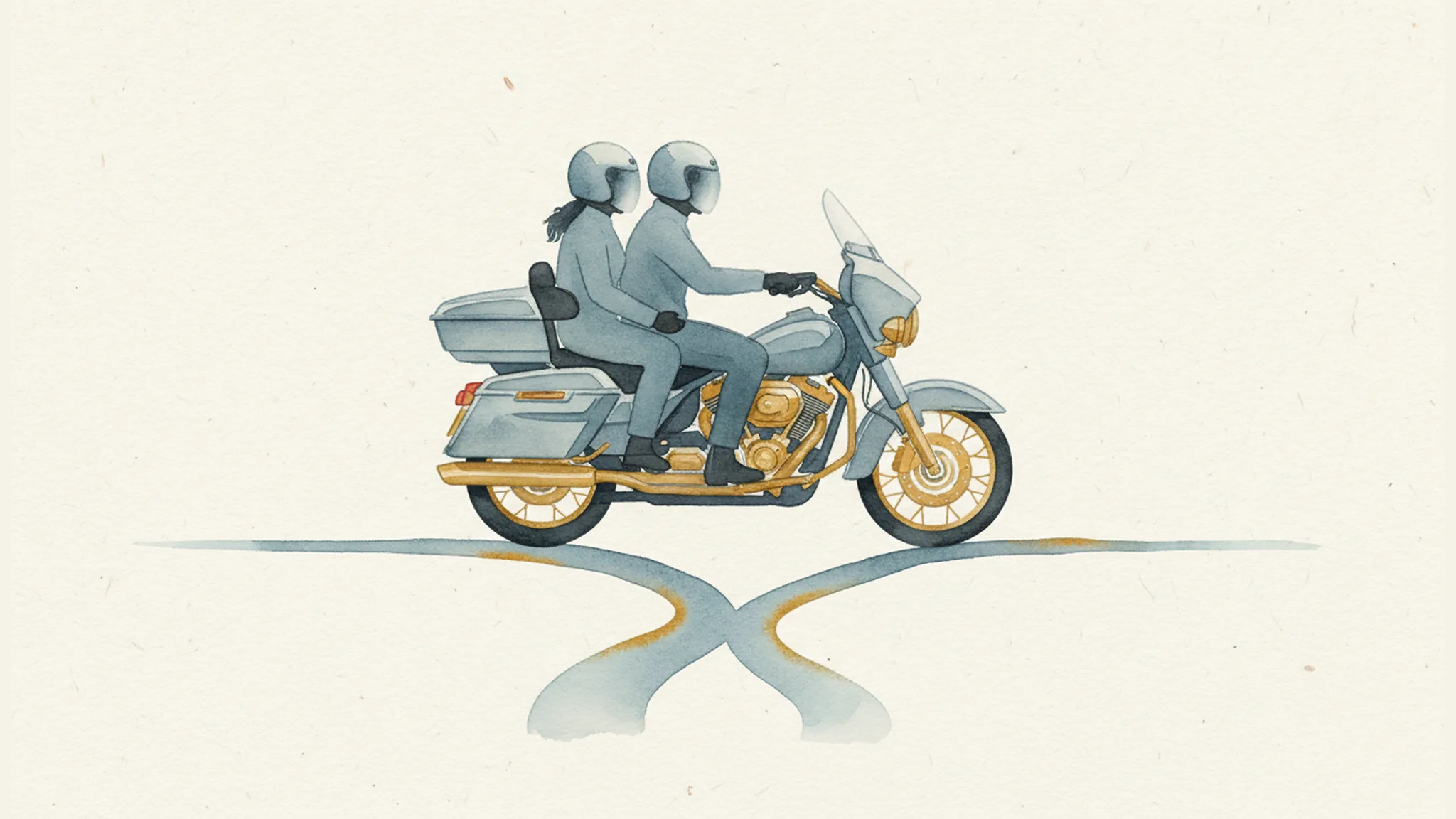
The operator/passenger distinction can matter in an injury claim. A motorcycle operator’s conduct may be evaluated differently from a passenger’s conduct because the passenger usually did not control the motorcycle’s operation or the other driver’s crash-causing choices. A passenger’s helmet nonuse may still be argued as an injury-causation issue, but that is different from blaming the passenger for causing the collision itself. For more on that separation, see Johnson Law’s article on motorcycle passenger claims when fault is disputed.
DOT-Compliant Helmets Versus Novelty or Noncompliant Helmets
Oregon law also defines what counts as a “motorcycle helmet.” ORS 801.366 describes a helmet with a hard outer shell, padding, a chin-strap retention system, and a sticker indicating compliance with U.S. Department of Transportation standards.
The federal motorcycle helmet standard, Federal Motor Vehicle Safety Standard No. 218, includes requirements related to impact attenuation, penetration, retention systems, peripheral vision, projections, and labeling. In a claim dispute, that can make the helmet itself important evidence. The question may not be limited to whether the person had something on their head. The condition, fit, apparent DOT compliance, retention system, and crash damage may all matter depending on the claimed injuries.
This article is not a helmet-design or product-liability guide. The practical point is that if helmet use is being questioned, the actual helmet and related gear may be evidence—not just property to replace.
How Oregon Comparative Fault Can Affect a Motorcycle Injury Claim
Oregon follows modified comparative fault. Under ORS 31.600, a claimant’s contributory negligence does not bar recovery if the claimant’s fault is not greater than the combined fault of the persons whose fault is being compared. If recovery is allowed, damages are reduced by the claimant’s percentage of fault.
For example, the statutory framework is not simply “the motorcyclist violated a helmet law, so the claim is denied.” A factfinder may need to consider total damages and percentage fault. ORS 31.605 provides that, when requested, the trier of fact answers special questions identifying the damages the claimant would receive if not at fault and the percentage fault of each person considered under ORS 31.600.
There is an important caveat: ORS 31.600 states that it does not itself create or abolish any defense. That means a helmet argument still has to fit the applicable legal, evidentiary, and causation rules. The mere fact that Oregon has a comparative-fault statute does not answer every helmet-nonuse question.
Fault Allocation Is Not a Fixed “Helmet Penalty”
Insurance adjusters sometimes speak in percentages: a proposed reduction, a comparative-fault number, or a settlement discount. But Oregon law does not create a universal percentage reduction for every no-helmet motorcycle claim.
A more careful analysis is more specific. What conduct is being compared? What damages are being valued? Is the helmet issue relevant to how the crash happened, to how severe a particular injury became, or both? Is there medical or technical support for that connection?
A flat reduction may be contestable when it treats helmet nonuse as a blanket discount for all losses, including losses that have little or no relationship to helmet protection.
Why the Seat-Belt 5% Rule Should Not Be Assumed to Apply
Oregon has a separate statute, ORS 31.760, dealing with nonuse of a safety belt or harness. That statute limits certain safety-belt or harness nonuse evidence to mitigation of damages and caps mitigation at 5% in the circumstances covered by the statute.
That is not the same as a motorcycle helmet statute. The text refers to a “safety belt or harness,” not a motorcycle helmet. Without confirmed Oregon authority applying that rule to motorcycle helmets, readers should not assume the 5% seat-belt cap controls helmet-nonuse arguments.
For helmet cases, the safer and more precise framing is that helmet nonuse may be argued through comparative fault, mitigation, relevance, injury causation, or damages theories depending on the facts and applicable law. The exact treatment may need case-specific legal analysis.
The Key Distinction: Did Helmet Nonuse Cause the Crash, or Affect the Injury?
The most useful way to think about helmet disputes is to separate crash causation from injury causation.
Crash causation asks: why did the collision happen? Injury causation asks: what injuries did the collision cause, and were those injuries worsened by something else?
Those are different questions. A rider’s missing helmet usually does not explain why a driver failed to yield, followed too closely, drifted into a lane, or struck a motorcycle at a stop. But helmet nonuse may be argued as affecting the severity of certain injuries after the impact occurred.
Oregon evidence rules help frame this distinction. Under Oregon Evidence Code Rule 401, relevant evidence is evidence that tends to make a consequential fact more or less probable. Under Rule 403, relevant evidence may still be excluded if its probative value is substantially outweighed by risks such as unfair prejudice, confusion, misleading the jury, undue delay, or needless cumulative evidence.
That means helmet evidence should be tied to a real issue in the case—not used simply to make the injured person look careless.
Crash-Causation Arguments
An insurer or defendant may sometimes try to suggest that helmet use affected how the motorcycle was operated. Those arguments need support. General assumptions are not enough.
The Insurance Institute for Highway Safety reports that studies have refuted claims that helmets cause neck injuries, and it cites research finding that helmets did not restrict a rider’s ability to hear horn signals or see a vehicle in an adjacent lane before changing lanes. That kind of safety context does not decide an Oregon case by itself, but it illustrates why crash-causation arguments about helmets should be fact-specific rather than speculative.
If the crash was a rear-end collision while the motorcycle was stopped, the helmet issue may have little to do with why the impact occurred. It may still be raised later in the damages discussion if the rider suffered head or brain symptoms. Johnson Law discusses a related distinction in its article on motorcycle rear-end injuries at a stop.
Injury-Causation and Damages Arguments
Helmet nonuse is more likely to matter when the claimed injury matches the kind of harm a helmet is designed to reduce. That may include:
- skull fracture;
- facial trauma;
- dental injury;
- traumatic brain injury;
- concussion or other head-impact injury; or
- death involving head impact.
Even then, the insurer’s argument should be specific. It is one thing to say helmets generally reduce the risk of death and brain injury in motorcycle crashes. It is another to prove that, in this crash, a compliant and properly worn helmet would have prevented or reduced this claimant’s particular injury, medical treatment, future care, lost income, or noneconomic harm.
Oregon’s damages statute, ORS 31.705, distinguishes economic damages such as reasonable medical expenses, rehabilitative expenses, lost income, and impairment of earning capacity from noneconomic damages such as pain, mental suffering, emotional distress, inconvenience, and interference with normal activities. A helmet dispute can affect either category if the disputed injuries are connected to head, face, or brain trauma.
What Medical and Causation Evidence Matters Most
When helmet nonuse is raised, evidence often matters more than argument. The insurer may point to general helmet-safety research, but the claim usually turns on the connection between the crash mechanics and the person’s actual injuries.
Oregon Evidence Code Rule 702 allows qualified expert testimony when scientific, technical, or specialized knowledge will assist the trier of fact. Oregon case law also recognizes validity and pertinence considerations for scientific evidence, including testability, peer review or publication, known or potential error rate, and acceptance in relevant scientific communities. In some cases, qualified experts may disagree, and the dispute may go to the weight of the evidence rather than being resolved by a simple rule.
Not every claim requires every type of expert or technical proof. But when a helmet-related reduction is being asserted, the following evidence may become important.
Medical Records, Imaging, and Diagnoses
Medical evidence is central when the insurer claims a helmet would have prevented or reduced a particular injury. Evidence may include:
- emergency medical services and emergency department records;
- imaging reports, such as CT, MRI, or X-ray studies when ordered;
- neurologic evaluation and testing;
- concussion or traumatic brain injury diagnoses;
- dental and maxillofacial records;
- treating-provider opinions about injury mechanism and prognosis;
- rehabilitation records;
- documented symptom progression; and
- work restrictions or earning-capacity evidence when brain or head injuries affect employment.
Timing can also matter. Early complaints of headache, confusion, memory problems, dizziness, vision changes, nausea, facial pain, or dental trauma may be important to the injury-causation analysis. So can later records showing whether symptoms resolved, persisted, or worsened.
Helmet Evidence: Fit, DOT Compliance, Condition, and Damage
If a helmet was worn, the helmet should usually be preserved. If no helmet was worn, other gear, scene photos, medical records, and witness accounts may still help establish how the impact occurred.
Helmet-related evidence may include:
- the helmet itself;
- photos of helmet damage;
- the chin strap and retention system;
- DOT labeling;
- evidence of fit and positioning;
- damage to the motorcycle, roadway, or other vehicle;
- damaged jacket, gloves, boots, or other riding gear;
- police reports and crash-scene photos; and
- witness descriptions of impact and rider movement.
Johnson Law has a separate resource on preserving a damaged helmet and riding gear. More generally, claimants commonly need to think early about preserving evidence after an accident, especially before damaged items are discarded, repaired, sold, or altered.
Expert Opinions and Competing Causation Theories
Helmet disputes can involve several kinds of expert or technical evidence, including:
- medical causation opinions;
- neurology or neuropsychology evidence;
- dental, facial, or maxillofacial opinions;
- accident reconstruction;
- biomechanical analysis;
- helmet inspection; and
- opinions about whether the claimed injury mechanism matches the crash evidence.
These issues can be contested. A claimant’s treating provider may connect symptoms to the crash, while an insurer may retain an expert who argues that helmet nonuse caused or worsened the same symptoms. Or experts may disagree about whether a particular brain injury is consistent with the documented impact.
The point is not that an injured person must have a perfect technical case before bringing a claim. The point is that a helmet-related reduction should be evaluated against the actual medical and causation record, not accepted simply because helmet nonuse sounds bad.
Injuries Where Helmet Nonuse May—and May Not—Matter
A useful practical test is to ask: what injury is the insurer trying to reduce, and how does a helmet relate to that injury?
Helmet nonuse may be more relevant to damages involving:
- head impact;
- skull fracture;
- traumatic brain injury;
- concussion;
- facial fractures;
- dental trauma;
- eye or orbital injuries; or
- death caused by head trauma.
Helmet nonuse is usually a weaker argument for injuries with no clear helmet connection, such as:
- leg fractures;
- knee injuries;
- ankle injuries;
- shoulder injuries;
- road rash on other parts of the body;
- burns or abrasions unrelated to head protection; or
- unrelated orthopedic or spinal injuries.
There may be unusual facts in a specific case that change the analysis. But as a general valuation principle, an insurer should not treat a missing helmet as an automatic discount on every category of damages.
Special Situations: Passengers, Severe Injury, Public-Body Claims, and Deadlines
Helmet arguments often appear alongside other motorcycle-claim issues. These special situations deserve attention, but each can involve rules beyond the helmet question.
Passenger Helmet Nonuse
Oregon’s passenger helmet rule is separate from the operator rule. A passenger who was not wearing a helmet may face an argument that helmet nonuse contributed to head, face, or brain injury damages. But that is not the same as saying the passenger caused the crash.
For example, if another driver failed to yield to the motorcycle, the passenger’s missing helmet does not explain the driver’s failure to yield. The insurer may still argue about whether the helmet issue worsened the passenger’s head injuries. Those are different issues and should be kept separate.
Severe Head or Brain Injuries and Coverage Pressure
Helmet disputes can become especially important when the injuries are severe. The Insurance Institute for Highway Safety reports that helmets reduce death risk and that unhelmeted riders are more likely to suffer traumatic brain injuries. That data is useful safety context.
But severe injury cases still require claim-specific proof. When medical expenses, future care, lost earning capacity, and noneconomic damages are substantial, insurers may scrutinize causation closely. Coverage limits may also become an issue, especially if the at-fault driver is uninsured or underinsured. Johnson Law discusses that separate coverage topic in its article on UM/UIM claims after severe motorcycle injuries.
Deadline Caveats Readers Should Not Ignore
Oregon injury deadlines are fact-specific. In general, ORS 12.110 provides a two-year limitations period for injury-to-person claims not arising on contract, unless another statute supplies a different rule. Wrongful death claims have separate timing rules under ORS 30.020. Claims involving public bodies can require much earlier notice under the Oregon Tort Claims Act, including 180-day notice for many non-death claims and one-year notice for wrongful death claims under ORS 30.275.
Advance payments can also create timing issues under ORS 12.155, depending on whether required written limitation-date notice is given.
The practical point: do not let a helmet dispute distract from evidence preservation or deadline review. This is especially important in cases involving a public vehicle, a public employee, road design, maintenance, debris, or other potential public-body issues. For that separate topic, see Johnson Law’s discussion of motorcycle road-hazard claims against a public body.
What to Do After an Oregon Motorcycle Crash If Helmet Use Is Being Questioned
If an insurer is asking about helmet use, the evidence record can matter. Depending on the facts, useful steps may include:
- preserving the helmet, even if it is cracked, scraped, or unusable;
- preserving other riding gear;
- photographing the helmet, gear, motorcycle, vehicles, roadway, and visible injuries;
- keeping copies of emergency and follow-up medical records;
- documenting head, facial, dental, vision, hearing, balance, memory, and cognitive symptoms;
- following up on recommended medical evaluation when symptoms persist;
- identifying witnesses who saw the crash or impact;
- avoiding casual statements that assume the insurer’s helmet-related reduction is legally correct; and
- verifying deadlines promptly, especially if a public body, wrongful death claim, minor, product issue, or advance payment may be involved.
Oregon law also identifies unfair claim settlement practices, including misrepresenting facts or policy provisions and refusing to pay without a reasonable investigation based on all available information. That does not mean every low helmet-related offer is unlawful. It does support the broader point that claim evaluation should be fact-based, not driven by a shortcut assumption that no helmet means the claim has little or no value.
Bottom Line: The Helmet Question Is Usually About Proof, Not a Blanket Discount
Oregon requires motorcycle helmets in most operator and passenger situations, but helmet nonuse does not automatically decide an injury claim.
The key questions are more specific:
- Did the helmet law apply?
- Was the injured person an operator or passenger?
- Is the insurer arguing crash causation, injury causation, or both?
- Are the claimed damages tied to head, face, brain, dental, or fatal head-impact injuries?
- What do the medical records, imaging, helmet evidence, crash mechanics, and expert opinions show?
- Is the insurer applying Oregon comparative fault correctly, or treating helmet nonuse as a flat discount?
For many Oregon motorcycle claims, the helmet issue is not a simple yes-or-no answer. It is a causation and damages question that should be evaluated against the actual evidence.
This article is for general educational purposes only and is not legal advice. If you have a live Oregon motorcycle injury claim, consider getting case-specific guidance promptly so evidence and deadlines are not lost.
FAQ
Does not wearing a motorcycle helmet automatically bar an Oregon injury claim?
No. Oregon law generally requires motorcycle operators and passengers to wear helmets unless an exemption applies, and helmet nonuse may become an issue. But it should not be described as an automatic bar to recovery. Oregon comparative fault can reduce damages within its statutory framework, and the analysis depends on fault, causation, damages, and evidence.
Can an insurer reduce compensation if a head injury would have been less severe with a helmet?
An insurer may make that argument. The stronger question is whether the insurer can connect helmet nonuse to the particular injury and damages being claimed. General helmet-safety research may provide context, but a claim-specific medical or technical connection is usually what matters.
Does Oregon’s 5% seat-belt rule apply to motorcycle helmets?
Do not assume that it does. Oregon’s seat-belt/harness mitigation statute refers to a “safety belt or harness,” not motorcycle helmets. Without confirmed authority applying that rule to helmets, it should not be treated as the controlling helmet rule.
What if I was a motorcycle passenger and was not wearing a helmet?
A passenger’s helmet nonuse may be argued as an injury-causation issue if the passenger suffered head, face, brain, dental, or fatal head-impact injuries. But that is different from blaming the passenger for the operator’s or another driver’s crash-causing conduct.
What evidence matters in a helmet-related injury dispute?
Depending on the dispute, important evidence may include medical records, imaging, neurologic testing, treating-provider opinions, helmet condition and DOT-compliance evidence, crash reconstruction, helmet inspection, and expert testimony. Not every case needs every category, but helmet-related reductions should be evaluated against the actual evidence.
Can helmet nonuse reduce compensation for injuries unrelated to the head or face?
That is usually a weaker argument unless the insurer can connect helmet nonuse to those specific damages. A missing helmet is more plausibly relevant to head, face, dental, brain, or fatal head-impact injuries than to unrelated leg fractures, road rash, shoulder injuries, or other orthopedic injuries.
Source Notes
- Oregon Revised Statutes, ORS 814.269, ORS 814.275, and ORS 814.290 — motorcycle operator and passenger helmet requirements and exemptions.
- Oregon Revised Statutes, ORS 801.366 — definition of “motorcycle helmet.”
- Electronic Code of Federal Regulations, 49 CFR § 571.218 — Federal Motor Vehicle Safety Standard No. 218 for motorcycle helmets.
- Oregon Revised Statutes, ORS 31.600, ORS 31.605, ORS 31.705, and ORS 31.760 — comparative fault, special verdict questions, damages definitions, and the separate safety-belt/harness mitigation rule.
- Oregon Revised Statutes, ORS 40.150, ORS 40.160, and ORS 40.410 — relevance, Rule 403 balancing, and expert testimony.
- State v. O’Key, 321 Or 285, 899 P2d 663 (1995), and Kennedy v. Eden Advanced Pest Technologies, 222 Or App 431, 193 P3d 1030 (2008) — scientific-evidence and expert-dispute context.
- Insurance Institute for Highway Safety, “Motorcycles” — general helmet-effectiveness and safety context, not Oregon-specific or case-specific causation proof.
- Oregon Revised Statutes, ORS 12.110 and ORS 12.155, and ORS 30.020 and ORS 30.275 — deadline caveats for personal injury, advance payments, wrongful death, and public-body notice.
- Oregon Revised Statutes, ORS 746.230 — unfair claim settlement practice context, used cautiously to support fact-based claim evaluation.
Client-First Fee Promise
Client First = Bills First, Fees Second
Your unpaid medical bills do not have to make your lawyer's fee bigger. Johnson Law subtracts qualifying medical bills before calculating our fee, helping clients keep more of their settlement.
Applies to qualifying cases. Results vary.