Motorcycle Rear-End at a Stop: Why These Injuries Are Often Worse Than They Look
Motorcycle Rear-End at a Stop: Why These Injuries Are Often Worse Than They Look
Educational information only, not legal advice. Oregon motorcycle injury claims are fact-specific, medically specific, and insurance-specific. This article explains the general Oregon framework for rear-end motorcycle crashes at a stop.
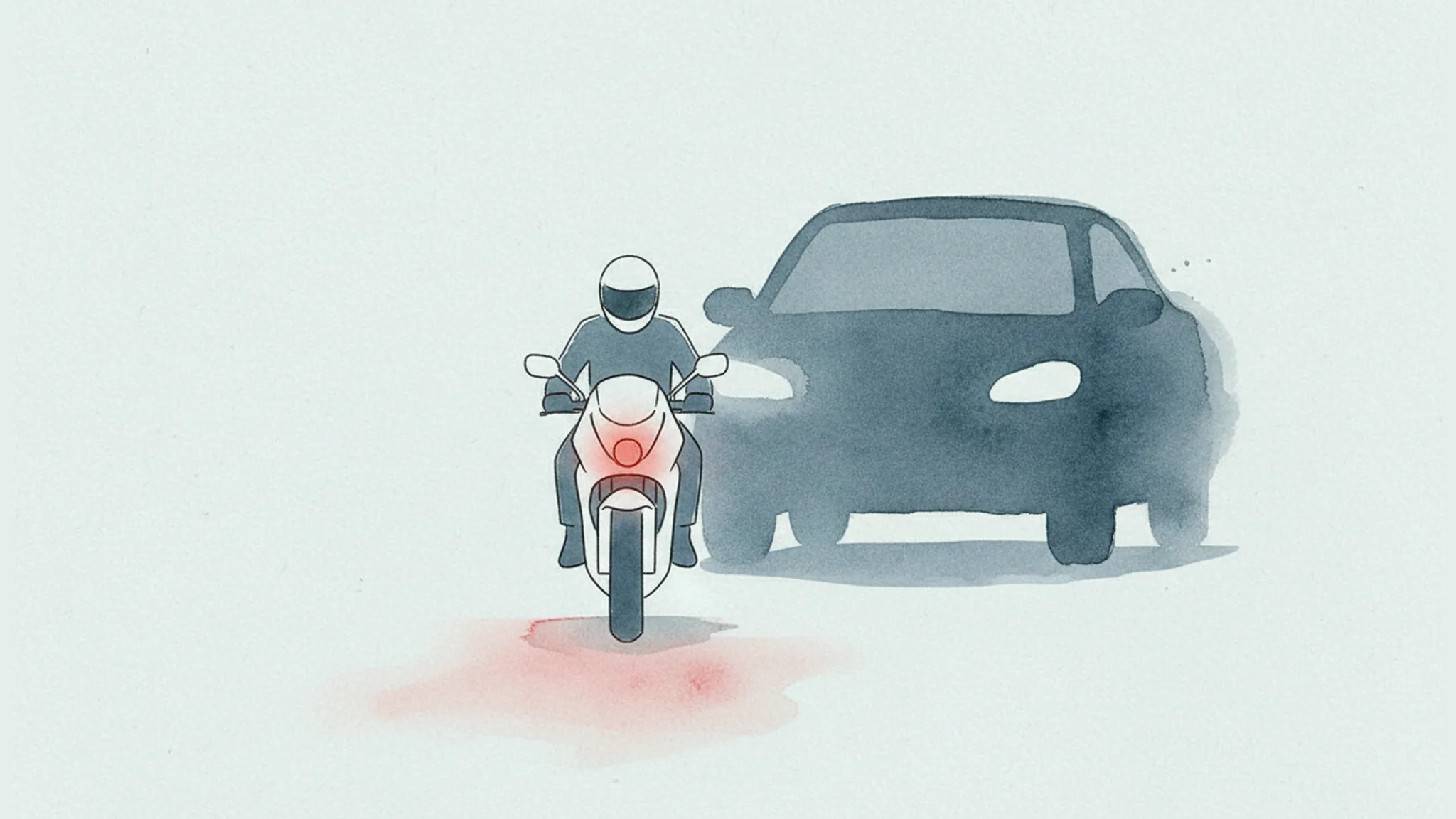
If you were stopped on a motorcycle and a vehicle hit you from behind, one of the first frustrating things you may hear is some version of: “The damage doesn’t look that bad.”
That can be a very misleading starting point.
When a rider is already stopped, the body often takes force differently than a driver sitting inside a car. The motorcycle can be driven forward, the rider can be jolted off balance, the legs can get trapped, and neck or head symptoms may not fully show up until after the adrenaline wears off.
In Oregon, these claims often look simple on liability but more complicated on injuries, evidence, and insurance.
If you want the broader rider-side context first, start with our motorcycle accident practice area page, our Oregon article on the sudden stop defense in rear-end crashes, and our post on preserving evidence after an accident.
1) Quick answer
Yes, a motorcycle rear-end crash at a stop can be more serious than it first looks.
In many Oregon cases, the trailing driver starts in a difficult fault position because drivers must not follow more closely than is reasonable and prudent under ORS 811.485. But the legal issue is only one part of the case. The bigger practical problem is that insurers often treat these collisions like low-damage car crashes even though a stopped rider may have very different injury mechanics.
2) Why these crashes often look smaller than they really are
In a car-versus-car rear-end collision, both occupants are inside enclosed vehicles with seats, belts, head restraints, and more structure around them.
A motorcyclist does not have that same protection.
Even when the impact speed seems modest, a stopped rider may experience one or more of these mechanisms:
- a sharp forward-and-back neck motion,
- the bike being driven forward into another vehicle or object,
- a foot or leg getting pinned,
- a fall to the pavement,
- secondary impact with the tank, bars, or roadway.
That is one reason visible bumper damage can be a poor shorthand for injury severity.
3) Oregon fault usually starts with the rear driver, but not automatically forever
In most rear-end claims, the first question is whether the trailing driver was following too closely or failed to stop in time. Oregon law makes that a natural starting point under ORS 811.485.
But Oregon does not use a magical rule that says every rear driver is always 100% at fault in every case.
Oregon still applies modified comparative fault under ORS 31.600. That means insurers may still argue things like:
- the rider stopped abruptly and unreasonably,
- the bike had lighting or visibility problems,
- the rider changed position unexpectedly,
- the rider contributed to the collision sequence in some other way.
Those arguments often overlap with the broader rear-end analysis discussed in our Oregon post on the sudden stop defense.
For riders, though, the more important takeaway is usually this: even if the other side raises a sudden-stop theory, a stopped motorcycle rear-end crash is still often a strong evidence case against the trailing driver.
4) Why delayed symptoms matter so much in motorcycle rear-end cases
These crashes are often underestimated because the rider may stand up, speak clearly, and go home.
That does not necessarily mean the injury picture is settled.
MedlinePlus notes that whiplash pain may not appear right away after an accident and may take hours to weeks to develop. CDC likewise notes that some mild traumatic brain injury or concussion symptoms may appear right away while others may not appear for hours or days after the injury.
That delayed-symptom pattern matters because insurers often use the first few scene impressions against the rider later.
5) Injury patterns that often deserve closer attention
Not every rider will suffer the same injuries. But stopped-motorcycle rear-end cases often raise concern about a few recurring categories.
Neck and soft-tissue injuries
Whiplash-style injuries can be written off as “just soreness” too early. But pain, stiffness, headaches, sleep disruption, and radiating symptoms can develop over time.
Concussion or mild traumatic brain injury symptoms
If the helmet strikes something, if the head snaps forcefully, or if the rider is thrown down, symptoms may not be obvious right away. Headache, dizziness, fogginess, light sensitivity, concentration problems, and nausea should be taken seriously.
Lower-extremity injuries
NHTSA motorcycle-injury research has found lower-extremity injuries are among the most common injuries in motorcycle crashes. In a rear-end-at-a-stop scenario, that can include foot, ankle, knee, or leg injuries from pinning, twisting, or impact during the fall sequence.
More severe chest, abdominal, or spine injury concerns
NHTSA also notes that while lower-extremity injuries are common, head, chest, and abdominal injuries tend to be more severe. That is one reason riders should be careful about assuming “I can walk, so I’m fine.”
6) The insurance company will often focus on visible damage first
This is one of the biggest claim traps.
Insurers may try to frame the case like this:
- small rear impact,
- limited motorcycle damage,
- rider was alert at the scene,
- treatment did not start immediately,
- therefore the injury must be minor.
That framing can be incomplete or simply wrong.
What often matters more is whether the records show:
- a consistent symptom timeline,
- prompt evaluation when symptoms appeared,
- imaging or follow-up when medically indicated,
- objective notes about balance issues, headaches, range-of-motion limits, leg pain, numbness, or weakness,
- photos showing the motorcycle geometry and contact points rather than just a broad “damage looks small” summary.
7) Evidence that helps these cases most
Because the other side may minimize both fault and injury, early evidence preservation matters.
High-value evidence includes:
- Photos of the motorcycle before repair from multiple angles.
- Photos of the other vehicle, especially bumper height and contact areas.
- Helmet, jacket, gloves, boots, and any visible scrape, crush, or impact marks.
- Scene photos showing lane position, stoplight, queue, crosswalk, skid marks, and whether the bike was pushed into another object.
- Witness names and contact information.
- Dashcam, helmet-cam, intersection, or nearby business video.
- Same-day notes about symptoms, body position, and what happened immediately after impact.
If you are worried about disappearing footage or repaired vehicles, our post on preserving evidence after an accident gives the broader spoliation framework. And if the bike was totaled and the helmet, jacket, or aftermarket parts were damaged too, see our companion guide on recovering motorcycle gear and accessory value after a serious crash.
8) Oregon reporting and practical post-crash steps
Oregon DMV requires a collision report to DMV within 72 hours when injury or death resulted, or when the property-damage thresholds listed by DMV are met.
If you are physically able after the crash:
- Get medically evaluated promptly, even if symptoms seem minor at first.
- Photograph the bike and gear before repair or disposal.
- Report the crash and keep a copy of everything submitted.
- Write down when symptoms began and how they changed over the next several days.
- Do not guess about fault or tell an adjuster you are “fine” if you do not actually know yet.
- Keep all insurer communications in one place.
9) When severe injuries turn into an insurance-limits problem
Rear-end motorcycle injuries can outrun minimum insurance fast.
Oregon minimum liability limits are generally $25,000 per person and $50,000 per crash for bodily injury under ORS 806.070. That may be nowhere near enough if the rider has surgery, fractures, extended rehab, significant wage loss, or a concussion-related recovery.
If the at-fault driver is uninsured or underinsured, UM/UIM issues may become critical. We cover that in detail in Uninsured Driver Hits a Motorcyclist in Oregon: How UM/UIM Claims Work When Injuries Are Severe.
If a passenger was also on the bike, the claim picture can become even more complex. See our companion article on motorcycle passenger claims when the driver may share fault.
Bottom line
A motorcycle rear-end crash at a stop can look deceptively small and still create a serious Oregon injury claim.
The big reasons are simple:
- riders do not have car-level protection,
- neck, concussion, and soft-tissue symptoms may be delayed,
- leg and crush injuries may be underestimated early,
- insurers often rely too heavily on visible damage,
- low policy limits can become a second problem fast.
If you are dealing with this kind of crash now, focus first on medical documentation, preserving the bike-and-gear evidence, and understanding the available insurance before the claim gets framed as something smaller than it is.
FAQ
Is the rear driver automatically at fault if my motorcycle was stopped?
Not automatically in the strict legal sense. But the trailing driver usually starts in a difficult fault position because Oregon law prohibits following more closely than is reasonable and prudent, and rear-end crashes often begin there.
Why can a motorcycle rear-end injury look minor at first?
Because the rider may still be exposed to forceful neck motion, a fall, leg pinning, or delayed head and soft-tissue symptoms even when visible property damage looks modest.
What symptoms should I take seriously after a motorcycle rear-end crash?
Neck pain, headaches, dizziness, nausea, fogginess, light sensitivity, numbness, weakness, and foot or leg pain all deserve attention, especially if they worsen after the first day.
What if the insurer says the bike damage was too small for a serious claim?
That is a common insurer framing move. The stronger response is objective evidence: symptom timeline, medical records, photos of the bike and gear, and proof of how the rider’s body was affected.
What if the other driver had minimum insurance or no insurance?
Then the liability claim may not be enough by itself. Motorcycle UM/UIM issues can become very important depending on the policies available.
Sources
Client-First Fee Promise
Client First = Bills First, Fees Second
Your unpaid medical bills do not have to make your lawyer's fee bigger. Johnson Law subtracts qualifying medical bills before calculating our fee, helping clients keep more of their settlement.
Applies to qualifying cases. Results vary.