Motorcycle vs. Door (Dooring): Liability When a Parked Driver Opens Into Your Path
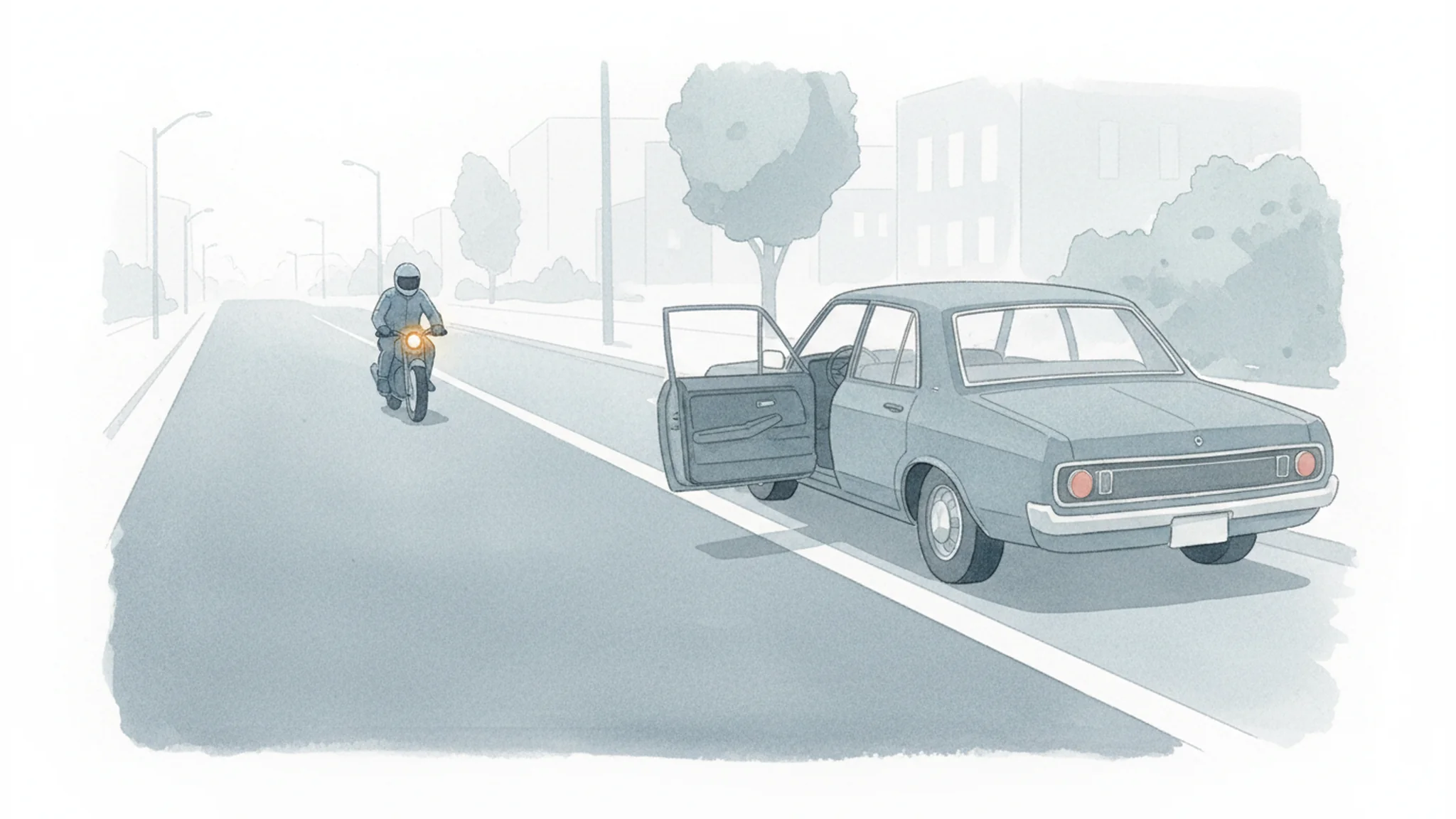
Motorcycle vs. Door (Dooring): Liability When a Parked Driver Opens Into Your Path
Educational information only, not legal advice. Oregon motorcycle dooring claims are fact-specific, roadway-specific, and insurance-specific. This article explains the general Oregon framework, not a guaranteed outcome in any individual case.
One of the most frustrating things a rider hears after a dooring crash is: “You should have seen the door.”
That line often leaves out the real problem. A parked vehicle occupant may open directly into the rider’s path with almost no usable reaction window, especially when the rider is moving through a normal travel lane beside curbside parking.
In Oregon, these claims often start with the unsafe-door-opening rule in ORS 811.490. But the real fight usually turns on proof: where the motorcycle was in the lane, how far the parked vehicle sat from the curb, how abruptly the door opened, and what evidence survives after the bike is moved or repaired.
If you want the broader rider-side context first, see our motorcycle accident practice area page, our post on motorcycle rear-end injuries at a stop, our guide to motorcycle passenger claims when the rider may share fault, our Oregon article on motorcycle UM/UIM claims after severe injuries, and our general guide to preserving evidence after an accident.
1) Quick answer
Yes. In Oregon, a motorcycle dooring claim often begins with ORS 811.490, which prohibits opening a vehicle door unless and until it is reasonably safe to do so and it can be done without interfering with traffic.
But that does not mean every case is automatically over the moment the door opened.
Oregon still applies modified comparative fault under ORS 31.600, so insurers may still argue about rider speed, lane position, visibility, and avoidability. In practice, the strongest motorcycle dooring claims are the ones with clear evidence of where the rider was and how the door entered the lane.
2) Why motorcycle dooring is not just a bicycle-dooring case with a different vehicle
The core unsafe-door rule is the same. But the roadway dynamics are often different.
In many bicycle dooring claims, the dispute centers on a bike lane, a parking lane, and the rider’s position relative to the painted bicycle space.
In many motorcycle dooring claims, the rider is instead traveling in the general lane of traffic. That changes the argument in a few important ways:
- the motorcycle may be lawfully occupying the lane rather than hugging parked cars,
- the closing speed can be higher,
- the bike’s width and balance make a sudden swerve or low-side more dangerous,
- the resulting impact may involve the bars, fairing, mirror, rider’s leg, or a secondary fall into another lane.
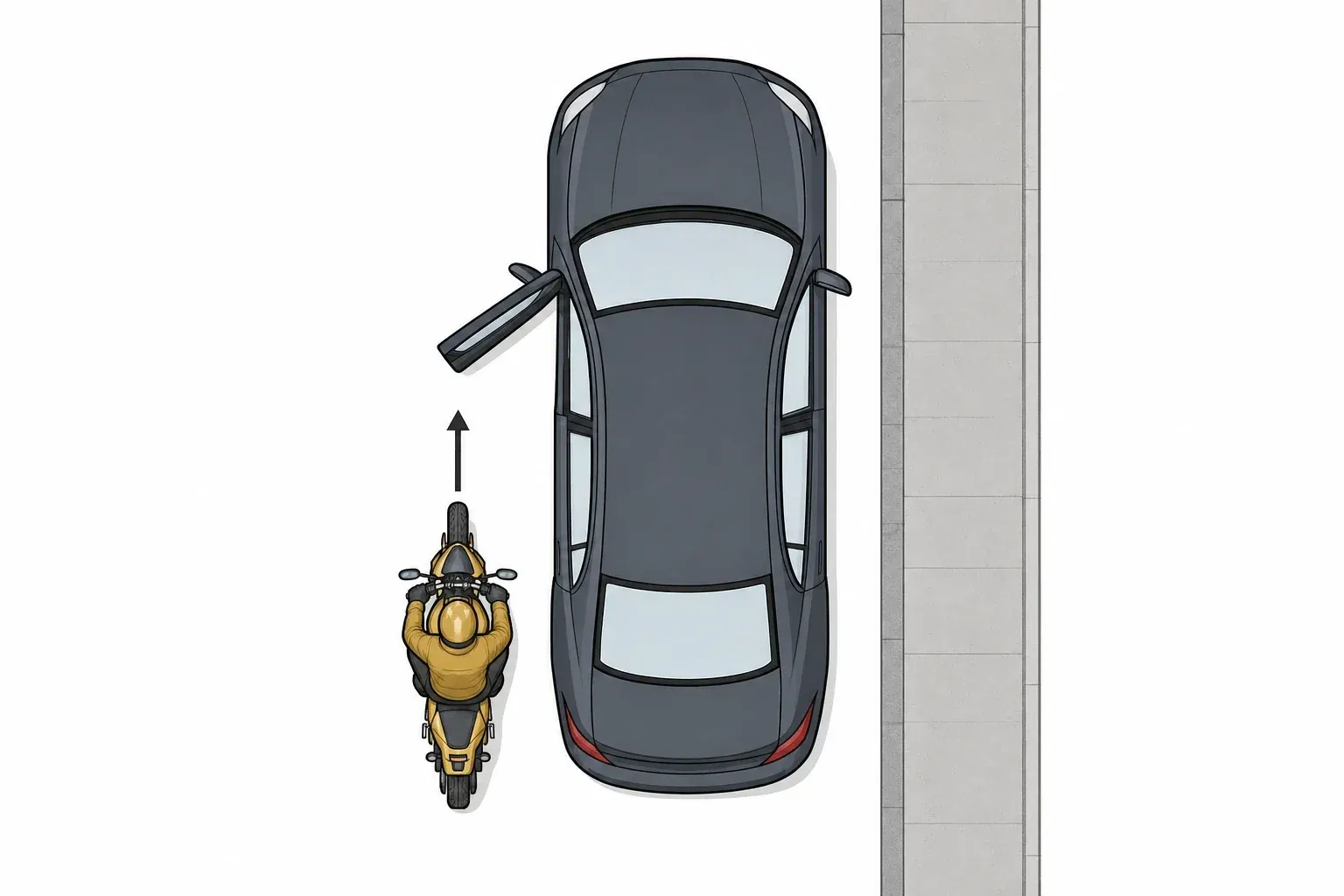
An open street-side door extends into a passing motorcyclist's travel path beside a curb-parked car.
That is one reason this topic should not be analyzed only through bicycle-door-zone assumptions. If you are looking for the bicycle-specific version, see our separate Portland post on how fault is usually proven after a bicycle dooring crash.
3) The Oregon legal starting points are straightforward, but the evidence story is not
ORS 811.490 is the starting point
ORS 811.490 makes it unlawful to open a vehicle door unless it is reasonably safe to do so and without interfering with traffic.
That means a parked driver or passenger cannot simply swing a door into an occupied lane and shift the whole problem to the rider.
Motorcyclists are entitled to a full lane
ORS 811.385 says a driver may not deprive a motorcycle or moped of the full lane to which it is entitled.
That matters in dooring cases because insurers sometimes act as if a rider should have been pressed tight against parked cars or should have given up normal lane position to leave extra room for an unexpected door swing.
That is not the safest or fairest way to frame the roadway.
Parked-car placement can matter too
ORS 811.570 generally requires a parallel-parked vehicle to be within 12 inches of the curb, subject to the terms of the statute.
If a vehicle sat noticeably far from the curb, that can widen the door arc and shrink the rider’s usable path. It does not replace the unsafe-door-opening rule, but it can support the rider’s account of why there was less room than the defense now claims.
4) Where motorcycle dooring cases usually become disputed
Even when the door-opening rule looks favorable, insurers often try to move the fight somewhere else.
“The rider was too close to parked cars”
This defense often ignores how riders actually navigate streets with curbside parking. A rider may have been in a normal lane position with ordinary traffic on the left and parked cars on the right. The question is not whether the rider could imagine a bad door opening in the abstract. The question is whether it was reasonably safe for the occupant to open the door when they did.
“The rider should have seen the door sooner”
Sometimes that argument has force if the door was already visibly open for a meaningful interval. Sometimes it does not. Many real cases turn on split-second timing, partial openings, tinted windows, parked SUVs, glare, or the rider’s limited escape options because of traffic on the left.
“The rider was traveling too fast for the parked-car corridor”
That is a comparative-fault argument, not an automatic defense. Under ORS 31.600, Oregon allows fault to be compared. So speed, visibility, and avoidability may still be argued even when the door opener started the event.
“This was really a lane-filtering problem”
Some insurers try to recast a dooring crash as a lane-position dispute instead of an unsafe-door-opening case. Sometimes that is just a blame-shifting move. Sometimes the rider’s exact path does matter. The key is not slogans. It is the actual scene geometry, door arc, and lane position in the seconds before impact.
5) The evidence that usually matters most
Motorcycle dooring cases can go sideways quickly if the key scene details disappear.
High-value evidence includes:
- Wide and close-up scene photos showing the open door, the curb, lane lines, parked-car spacing, and where the motorcycle came to rest.
- Photos of the parked vehicle’s position relative to the curb so you can tell whether the vehicle was tucked in normally or sitting far out.
- Impact marks on the motorcycle such as bars, levers, mirror, fairing, tank, foot controls, or scrapes showing a low-side after evasive action.
- Photos of the door edge and damage pattern before the car is moved or repaired.
- Witness names and phone numbers from pedestrians, nearby drivers, or passengers who saw when the door opened.
- Helmet-cam, dashcam, business, or residential video before overwrite windows close.
- Same-day rider notes about lane position, traffic to the left, whether there was time to brake, and whether the rider struck the door directly or swerved and went down.
If you are worried about disappearing video or repair-related evidence loss, our broader article on preserving evidence after an accident explains the spoliation side in more detail.
6) Why these claims are often underestimated at the start
A motorcycle dooring crash can look deceptively small in a claim file summary.
The adjuster may write it up as:
- parked car,
- door opened,
- rider down,
- limited visible car damage.
But the real injury mechanism may be much more serious.
A rider may strike the door with the upper body or bars, pin or twist a leg, get thrown off balance, lay the bike down, or slide into a second impact. That can produce injuries to the shoulder, arm, hand, knee, lower leg, head, neck, or chest even if the parked vehicle itself does not look badly damaged.
That is one reason bike-and-gear photos, symptom timeline, and same-day body-mechanics notes can matter more than a quick insurer statement that the “property damage was minor.”
7) Insurance problems can become the second fight
Even when liability looks favorable, the available insurance may be smaller than the harm.
Oregon minimum liability limits are generally $25,000 per person, $50,000 per crash for bodily injury, and $20,000 for property damage under ORS 806.070.
That may not go far in a motorcycle case involving surgery, fractures, extended time off work, or a secondary crash sequence.
And some dooring cases get more complicated than they first appear:
- a passenger may also be injured,
- the rider may be thrown into another lane or vehicle,
- multiple fault allocations may be argued,
- uninsured or underinsured motorist questions may matter if a second vehicle becomes part of the loss.
If a passenger was on the motorcycle, see our companion article on passenger claims when the motorcycle driver may share fault. If the available liability coverage is too small or another responsible driver lacks enough insurance, see our Oregon guide to UM/UIM claims after severe motorcycle injuries.
8) Practical steps after a motorcycle dooring crash in Oregon
If you are physically able after the collision:
- Get medically evaluated promptly.
- Photograph the door, the parked vehicle, the curb spacing, and the motorcycle before repair.
- Get the driver or occupant information and insurance details.
- Identify witnesses immediately.
- Look for nearby cameras right away.
- Preserve the helmet, jacket, gloves, boots, and damaged bike parts.
- Write down exactly where you were in the lane and what traffic was doing around you.
- Submit the Oregon DMV collision report within 72 hours if the crash meets the reporting thresholds described by DMV.
- Be careful about recorded statements that push you to guess about speed, spacing, or what you “could have” done.
Oregon DMV says a report is required within 72 hours when injury or death resulted, when damage to your vehicle exceeds $2,500, when damage to any vehicle exceeds $2,500 and any vehicle is towed, or when damage to other property exceeds $2,500.
Bottom line
In Oregon, a motorcycle dooring claim often starts with a simple rule: a parked vehicle door cannot be opened unless it is reasonably safe to do so and without interfering with traffic.
But the case usually succeeds or fails on more than the statute alone.
What often matters most is whether the evidence shows:
- where the motorcycle was in the lane,
- how far the door entered the travel path,
- whether the parked vehicle sat unusually far from the curb,
- how little time the rider had to react,
- and how the impact or evasive fall actually caused injury.
FAQ
Is opening a car door into a motorcycle’s path illegal in Oregon?
Often, yes. ORS 811.490 prohibits opening a vehicle door unless and until it is reasonably safe to do so and it can be done without interfering with traffic.
Is the parked driver automatically 100% at fault in a motorcycle dooring crash?
Not automatically in every civil case. ORS 811.490 is a strong starting point, but Oregon comparative fault under ORS 31.600 still allows arguments about rider speed, lane position, visibility, and avoidability.
What if I was riding left in my lane to stay away from parked cars?
That may be a very important fact, not a problem. ORS 811.385 supports the principle that a motorcycle is entitled to its full lane. Riders are not required to treat the lane like parked cars own part of it.
What evidence matters most if the insurer says I should have avoided the door?
The most useful proof is usually scene geometry: photos of the open door and curb spacing, the motorcycle’s contact damage, witness accounts, video, and same-day notes showing where the rider was and how quickly the door opened.
What if the available insurance is not enough for the injuries?
That can happen quickly in a motorcycle case. Oregon minimum liability limits may be inadequate for serious injuries, and secondary UM/UIM questions may arise depending on the vehicles and policies involved.
Sources
Client-First Fee Promise
Client First = Bills First, Fees Second
Your unpaid medical bills do not have to make your lawyer's fee bigger. Johnson Law subtracts qualifying medical bills before calculating our fee, helping clients keep more of their settlement.
Applies to qualifying cases. Results vary.