Oregon Outpatient Pharmacy Prescription Errors: What Records and Evidence Matter?
Oregon Outpatient Pharmacy Prescription Errors: What Records and Evidence Matter?
After a suspected prescription error at an Oregon retail or mail-order pharmacy, the clearest picture often comes from comparing four things: what the prescriber authorized, what the pharmacy recorded, what the label said, and what medication the patient actually received.
That comparison may reveal a wrong drug, wrong strength, incorrect directions, a refill problem, or a breakdown during a transfer or prescriber-pharmacy handoff. It may also show that an unexpected brand, manufacturer, or dosage form was a permitted substitution rather than an error. A discrepancy raises questions; it does not, by itself, establish negligence, causation, or a right to compensation.
If someone may have received or taken the wrong medication or dose, do not rely on an online article to make an individualized medical decision. Contact an appropriate pharmacist or health care professional promptly. Seek urgent or emergency help when the situation or symptoms warrant it.
This article concerns outpatient dispensing by Oregon retail and mail-order pharmacies. It does not address medication administered in a hospital, and it does not address defective-drug claims involving a drug’s design, manufacture, or contamination.
Start With the Medication, Label, and Packaging You Still Have
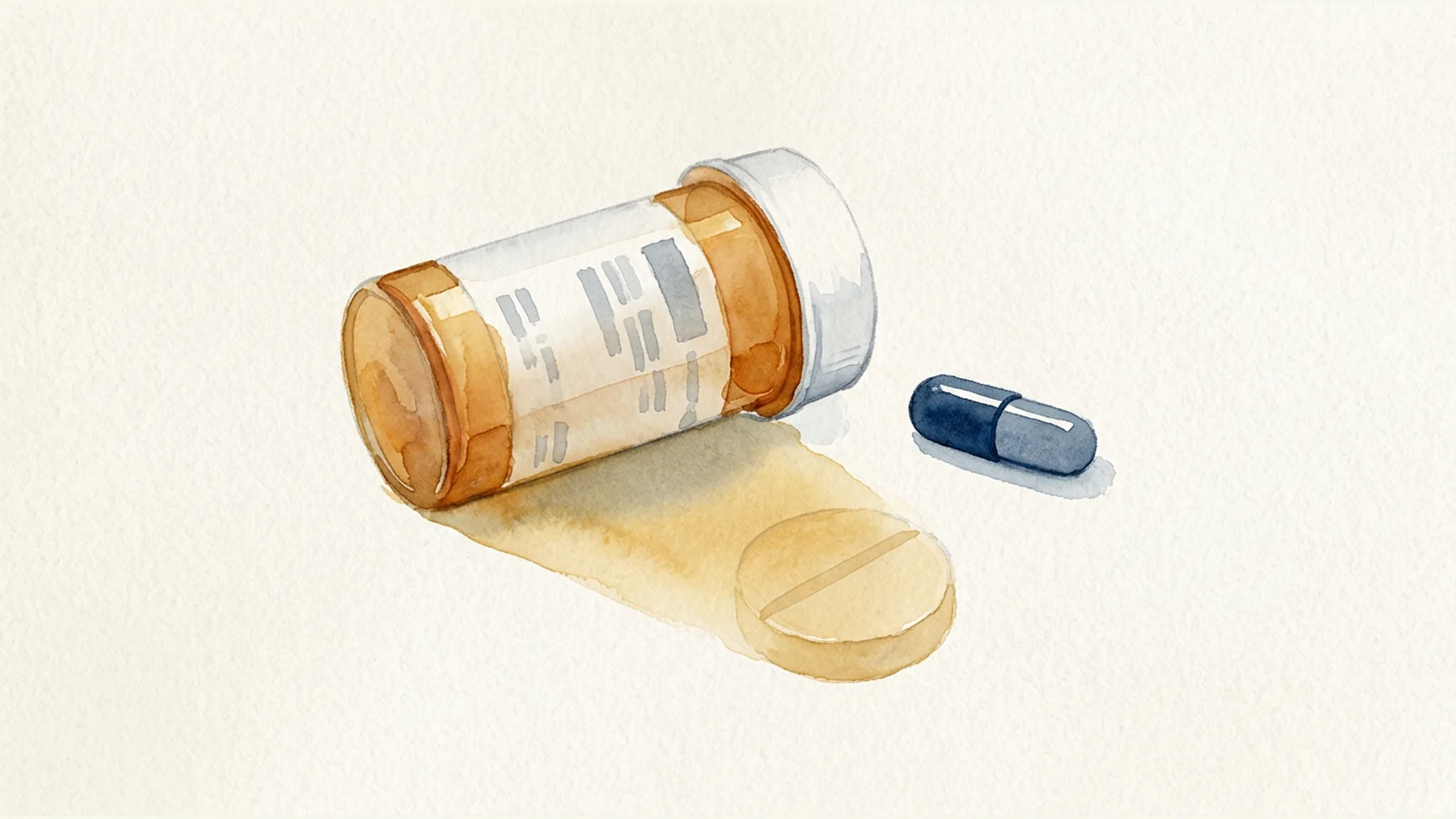
If it is practical to do so, keep the remaining medication, original container, and label together. These items may preserve details that are difficult to reconstruct later, including:
- the tablet or capsule’s color, shape, and imprint;
- the prescription number and fill date;
- the listed drug, strength, quantity, and directions;
- the patient’s and prescriber’s identifying information;
- the pharmacy’s name and contact information; and
- the expiration date and other label warnings or instructions.
Preserving these materials is a practical evidence step, not a general duty Oregon pharmacy law places on patients. Avoid altering the label, combining pills from different containers, or discarding the packaging before the questioned fill has been documented.
Photograph the medication and label clearly
Take clear photographs of the front and back of the container, the full label, and the medication from more than one angle. If the medication is a tablet or capsule, photograph any imprint or identification code. The FDA explains that an imprint can be important when identifying a solid oral dosage form that has been separated from its packaging. Oregon’s current outpatient label rule also calls for a physical description, including an identification code or imprint, when a drug is not dispensed in unit-dose or unit-of-use packaging.
Photographs do not determine who was at fault. They preserve what the medication and packaging looked like at a particular time so those details can be compared with the prescription and pharmacy records.
Keep mail-order and refill materials together
For a mail-order or automatic-refill question, other materials may help establish ordering, shipment, receipt, and timing. Consider keeping:
- outer shipping packaging and mailing labels;
- medication inserts and paperwork enclosed with the shipment;
- receipts and order confirmations;
- refill-request or enrollment screens;
- text messages, emails, and app notifications; and
- contemporaneous messages or notes of calls involving the patient, pharmacy, or prescriber.
These materials may complement the pharmacy’s records. Oregon’s rules do not impose a general patient duty to retain them.
Compare What Was Authorized With What Was Dispensed
Oregon defines dispensing as preparing and delivering a prescription drug under a lawful practitioner’s order in a suitable, appropriately labeled container for later use. Current Oregon rules require a pharmacist to dispense accurately for the correct patient or authorized recipient and according to the practitioner’s authorization.
A useful review therefore goes beyond asking whether the pill “looked different.” It compares the authorized prescription, pharmacy record, label, physical medication, and timing line by line.
Build one timeline and comparison list
Create a single timeline and record the information that is available without guessing. Useful entries may include:
- prescription issue date;
- original fill date;
- refill, shipment, delivery, and pickup dates;
- date the possible discrepancy was discovered;
- dates of symptoms, injury, communications, and later treatment;
- patient and prescriber shown in the records;
- drug name and strength;
- dosage form, such as tablet, capsule, or liquid;
- quantity prescribed and quantity dispensed;
- directions for use;
- refill number and refill authorization; and
- any later clarification or changed instruction from the prescriber.
Keep strength, dosage form, and directions separate. For example, the amount of active ingredient in a tablet is not the same question as how many tablets the directions tell the patient to take.
This timeline is an organizational tool, not a legal test. It can help identify which records are missing and where the authorized and dispensed information may diverge.
Look closely at label information without assuming every omission is unlawful
Under Oregon’s current outpatient label rule, a label generally contains the pharmacy’s name, address, and phone number; the fill date and prescription identifier; the patient; the drug, strength, and quantity; directions; the practitioner; required precautions or cautions; and an expiration date. A generic-drug label also includes a manufacturer or distributor identifier.
There are exceptions. Oregon law includes a narrow exception concerning the patient’s name and allows the drug name and quantity per unit to be omitted when the prescriber directs that omission. An absent item therefore should not automatically be called a labeling violation without checking the rule that applied on the event date and any documented prescriber direction.
A Substitution or Manufacturer Change Is Not Automatically an Error
Medication can differ in color, shape, brand name, or manufacturer from an earlier fill without being the wrong drug. Oregon law generally permits a pharmacist to substitute a drug with the same generic name, strength, quantity, dose, dosage form, and therapeutic equivalence unless the purchaser instructs otherwise, subject to statutory conditions. A prescriber may prohibit substitution, and a substitution may not add cost. Oregon law also permits a limited dosage-form substitution when the prescriber is unavailable and the statutory conditions are met.
That does not mean every change is proper. It means the records and medication need to be compared before reaching a conclusion.
Questions that help distinguish substitution from discrepancy
Relevant questions include:
- Did the prescribed and dispensed products have the same generic name?
- Were the strength, quantity, dose, and dosage form the same?
- Was the substituted product therapeutically equivalent?
- Did the prescriber prohibit substitution?
- Did the purchaser instruct the pharmacy not to substitute?
- If the dosage form changed, was the change within the limited statutory conditions?
- Did the substitution add cost?
- Did the label identify the dispensed drug and, when a generic name was used or the substituted drug had no brand name, include the required manufacturer or distributor identification?
The answers should come from the event-specific prescription, label, medication, and pharmacy records—not appearance alone.
Pharmacy Records May Reconstruct the Prescription and Fill
Oregon law generally requires a pharmacy to retain the original record of every prescription it fills for three years. Division 41 rules also generally require original prescriptions and other covered records to be retained for three years and stored so they can be inspected.
These retention duties belong to the pharmacy. They are different from the practical choice a patient may make to preserve medication and packaging.
Original prescription and dispensing record
The prescription record may identify:
- the patient and date of birth;
- the prescriber and contact information;
- the drug name, strength, and dosage form;
- quantities prescribed and dispensed;
- directions for use;
- issue and fill dates; and
- authorized and completed refills.
If a prescription was communicated orally, the record may identify who transmitted and received it. For a paper prescription that is not for a controlled substance, Oregon rules permit destruction of the paper after 120 days only if the electronic form is an exact, legible image and notes of clarifications or changes are directly associated with it. Those details may help show whether instructions changed between prescribing and dispensing.
Patient profile and earlier fills
The pharmacy’s patient profile may provide a broader history than the questioned transaction alone. Oregon rules require the patient record to identify drugs previously dispensed and include the prescription number, drug name and strength, quantity, date received, and prescriber. It may also include allergy or adverse-reaction information and relevant pharmacist comments.
Comparing the questioned fill with earlier fills may help answer whether the drug, strength, instructions, or manufacturer changed and whether the pharmacy record contained relevant allergy or reaction information.
Requesting pharmacy records
An Oregon patient or authorized representative may request to inspect or obtain all or part of the patient’s protected health information in the pharmacy’s possession, including records received from other providers, subject to listed exceptions. Under the current rule, the pharmacy must act within a reasonable time and no later than 30 days. A pharmacy may provide a summary instead of the records only if the patient agrees.
This access right is not absolute. The rule includes exceptions, including for certain material compiled in reasonable anticipation of, or for use in, a civil, criminal, or administrative action or proceeding. A response to a patient-access request therefore may not include every item in the pharmacy’s possession. This access rule does not determine what must later be produced in civil discovery, and a pharmacy’s retention duties, a party’s evidence-preservation obligations, and litigation-production duties are separate questions.
A focused patient-access request can identify the patient, pharmacy, questioned drug, and relevant date range and ask for the prescription, dispensing history, refill records, patient profile, transfer information, and documented clarifications or changed authorizations. The exact records available will depend on the event.
Refill History Can Show Timing and Authorization
A refill problem may involve a different set of questions from an original fill. Oregon refill records must document the source and date of refill authorization and the authorizer’s name. They also identify the responsible pharmacist, patient, drug, refill date, and quantity dispensed and must be retained for three years.
Request and authorization details
A refill generally requires a specific request. Oregon rules permit qualifying automatic refills of noncontrolled drugs in retail and mail-order settings under stated conditions, so automatic enrollment is not inherently improper. When an automatic refill is questioned, the request or enrollment history, notices, shipment records, authorizations, and any cancellation communications may help explain what occurred.
Dates and expected dosage schedule
Compare the prescription’s issue date, original fill date, refill dates, directions, and expected dosage schedule. Under the cited current Oregon rule, a prescription for a noncontrolled drug is invalid one year after issuance. A pharmacist also may not refill it outside the approximate dosage schedule unless the prescriber specifically authorizes the refill.
The rule in effect when the refill occurred should be checked before drawing a conclusion.
Pharmacy–Prescriber and Pharmacy–Pharmacy Handoffs May Explain a Change
Not every questioned fill begins and ends at one pharmacy counter. A prescriber may clarify instructions, a refill may receive later authorization, or a prescription may move from one pharmacy to another. Records from each participant may be needed to reconstruct the handoff.
Prescriber clarifications and changed instructions
When instructions changed after a call or message, useful records may include:
- the oral-prescription record and the identities of the transmitter and receiver;
- clarification or change notes associated with the prescription;
- the source, date, and authorizer for a refill;
- later prescriber authorizations; and
- contemporaneous phone logs, portal messages, emails, or other communications.
These records may show what information was communicated and when. They should not be used to assume, without review, that a particular person or organization caused the discrepancy.
Transfers between pharmacies
When an Oregon prescription is transferred for an initial fill or a refill, the sending pharmacy must invalidate it, and the receiving pharmacy must accurately and accountably obtain the prescription information and relevant refill history. Different documentation provisions may apply when pharmacies use the same electronic prescription database.
Requesting records from both the sending and receiving pharmacies may help show what information moved between them. One pharmacy should not automatically be assumed to possess the entire record.
Controlled-substance records require a narrower review
If the questioned medication is a controlled substance, the drug’s schedule and whether the event involved an initial prescription, refill, or transfer affect the governing requirements. Federal law generally requires controlled-substance records to be retained for at least two years, while Oregon’s generally applicable three-year rules may require longer retention.
Federal rules limit Schedule III and IV prescriptions to no more than five refills within six months after issuance. They also generally limit the transfer of a Schedule III, IV, or V refill prescription to one transfer unless the pharmacies share a real-time online database. Initial transfers of electronic controlled-substance prescriptions are addressed separately, so the refill-transfer rule should not be generalized to every controlled-substance transfer.
Separate the Dispensing Evidence From the Injury Evidence
Pharmacy records may help establish what was authorized, filled, labeled, transferred, and delivered. They do not necessarily establish that the patient used the medication, suffered an injury because of it, or experienced a particular effect on daily life.
Keep the dispensing materials together, but organize subsequent evidence separately. That may include records from the prescriber and from urgent, emergency, poison-control, or other health care contacts, along with information concerning symptoms, treatment, missed work, and day-to-day effects. Johnson Law’s discussion of documenting the effects of an injury explains why clinical records may not capture the full impact. A general medical documentation checklist may also help organize materials, but it does not replace a focused request for pharmacy dispensing and refill records.
A Record Discrepancy Does Not Decide Liability or the Filing Deadline
An apparent difference among the prescription, pharmacy record, label, and medication may identify an issue that deserves closer review. It does not alone answer whether a legal duty was breached, whether the discrepancy caused an injury, which person or entity may be responsible, or which claim and deadline apply.
Oregon negligence law also distinguishes the source and scope of a claim. A claim by a pharmacy patient may invoke the pharmacist-patient relationship and the professional standard of care. In Stone v. Witt, the Oregon Supreme Court separately recognized an ordinary-negligence theory for physical harm to a nonpatient when a medical professional’s conduct in treating a patient in fact unreasonably created a foreseeable risk of that kind of harm. In either setting, the pharmacist’s professional standard may inform whether the conduct was unreasonable, and expert evidence is commonly required. Stone did not decide which limitation period governs a routine pharmacy-only wrong-drug or wrong-dose claim.
Oregon has multiple limitation and repose provisions that may be relevant depending on the pleaded facts, defendants, conduct, injury, and legal classification. The approved research did not identify a verified Oregon appellate holding that squarely classifies a routine pharmacy-only wrong-drug or wrong-dose claim for deadline purposes. It would therefore be misleading to assign every suspected outpatient dispensing claim the same filing period.
Because record-retention periods and civil filing deadlines are different, the fact that a pharmacy generally retains certain records for three years does not determine how long a patient has to bring a claim.
Do not wait for a Board complaint to resolve a civil deadline
The Oregon Board of Pharmacy accepts complaints alleging violations of pharmacy statutes or rules. That is an administrative process, not a civil damages lawsuit. Filing a Board complaint should not be assumed to toll, preserve, or satisfy any deadline for a civil claim.
A Practical Record Checklist for an Oregon Outpatient Pharmacy Event
The following checklist consolidates the materials that may help reconstruct a questioned outpatient fill:
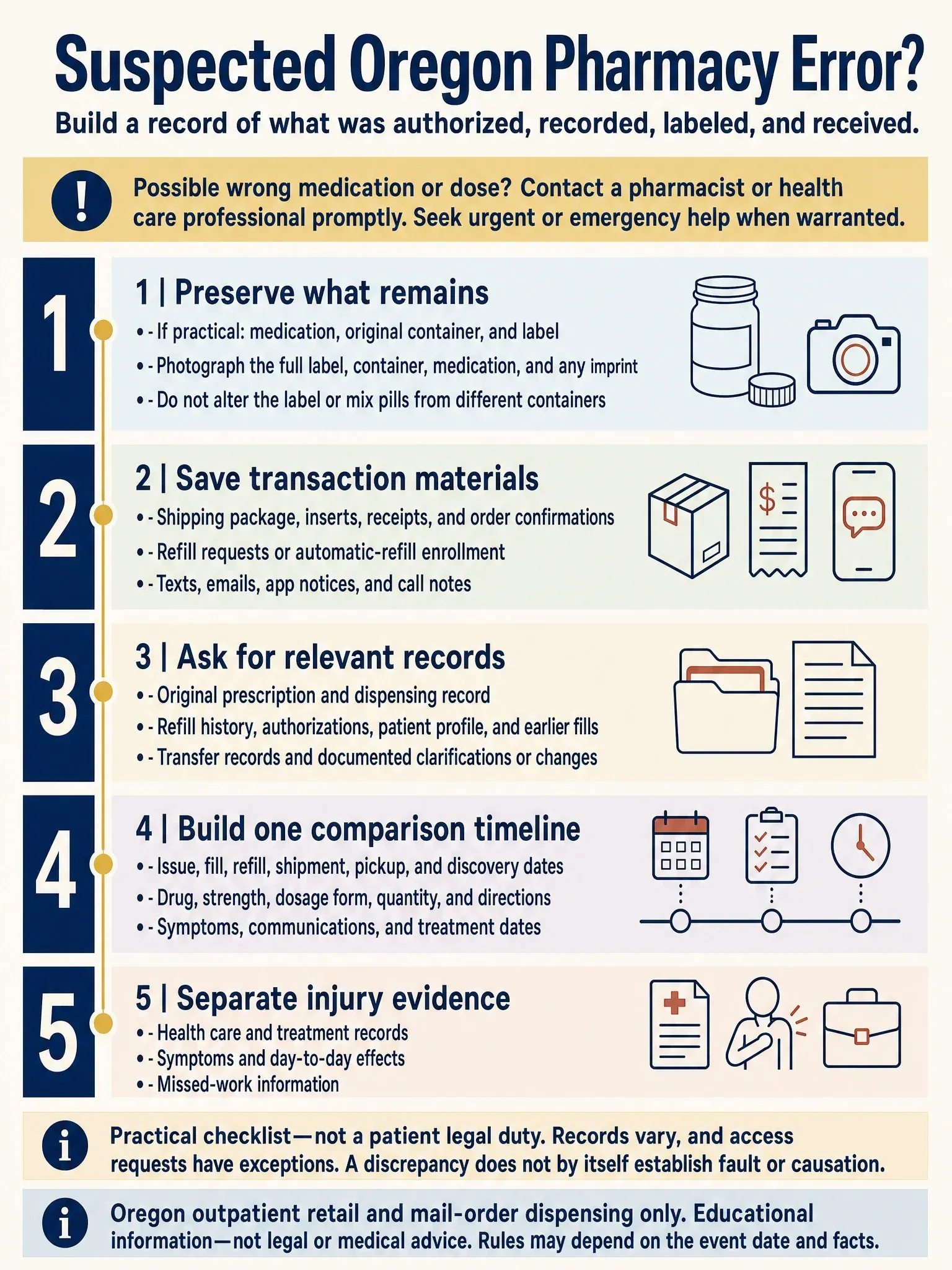
- Remaining medication, original container, and label
- Clear photographs of the medication, imprint, container, and full label
- Outer mail packaging, inserts, receipts, order confirmations, and electronic notices
- Refill-request or automatic-refill enrollment information
- Original prescription and dispensing record
- Refill authorization, fill-date, and quantity history
- Pharmacy patient profile and relevant earlier fills
- Oral-prescription, clarification, changed-instruction, and later-authorization records
- Sending- and receiving-pharmacy records for a transfer
- A timeline of prescribing, filling, shipment or pickup, discovery, symptoms, communications, and treatment
- Subsequent health care and injury-impact records, organized separately from dispensing records
This is a practical organization list, not a statement that Oregon law requires a patient to preserve every item or that every item will exist in every case.
When a Case-Specific Review May Help
A case-specific review may compare the prescription, medication, pharmacy records, participating entities, handoff communications, injury evidence, and potentially applicable deadlines. It may also help distinguish a permitted substitution or explainable record difference from a dispensing issue requiring further investigation. A suspected discrepancy does not itself establish a viable claim or predict an outcome.
Johnson Law provides general information about Oregon medical malpractice claims, including records that may matter in medication-related cases. Whether that framework and its deadlines apply to a pharmacy-only dispensing claim requires separate, fact-specific analysis.
This article remains limited to outpatient retail and mail-order pharmacy dispensing. Hospital medication administration and defective-drug claims involving design, manufacture, or contamination require different factual and legal analysis.
Disclaimer: This article provides educational information only and is not legal or medical advice. Laws and pharmacy rules can change, and the rules applicable to a particular event may depend on its date and facts. Consult an appropriate medical professional about health and medication questions and a qualified attorney about legal rights and deadlines.
Frequently Asked Questions
What should I keep after a suspected Oregon pharmacy dispensing error?
As a practical matter, consider keeping the remaining medication, original container and label, and clear photographs. Mail packaging, inserts, receipts, electronic notices, refill screens, and relevant communications may also help establish what was ordered, filled, shipped, and received. Oregon pharmacy law does not impose a general patient duty to preserve all of these items.
Does a different generic drug or manufacturer mean the pharmacy made an error?
Not necessarily. Oregon may permit substitution when its conditions are met. Compare the generic name, strength, quantity, dose, dosage form, therapeutic equivalence, prescriber restriction, purchaser instruction, cost, and required label information before drawing a conclusion.
What pharmacy records can an Oregon patient request?
A request may seek the original prescription and dispensing data, refill history, patient profile, transfer information, and documented clarifications or changed authorizations. A patient or authorized representative may obtain all or part of the protected health information in the pharmacy’s possession, including records received from other providers, subject to exceptions in Oregon’s access rule.
How long does an Oregon pharmacy keep prescription and refill records?
The cited Oregon provisions generally require covered prescription and refill records to be retained for three years. Federal controlled-substance rules generally require covered records for at least two years. The record type, drug schedule, event date, and rules then in effect matter.
What records matter when a prescription was transferred or changed after a prescriber call?
Potentially useful materials include records from the sending and receiving pharmacies, refill history, the identities of people who transmitted and received an oral prescription, clarification or change notes, later authorizations, and contemporaneous communications among the pharmacy, prescriber, and patient.
Does filing an Oregon Board of Pharmacy complaint protect a civil claim deadline?
It should not be assumed to do so. A Board complaint is an administrative process, not a civil damages lawsuit, and the deadline for a civil claim requires separate, fact-specific legal analysis.
Sources and Source Notes
Research for this article was current through August 25, 2026. Oregon statutes, administrative rules, and federal regulations should be checked for the date of the event and again before publication or reliance.
- ORS chapter 689, including ORS 689.005, 689.505, 689.508, and 689.515 (dispensing, labels, records, and substitution)
- OAR 855-041-1105 (dispensing accuracy and prescription-record contents)
- OAR 855-041-1120 and OAR 855-041-1125 (refills, authorization, validity, and timing)
- OAR 855-041-1130 (outpatient prescription labels)
- OAR 855-041-1160, OAR 855-041-1165, and OAR 855-041-1167 (retention, patient profiles, and patient access)
- OAR 855-041-2115 (prescription transfers for initial or refill dispensing)
- 21 CFR 1304.04, 21 CFR 1306.22, and 21 CFR 1306.25 (controlled-substance records, refills, and refill transfers)
- ORS chapter 12, including ORS 12.110 and 12.115 (limitation and repose provisions; application to a particular pharmacy claim remains fact- and classification-dependent)
- Stone v. Witt, 374 Or 524 (2025) (ordinary-negligence pleading holding involving alleged physical harm to a nonpatient; not a decision selecting the deadline for a routine pharmacy-only dispensing claim)
- Oregon Board of Pharmacy complaint information (administrative complaint process)
- FDA guidance on medication-error-resistant product design (cited only for the practical identification value of a solid oral dosage-form imprint, not for any defective-drug theory)
Client-First Fee Promise
Client First = Bills First, Fees Second
Your unpaid medical bills do not have to make your lawyer's fee bigger. Johnson Law subtracts qualifying medical bills before calculating our fee, helping clients keep more of their settlement.
Applies to qualifying cases. Results vary.