Truck Driver Training Provider Records After a Commercial Crash: What They Can—and Cannot—Show

Truck Driver Training Provider Records After a Commercial Crash: What They Can—and Cannot—Show
After a commercial crash, a driver’s entry in the federal Training Provider Registry is only one piece of the training-record picture. The provider may hold the underlying lesson plans, instructor-qualification materials, permit or license copies, and individual assessments. The motor carrier may hold separate employer-created training records. Its driver qualification file, or DQF, documents a different set of qualification matters.
Those distinctions matter because each record has a different custodian and answers a different question. None, standing alone, proves that the provider complied with every rule, that the driver was or was not qualified, that the carrier acted improperly, or that a training issue caused the crash.
Why the August 31, 2026 FMCSA Action Raises a Narrow Records Question
On August 31, 2026, the Federal Motor Carrier Safety Administration announced that it would execute the emergency removal of more than 110 entry-level driver training providers from the Training Provider Registry. FMCSA said it took that action after comparing provider certifications with roadside records associated with more than 5,000 drivers cited for English-proficiency violations. The agency also reported nearly 400 investigations in 40 states and more than 160 proposed-removal notices alleging facility, instructor, or record deficiencies. A proposed removal is not a completed removal or a final finding of fraud.
FMCSA also reported that drivers certified by the 160-plus providers were associated with 239 commercial-motor-vehicle-related fatalities. That figure does not establish that training deficiencies, English proficiency, or any provider’s conduct caused those crashes. The announcement did not publish its underlying provider-level matching methodology. An English-proficiency citation does not establish why a collision occurred, and nationality, immigration status, or language background should not be treated as a substitute for crash-specific evidence.
The useful lesson is narrower: a registry certification may not answer what instruction and assessment actually occurred. A crash investigation may require identifying the underlying provider records—but the FMCSA announcement does not establish that any particular provider, driver, carrier, or crash involved deficient training.
Start With the Custodian: Four Questions, Four Record Categories
“Driver training records” is not one file held in one place. The following distinctions help prevent a record from being asked to prove more than it can.
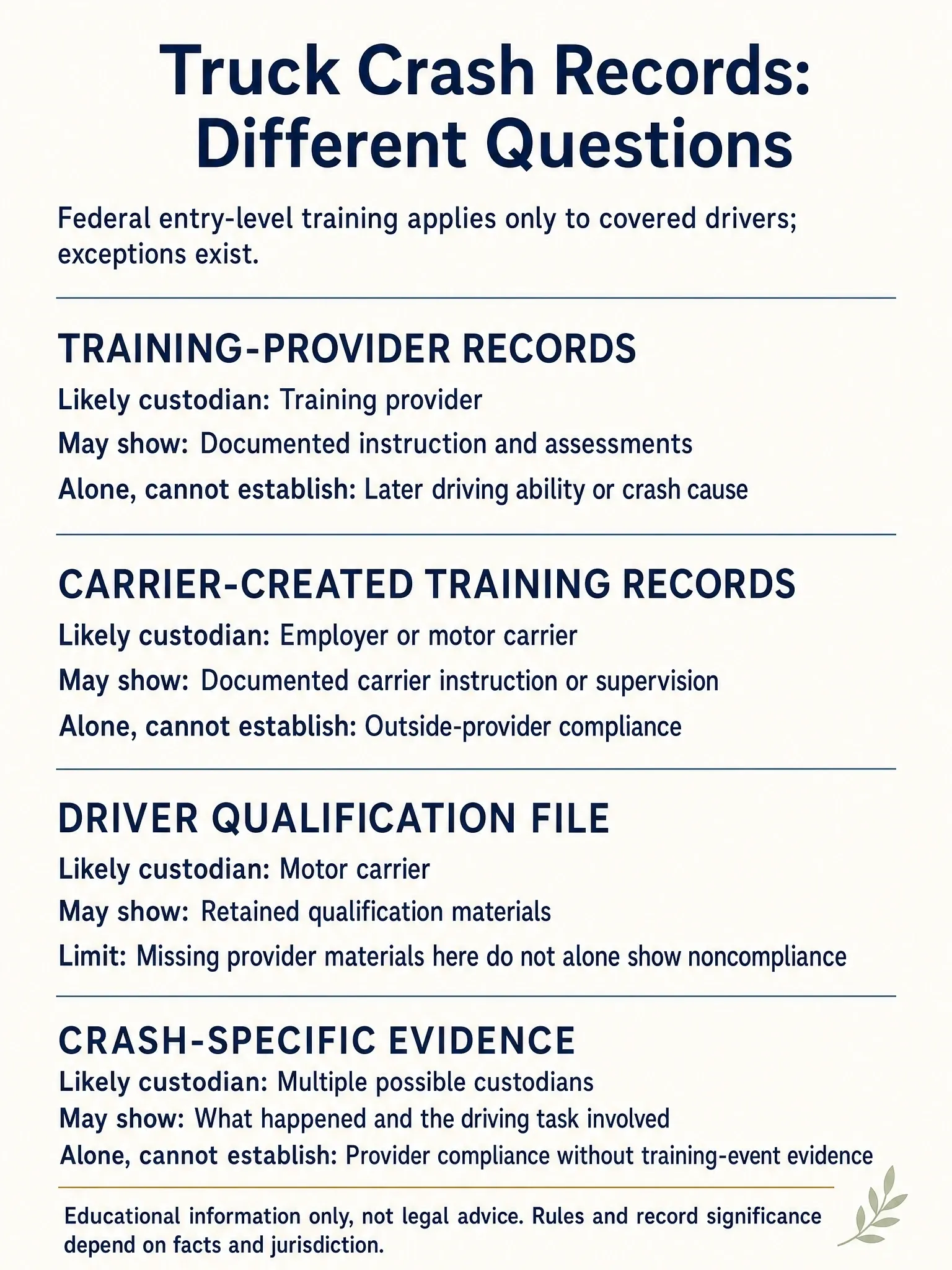
| Record category | Likely custodian | Primary question it may address | What it does not establish by itself |
|---|---|---|---|
| Training-provider records | The entry-level driver training provider | What ELDT instruction, assessment, and instructor qualifications the provider documented | The driver’s complete later operating ability or the cause of a crash |
| Carrier-created training records | The employer or motor carrier | What orientation, task-specific instruction, supervision, or other training the carrier documented | Whether the outside provider complied with its ELDT obligations |
| Driver qualification file | The motor carrier | What qualification materials the carrier retained under the motor-carrier rules | The contents of the provider’s underlying ELDT file |
| Crash-specific evidence | Multiple possible custodians | What happened in the collision and whether a particular skill or act was involved | Provider compliance without evidence about the training event |
Training-provider records concern the provider’s training event
Federal entry-level driver training, or ELDT, generally applies to first-time Class A or B commercial driver’s licenses, certain upgrades, and first-time passenger, school-bus, or hazardous-material endorsements obtained under the rules effective February 7, 2022. Exceptions exist, so the driver’s credential history must be checked before assuming ELDT applied.
When it did apply, the training provider is the central custodian for the underlying ELDT records. Those records concern what the provider documented about curriculum coverage, the instructor, assessment, and any applicable behind-the-wheel proficiency. They do not describe the driver’s entire career after training.
Carrier-created training records concern the carrier’s own conduct
A motor carrier may separately create orientation, vehicle-specific, route-specific, policy, supervision, or remedial-training records. These employer-side materials are not interchangeable with an outside provider’s ELDT file. A request directed only to the carrier may therefore miss records that remained with the provider.
The DQF documents a different qualification framework
Under 49 C.F.R. § 391.51, a carrier’s DQF generally includes materials such as the driver’s application, licensing records, a road-test certificate or equivalent, annual driving-record materials, and specified medical-qualification documentation, such as medical-certification status evidence and any applicable medical variance. It does not necessarily contain the training provider’s lesson plans, instructor records, or individual assessments. The absence of those provider materials from the DQF does not, by itself, show noncompliance.
For the broader role of qualification, hiring, and safety-history evidence, see our guide to driver qualification and safety-history evidence after a fatal truck crash. This article remains focused on the narrower provider-file question.
Crash evidence addresses causation
Provider compliance, driver qualification, carrier conduct, and crash causation remain separate inquiries. Physical evidence, testimony, vehicle data, video, and other crash-specific proof may be needed to determine what occurred. A training record becomes potentially relevant to causation only when evidence connects it to the driving task implicated in the collision.
A TPR Certification Is a Summary, Not the Provider’s Complete File
The Training Provider Registry, or TPR, is an important starting point—but it should not be mistaken for the complete training file.
What the TPR certification summarizes
Under 49 C.F.R. § 380.717, a provider’s certification to the TPR contains specified information, including:
- driver and license information;
- the CDL class or endorsement;
- the type of training completed;
- applicable behind-the-wheel hours;
- the provider’s identity; and
- the completion date.
That summary may help identify the provider, establish a reported training date, and frame the next requests. It does not show every lesson delivered, every assessment result, or the instructor’s underlying qualifications.
What may remain in the provider’s underlying file
Under 49 C.F.R. § 380.725, training providers must retain several categories of underlying records, as applicable:
- copies of the driver’s commercial learner’s permit or commercial driver’s license;
- for accepted behind-the-wheel applicants, the applicant certifications required by 49 C.F.R. § 380.707(a);
- records supporting instructor qualifications;
- lesson plans for theory and behind-the-wheel training; and
- individual driver assessment records.
These materials may help test whether the underlying file aligns with the TPR certification. For example, the completion date, type of training, applicable behind-the-wheel information, instructor documentation, lesson plans, and assessments may be compared with one another and with the driver’s credential timeline. An inconsistency may identify a focused issue for investigation.
Care is still required. Not every file will contain the same optional material, and a record’s existence does not mean that it is publicly available. Access, discoverability, admissibility, and evidentiary weight are separate questions.
A TPR listing is not FMCSA approval
FMCSA explains that a provider’s TPR listing is based on registration and self-certification. It does not mean FMCSA has approved or certified each provider. Listing therefore is not a guarantee that every requirement was satisfied.
The opposite inference is also unsafe. A later provider problem or removal does not, by itself, establish that a particular trainee lacked knowledge or skill. The driver’s dates, records, credential history, and actual performance still matter.
What Provider Records May Establish—and What They Cannot Establish Alone
Provider records are most useful when the question is precisely framed: What did this provider document about this driver’s training event, and does that documentation relate to the skill implicated in this crash?
What the records may help establish
Depending on the file and whether ELDT applied, provider records may help show:
- whether the provider documented coverage of the applicable curriculum;
- whether it retained assessments relevant to the driver’s knowledge or demonstrated proficiency;
- who reportedly provided the instruction and what qualification records supported that role;
- whether the underlying file is consistent with the TPR certification, credential timeline, and available state testing information; and
- whether a document existed before the crash and what it reported about that particular training event.
A discrepancy may be important without being conclusive. A completion certification that does not align with the underlying assessment or date records, for example, may justify further inquiry into the provider’s documentation. It does not automatically resolve what the driver learned, what the carrier knew, or why the crash occurred.
What the records do not prove by themselves
A complete file is not conclusive proof that the driver later operated safely. A driver may satisfy a training or testing requirement and still make an unsafe decision later.
Likewise, a missing or inconsistent item does not automatically prove that the driver lacked competence, that the carrier was negligent, or that a training issue caused the collision. A deficiency may concern recordkeeping rather than the instruction actually delivered. Its significance depends on the specific requirement, the rest of the file, and crash-specific corroboration.
Training hours also require careful interpretation. Federal Class A and B curricula do not prescribe a minimum number of theory or behind-the-wheel hours. The regulations instead focus on curriculum coverage, knowledge assessment, and demonstrated proficiency. Low hours alone therefore do not establish a federal violation.
Finally, ELDT is a prerequisite to specified CDL tests; it does not replace the CDL test itself. Provider training records and state testing records concern related but distinct events, often held by different custodians.
Provider Removal Has Date-Specific—and Limited—Meaning
FMCSA may remove a provider from the TPR for reasons including qualification failures, denial of an audit, material deficiencies, or a false claim of required state licensure, certification, registration, or authorization. Under 49 C.F.R. §§ 380.721 and 380.723, training conducted after the removal’s effective date is invalid.
That rule does not mean every earlier trainee loses a CDL. Provider removal does not automatically invalidate training completed before the effective removal date or an already issued CDL. FMCSA guidance describes retroactive action involving earlier training as case-specific, including circumstances involving fraud or criminal conduct and knowing trainee participation.
Interpreting a removal therefore requires a date comparison:
- When did the driver complete the relevant training?
- When did the removal become effective?
- When and how did the driver obtain the credential?
- Did an agency take any driver-specific action concerning the earlier certification or credential?
Without those answers, labels such as “invalid CDL” or “fraudulent driver” go beyond what removal alone establishes.
Carrier Training and Driver Qualification Are Separate Follow-Up Questions
The provider file does not answer every question about the carrier. Under 49 C.F.R. § 391.11, a carrier may not permit a person to drive unless the person is qualified, including through experience, training, or both to operate the assigned commercial vehicle safely. Carriers also generally investigate three years of licensing and prior DOT-employer safety history and conduct annual motor-vehicle-record reviews under §§ 391.23 and 391.25.
Whether information was significant to the carrier depends on what existed, what the carrier knew or reasonably obtained, and when. That inquiry is distinct from whether the training provider properly documented an earlier ELDT event. Likewise, the DQF does not replace the provider file, and the provider file does not establish what the carrier later taught or learned.
For wider context that this provider-record discussion intentionally does not cover, see our commercial-truck claim and evidence overview.
The Crash-Specific Question: Does the Record Relate to the Driving Task at Issue?
The most important analytical step is connecting any provider-side issue to the actual collision without skipping intermediate questions.
Identify the driving task implicated by the evidence
Start with what the crash evidence places at issue: a particular maneuver, response, or operational skill. Then ask whether the applicable curriculum, lesson plan, or individual assessment addressed that task. This sequence avoids beginning with a record discrepancy and assuming it explains the crash.
For example, if the evidence in a hypothetical crash placed a specific maneuver at issue, an investigator could examine whether the provider documented instruction and demonstrated proficiency concerning that maneuver. An incomplete assessment might support further inquiry. It would not, by itself, prove that the driver could not perform the maneuver on the crash date or that any training deficiency caused the collision.
Compare the right records, dates, and custodians
A focused review may proceed in this order:
- Confirm whether ELDT applied by checking the credential type, dates, upgrade or endorsement history, and any exception.
- Identify the training provider and the reported training date.
- Compare the TPR certification with available provider-side lesson plans, instructor materials, and individual assessments.
- Keep state testing records separate from provider training records.
- Separately ask whether the carrier possessed crash-relevant qualification or training information and when it obtained that information.
This method keeps each inference tied to the entity that created or held the record and to the time when the relevant event occurred.
Require crash-specific corroboration
An apparent training problem becomes potentially meaningful to causation only if other evidence connects it to the driving task and collision. A clean provider file may not rule out later unsafe operation. A deficient file may reflect poor documentation rather than actual inability. The legal effect of either depends on the facts, applicable law, and admissible evidence.
Focused Preservation: Why Provider Records May Need Early Attention
Under 49 C.F.R. § 380.725, a provider generally must retain required records for at least three years from each record’s generation or receipt. That period runs by record—not necessarily from the crash or from a single universal “file date.” Materials in the same provider file may therefore have different retention dates, and the crash may occur long after training.
Focused preservation may require promptly identifying the provider and accurately describing potentially relevant categories, such as the applicable permit or license copy; for accepted behind-the-wheel applicants, the required applicant certifications; instructor-qualification records; lesson plans; and individual assessments. Carrier-created training materials should be identified separately rather than assuming the carrier holds the provider’s file.
State or third-party testing records are another distinct category. Under 49 C.F.R. § 383.75, completed CDL skills-test scoring sheets held by a third-party tester are subject to a different retention framework—generally the current year plus the two prior calendar years. That difference reinforces why record requests should be directed to the correct custodian rather than grouped under a generic demand for “training records.”
A regulatory retention minimum does not determine whether a particular person can obtain a document, whether it is discoverable in a claim, or whether a court will admit or credit it. For the broader principles, see our guide to preserving crash evidence before routine loss. The appropriate preservation steps depend on the matter and should be assessed individually.
A Limited Oregon Note
Oregon has adopted listed federal motor-carrier rules for covered carrier operations, with state modifications, under OAR 740-100-0010 and MCTD 1-2026. Federal ELDT requirements separately apply to covered entry-level drivers intending to operate commercial motor vehicles in interstate or intrastate commerce. Whether a particular requirement applies still depends on the vehicle, operation, credential history, and any exception.
Frequently Asked Questions
Is a driver’s TPR certification the complete training file?
No. It is a summary containing specified certification information. Applicable permit or license copies; for accepted behind-the-wheel applicants, required applicant certifications; instructor-qualification records; lesson plans; and individual assessments may remain with the training provider.
Does a training provider’s removal invalidate every CDL connected to that provider?
No. Training conducted after the removal’s effective date is invalid, but removal does not automatically invalidate pre-removal training or an already issued CDL. Earlier training and any driver-specific agency action require a case-specific review.
Are truck driver training records kept in the carrier’s DQF?
Not necessarily. The carrier’s DQF and the provider’s underlying ELDT file have different required contents and custodians. The absence of underlying provider records from a DQF does not itself establish noncompliance.
How long must an ELDT provider retain underlying training records?
Generally, at least three years from each record’s generation or receipt under 49 C.F.R. § 380.725. Because timing is record-specific and a crash may occur years after training, identifying the provider and relevant record dates may warrant prompt attention in some matters.
Do missing or inconsistent training records prove that training caused a crash?
No. They may identify a provider-compliance issue or a factual question worth investigating, but causation requires evidence connecting the issue to the specific driving task and collision.
Did FMCSA’s 2026 provider action show that English-proficiency violations caused commercial crashes?
No. FMCSA described an enforcement initiative based in part on matching provider certifications with roadside records and reported associations involving fatalities. The announcement did not establish that English proficiency or a provider deficiency caused any particular crash.
The Bottom Line: Identify the Right File Before Drawing a Conclusion
The TPR certification, provider’s underlying file, carrier-created training records, DQF, state testing records, and crash evidence answer different questions. Identifying the correct custodian is the first step. The next is comparing dates and contents without turning a regulatory or recordkeeping issue into an unsupported conclusion about qualification, carrier fault, or causation.
Prompt, focused investigation can matter because provider records generally have record-specific three-year minimum retention periods. But no single training document establishes provider noncompliance, driver disqualification, carrier responsibility, or the cause of a commercial crash by itself.
This article provides educational information only and is not legal advice. The rules that apply and the availability, discoverability, admissibility, and significance of records depend on the facts and jurisdiction.
Sources and Source Notes
- FMCSA, August 31, 2026 provider-enforcement announcement. Enforcement figures and associations in this article are attributed to FMCSA; the supplied announcement did not provide its underlying provider-level matching methodology.
- 49 C.F.R. Part 380, including §§ 380.603, 380.609, 380.707, 380.717, 380.721, 380.723, and 380.725 and Appendices A and B. Covers ELDT applicability, curricula, accepted behind-the-wheel applicant certifications, TPR certifications, provider removal, and provider record retention.
- 49 C.F.R. Part 391, including §§ 391.11, 391.23, 391.25, and 391.51. Covers driver qualification, carrier inquiries and reviews, and DQF contents.
- 49 C.F.R. § 383.75. Covers third-party CDL testing and completed skills-test scoring-sheet retention.
- FMCSA ELDT State Driver Licensing Agency FAQs. Agency guidance concerning provider removal and earlier training.
- FMCSA Training Provider Registry provider page. Explains that registry listing is based on provider registration and self-certification and is not FMCSA approval of each provider.
- Oregon Administrative Rule 740-100-0010 and MCTD 1-2026. Oregon adoption framing for covered operations, subject to state modifications and fact-specific applicability.
Client-First Fee Promise
Client First = Bills First, Fees Second
Your unpaid medical bills do not have to make your lawyer's fee bigger. Johnson Law subtracts qualifying medical bills before calculating our fee, helping clients keep more of their settlement.
Applies to qualifying cases. Results vary.