What Records Must a Trucking Company Keep After a Serious Crash?

A covered trucking company must retain an accident register and specified required accident reports for three years after a qualifying accident. But that is not a three-year retention rule for everything connected to the crash. Driver logs, maintenance records, inspection reports, and driver files have different schedules—and different starting points.
The distinction matters when a family is trying to understand what information may still be available after a serious truck crash:
- Crash-specific records: The three-year requirement covers the register and specified reports, not an entire investigation file.
- Ordinary business records: Separate rules govern logs, inspections, maintenance, and driver qualifications.
- Litigation preservation: Evidence may need to be preserved beyond an ordinary retention schedule.
- Access: A company’s duty to keep a record does not automatically give an injured person the right to receive it.
The three-year rule covers an accident register and specified reports
Which accidents and carriers does this rule cover?
The federal definition generally covers a commercial motor vehicle highway accident involving a fatality, bodily injury to a person who, because of the injury, immediately receives medical treatment away from the scene, or disabling vehicle damage requiring transport away. It excludes events involving only loading or unloading cargo, or only boarding or leaving a stationary vehicle. See 49 CFR §390.5.
That definition does not, by itself, establish that every truck or intrastate operation is federally covered. The operation and applicable state rules also matter.
What the register actually contains
Under 49 CFR §390.15, the register includes the accident date, location and state, driver, numbers of injuries and fatalities, and whether hazardous materials were released other than fuel from the involved vehicles’ fuel tanks.
The three-year requirement also covers copies of accident reports required by states, other government entities, or insurers. It does not mean every insurer document, photograph, reconstruction, or message is part of this required set. The period runs from the accident—not from the date someone makes a claim.
Other trucking records follow their own retention schedules
The following federal schedules are a reference for covered records, not a promise that each record exists in every case. They should not all be read as periods “after the crash.”
| Record | Retention period and trigger | Important limitation |
|---|---|---|
| Required records of duty status (RODS) and supporting documents | At least six months from receipt. §395.8(k)(1) | Exceptions apply; not every driver must use an electronic logging device (ELD). |
| ELD backups | Six months, on a separate device. §395.22(i) | This is not a retention rule for every electronic system on the truck. |
| Vehicle maintenance records | One year where the vehicle is housed or maintained, and six months after it leaves the carrier’s control. §396.3 | This recordkeeping provision applies to vehicles controlled for 30 consecutive days, subject to an exception. The basic maintenance duty is separate. This is not “18 months after a crash.” |
| Required driver vehicle inspection reports (DVIRs), with repair and review certifications | Three months from preparation. §396.11 | A no-defect report is generally unnecessary; other exceptions apply. Do not assume a report exists for every day. |
| Periodic inspection reports | Fourteen months from the report date. §396.21 | The responsible inspecting entity may hold the report. Retrieval provisions matter when the carrier did not perform the inspection. |
| Driver qualification file | Generally throughout employment and for three years afterward. §391.51 | Enumerated recurring items may be removed three years after execution. The rule does not cover every personnel document. |
| Prior-employer safety investigation history | Throughout employment and for three years afterward. §391.53 | Kept in a separate investigation-history file with controlled access. |
Supporting documents for duty-status records can include qualifying trip and dispatch records, receipts, mobile fleet communications, and payroll or settlement records. Section 395.11 has requirements governing which documents qualify and how they relate to the driver’s records. It does not make every dispatch message a required supporting document—or authorize destruction of crash evidence merely because an ordinary document limit has been met.
For what these records may show, rather than how long they must be kept, see our guides to ELD and logbook evidence in a truck claim and maintenance-failure evidence.
Do these rules cover dashcam, GPS, and engine data?
An ELD records hours-of-service information. It should not be treated as another name for an engine control module, a dashcam, or every system sometimes called a truck’s “black box.”
The cited ELD provisions do not establish a universal retention period for all engine data, GPS information, telematics, or video. Some fleet communications can qualify as supporting documents, but that does not create one schedule for all electronic information.
The practical questions are which systems existed, what they recorded, who holds the information, and what retention and preservation duties apply. There is no supported universal overwrite countdown here. Nor should a reader assume that a particular truck recorded video or still has recoverable engine data.
Retention, preservation, and access are different questions
An ordinary schedule does not settle litigation preservation
A regulatory minimum tells a company how long specified records ordinarily must be kept. It does not necessarily resolve what must be preserved when litigation is anticipated or underway. Preservation questions can arise before a lawsuit is filed.
For example, Federal Rule of Civil Procedure 37(e) addresses electronically stored information that should have been preserved for anticipated or ongoing litigation, was lost because reasonable preservation steps were not taken, and cannot be restored or replaced through additional discovery. The rule’s most severe sanctions require intent to deprive another party of the information’s use in litigation.
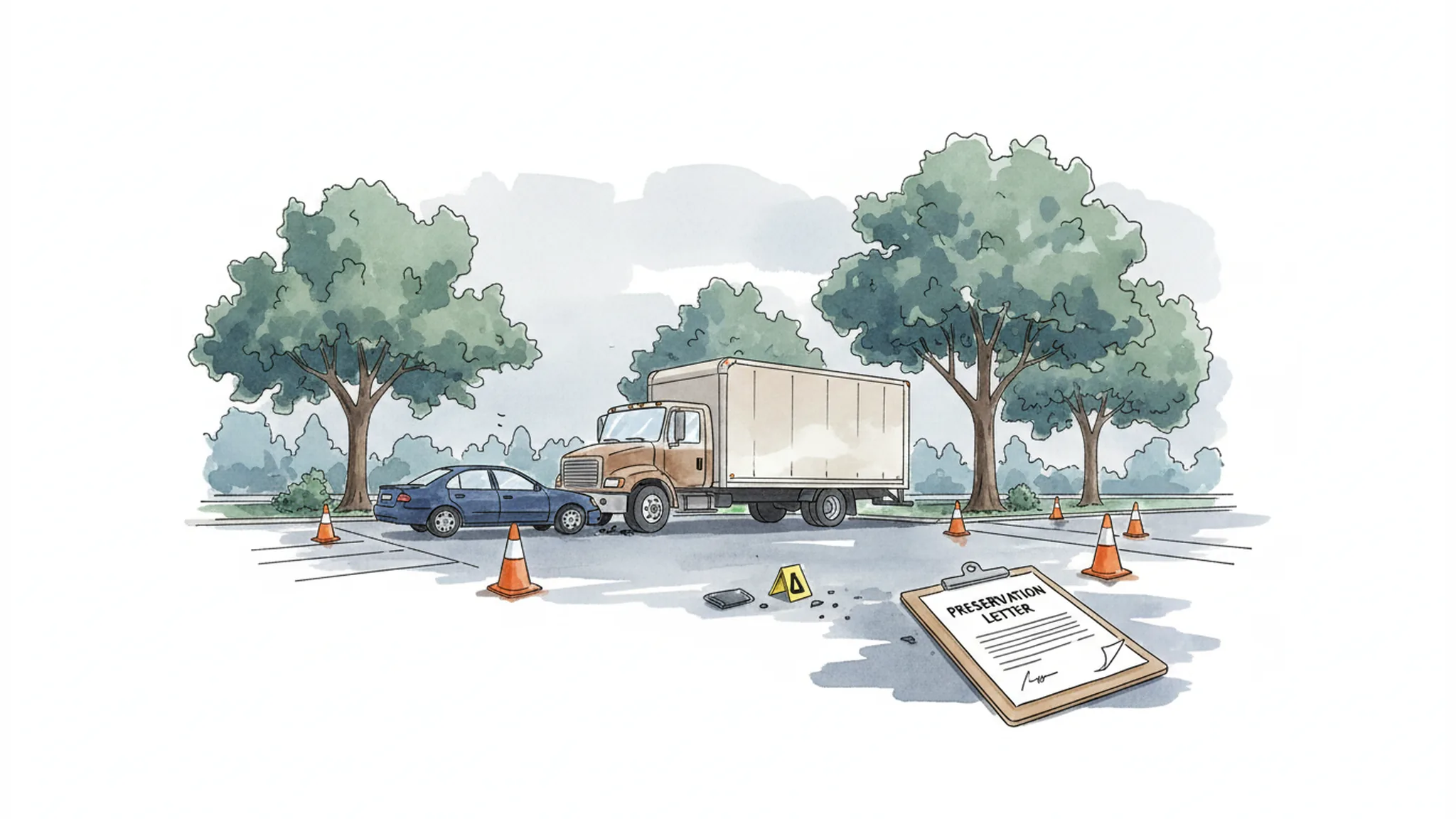
That is a federal electronic-evidence rule—not a universal rule for physical evidence or every Oregon or Washington state case. A preservation letter is not the only possible trigger for a duty, and sending one does not guarantee indefinite retention, disclosure, or a sanction. Conversely, expiration of an ordinary retention period is not permission to destroy evidence subject to a preservation duty.
Keeping records does not mean automatic public disclosure
Section 390.15’s access provision concerns specified authorized representatives. It does not make the carrier’s records an automatically available public file for injured people.
In federal litigation, Rules 26, 34, and 45 provide procedures for obtaining relevant, proportional, nonprivileged information. Possession or control, objections, privilege, and protective rules can affect production. State procedures differ.
That is why a useful early conversation focuses on which records may matter, who may have them, and how to preserve and seek them appropriately. Waiting for a regulatory period to expire does not help answer those questions. Missing records alone do not establish that a trucking company caused the crash.
How the federal framework relates to Oregon and Washington
Both states adopt specified federal motor-carrier provisions with exceptions: see OAR 740-100-0010 in MCTD 1-2026 and WAC 446-65-010. The applicable operation and state provisions need review rather than an assumption that every truck follows an identical schedule.
For example, Washington has a qualifying intrastate logging- and dump-truck exception involving twelve-month retention of time records. “All truck logs last six months” is therefore too broad.
The table is nonexhaustive. Other applicable requirements may add duties; it is not a complete carrier compliance manual.
Frequently asked questions
Does the three-year rule cover every document about the crash?
No. It covers the accident register and specified required accident reports. Other records have their own schedules, and litigation-preservation duties require a separate assessment.
Does a truck’s “black box” have the same six-month rule as ELD records?
Not necessarily. Those terms can refer to different systems. The cited ELD rules do not establish one retention period for all engine data, video, GPS, or telematics.
Can I request records directly from the company?
A retention duty does not create an automatic right for an injured person to obtain the records. Appropriate requests and legal procedures depend on the records, their custodian, and the case.
Does a missing record prove the company caused the crash?
No. Whether a record had to exist, whether it had to be retained or preserved, why it is missing, and whether the company caused the crash are separate questions.
If you need case-specific help identifying preservation concerns, Johnson Law can discuss the available facts. Our commercial truck crash claims page explains the broader practice area without replacing an individual evidence assessment.
Educational disclaimer: This article provides educational information only, not legal advice, and does not create an attorney-client relationship. Recordkeeping, preservation, access, and liability depend on the operation, jurisdiction, and facts. No evidence-recovery or case outcome is guaranteed.
Source notes
- The dated eCFR provisions linked above support the crash-register requirement and each separate federal retention schedule. The dates identify the regulatory snapshots.
- The official Federal Rules of Civil Procedure, amended through December 1, 2025, support the limited discussion of Rules 26, 34, 37(e), and 45.
- The linked Oregon and Washington adoption rules support the qualified state-framework discussion.
Client-First Fee Promise
Client First = Bills First, Fees Second
Your unpaid medical bills do not have to make your lawyer's fee bigger. Johnson Law subtracts qualifying medical bills before calculating our fee, helping clients keep more of their settlement.
Applies to qualifying cases. Results vary.