Can I Own Quail in Oregon? What to Check Before Keeping Backyard Quail
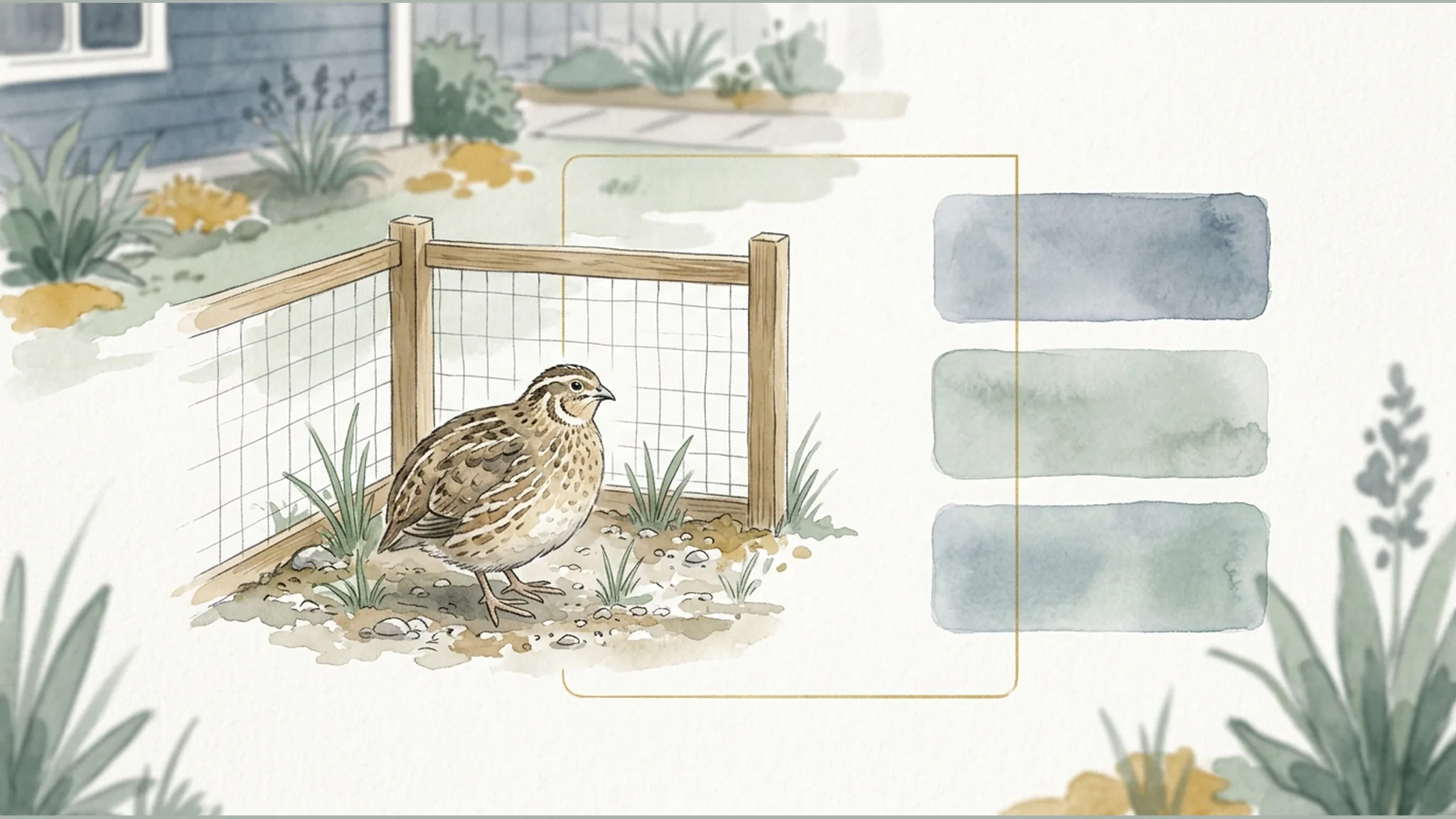
Can I Own Quail in Oregon?
Usually, Oregon residents who want to keep legally sourced domestic quail for personal use are dealing with a different issue than someone who captures wild quail, imports birds from another state, breeds or sells game birds, or releases birds for training. But “quail” is not a single legal category, and a simple yes-or-no answer can be misleading.
The practical answer is this: legally sourced domestic Japanese/Coturnix quail for personal backyard keeping are generally not the same as wild Oregon quail. ODFW’s 2025 Game Bird Propagation License application states that a permit is not needed for Coturnix japonica (Japanese quail), and it also says a propagation license is not required to purchase and hold propagated game birds for personal use. That does not mean every quail-related activity is unregulated.
Before buying birds or hatching eggs, Oregon residents should check:
- the species and scientific name;
- whether the birds or eggs are legally sourced;
- whether the plan is personal keeping, breeding, selling, shipping, importing, releasing, or training;
- Oregon Department of Fish and Wildlife rules for wild birds and game-bird propagation;
- Oregon Department of Agriculture import and poultry-health requirements;
- city, county, zoning, animal-services, lease, and HOA rules for the exact property.
Those details matter because different species can trigger different Oregon permit rules. For example, Oregon zebra ownership rules are a different animal-law problem than backyard domestic quail, and quail rules should not be treated as generic exotic-pet rules.
Educational disclaimer: This article is general educational information based on the sources reviewed for publication. It is not legal advice. Quail ownership rules can depend on the species, source of the birds or eggs, intended use, import status, local ordinances, lease or HOA restrictions, and date-sensitive animal-health rules.
The Short Answer: Usually Possible for Legally Sourced Domestic Quail, But Not a Blanket “Yes”
If you are asking about a few legally purchased domestic Japanese/Coturnix quail kept at home for personal use, Oregon state wildlife rules are generally more favorable than if you are asking about wild quail, native quail, imported birds, commercial breeding, sales, or release activities.
A more precise way to think about the issue is not “Are quail legal?” but “Which quail, from where, and for what purpose?”
Personal backyard keeping versus other activities
Personal keeping is not the same as propagation for sale, interstate import, shipping, dog-training release, raptor-training release, or hunting-preserve use.
ODFW rules define “propagation” to include breeding, reproduction, production, incubation, or rearing of wildlife for sale, release, or other uses, and the Division 44 propagation rules refer specifically to game-bird species. A Game Bird Propagation License is required for a person or business that wants to propagate for sale covered game birds listed in OAR 635-044-0540.
By contrast, ODFW’s 2025 Game Bird Propagation License application states that the license is not required to purchase and hold propagated game birds for personal use. That distinction is important for backyard owners who are not selling birds or eggs.
Why “quail” is not one legal category
Oregon wildlife law defines “game bird” to include members of the family Phasianidae commonly known as pheasants, quail, and partridge. ODFW’s game-bird propagation rule is more specific for licensing purposes, listing quail-related categories such as common quail (Coturnix coturnix) and genera including Callipepla, Colinus, and Oreortyx.
Those names matter. Callipepla includes California or valley quail, Colinus includes bobwhite quail, and Oreortyx includes mountain quail. ODFW’s species information says Oregon has two of the six quail species native to North America: California/valley quail and mountain quail. Domestic Japanese quail (Coturnix japonica) should not be casually treated as legally identical to native Oregon quail.
Do Not Capture Wild Oregon Quail as Pets
Do not take live wild quail, chicks, or eggs from the wild and assume you can keep them as pets.
Oregon law defines “take” to include obtaining possession or control of wildlife. ODFW rules define “hold” broadly as possession or control of a live animal, gamete, or hybrid, with a limited exclusion for observing or casually and temporarily holding wildlife in its natural habitat without removing it from its immediate location.
ODFW rules also provide that wildlife may not be captured from the wild or held except under specified permits or licenses, such as a Game Bird Propagation License, game-bird release permits, hunting preserve license, or other listed authorizations. Oregon’s game-bird definition includes quail, and ODFW identifies California/valley quail and mountain quail as native Oregon quail species.
That means a wild quail wandering through a yard is not the same thing as a domestic bird purchased from a lawful source. Hunting seasons and bag limits for wild quail are also not pet-ownership rules. A lawfully hunted dead game bird is a different legal situation from keeping a live wild bird.
What ODFW Says About Propagated Game Birds and Coturnix/Japanese Quail
ODFW’s game-bird propagation framework is a key statewide source for Oregon quail questions, but it should be read carefully.
When a Game Bird Propagation License may be required
Under OAR 635-044-0540, a Game Bird Propagation License is required for a person or business that wants to propagate for sale covered game birds listed in that rule. The quail-related birds covered by the rule include common quail (Coturnix coturnix) and genera Callipepla, Colinus, and Oreortyx.
The license requirement is not framed the same way as ordinary personal ownership. It is tied to propagation for sale of covered game birds.
What ODFW guidance says about personal holding
ODFW’s 2025 Game Bird Propagation License application states that a propagation license is required to raise game birds or their eggs for sale, but is not required to purchase and hold propagated game birds for personal use.
ODFW’s Wildlife Holding Permit rule also says no Wildlife Holding Permit is required for game birds that are legally acquired and held under a Game Bird Propagation License, legally acquired from a licensed propagator, or legally acquired with a valid Oregon Department of Agriculture import permit.
That supports a practical point for backyard owners: if the birds are legally acquired propagated birds kept for personal use, the analysis is different from capturing wild quail or running a propagation-for-sale operation. But it does not erase other rules.
Coturnix japonica caution
ODFW’s 2025 Game Bird Propagation License application states: “Permit is NOT needed for Coturnix japonica (Japanese quail).” That is the clearest agency guidance found in the supplied fact sheet for domestic Japanese/Coturnix quail.
Still, the statement appears in the Game Bird Propagation License context. It should not be read to waive Oregon Department of Agriculture import rules, poultry-health requirements, disease-event restrictions, city or county backyard-fowl limits, nuisance rules, humane-care obligations, lease terms, or HOA covenants.
It also should not be stretched into an unsupported statement that every Coturnix breeding or sale activity is outside ODFW authority. If a business or seller is relying on that point, current agency guidance should be checked directly.
Can You Keep Quail for Eggs in Oregon?
Many backyard quail owners are interested in eggs for household use. For Oregon state wildlife purposes, keeping legally sourced propagated quail at home for personal use is different from breeding, hatching, selling, shipping, or operating a business involving birds or eggs.
ODFW’s 2025 Game Bird Propagation License application says a propagation license is not required to purchase and hold propagated game birds for personal use, while a license is required to raise game birds or their eggs for sale. That supports a practical distinction between eating eggs produced by a small personal flock and selling eggs, selling birds, or running a propagation operation.
Do not assume that “eggs” are always treated the same way. Edible eggs used within a household are different from hatching eggs, imported eggs, shipped eggs, or eggs sold as part of a business. Hatching eggs can raise import, shipping, poultry-health, NPIP, and propagation-record questions, especially if they cross state lines or are connected to a sale.
Local rules can also matter even when the intended use is personal. A city, county, lease, or HOA may regulate the number of birds, commercial home occupations, nuisance, sanitation, odor, noise, slaughter, and enclosure conditions. Before selling quail eggs or birds, check local business rules, Oregon Department of Agriculture requirements, and any ODFW guidance that applies to the species and activity.
Buying, Importing, or Shipping Quail and Hatching Eggs Into Oregon
Buying quail locally from a lawful source is one thing. Bringing live birds or hatching eggs into Oregon from another state can raise separate import and animal-health questions.
Oregon Department of Agriculture import rules may apply
ODFW rules state that importing game birds into Oregon requires a Certificate of Veterinary Inspection from a federally accredited veterinarian and an Oregon Department of Agriculture import permit, subject to ODA import-rule exceptions.
ODA’s current import guidance should be checked before birds or hatching eggs are moved into Oregon. The supplied fact sheet notes that exact ODA rule numbering can be date-sensitive, so the safer practical approach is to consult ODA’s current import page, a veterinarian, or the relevant agency before shipment or entry.
NPIP and poultry-health requirements
ODA’s livestock-health definitions include quail in the poultry context, and ODA administers Oregon’s National Poultry Improvement Plan program. ODA’s NPIP page states that Oregon NPIP testing covers Salmonella Pullorum, avian influenza, Mycoplasma gallisepticum, and Mycoplasma synoviae using NPIP standards.
For poultry from pullorum-typhoid clean NPIP flocks recorded on USDA APHIS Form VS 9-3, ODA’s import page says those birds are exempt from all other Oregon poultry import requirements. For poultry from sources that do not qualify for that exemption, ODA guidance lists a Certificate of Veterinary Inspection issued by an accredited veterinarian within 30 days before entering Oregon, an ODA import permit within 30 days before entry, and a negative pullorum-typhoid blood test within 30 days before entry. ODA guidance also notes that veterinarians using an approved electronic CVI are not required to obtain a separate import permit.
Those details are especially important for people ordering live birds or hatching eggs from out of state.
Disease-event caveat
Poultry and game-bird movement rules can change during avian influenza or other disease events. ODA import guidance, NPIP documentation, testing rules, fair or exhibition limits, and interstate movement advisories should be checked close to the time of transport—not months earlier.
ODFW rules also allow the Department to order a holder to euthanize, confine, or transfer captive wildlife if a communicable disease outbreak among captive wildlife creates an imminent danger to public, wildlife, domestic animal, or livestock health. That is an outbreak-control authority, not something to describe as routine backyard enforcement.
Breeding, Selling, Releasing, or Using Quail for Training Can Change the Rules
Even when personal keeping is allowed, additional activities can trigger different rules.
Breeding or raising for sale
If a person or business wants to propagate for sale covered game birds listed in OAR 635-044-0540, a Game Bird Propagation License may be required. ODFW’s 2025 application says the license is required to raise game birds or their eggs for sale, while not required to purchase and hold propagated game birds for personal use.
The fact sheet located a 2025 ODFW application and an Oregon Business Xpress listing describing the license as an annual January 1 through December 31 license, with a listed fee of $58 and estimated processing time of two to three weeks. Those practical details should be verified against current agency materials before anyone relies on them.
Records and shipping for license holders
Licensed propagation operations can have recordkeeping and shipping obligations that do not necessarily apply to every backyard owner.
For example, ODFW rules require a Game Bird Propagation License holder shipping game birds within or outside Oregon to attach a record to the shipping container with the shipper’s name, address, and license number; the consignee’s name and address; the species’ common and scientific names; and the number of birds.
ODFW rules also require propagation license holders to keep current records of sale or purchase transactions involving eggs or game birds and to make current-year records available for inspection by Oregon State Police or ODFW personnel. Annual reports with renewal materials must list game birds by species purchased or acquired and sales or transfers by species, including eggs, births, and deaths in the previous calendar year.
Those requirements are examples of why a breeder, seller, or shipper should not rely on a simple backyard-ownership answer.
Releasing birds is not backyard ownership
Releasing domestic quail is a different activity from keeping quail in a backyard coop.
ODFW rules require a Game Bird Release Permit for Hunting Dog and Raptor Training before releasing domestically raised game birds for that purpose. The listed releasable quail include California/valley, bobwhite, and Coturnix quail if lawfully acquired. ODFW rules also require a Competitive Hunting Dog Trial Permit to hold a competitive hunting dog trial if domestically raised game birds are released, if wildlife is used outside the pursuit or hunting season, or if the trial occurs between March 16 and August 14.
Those rules are not general backyard-ownership permits. They apply to release and trial activities.
Check Your City, County, Lease, and HOA Before Building a Quail Coop
State wildlife guidance is only part of the answer. Local rules can control whether quail are allowed at a particular address, how many birds may be kept, the size and location of shelters or pens, nuisance or sanitation standards, slaughter rules, and permit requirements.
Private rules can matter too. A lease, HOA, CC&Rs, or neighborhood covenant may be more restrictive than city or state law.
Portland example
Portland allows a limited number of chickens, ducks, pigeons, and/or similarly sized domestic fowl on lots, with different limits based on lot size. Portland’s public page says permits are not required, but Title 13 standards must be followed. Portland City Code requires each chicken or other domestic fowl over 12 weeks of age to have at least 10 square feet of usable shelter or pen area.
The fact sheet notes an important caveat: the Portland page excerpt reviewed did not specifically name quail. A Portland resident should verify whether their specific birds and property fit Portland’s rules before relying on the “similarly sized domestic fowl” language.
Eugene example
Eugene’s urban animal keeping guidance expressly lists “Chickens and Domestic Fowl” and includes quails, pheasants, ducks, pigeons, and doves. For properties less than 20,000 square feet, Eugene guidance allows up to six in that category over six months of age and six under six months of age, with no roosters, geese, peacocks, or turkeys.
Eugene also warns that CC&Rs, HOAs, and landlords may be more restrictive. That warning is useful beyond Eugene: local permission is not the same as private permission.
Salem example
Salem appears more favorable for backyard quail than Beaverton under the current city materials reviewed. Salem Revised Code 50.710 is titled “Keeping of poultry” and defines poultry as domesticated birds kept for eggs or meat, including chicken, duck, guinea fowl, pheasant, pigeon, quail, partridge, dove, or a similar bird. Larger birds such as geese, turkeys, emus, ostriches, and similar-sized birds are excluded from that poultry section.
Under Salem’s standard poultry-keeping rules, a premises may keep up to 12 total poultry. Poultry must generally be confined unless under the owner’s personal control, facilities must generally be in the rear yard, setbacks and nuisance standards apply, and a coop may not exceed 120 square feet. For quail and similar small poultry, Salem requires at least 1 square foot of coop space per bird. Salem’s public poultry-keeping page also says no permit or license is needed if the guidelines are followed.
This appears to be an intentional local-code change. Salem Legistar File 21-531 and Ordinance No. 13-21 reflect a 2022 update from “Keeping of chickens and ducks” to “Keeping of poultry,” expanding the covered birds to include quail. Salem residents should still check the current code, zoning, nuisance, lease, and HOA rules for the exact property before building a pen or ordering birds.
Beaverton example
Beaverton residents should start with Beaverton’s municipal code, not Washington County’s rules for unincorporated property. Washington County’s development-review FAQ is for unincorporated county property, and city addresses can be governed by city rules instead.
Beaverton Code 5.05.025 says that, except for household pets and as otherwise permitted by code or city ordinance, no person may keep or maintain livestock or poultry within the city. Beaverton also has a separate Chapter 5.09 for “Urban Chickens,” but that chapter is written for chickens rather than quail. The reviewed Beaverton sources did not clearly define “household pet” or “poultry” in a way that resolves ordinary domestic quail.
The chicken chapter illustrates how specific Beaverton’s local rules can be. It includes property and location requirements, such as a 5,000-square-foot minimum lot, a detached single-family dwelling or duplex, principal-residence requirements, written owner permission for renters, no front-yard chicken area, and enclosures at least 20 feet from a neighboring dwelling. Beaverton allows no more than four hens, prohibits roosters, requires secure and sanitary enclosures, and prohibits nuisance chicken keeping, residential slaughter of chickens, and allowing chickens to enter adjoining property.
Those chicken rules should not be rewritten as a quail allowance. Beaverton appears much less favorable for backyard quail than Salem. Based on the sources reviewed, quail likely are not clearly allowed in Beaverton unless the city treats the specific birds as household pets or identifies another applicable authorization. No Beaverton quail-specific allowance was found. Because the code does not expressly say “quail are banned,” and because the household-pet exception requires city interpretation, a Beaverton resident should confirm with Beaverton Code Compliance or Planning before keeping quail.
Beaverton’s exotic-animal rules do not appear to be the main issue for ordinary domestic quail. Beaverton Code 5.05.037 defines “Exotic Animal” and “Wild Animal” for that section, but the reviewed definitions do not list birds or quail. The more important local question for backyard domestic quail is how Beaverton applies its livestock, poultry, household-pet, and urban-chicken provisions. Native or wild quail can still raise separate Oregon wildlife-law issues.
Beaverton’s noise code is also relevant. It prohibits, among other things, unreasonably loud or raucous animal and bird noise. Even if a resident receives a favorable local interpretation for keeping quail, nuisance, sanitation, enclosure, lease, and HOA rules may still matter.
How to verify locally
Before building a coop or ordering birds, check the rules for the exact address. Useful places to start include:
- city code and zoning rules;
- county zoning and animal-services rules, especially outside city limits;
- local nuisance, sanitation, noise, and slaughter rules;
- shelter or pen area requirements;
- lease terms;
- HOA rules and CC&Rs;
- any local permit or complaint process.
Portland, Eugene, Salem, and Beaverton are only examples. Bend, Medford, unincorporated county land, and HOA communities may have different rules.
A Practical Pre-Purchase Checklist for Oregon Quail Owners
Before buying quail or hatching eggs in Oregon, consider this checklist:
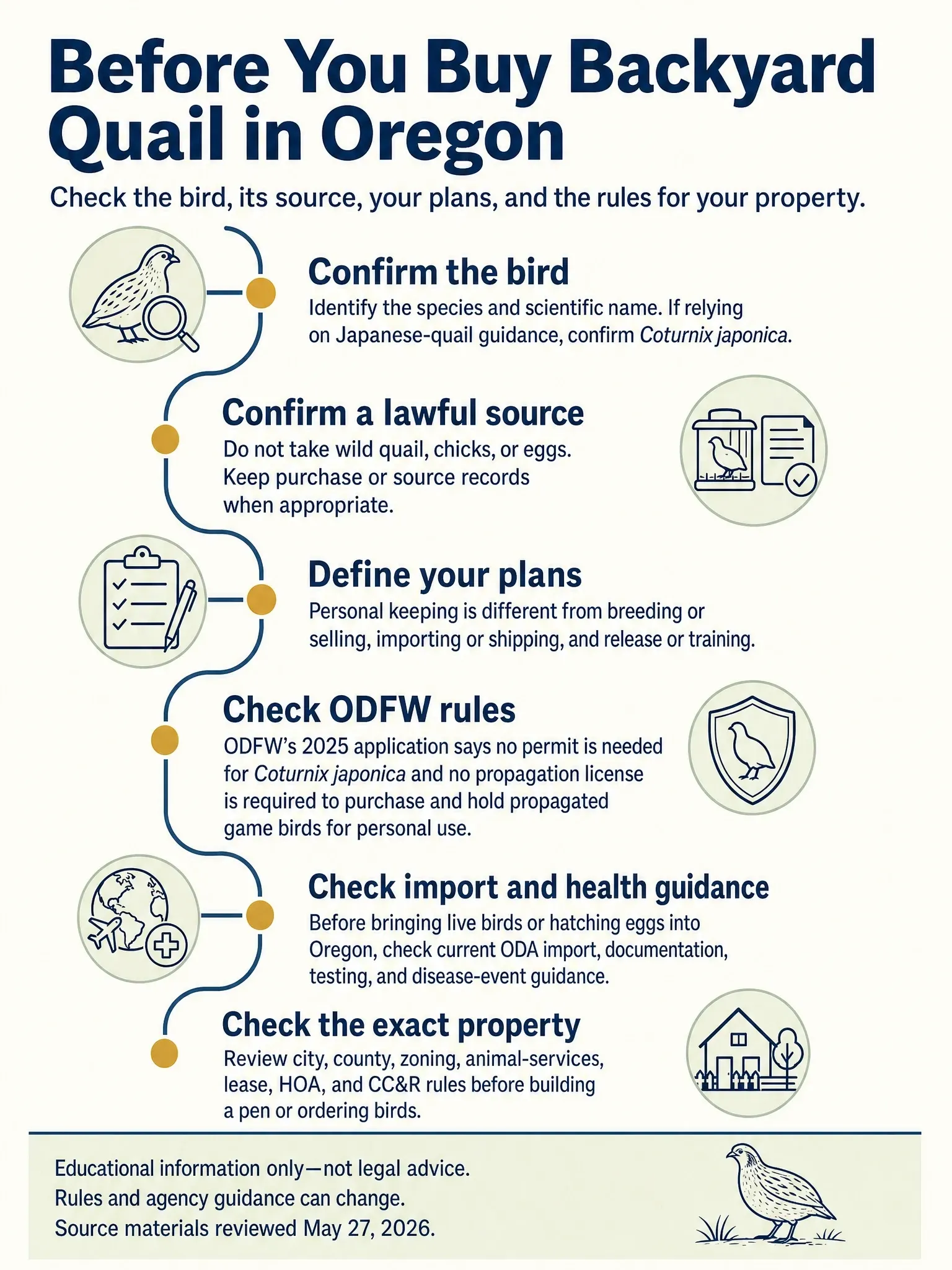
- Confirm the species and scientific name. In particular, confirm whether the birds are Coturnix japonica if you are relying on ODFW’s Japanese-quail guidance.
- Confirm the source. Do not take wild quail, chicks, or eggs. Keep purchase or source documentation when appropriate.
- Define the intended use. Personal keeping and household egg use are different from breeding for sale, selling birds or eggs, shipping, importing, releasing, dog training, raptor training, or competitive trial use.
- Check ODFW rules. This is especially important for covered game birds, wild/native quail, propagation for sale, release, training, or trial activities.
- Check ODA import and health guidance. Do this before bringing live birds or hatching eggs into Oregon, especially from out-of-state sources.
- Check disease-event updates. Avian influenza and other disease events can affect movement, testing, import, exhibition, and flock-health requirements.
- Check local and private rules. City, county, lease, HOA, and CC&R rules can be more restrictive than state wildlife guidance.
- Keep records when appropriate. Records are especially important if birds or eggs are moved, imported, sold, transferred, or later connected to a licensed activity.
This checklist does not create new legal requirements. It is a practical way to avoid assuming that one agency’s answer covers every issue.
When to Contact an Agency or Lawyer
For many quail questions, a direct next step is to ask the agency that handles the specific issue:
- ODFW for wild birds, game birds, capture or holding of wildlife, game-bird propagation, release, hunting dog or raptor training, and competitive hunting dog trial questions;
- ODA or a veterinarian for import, Certificate of Veterinary Inspection, NPIP, pullorum-typhoid testing, avian influenza, and poultry-health questions;
- local zoning, code enforcement, or animal services for backyard-fowl limits, nuisance rules, shelter or pen requirements, and property-specific local rules;
- a landlord, HOA, or property manager for lease, CC&R, or private community restrictions.
An Oregon attorney may be useful if there is an enforcement notice, citation, business operation, sale or shipping dispute, HOA or landlord conflict, or uncertainty about how multiple rules apply to a particular situation. Johnson Law may not handle animal permitting, backyard-livestock, HOA, or agency-licensing disputes; depending on the issue, another Oregon lawyer, the Oregon State Bar Lawyer Referral Service, or the relevant agency may be a better fit.
FAQ
Can I keep Coturnix quail in Oregon?
Often, yes, if the birds are legally sourced and kept for personal use. ODFW’s 2025 Game Bird Propagation License application states that a permit is not needed for Coturnix japonica (Japanese quail), and that a propagation license is not required to purchase and hold propagated game birds for personal use. However, that does not waive ODA import rules, disease-event requirements, city or county rules, leases, HOAs, or other restrictions.
Can I catch wild quail in my Oregon yard and keep them?
Do not assume that is allowed. Oregon law defines “take” to include obtaining possession or control of wildlife, and ODFW rules restrict capturing wildlife from the wild or holding wildlife except under specified permits or licenses. Wild Oregon quail in a yard are not the same as legally purchased domestic quail.
Do I need an ODFW Game Bird Propagation License for backyard quail?
ODFW’s 2025 application guidance says a Game Bird Propagation License is not required to purchase and hold propagated game birds for personal use. A license may be required for a person or business that propagates for sale covered game birds listed in OAR 635-044-0540. The answer depends on the species and activity.
Can I keep quail for eggs?
Possibly, if the birds are legally sourced, the use is personal household egg use, and state, local, lease, and HOA rules allow the flock. Do not assume that selling quail eggs, selling birds, shipping hatching eggs, importing hatching eggs, or operating a home business is covered by the same personal-use analysis. Those activities can add ODFW, ODA, local business, zoning, nuisance, sanitation, and recordkeeping issues.
Can I buy quail or hatching eggs from another state?
Possibly, but importing live quail or hatching eggs into Oregon can trigger ODA import and poultry-health requirements. Depending on the source and documentation, ODA guidance may involve NPIP/VS 9-3 documentation or requirements such as a Certificate of Veterinary Inspection, import permit, and pullorum-typhoid testing. Disease-event rules can change, so check current ODA guidance before shipment or entry.
Do Portland, Eugene, Salem, or Beaverton allow quail?
Portland, Eugene, Salem, and Beaverton have local rules, but they are not statewide rules. Portland allows limited chickens, ducks, pigeons, and/or similarly sized domestic fowl by lot size and requires usable shelter or pen area for domestic fowl over 12 weeks; the fact sheet notes that the Portland excerpt reviewed did not specifically name quail. Eugene guidance expressly lists quails within domestic fowl and sets quantity limits for properties under 20,000 square feet. Salem’s poultry code expressly includes quail and generally allows up to 12 total poultry per premises if the confinement, rear-yard, setback, coop-size, space-per-bird, nuisance, and other requirements are met. Beaverton appears much less favorable: it generally restricts livestock or poultry unless an exception or specific authorization applies, Chapter 5.09 is chicken-specific, and no Beaverton quail-specific allowance was found in the sources reviewed. Beaverton’s exotic-animal definitions do not appear to be the main local issue for ordinary domestic quail; the harder question is how the city treats quail under livestock, poultry, and household-pet rules. In any Oregon community, check the rules for the exact property, including lease and HOA restrictions.
Can I release domestic quail for dog training in Oregon?
Release for hunting dog or raptor training is a separate activity. ODFW rules require a Game Bird Release Permit for Hunting Dog and Raptor Training before releasing domestically raised game birds for that purpose. Competitive hunting dog trials can also require a separate permit in specified circumstances. This is not the same as ordinary backyard ownership.
Source Notes
This article relies on Oregon statutes, Oregon administrative rules, agency materials, and local government examples reviewed on May 27, 2026. Date-sensitive agency forms, import guidance, disease-event restrictions, and local code pages should be checked again before anyone relies on them for a specific shipment, permit, citation, or property decision.
- ORS 496.004, defining “take” to include possession or control of wildlife.
- ORS 496.007, defining “game bird” to include pheasants, quail, and partridge.
- OAR 635-044-0420, including definitions of “hold” and “propagation.”
- OAR 635-044-0440, addressing capture and holding of wildlife.
- OAR 635-044-0450, addressing Wildlife Holding Permit requirements for legally acquired game birds in specified circumstances.
- OAR 635-044-0540, addressing Game Bird Propagation License requirements for covered game birds propagated for sale.
- ODFW’s 2025 Game Bird Propagation License application, including the statements that a propagation license is not required to purchase and hold propagated game birds for personal use and that a permit is not needed for Coturnix japonica (Japanese quail).
- OAR 635-044-0550 and OAR 635-044-0560, addressing import, shipping, record, and annual-report requirements for game-bird propagation contexts.
- ODA Oregon Import Requirements and ODA NPIP guidance for poultry/game-bird import and health documentation issues.
- ODFW’s quail species information for Oregon’s native California/valley quail and mountain quail.
- OAR 635-046-0050 and OAR 635-046-0055, addressing release and dog-training or trial permits.
- Portland, Eugene, and Salem local domestic-fowl or poultry materials, used only as examples of local rules that may differ by city and property.
- Salem Revised Code 50.710, addressing keeping of poultry and expressly including quail in the poultry definition.
- City of Salem Poultry Keeping Rules, summarizing Salem poultry limits, no-permit guidance, facility standards, and space requirements.
- Salem Revised Code 400.120(d), addressing related farm, forest, and animal services use standards.
- Salem Legistar File 21-531, reflecting Ordinance No. 13-21 and the 2022 poultry-code update.
- Beaverton Code 5.05.025, addressing livestock and poultry within city limits.
- Beaverton Code 5.05.037, addressing exotic-animal rules and definitions reviewed for the Beaverton clarification.
- Beaverton Code Chapter 5.09, including urban-chicken rules such as property requirements, hen limits, rooster prohibition, enclosure standards, nuisance provisions, residential-slaughter prohibition, and adjoining-property restrictions.
- Beaverton Code 5.15.030, addressing noise, including unreasonably loud or raucous animal and bird noise.
- Washington County development-review FAQ, used for the point that county FAQ guidance applies to unincorporated county property rather than city property.