Oregon Lane Filtering: Is It Legal, and How Does It Affect Fault After a Motorcycle Crash?
Oregon Lane Filtering: Is It Legal, and How Does It Affect Fault After a Motorcycle Crash?
If you are an Oregon rider, you have probably heard conflicting answers about lane filtering and lane splitting. Some riders say it is legal in stopped traffic. Some drivers say it is always illegal. Insurance adjusters often treat those two ideas as if they are the same.
That confusion matters in a real Oregon lane filtering motorcycle accident claim. When there is a crash, fault arguments usually turn on three issues very quickly:
- Whether the rider’s maneuver was lawful,
- The speed difference between motorcycle and surrounding traffic,
- Exactly where each vehicle was positioned before impact.
This guide breaks those issues down in plain English for a general Oregon audience.
If you want a broader recovery roadmap, you can also review our Oregon personal injury law guide and our motorcycle accident practice area overview.
Quick answer
As of this publication date, Oregon law generally prohibits a motorcycle from riding between lanes of traffic or between adjacent lines or rows of vehicles under ORS 814.240. In a crash claim, that does not automatically make the rider 100% at fault, but it can become a major comparative-fault argument under ORS 31.600. Fault outcomes usually depend on the full evidence picture: speeds, lane positions, visibility, signaling, and avoidability.
Lane filtering vs. lane splitting: why definitions matter
People use these terms interchangeably, but claims analysis usually separates them.
| Term | Typical meaning | Why it matters in a fault dispute |
|---|---|---|
| Lane splitting | Riding between lanes while traffic is moving | Usually easier for insurers to frame as high-risk if speed differential is high |
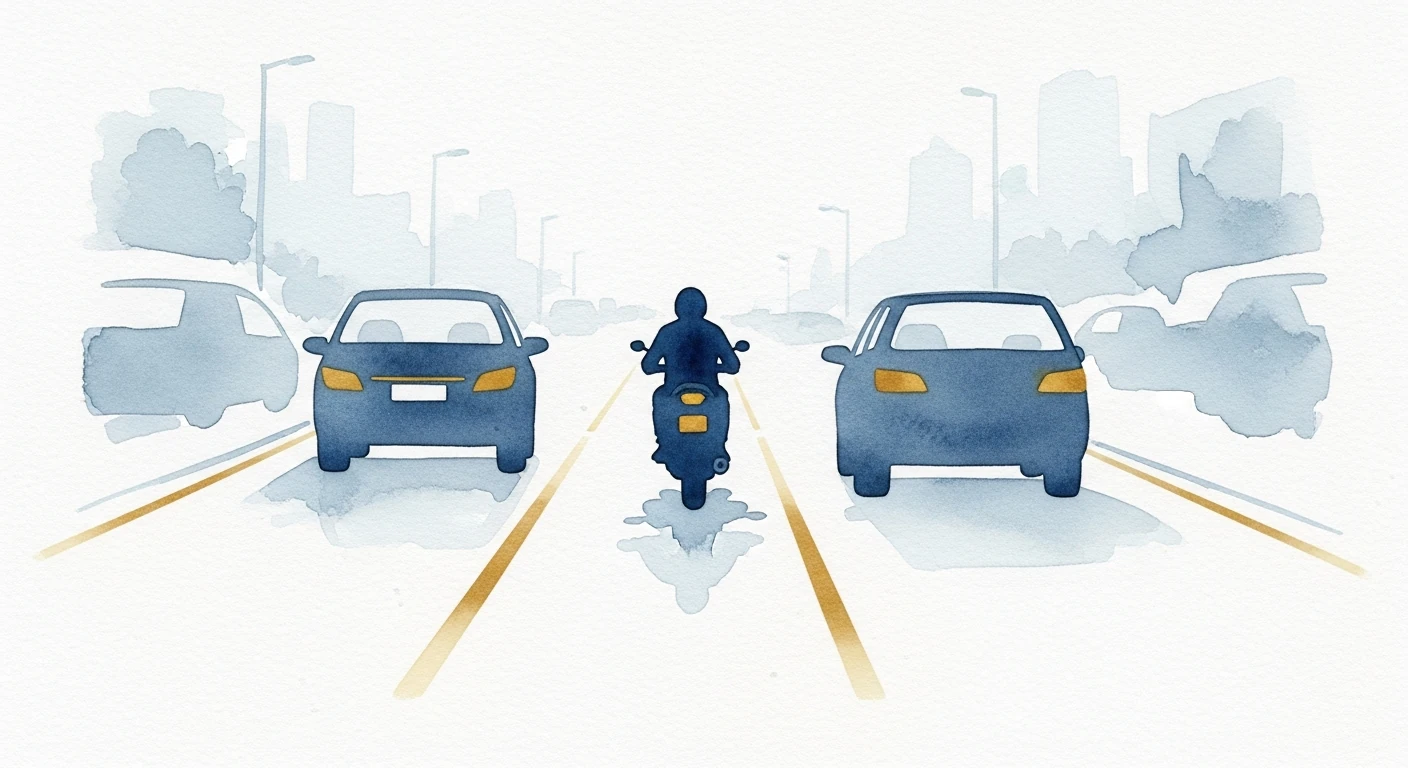
| Lane filtering | Moving between slow or stopped vehicles near intersections/congestion | Often argued as “low-speed and controlled” by riders, but still judged against Oregon statutes |
In many claims, the first battle is framing: was this a reckless “split” at speed, or a slow “filter” in congestion? The second battle is evidence.
Is lane filtering legal in Oregon right now?
The controlling statute most people start with is ORS 814.240, which states that a motorcycle or moped operator commits unlawful passing if the operator:
- Overtakes and passes in the same lane occupied by the vehicle being overtaken (with limited motorcycle/moped exceptions), or
- Operates between lanes of traffic or between adjacent lines or rows of vehicles.
That language is why the current legal baseline is generally understood as: lane splitting/lane filtering are prohibited unless Oregon law changes.
To follow any updates, track the Oregon Legislature’s official measure pages directly (for example, OLIS bill tracking).
Why legality is only the start of a fault analysis
In a typical Oregon lane filtering motorcycle accident claim, adjusters and attorneys look at negligence and comparative fault, not just one citation line.
Oregon uses modified comparative fault under ORS 31.600. In practical terms:
- Fault can be split across multiple parties,
- A rider’s percentage can reduce damages,
- Evidence quality often determines how aggressively fault is shifted.
So even if a rider violated ORS 814.240, the driver can still share substantial fault if the driver made an unsafe lane change, failed to signal, turned across traffic, or otherwise created an avoidable conflict.
For a deeper breakdown of fault allocation mechanics, see Oregon comparative fault in motor vehicle claims.
The three variables that usually drive fault arguments
1) Legality and statutory framing
Insurers often lead with: “Rider was between lanes, therefore rider caused the crash.”
That argument is common, but not complete. A stronger analysis asks:
- Was the rider’s position the direct cause of impact, or one factor among many?
- Did the driver check mirrors and blind spots before moving laterally?
- Did either party have the last clear chance to avoid the collision?
2) Speed differential
Speed differential is frequently the most persuasive technical point in negotiations.
Examples:
- Low differential scenario: traffic stopped at a signal, motorcycle moving slowly past queued vehicles.
- High differential scenario: traffic moving at 20 mph, motorcycle moving 45 mph between rows.
The higher the differential, the easier it is for a defense to argue limited reaction time and foreseeability concerns. The lower and more controlled the differential, the stronger the argument that the crash came from driver inattention, abrupt lane movement, or failure to yield.
3) Positioning and visibility
Positioning includes more than “between lanes.” It includes exactly where each vehicle was in the seconds before impact.
Key positioning questions:
- Was the motorcycle centered over a lane line or offset?
- Was the rider adjacent to a vehicle’s blind spot at the critical moment?
- Did the driver drift or sharply change lanes?
- Were turn indicators used with enough lead time?
- Was there enough lateral clearance for safe movement by either party?
Small positioning details often make big differences in percentage fault allocation.
Fault scenarios Oregon riders and drivers actually see
Scenario A: Congested arterial, car changes lanes without signaling
- Rider is moving slowly between near-stopped lanes.
- Driver moves left abruptly and clips rider.
Likely arguments:
- Defense: rider should not be between lanes under ORS 814.240.
- Rider side: unsafe lane change, poor lookout, no signal, avoidable by driver.
Potential outcome pattern: shared fault, with percentage shaped by speed differential evidence and turn-signal timing.
Scenario B: Freeway slowdown, motorcycle moving much faster than traffic
- Traffic is rolling 10–20 mph.
- Rider passes between rows at materially higher speed.
- Driver begins a gradual lane shift and collision occurs.
Likely arguments:
- Defense emphasizes high differential and surprise factor.
- Rider side emphasizes duty to check mirrors, blind spots, and signal before lane movement.
Potential outcome pattern: higher rider comparative fault risk if data supports a large speed gap.
Scenario C: Approaching red light queue, right-side filtering near curb lane
- Rider advances along queue at low speed.
- Right-turning vehicle cuts across rider path.
Likely arguments:
- Defense: prohibited filtering maneuver.
- Rider side: turning driver failed to maintain proper lookout and crossed into occupied path.
Potential outcome pattern: strong causation battle over line-of-sight and timing.
Intersection conflicts are a recurring theme in Oregon crash litigation. For more context, see left-turn crash fault arguments in Oregon and Portland intersection T-bone fault analysis.
Evidence that most influences lane-filtering crash outcomes
If you want to reduce speculation in an Oregon lane filtering motorcycle accident case, preserve objective evidence quickly.
High-value evidence (first priority)
- Helmet-cam or dashcam footage
- Nearby business/traffic video before overwrite windows close
- Vehicle damage photos before repair
- Precise scene photos (lane markings, final positions, sight obstructions)
- Witness names and contact information
Strong supporting evidence
- Police report and any supplements
- 911 call timeline
- Signal phasing data where intersection timing is disputed
- Medical records that align injury mechanism with impact direction
Oregon records/resources
- Oregon DMV crash reporting information
- Oregon State Police public records requests
- ODOT TripCheck traffic/camera context
If evidence windows are a concern, read preserving evidence after an accident (spoliation).
How insurers often frame these claims
After a motorcycle crash, insurers commonly try to lock in a fault narrative early:
- “Between lanes = automatic fault”
- “Driver could not have expected a motorcycle there”
- “Speed differential made impact unavoidable”
A practical response is evidence-first, not argument-first. The strongest counter usually comes from video, objective timelines, and clear scene geometry.
Oregon-specific legal points riders should know
- Oregon riders are generally entitled to a full lane under ORS 811.385.
- No more than two motorcycles may ride abreast in one lane under ORS 814.250.
- Comparative fault is governed by ORS 31.600.
Those statutes are often analyzed together when liability is disputed.
Practical steps after a motorcycle collision involving lane-position disputes
- Get medical evaluation promptly (even if symptoms seem minor).
- Preserve your gear and bike condition before repairs.
- Save all photos/videos and back them up.
- Write a same-day timeline while details are fresh.
- Avoid speculative recorded statements.
- Track every insurer communication in one file.
Soft but practical: when speaking with a personal injury lawyer helps
Not every collision requires a lawsuit. But in a lane-filtering or lane-splitting dispute, early legal guidance can be useful because fault arguments become technical quickly.
People often seek help when they need:
- A clear comparative-fault risk assessment,
- Evidence preservation before video disappears,
- A strategy for handling insurer blame-shifting,
- A realistic valuation based on liability strength, not pressure.
That is usually less about “fighting” and more about making sure the record reflects what actually happened.
If you are evaluating next steps right now, these pages may help:
- Passenger on a Motorcycle in Oregon: What If the Driver Was Partially at Fault?
- Uninsured Driver Hits a Motorcyclist in Oregon: How UM/UIM Claims Work When Injuries Are Severe
- What to do after an Oregon highway accident injury
- How insurers frame the low impact = no injury argument
- How distracted-driving evidence is proven
- Contact Johnson Law, P.C.
Bottom line
For a modern Oregon lane filtering motorcycle accident claim, the legal question is only step one. The bigger question is how convincingly the evidence explains speed differential, rider and driver positioning, and avoidability.
When those details are documented well, fault discussions become far more accurate—and often far fairer.
Frequently asked questions
Is lane filtering legal in Oregon?
As of this publication date, Oregon law generally prohibits operating a motorcycle between lanes or between adjacent lines/rows of vehicles under ORS 814.240.
Is lane splitting the same as lane filtering in Oregon law?
People use the terms differently, but both usually involve travel between lanes/rows of traffic, which is the conduct addressed in ORS 814.240.
If a rider was filtering, are they automatically at fault?
Not automatically. A statutory violation can matter a lot, but Oregon comparative fault still examines all causal conduct by all parties.
How does speed differential affect fault?
Larger speed gaps often support defense arguments about reaction time and foreseeability. Lower, controlled differentials can support arguments that driver lookout and lane-change behavior caused the crash.
Why does positioning matter so much?
Because many collisions happen during lane changes or turns, and inches of lateral position can determine visibility, avoidability, and fault percentages.
Can a driver still be mostly at fault if a rider was between lanes?
Yes, depending on facts. Unsafe lane changes, poor mirror checks, and failure to signal can create substantial driver fault even where rider conduct is disputed.
What evidence is most useful in these claims?
Video, scene photos with lane markings, witness statements, timeline data, and early medical documentation are usually most persuasive.
Should I give a recorded statement right away?
Provide necessary basic facts, but avoid guessing or speculation before reviewing the full facts and records.
Does Oregon allow motorcycles to share one lane?
Up to two motorcycles may ride abreast in one lane under ORS 814.250, and riders generally retain full-lane rights under ORS 811.385.
Where can I verify Oregon crash-reporting requirements?
Use Oregon DMV’s official accident reporting resources and Oregon State Police crash records pages.
Is this legal advice for my specific crash?
No. This article provides general educational information, not legal advice for any specific case.
Related Oregon resources
- Motorcycle Accidents Practice Area
- Passenger on a Motorcycle in Oregon: What If the Driver Was Partially at Fault?
- Uninsured Driver Hits a Motorcyclist in Oregon: How UM/UIM Claims Work When Injuries Are Severe
- Oregon Comparative Fault Car Accident Guide
- Preserving Evidence After an Accident
- Left-Turn Accident Fault in Oregon
- Oregon Personal Injury Law 2025 Guide
Sources
- Oregon Legislature – ORS 814.240 and related motorcycle provisions
- Oregon Legislature – ORS 811.385 (Motorcycle entitlement to full lane)
- Oregon Legislature – ORS 31.600 (Comparative fault)
- Oregon Legislative Information System (OLIS)
- Oregon DMV – Accident and Insurance Report
- Oregon State Police – Public Records Requests
- ODOT TripCheck
- NHTSA – Motorcycles
- NHTSA Traffic Safety Facts (Motorcycles)
- IIHS – Fatality Facts: Motorcycles and ATVs
This page provides general educational information and is not legal advice.
Client-First Fee Promise
Client First = Bills First, Fees Second
Your unpaid medical bills do not have to make your lawyer's fee bigger. Johnson Law subtracts qualifying medical bills before calculating our fee, helping clients keep more of their settlement.
Applies to qualifying cases. Results vary.