Portland Bike Lane Collisions: How Local Street Design Creates Predictable Right-Hook Scenarios
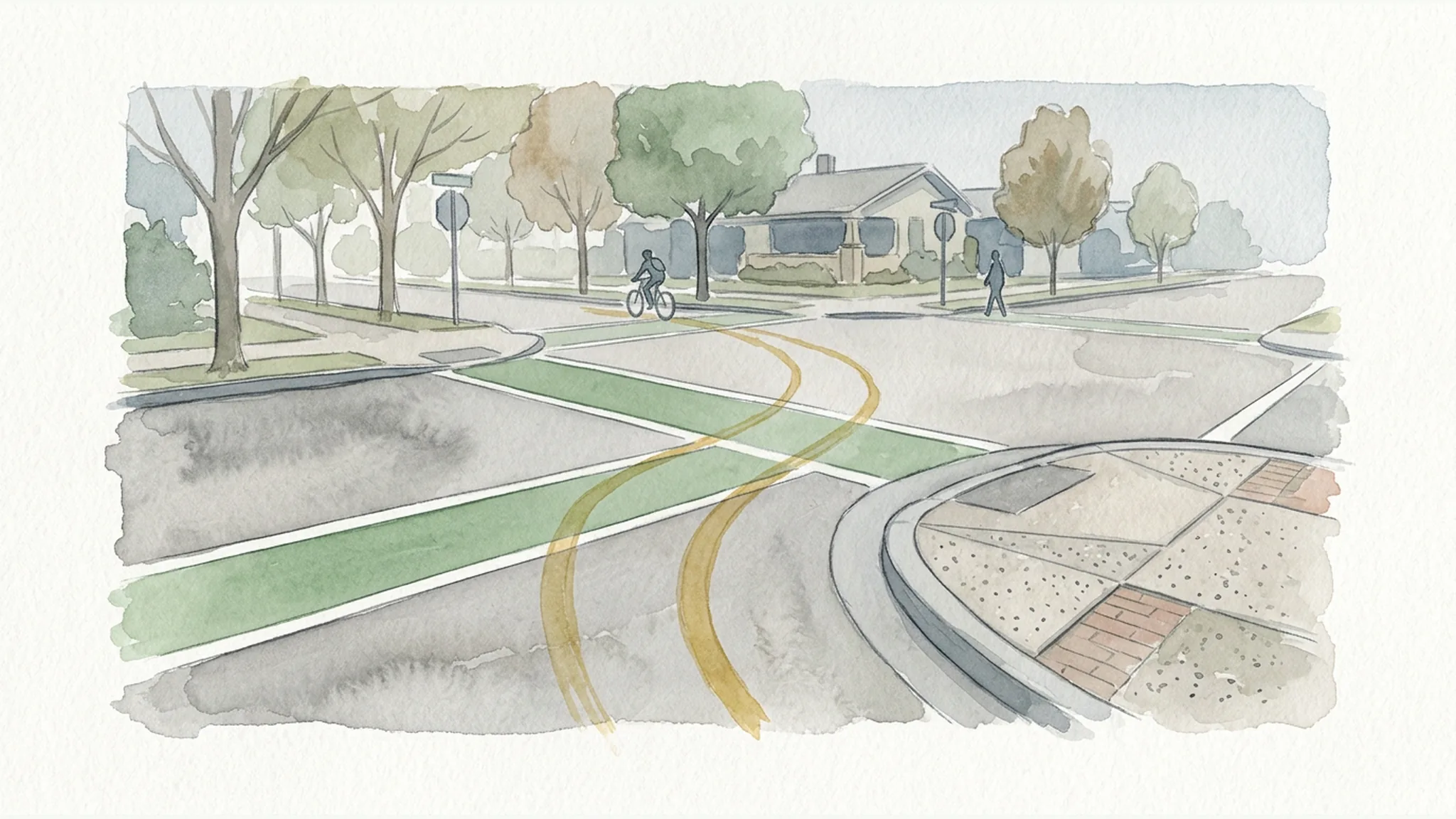
Portland Bike Lane Collisions: How Local Street Design Creates Predictable Right-Hook Scenarios
A Portland bike-lane “right hook” crash usually starts with a simple conflict: a driver turns right across the path of a bicyclist who is traveling straight in or near a bike lane. The legal questions matter, but the street itself often holds much of the evidence.
Was there a bike box? Was right-on-red prohibited? Did parked cars block sight distance? Did the bike lane continue through the intersection with green markings? Was the crash at a driveway rather than a traditional intersection? Who controlled the street, signal, markings, and maintenance records?
Those details can help explain whether the conflict was sudden and unusual—or whether the street layout made the conflict predictable enough to investigate through design records, photos, and traffic-control evidence.
This article focuses on Portland street-design and evidence issues in right-hook bike crashes. For the narrower Oregon yielding and turning-duty overview, see Johnson Law’s companion article on right-hook bike crash legal duties in Oregon.
Educational information only, not legal advice. The right analysis after a crash depends on the exact location, signs, signal timing, lane position, visibility, and available records. Statutory summaries should also be checked against the current Oregon Revised Statutes before anyone relies on a specific provision, especially because Oregon Legislature materials for ORS chapters 811 and 814 flagged 2026 session activity when this article was prepared.
What Is a “Right Hook” Bike-Lane Crash?
A right-hook bicycle crash generally involves a right-turning motor vehicle and a bicyclist who is continuing straight. In a bike-lane setting, the driver may be turning across the bike lane at an intersection, into a driveway, or across a marked bicycle path through the intersection.
Oregon transportation research has used that basic definition: a collision between a right-turning vehicle and a through-moving bicycle. A later simulator-based study also described the signalized-intersection version of the conflict, where a right-turning motor vehicle and an adjacent through-moving bicycle both have concurrent green movements.
The key point for injured riders and families is that a right hook is not always just a “did the driver turn?” question. It can involve how the street placed the bicyclist and driver next to each other, how visible the rider was, what traffic controls existed, and whether the driver had enough information and time to yield.
The Common Portland Scenario
The familiar Portland scenario is a bicyclist traveling straight in a bike lane to the right of motor-vehicle traffic while a driver turns right across that path. That can happen at a signal, a stop-controlled intersection, a commercial driveway, an alley, or another access point.
ODOT-sponsored research on Oregon bicycle crashes found that, among identified potential right-hook crashes in the study, 74% occurred at intersections and 26% occurred at driveways. The same report identified a bike lane to the right of a through motor-vehicle lane with no right-turn lane as the most common studied intersection configuration for right-hook crashes, accounting for 59% of total crashes at signalized intersections and 64% at minor stop intersections in that dataset.
Those figures come from older statewide data, not current Portland-only crash statistics. They are still useful for understanding why the pattern is foreseeable as an evidence issue: when a through-moving bicycle is placed to the right of a lane where drivers may turn, both users can arrive at the same conflict point at the same time.
For related intersection context beyond right hooks, Johnson Law also covers bike-versus-car right-of-way at intersections.
Brief Legal Context: Design Evidence Does Not Replace Fault Analysis
Oregon law supplies the statewide duty framework. ORS 811.050 addresses yielding to a rider in a bicycle lane, while ORS 811.440 permits limited motor-vehicle use of a bicycle lane for movements such as turns and driveway access. Other turning, signaling, lane-position, and comparative-fault rules may also matter.
This Portland article does not repeat that legal analysis. See the companion guide to Oregon right-hook duties and fault for the statewide rules. Here, the question is what the Portland street communicated through geometry, markings, signs, signal phases, and sight distance—and which agency records can document those conditions.
How Portland Street Design Can Create Predictable Conflict Points
Portland has many types of bicycle facilities: painted bike lanes, buffered lanes, protected lanes, parking-protected lanes, bike boxes, marked bike-lane extensions, mixing zones, bicycle signals, lead bicycle intervals, and other treatments. PBOT’s Traffic Design Manual identifies a wide range of bicycle-related traffic-control and design sections, including green colored pavement, intersection bike boxes, two-stage turn boxes, crossbike markings, bicycle lane weaving sections, mixing zones, bicycle signals, lead bicycle intervals, and bicycle detection.
Those materials do not prove fault by themselves. Design manuals, standard drawings, and federal or state guidance are usually starting points for investigation, not automatic civil-liability rules. But they can identify what the roadway was supposed to communicate to drivers and riders—and what records may exist.
Bike Lanes to the Right of Through Traffic
The classic right-hook geometry puts a bicycle lane to the right of a through motor-vehicle lane. If a driver in the motor-vehicle lane turns right across the bike lane, the driver must search for and yield to a rider who may be beside or slightly behind the vehicle.
That geometry can be especially important where there is no separate right-turn lane, where the bike lane continues straight through the intersection, or where a driveway creates a turning movement before the rider expects it.
In the Oregon research discussed above, this bike-lane-to-the-right-of-through-traffic configuration was the most common studied intersection configuration for right-hook crashes. That does not mean every Portland street with that layout is dangerous or defective. It does mean the layout is an important evidence issue: photos, plan sheets, lane markings, sight lines, and signal phasing may all help explain whether the driver should have anticipated a bicyclist continuing straight.
Bike Boxes, Green Paint, and Bike-Lane Extensions
Bike boxes and green markings can be important because they show expected bicycle positioning and potential conflict zones.
FHWA’s Separated Bike Lane Planning and Design Guide explains that bike boxes at signalized intersections allow bicyclists to queue in front of motor vehicles at red lights, increase the visibility of queued bicyclists, and allow bicyclists to start and enter the intersection in front of motor vehicles when the signal turns green.
PBOT’s Standard Drawing Report P-436 includes green pavement marking and bike-lane extension details. The report also notes that green markings for bike facilities are based on FHWA’s Interim Approval for optional use of green colored pavement for bike lanes.
After a crash, these markings may help answer questions such as:
- Did the bike lane continue through the intersection?
- Did green paint mark a known conflict area?
- Did a bike box place bicyclists ahead of vehicles at a red signal?
- Were the markings visible, worn, blocked, or changed by construction?
- Did the driver turn from a lane where bicycles were expected to proceed straight?
The presence or absence of green paint does not prove negligence by itself. A fully marked intersection can still require fact-specific analysis, and an unmarked conflict zone may still involve a duty to yield or exercise care.
No-Turn-on-Red Signs and Bicycle Signal Timing
No-turn-on-red restrictions can matter in right-hook cases because they control when a driver may turn across a bicyclist’s path.
PBOT’s No Turn on Red guidelines state that no-turn-on-red restrictions should be considered in several bicycle and pedestrian conflict settings, including where there are exclusive pedestrian or bicycle phases or leading intervals, where bike boxes are present, at Neighborhood Greenways, where turns cross separated paths, at high-conflict intersections, and where geometric or operational characteristics create unexpected conflicts or inadequate sight distance.
The same PBOT guidance notes that no-turn-on-red prohibitions must be signed because Oregon law generally permits turns on red when statutory conditions are met. PBOT’s memo also states that MUTCD Section 9E.12 provides that turns on red shall be prohibited from the lane where a bike box is placed, and PBOT applies that rule to intersection bike box and turn bike box conflicts.
For evidence purposes, that means current photos and records matter. A rider or investigator may need to document:
- whether no-turn-on-red signs were present;
- whether they applied to the driver’s lane;
- whether a bike box or bicycle signal was present;
- whether the crash happened during a red, green, leading bicycle interval, or other signal phase;
- whether signs were blocked, missing, inconsistent, or newly installed after the crash.
Protected Lanes, Parking-Protected Lanes, and Sight Distance
Not every Portland bike lane is protected, and not every protected facility works the same way.
PBOT’s Protected Bicycle Lane Planning and Design Guide describes several retrofit designs used on Portland roadways, including parking-protected, parking-protected with delineators, delineator-protected, traffic-separator-protected, planter-protected, and concrete-island-protected designs. The guide focuses principally on street-level retrofits, while also identifying raised sidewalk-level protected bicycle lanes as desirable.
In a right-hook investigation, protected-lane design can raise several evidence questions:
- Did parked vehicles, planters, separators, or other vertical elements affect sight distance?
- Was parking removed far enough before an intersection or major driveway for drivers and cyclists to see each other?
- Did the bicycling zone give the rider enough clear width?
- Did the lane design push riders toward a buffer or door-zone area?
- Did a driveway crossing create a conflict point outside a traditional intersection?
PBOT’s protected-lane guide recommends a minimum clear bicycling-zone width of 6.5 feet under most conditions. It also warns that a too-narrow bicycling zone in parking-protected bike lanes can push people bicycling into the buffer zone where car doors open. For sight distance in parking-protected bike lanes, the guide calls for removing on-street parking at least 60 feet before an intersecting roadway or major driveway and 8 feet after the driveway for turning movements; for residential or lower-use driveways, it lists lower minimums of 20 feet approaching and 6 feet following.
Those details do not automatically establish a claim. They do help identify what should be measured, photographed, and requested from agency records. For a related bike-lane proof problem involving parked vehicles, see Johnson Law’s article on Portland bike-lane evidence after a dooring crash.
What the Driver May Have Missed: Visibility, Blind Zones, and Search Behavior
Right-hook crashes often turn on what the driver did or did not see before turning. Transportation research can help frame those questions without assuming the answer in every case.
ODOT-sponsored research reported that the worst-case simulated right-hook scenario occurred when a bicyclist approached the intersection at 16 mph and was positioned in the driver’s blind zone. In crash and near-crash situations, the report identified the most common cause as the driver’s failure to actively search for the adjacent bicyclist. Other failures involved projection—such as assuming the bicyclist would yield or assuming there was enough time to turn.
That does not mean every right-hook crash happened because the driver failed to look. It does mean investigators often need to evaluate:
- mirror and blind-zone visibility;
- turn speed and approach speed;
- whether the driver signaled and slowed before turning;
- whether the bicyclist was alongside, ahead, or behind the vehicle;
- sight obstructions from parked vehicles, traffic, construction, or street furniture;
- whether traffic controls or markings warned drivers to yield to bicyclists.
Turning-Vehicles-Yield Signs
Signs can matter as both safety measures and evidence.
PBOT’s Traffic Design Manual includes R4600L/R4600R “TURNING VEHICLES [arrow] YIELD TO [bicycle symbol]” signs, with guidance that they may be used to remind drivers who are making turns to yield to people on bicycles.
A 2017 simulator study by Oregon State University and Portland State University researchers reported that ODOT’s OR10-15b “Turning Vehicles Yield to Bicycles” sign positively influenced driver visual attention, increasing time spent scanning the side mirror for bicyclists by 9% overall and by 10% close to the intersection compared with no signage.
That finding came from a simulator study and should not be treated as proof that a missing sign caused a particular crash. But in a Portland right-hook case, it can be worth documenting whether a turning-vehicles-yield sign was present, visible, obscured, damaged, or inconsistent with the lane configuration.
What Evidence to Preserve After a Portland Right-Hook Crash
Right-hook evidence can disappear quickly. Markings fade or are repainted. Construction detours change. Parking patterns shift. Signal timing can be updated. Signs can be replaced or moved.
If it is safe and practical, scene documentation soon after the crash can be valuable. When an injured rider cannot return to the location, a trusted family member, friend, investigator, or lawyer may be able to help preserve evidence.
Scene Evidence
Useful scene evidence may include photos or video of:
- the bike lane and its approach to the intersection or driveway;
- any bike box, green paint, bike-lane extension, crossbike marking, or mixing zone;
- no-turn-on-red signs, bicycle signals, traffic signals, and lane-control signs;
- “turning vehicles yield” signs or other bicycle warning signs;
- parked cars, parking setbacks, loading zones, or sight-distance obstructions;
- lane width, buffer width, separators, planters, curbs, or vertical delineators;
- driveways, alleys, construction detours, temporary signs, or work-zone changes;
- skid marks, debris, vehicle-rest positions, bicycle damage, and the point of impact.
Current photos matter because the street may not look the same weeks or months later.
Connect the Design Record to the Collision Evidence
Vehicle damage, bicycle damage, video, witnesses, and user movements may establish where and when the collision occurred. Their design-specific value is in connecting that event to the bike box, lane extension, signal phase, turning path, sight obstruction, or other documented feature at the conflict point. The companion statewide right-hook guide covers general fault evidence and comparative-fault arguments.
Public Records and Agency Records
Portland crash records can be spread across multiple agencies. PBOT states that it does not own or maintain crash data; ODOT is the custodian of official crash records, and the Portland Police Bureau is the custodian of crash-investigation information. PBOT also notes that recent deadly crash data can be preliminary and that much official crash data relies on self-reporting.
ODOT releases the complete official crash record 12 to 18 months after the reported year ends. That lag can matter when someone tries to use public data to understand a recent crash location.
Agency ownership also matters. PBOT, ODOT, Multnomah County, or another entity may control different streets, bridges, signals, markings, maintenance, or project files. A Portland crash on or near a state-managed road may involve different records than a crash on a PBOT-managed neighborhood street. For more on that issue, see Johnson Law’s article on why ODOT versus PBOT control can matter on Portland streets.
Depending on the location, useful records may include signal plans, timing records, work orders, striping plans, project drawings, traffic-control device records, parking or curb-use records, crash reports, officer notes, and maintenance records. The correct request depends on the exact crash location and who controls the relevant asset.
How Public Crash Data Helps—and Where It Falls Short
Portland’s public crash resources can provide context, but they should not be mistaken for a complete investigation.
For a fuller method for separating data vintages, preserving reproducible queries, and moving from public summaries to underlying records, see how to use Portland High Crash Network data after a street injury.
PBOT’s High Crash Network page describes the network as including 30 streets and 30 intersections with serious crash histories. PBOT says the network makes up 8% of Portland streets and accounted for an average of 67% of traffic deaths from 2020 to 2024.
PBOT lists several High Crash Network streets with deadly or serious injury crashes by bicycle mode, including SE 7th Avenue, 82nd Avenue, Barbur Boulevard, Broadway, Burnside Road, Columbia Boulevard, Division Street, Foster Road, Hawthorne Boulevard, Interstate Avenue, Lombard Street, Martin Luther King Jr. Boulevard, Powell Boulevard, Sandy Boulevard, and Stark Street.
That list can help identify corridors where bicycle crash evidence and agency records may deserve closer attention. It does not prove that a specific crash was a right hook, that a specific intersection caused the crash, or that a particular design feature was negligent.
PBOT’s own methodology notes also matter. Its High Crash Network intersection analysis uses ODOT crash data queried from PBOT’s Accident History database and includes fatal and injury crashes at intersections or intersection-related locations from 2020 through 2024. PBOT notes that, because of under-reporting, the list should not be considered to represent all collisions at listed intersections.
Portland Corridors May Provide Context, Not Automatic Answers
If a crash happened on a High Crash Network street, that status may be a useful lead. It may point toward additional records, prior project files, or known conflict-management efforts.
But it is not a shortcut. A right-hook case still needs site-specific evidence: the actual lane layout, signs, signal timing, traffic controls, sight distance, crash location, and user movements at the time of the collision.
Keep the Portland Design Question Separate From Statewide Fault
Lane continuity, blocked or narrow facilities, right-turn-only movements, debris, parking, and sight obstructions can affect both rider position and the predictability of the conflict. In this article, those facts matter because they identify measurements, plans, standards, work orders, and signal or marking records to obtain. Their legal effect—including Oregon comparative fault and bike-lane-use exceptions—belongs to the statewide right-hook law guide.
When to Talk With a Lawyer After a Portland Right-Hook Collision
You do not need to know every statute or design manual before asking for help. But if a Portland right-hook crash caused injury, it is often worth getting advice before evidence changes or records become harder to obtain.
A lawyer can help evaluate the legal duties, preserve evidence, identify the correct agencies, request records, and assess how Oregon comparative-fault issues may be raised. That is especially important when the crash involves a bike box, no-turn-on-red control, protected or parking-protected lane, driveway conflict, street construction, state-managed road, or disputed signal phase. For broader claim context, Johnson Law’s Oregon bicycle accident claims page explains the firm’s bicycle-injury practice area.
This article is general educational information for Oregon and Portland readers. It is not legal advice and does not create an attorney-client relationship. A right-hook crash should be evaluated based on the specific facts, location, records, and injuries involved.
FAQ
Is a right-turning driver always at fault for hitting a cyclist in a Portland bike lane?
No. This article addresses design evidence, not an automatic fault rule. The Oregon right-hook law guide explains the statewide yielding, turning, signaling, lane-position, and comparative-fault framework.
Can a driver legally enter a bike lane to turn in Oregon?
Oregon law permits limited motor-vehicle use of a bicycle lane for specified movements, but the legal effect depends on the full facts. See the statewide right-hook article for that analysis; this page focuses on Portland controls, geometry, sight distance, and records.
What evidence matters most after a Portland right-hook bike crash?
Important evidence may include photos or video of bike-lane markings, bike boxes, green paint, no-turn-on-red signs, signals, sight obstructions, parking setbacks, lane geometry, driveways, vehicle and bicycle damage, witness information, police records, and relevant PBOT or ODOT records. The most important evidence depends on the exact crash location.
Do bike boxes or green bike-lane markings prove the driver was negligent?
No, not by themselves. Bike boxes and green markings can help show expected bicycle movement, visibility measures, and conflict areas. But a negligence analysis still depends on the full facts, including traffic controls, user movements, visibility, and whether legal duties were violated.
Why does ODOT versus PBOT control matter after a Portland bike crash?
Different agencies may hold different records. PBOT, ODOT, Multnomah County, or another entity may control the street, signal, bridge, markings, maintenance, or project files. Correctly identifying the responsible agency can affect where design records, signal records, crash data, and maintenance information are requested.
Are Portland crash dashboards enough to prove a dangerous intersection?
No. Portland crash dashboards and High Crash Network materials can provide useful context, but PBOT notes limits such as under-reporting, self-reporting, official-data lag, and separate custody of official crash records and police investigation information. A specific crash still requires scene-specific evidence and records.
Sources
- ORS chapter 811, including ORS 811.050, ORS 811.100, ORS 811.355, ORS 811.360, and ORS 811.440.
- ORS chapter 814, including ORS 814.400, ORS 814.420, and ORS 814.440.
- Portland Bureau of Transportation, No Turn on Red Guidelines at Signalized Intersections.
- Portland Bureau of Transportation, Traffic Design Manual: Permanent Traffic Control.
- Portland Bureau of Transportation, Portland Protected Bicycle Lane Planning and Design Guide.
- Portland Bureau of Transportation, Standard Drawing Report P-436.
- Portland Bureau of Transportation, High Crash Network streets and intersections.
- Portland Bureau of Transportation, Vision Zero data and Guide to the Vision Zero dashboard.
- Oregon Department of Transportation Research Report SPR 767, Towards Effective Design Treatment for Right Turns at Intersections with Bicycle Traffic.
- Warner, Hurwitz, Monsere & Fleskes, A Simulator-Based Analysis of Engineering Treatments for Right-Hook Bicycle Crashes at Signalized Intersections.
- Federal Highway Administration, Separated Bike Lane Planning and Design Guide.
Client-First Fee Promise
Client First = Bills First, Fees Second
Your unpaid medical bills do not have to make your lawyer's fee bigger. Johnson Law subtracts qualifying medical bills before calculating our fee, helping clients keep more of their settlement.
Applies to qualifying cases. Results vary.